
Essential German Phrases for Beginners: 60+ Survival Phrases
 Beyond German Team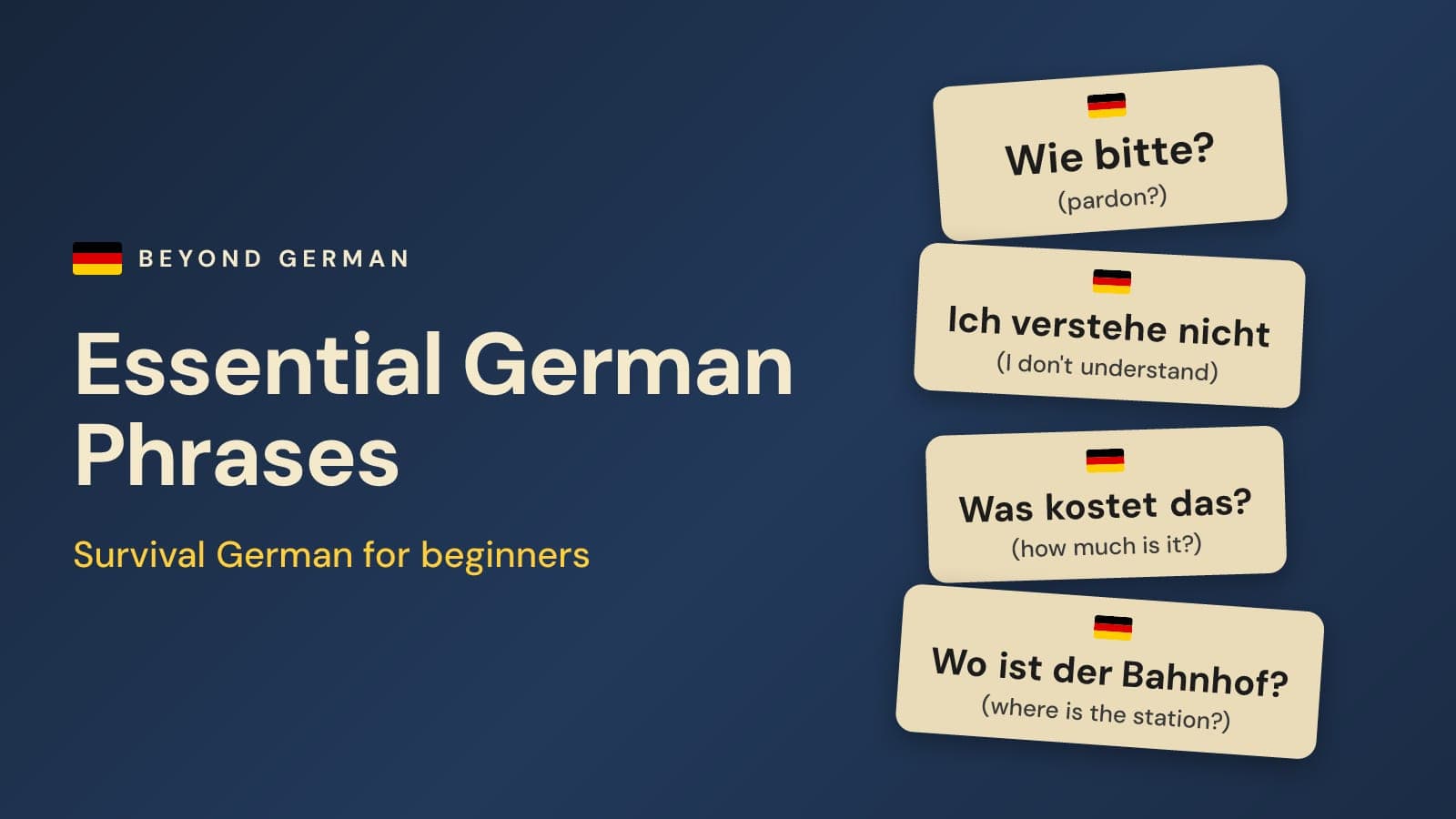
The most essential German phrases for beginners are Hallo (hello), Bitte (please), Danke (thank you), Entschuldigung (excuse me), Ich verstehe nicht (I don't understand) and Sprechen Sie Englisch? (Do you speak English?). With those six, you can get through almost any first encounter in German. Below are more than 60 basic German phrases for travel and everyday life, grouped by situation, each with its meaning and when to use it.
Almost every phrase here uses Sie, the polite form of "you". Use it with anyone you don't know: shop staff, waiters, people on the street. Save du for friends, family and children, or for when someone offers it. Young people often use du with each other right away.
Greetings and Politeness
You'll use these dozens of times a day. Germans usually say hello when they walk into a small shop or a bakery, and goodbye when they leave.
| German | English | When to use |
|---|---|---|
| Hallo! | Hello! / Hi! | Friendly greeting for most everyday situations |
| Guten Morgen! | Good morning! | In the morning, until around noon |
| Guten Tag! | Hello! / Good day! | Polite greeting during the day; safe with anyone |
| Guten Abend! | Good evening! | From about 6 p.m. |
| Gute Nacht! | Good night! | Only at bedtime or when leaving late at night |
| Tschüss! | Bye! | Casual goodbye; also common in shops |
| Auf Wiedersehen! | Goodbye! | Polite goodbye with strangers and in formal situations |
| Bitte. | Please. | Add it to every request |
| Danke! / Vielen Dank! | Thank you! / Thank you very much! | Whenever someone helps you |
| Bitte schön. / Gern geschehen. | You're welcome. | When someone thanks you |
| Entschuldigung! | Excuse me! / Sorry! | To get attention, squeeze past someone, or after bumping into them |
| Es tut mir leid. | I'm sorry. | Real apologies and sympathy |
| Ja, gern. | Yes, please. | To accept an offer |
| Nein, danke. | No, thank you. | To turn down an offer |
For regional greetings like Moin and Servus, see our guide to German greetings. We also have full guides on how to say goodbye in German and how to say thank you in German.
Entschuldigung or Es tut mir leid? Use Entschuldigung for small things, like getting a waiter's attention or squeezing past someone on the train. Es tut mir leid expresses real regret or sympathy:
- Entschuldigung, ist hier noch frei? — Excuse me, is this seat free?
- Es tut mir leid, ich habe keine Zeit. — I'm sorry, I don't have time.
When You Don't Understand
This is the most important group for beginners. When German comes at you too fast, these phrases buy you time, and most people will happily slow down once they know you're learning.
| German | English | When to use |
|---|---|---|
| Wie bitte? | Sorry? / Pardon? | You didn't catch what someone said |
| Ich verstehe nicht. | I don't understand. | You heard it but didn't understand it |
| Können Sie das bitte wiederholen? | Could you repeat that, please? | You need to hear it again |
| Langsamer, bitte. | Slower, please. | Someone is speaking too fast |
| Können Sie bitte langsamer sprechen? | Could you speak more slowly, please? | The full, more polite version |
| Was bedeutet das? | What does that mean? | You hear or read a word you don't know |
| Wie heißt das auf Deutsch? | What's that called in German? | Point at something to learn its name |
| Ich spreche ein bisschen Deutsch. | I speak a little German. | At the start of a conversation, to set expectations |
| Ich lerne Deutsch. | I'm learning German. | People will often slow down and help |
| Sprechen Sie Englisch? | Do you speak English? | When you're really stuck |
Combine them, and you can rescue almost any conversation:
- Entschuldigung, ich verstehe nicht. Können Sie das bitte wiederholen? — Sorry, I don't understand. Could you repeat that, please?
- Ich lerne Deutsch. Langsamer, bitte! — I'm learning German. Slower, please!
Even when you need English, ask for it in German. Sprechen Sie Englisch? is more polite than launching straight into English, and it shows you've made the effort.
Asking for Directions
Two patterns get you almost anywhere: Wo ist…? (Where is…?) and Wie komme ich zum/zur…? (How do I get to…?). Start with Entschuldigung to get someone's attention.
| German | English | When to use |
|---|---|---|
| Entschuldigung, wo ist der Bahnhof? | Excuse me, where is the train station? | Asking for a specific place |
| Wo ist die Toilette? | Where is the toilet / restroom? | In restaurants, stations and museums |
| Wie komme ich zum Hotel? | How do I get to the hotel? | Asking the way to a der or das place |
| Wie komme ich zur Haltestelle? | How do I get to the bus stop? | Asking the way to a die place |
| Ist es weit? | Is it far? | Before you decide how to get there |
| Kann man zu Fuß gehen? | Can you walk there? | When you'd rather walk than take a bus or taxi |
| Gibt es hier in der Nähe eine Apotheke? | Is there a pharmacy near here? | Looking for any place of a certain type |
Why zum and zur? Zu always takes the dative, and it merges with the article: zu + dem = zum (for der and das words) and zu + der = zur (for die words). So it's zum Bahnhof (der Bahnhof), zum Hotel (das Hotel) and zur Post (die Post). For cities and countries, use nach: Wie komme ich nach Berlin? — How do I get to Berlin? Our guide to German dative prepositions explains both.
Understanding the Answer
The answer is often the hard part. Listen for these key phrases:
- Gehen Sie geradeaus. — Go straight ahead.
- Dann links. / Dann rechts. — Then left. / Then right.
- Nehmen Sie die zweite Straße rechts. — Take the second street on the right.
- Das ist gleich um die Ecke. — It's just around the corner.
- Das sind ungefähr zehn Minuten zu Fuß. — It's about ten minutes on foot.
If it's too fast, you already know what to say: Langsamer, bitte!
Shopping and Eating Out
In shops, cafés and restaurants, a handful of phrases do almost all the work. Add bitte to any request, and you'll sound polite.
| German | English | When to use |
|---|---|---|
| Ich möchte … | I would like … | The all-purpose polite way to ask for something |
| Ich hätte gern … | I'd like … | Just as polite; very common when ordering |
| Haben Sie …? | Do you have …? | Asking if a shop sells something |
| Ich schaue nur. | I'm just looking. | When a shop assistant offers help |
| Was kostet das? | How much is that? | Point at the item and ask |
| Kann ich mit Karte zahlen? | Can I pay by card? | Ask before you order: cash is still common |
| Die Speisekarte, bitte. | The menu, please. | When you sit down in a restaurant |
| Die Rechnung, bitte. | The bill, please. / The check, please. | The server won't bring it until you ask |
| Zahlen, bitte. | I'd like to pay, please. | Same as Die Rechnung, bitte; very common |
| Zusammen oder getrennt? | Together or separately? | The server asks this; answer Zusammen, bitte or Getrennt, bitte |
| Stimmt so. | Keep the change. | When the money you hand over includes the tip |
Ich möchte is your all-purpose phrase. Avoid Ich will (I want), which sounds demanding. What you ask for is the direct object, so masculine nouns take einen:
- Ich möchte einen Kaffee, bitte. — I'd like a coffee, please.
- Ich hätte gern zwei Brötchen. — I'd like two bread rolls.
- Was kostet die Jacke? — How much is the jacket?
Tipping: Germans usually round up or add about 5–10%. Tell the server the total you want to pay (Machen Sie zwanzig. — Make it twenty.), or hand over the money and say Stimmt so. For the full restaurant routine, from ordering to paying, read our guide to German food and drink vocabulary.
Small Talk
German small talk is short and to the point. These phrases cover your first conversation with a neighbor, a colleague or someone at a party.
| German | English | When to use |
|---|---|---|
| Wie geht es Ihnen? | How are you? | Formal; with people you call Sie |
| Wie geht's? | How's it going? | Informal; friends and colleagues |
| Gut, danke. Und Ihnen? | Fine, thanks. And you? | The standard answer (informal: Und dir?) |
| Wie heißen Sie? | What's your name? | Formal (informal: Wie heißt du?) |
| Ich heiße … / Mein Name ist … | My name is … | Introducing yourself |
| Freut mich! | Nice to meet you! | Right after you've been introduced |
| Woher kommen Sie? | Where are you from? | Formal (informal: Woher kommst du?) |
| Ich komme aus … | I'm from … | Your home country or city |
| Ich wohne in … | I live in … | Where you live now |
| Was machen Sie beruflich? | What do you do for a living? | A common question at parties and events |
| Schönes Wetter heute, oder? | Nice weather today, isn't it? | The classic conversation starter |
Most countries need no article, but a few do, including the US:
- Ich komme aus England, aber ich wohne in Berlin. — I'm from England, but I live in Berlin.
- Ich komme aus den USA. — I'm from the US.
One cultural note: Wie geht's? is a real question in Germany, not just a greeting, so expect an honest answer. Our guide to how are you in German shows how to reply, and how to introduce yourself in German takes you from Ich heiße… to a full self-introduction.
Emergencies
Hopefully you'll never need these, but learn them anyway. In Germany, call 112 for an ambulance or the fire department and 110 for the police. 112 also works across the EU.
| German | English | When to use |
|---|---|---|
| Hilfe! | Help! | Shout it in any emergency |
| Ich brauche Hilfe. | I need help. | Asking a passer-by or staff member for help |
| Ich brauche einen Arzt. | I need a doctor. | You're ill or injured |
| Rufen Sie bitte die Polizei! | Please call the police! | A theft, an accident or danger |
| Rufen Sie einen Krankenwagen! | Call an ambulance! | Someone is seriously hurt |
| Wo ist das nächste Krankenhaus? | Where is the nearest hospital? | You need a hospital fast |
| Wo ist die nächste Apotheke? | Where is the nearest pharmacy? | You need medicine |
| Ich bin krank. | I'm sick. | At the doctor's or the pharmacy |
| Mir ist schlecht. | I feel sick. | You feel nauseous |
| Ich habe meinen Pass verloren. | I've lost my passport. | At the police station or your embassy |
Good to know: in Germany, even basic painkillers like ibuprofen are sold only in pharmacies (die Apotheke), not in supermarkets or drugstores.
Common Mistakes
Saying "Was?" Instead of "Wie bitte?"
A bare Was? (What?) sounds blunt, especially with strangers. Wie bitte? is the polite way to ask someone to repeat themselves.
Saying "Ich will" When You Order
Ich will einen Kaffee means "I want a coffee" and sounds demanding. Say Ich möchte einen Kaffee. or Ich hätte gern einen Kaffee. — I'd like a coffee.
Saying "Guten Nacht"
Morgen, Tag and Abend are masculine, so they take guten. Nacht is feminine (die Nacht), so it's Gute Nacht! And it's only for bedtime, never a greeting.
Using du With Strangers
Sprichst du Englisch? is fine with a fellow student, but with a shop assistant or an older stranger, ask Sprechen Sie Englisch? When in doubt, start with Sie.
How to Practice These Phrases
Reading a list once won't make the words come out when you need them. Survival German is about speed, so practice like this:
- Say them out loud. Read each table aloud, then cover the German column and say the phrases from the English.
- Learn by situation. Going to a café this week? Start with the eating-out table. Five phrases a day is plenty.
- Add music. A melody makes phrases stick. Sing along with our YouTube short Learn German with Music | Daily Survival Phrases.
- Test yourself. Take an A1 German quiz, and browse our German phrases collection for more phrases with pronunciation and example sentences.
Quick check: what would you say?
- The waiter speaks too fast.
- You want to pay.
- You're looking for the train station.
- You didn't catch what someone said.
- You need a doctor.
Answers: 1. Langsamer, bitte! 2. Die Rechnung, bitte! (or Zahlen, bitte!) 3. Entschuldigung, wo ist der Bahnhof? 4. Wie bitte? 5. Ich brauche einen Arzt.
Keep learning:
- How to Tip in Germany: Paying the Bill, Stimmt so & More
- German at the Doctor: Phrases for Appointments & Symptoms
- Anmeldung in Germany: German Phrases for the Bürgeramt
FAQ
What are the most important German phrases for beginners?
Start with Hallo, Bitte, Danke, Entschuldigung, Ich verstehe nicht and Sprechen Sie Englisch? Add Ich möchte… and Wo ist…?, and you can order food and find your way.
Do I need to speak German to travel in Germany?
Not strictly. Many people in big cities speak English, especially younger people. But even a few German phrases make every interaction friendlier, and outside the big cities you'll need them more.
How do you say "Do you speak English?" in German?
Ask strangers Sprechen Sie Englisch? With friends or people your age, ask Sprichst du Englisch?
Should I use du or Sie as a beginner?
Use Sie with anyone you don't know, and du with friends, family and children. If you're unsure, start with Sie and let the other person offer du.
Level Up Your German
Join 1,000+ learners getting weekly tips, grammar shortcuts, and cultural insights.
Share this article
Continue Reading
Colors in German: Rot, Blau, Grün and How to Use Them
All the colors in German with pronunciation, light and dark shades, when colors take endings, how to ask Welche Farbe hat…?, and the color idioms Germans really use.
Merry Christmas in German: Frohe Weihnachten & Traditions
Learn how to say Merry Christmas and Happy New Year in German, plus the traditions from Advent and Nikolaus to Heiligabend and Silvester, with food and market words.
Happy Birthday in German: Alles Gute zum Geburtstag & Wishes
Learn how to say happy birthday in German, from Alles Gute zum Geburtstag to formal card wishes, plus belated wishes, the birthday song and why Germans never congratulate early.