
How to Be Polite in German: Würde, Könnte, Hätte gern & More
 Beyond German Team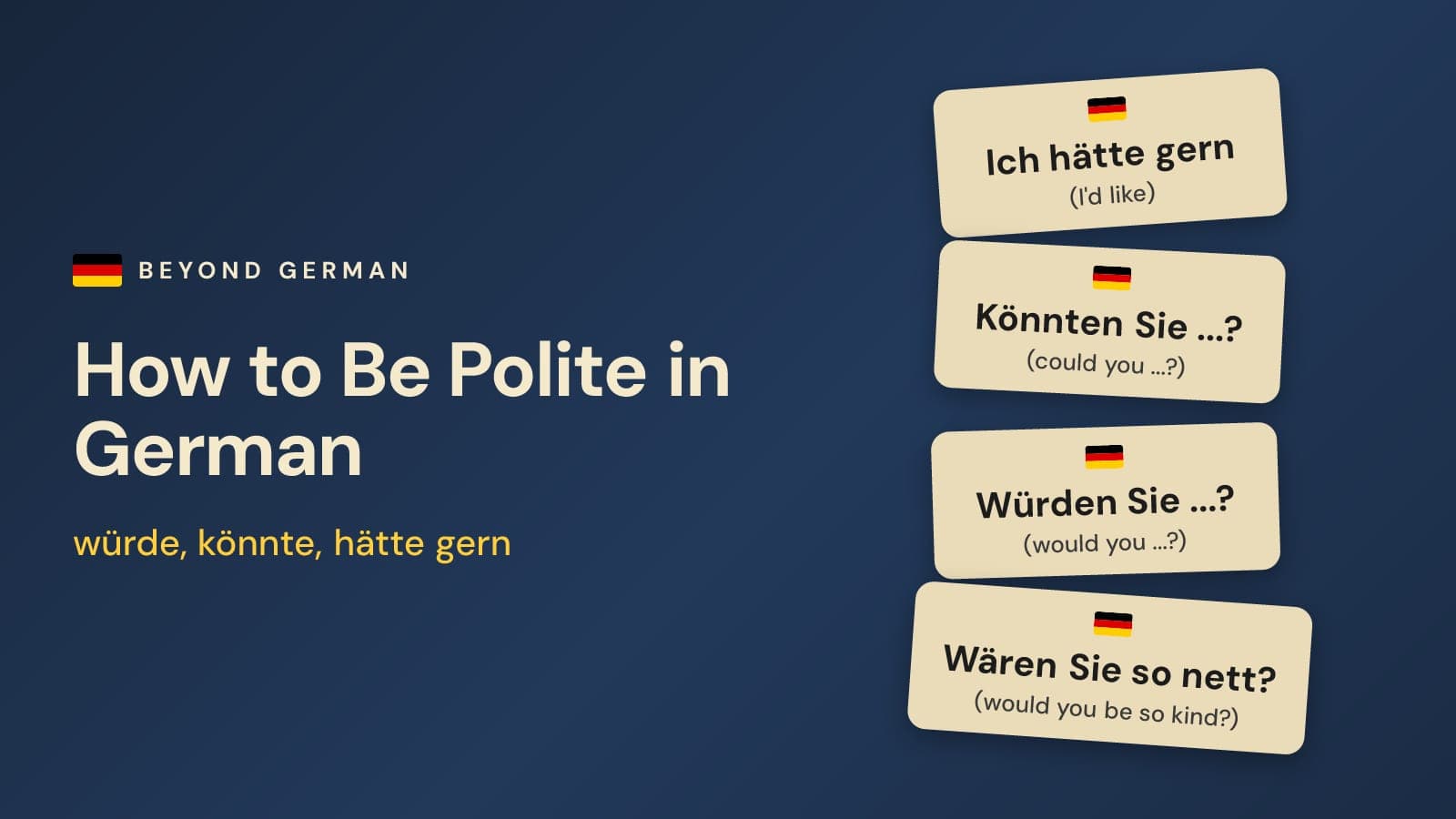
To be polite in German, turn commands into questions and use the Konjunktiv II, the German "would/could" form: Könnten Sie mir helfen? — Could you help me? To ask for something, say Ich hätte gern… or Ich möchte… (I'd like…), not Ich will… (I want…). Add bitte, use Sie with people you don't know, and you'll sound friendly and respectful.
Why German Politeness Uses Konjunktiv II
The Konjunktiv II is the mood for things that aren't real: wishes, daydreams and "what if". Put a request in Konjunktiv II and it sounds hypothetical, so it doesn't assume the answer is yes. That leaves the other person room to say no, and that's exactly what makes it polite.
English does the same thing: "Can you…?" becomes "Could you…?", and "I want…" becomes "I'd like…". Here's one request climbing the politeness ladder:
| German | English | How it sounds |
|---|---|---|
| Schließen Sie das Fenster! | Close the window! | An order |
| Können Sie das Fenster schließen? | Can you close the window? | Neutral and fine |
| Könnten Sie bitte das Fenster schließen? | Could you please close the window? | Polite |
| Wären Sie so nett, das Fenster zu schließen? | Would you be so kind as to close the window? | Very polite |
The neutral version is fine for everyday requests. Each step up adds a little more respect.
The 6 Konjunktiv II Forms You Need
You don't need the whole Konjunktiv II to sound polite. These six forms do almost all the work:
| Verb | ich, er, sie, es | du | wir, sie, Sie | Example |
|---|---|---|---|---|
| haben | hätte | hättest | hätten | Ich hätte gern einen Tee. |
| sein | wäre | wärst | wären | Das wäre super! |
| können | könnte | könntest | könnten | Könnten Sie mir helfen? |
| werden | würde | würdest | würden | Würden Sie hier unterschreiben? |
| dürfen | dürfte | dürftest | dürften | Dürfte ich kurz stören? |
| mögen | möchte | möchtest | möchten | Ich möchte bezahlen. |
See the pattern? Take the simple past (hatte, war, konnte, wurde, durfte, mochte), add an umlaut and, where needed, an -e. Möchte started out as the Konjunktiv II of mögen (to like), but today it works as a verb of its own meaning "would like".
Asking for Things: Ich hätte gern and Ich möchte
Ich hätte gern… (Not Ich will…)
Ich hätte gern (literally "I would gladly have") is the classic way to order in a café, bakery or shop: Ich hätte gern einen Kaffee, bitte. — I'd like a coffee, please. Gern and gerne are interchangeable, and what you order is in the accusative (einen Kaffee).
Now compare Ich will einen Kaffee. — I want a coffee. Wollen expresses a strong wish or a demand, so at a counter it sounds like a toddler insisting on a toy. Save it for plans: Ich will Deutsch lernen. — I want to learn German.
Ich möchte… and Ich würde gern…
Ich möchte (I'd like) is just as polite and more flexible: it works with a noun or with another verb, which goes to the end as with every modal verb (see German modal verbs explained).
- Ich möchte gern einen Termin vereinbaren. — I'd like to make an appointment.
- Möchten Sie etwas trinken? — Would you like something to drink?
For actions, Ich würde gern… + infinitive works too: Ich würde gern mit Frau Meyer sprechen. — I'd like to speak to Ms. Meyer. Rule of thumb: hätte gern for things, würde gern for actions, möchte for both.
Polite Requests: Könnten Sie, Würden Sie, Wären Sie so nett
In all three, the Konjunktiv II verb comes first and the infinitive goes to the end.
Könnten Sie…? (Could You…?)
The safest, most common polite request. It asks whether something is possible:
- Könnten Sie mir helfen? — Could you help me?
- Könnten Sie das bitte wiederholen? — Could you repeat that, please?
- Könntest du mich morgen abholen? — Could you pick me up tomorrow? (informal)
Würden Sie…? (Would You…?)
Würden Sie asks whether someone is willing. It's just as polite, and with bitte it's the standard friendly instruction you'll hear from receptionists and officials: Würden Sie bitte hier unterschreiben? — Would you sign here, please?
Wären Sie so nett, …? (Would You Be So Kind…?)
The extra-polite option for bigger favors. The rest of the sentence becomes a zu + infinitive phrase after a comma:
- Wären Sie so nett, mir kurz zu helfen? — Would you be so kind as to help me for a moment?
- Wärst du so lieb, den Müll rauszubringen? — Would you be a dear and take out the trash? (informal)
Asking Permission and Time: Dürfte ich…? and Hätten Sie kurz Zeit?
Dürfte ich…? (Might I…?)
Darf ich…? (May I…?) is already polite. Dürfte ich…? is one notch more formal, perfect for strangers, older people and the office:
- Dürfte ich Sie etwas fragen? — Could I ask you something?
- Dürfte ich kurz stören? — May I interrupt for a moment?
Hätten Sie kurz Zeit? (Do You Have a Moment?)
Hätten Sie…? sounds much softer than Haben Sie…? when you ask for someone's time or for something you need:
- Hätten Sie kurz Zeit? — Do you have a moment?
- Hätten Sie das auch in Größe M? — Would you have this in a medium, too?
- Hätten Sie etwas dagegen, wenn ich das Fenster aufmache? — Would you mind if I opened the window?
As with "Do you mind…?" in English, the friendly answer to the last one is no: Nein, gar nicht. — No, not at all.
Softening Words: Bitte, Mal, Kurz and More
Small words make a favor sound smaller or less pushy, and Germans often stack them: Könnten Sie mir vielleicht mal kurz helfen? — Could you maybe give me a hand for a sec?
| Word | What it adds | Example | English |
|---|---|---|---|
| bitte | "Please": the basic polite marker | Zwei Brötchen, bitte. | Two bread rolls, please. |
| vielleicht | "Maybe": makes the request tentative | Haben Sie vielleicht ein Ladekabel? | Do you have a charger, by any chance? |
| mal | "Just": makes it sound small and casual | Kannst du mir mal das Salz geben? | Could you pass me the salt? |
| eventuell | "Possibly": formal, common in emails | Könnten Sie mir eventuell die Unterlagen schicken? | Could you possibly send me the documents? |
| gern | "Gladly": shows you're happy to | Ja, gern! | Yes, please! / I'd love to! |
| kurz | "Briefly": promises it won't take long | Hast du kurz Zeit? | Have you got a minute? |
One warning: eventuell is a false friend. It means "possibly", never "eventually" (that's irgendwann or schließlich).
Sie vs. Du: When to Switch
Politeness in German starts with the choice between Sie (formal "you") and du (informal). Use Sie with adults you don't know, staff, officials and most work contacts. Use du with friends, family, children and, if you're young, people your own age. Among students and in many startups, du is normal from day one.
Every request in this guide works with both: Könnten Sie…? simply becomes Könntest du…?
Das Duzen: Who Offers "Du"?
Saying du is called duzen (das Duzen), and saying Sie is siezen. Don't switch on your own. Wait for the offer, which traditionally comes from the older or more senior person:
- Wollen wir uns duzen? — Shall we say "du" to each other?
- Ich bin übrigens Thomas. — I'm Thomas, by the way. (This usually means the same.)
Answer with Gern! Ich bin… plus your first name. Once you've switched, there's no going back. When in doubt, stick with Sie: being a little too formal is rarely a problem, but an uninvited du can come across as rude.
How to Disagree and Say No Politely
Disagreeing
Germans are often direct in discussions, and a clear "I disagree" isn't considered rude. A soft start still helps, especially at work:
- Da bin ich mir nicht ganz sicher. — I'm not so sure about that.
- Ich sehe das etwas anders. — I see that a bit differently.
- Das stimmt schon, aber… — That's true, but…
- Wäre es nicht besser, wenn wir erst nächste Woche anfangen? — Wouldn't it be better if we didn't start until next week?
For more ways to agree and disagree, see how to give your opinion in German.
Saying No
A polite German "no" usually has three parts: thanks, leider (unfortunately) and, if you like, an alternative:
- Danke, das ist sehr nett, aber leider kann ich nicht. — Thanks, that's very kind, but unfortunately I can't.
- Ich würde gern kommen, aber ich habe am Samstag schon etwas vor. — I'd love to come, but I already have plans on Saturday.
- Vielleicht ein anderes Mal? — Maybe another time?
Saying Thank You
Danke and Vielen Dank always work, and Konjunktiv II helps you accept offers gracefully:
- Das ist sehr nett von Ihnen. — That's very kind of you.
- Das wäre super! — That would be great!
- Ich wäre Ihnen sehr dankbar, wenn Sie mir helfen könnten. — I'd be very grateful if you could help me.
The last one is a classic in formal emails. For every other way to say thanks, and how to reply, see thank you in German.
Mini Dialogues: Café, Office, Neighbor
At a Café
| Who | German | English |
|---|---|---|
| Server | Hallo! Was darf ich Ihnen bringen? | Hi! What can I get you? |
| You | Ich hätte gern einen Cappuccino, bitte. Und könnten Sie mir ein Glas Wasser bringen? | I'd like a cappuccino, please. And could you bring me a glass of water? |
| Server | Gern. | Sure. |
| You | (later) Entschuldigung, ich würde gern zahlen. | (later) Excuse me, I'd like to pay. |
| Server | Das macht 4,60 Euro. | That's 4.60 euros. |
| You | Fünf, bitte. | Make it five, please. |
At the Office
| Who | German | English |
|---|---|---|
| You | Entschuldigung, Herr Klein, hätten Sie kurz Zeit? | Excuse me, Mr. Klein, do you have a moment? |
| Herr Klein | Ja, natürlich. Worum geht es? | Yes, of course. What's it about? |
| You | Könnten Sie sich meinen Bericht ansehen? | Could you take a look at my report? |
| Herr Klein | Heute schaffe ich das leider nicht mehr. Würde Ihnen Donnerstag passen? | I won't get to it today, unfortunately. Would Thursday work for you? |
| You | Ja, das passt. Vielen Dank, das ist sehr nett von Ihnen! | Yes, that works. Thank you, that's very kind of you! |
Preparing for a job interview? Our German job interview phrases use the same polite forms.
With a Neighbor
| Who | German | English |
|---|---|---|
| You | Entschuldigen Sie die Störung, Frau Schulz. Ich bekomme morgen ein Paket, bin aber nicht zu Hause. Könnten Sie es vielleicht annehmen? | Sorry to bother you, Ms. Schulz. I'm getting a package tomorrow, but I won't be home. Could you maybe take it in? |
| Frau Schulz | Ja, klar, das mache ich gern. | Sure, I'm happy to. |
| You | Das wäre super. Vielen Dank! | That would be great. Thanks so much! |
| Frau Schulz | Gern! Wir sind doch Nachbarn. Wollen wir uns nicht duzen? Ich bin Petra. | My pleasure! We're neighbors, after all. Why don't we say "du"? I'm Petra. |
| You | Sehr gern! Ich bin Alex. | I'd love to! I'm Alex. |
Common Mistakes
| Wrong | Right | Why |
|---|---|---|
| Ich will einen Kaffee. | Ich hätte gern einen Kaffee. | Ich will sounds demanding. |
| Ich würde mögen einen Tee. | Ich möchte einen Tee. | Möchte already means "would like". |
| Könnten Sie mich helfen? | Könnten Sie mir helfen? | Helfen takes the dative. |
| Ich möchte zu bezahlen. | Ich möchte bezahlen. | No zu after möchte and other modal verbs. |
| Kannst du mir helfen? (to a stranger) | Können Sie mir helfen? | Use Sie with people you don't know. |
| Könnten sie mir helfen? (in writing) | Könnten Sie mir helfen? | Lowercase sie means "she" or "they". |
For more slip-ups to avoid, see common German mistakes English speakers make.
Practice: Make It Polite
Make each one polite:
- Ich will ein Wasser. (in a café)
- Helfen Sie mir! (to a stranger)
- Haben Sie Zeit? (to your boss)
- Kann ich das Fenster aufmachen? (to a stranger on the train)
- Gib mir das Salz! (to a friend)
- Politely turn down a neighbor's party invitation for Saturday.
Answers:
- Ich hätte gern ein Wasser, bitte.
- Könnten Sie mir bitte helfen?
- Hätten Sie kurz Zeit?
- Dürfte ich das Fenster aufmachen?
- Könntest du mir mal das Salz geben?
- Das ist sehr nett, aber am Samstag kann ich leider nicht. Vielleicht ein anderes Mal?
Want more? Learn how all the forms are built in our Konjunktiv II guide, then test yourself in the A2 German quiz.
FAQ
Is "Ich will" rude in German?
When you're asking for something, yes: Ich will einen Kaffee sounds demanding, so use Ich möchte or Ich hätte gern. For plans, Ich will is fine.
What's the difference between "Ich hätte gern" and "Ich möchte"?
Both mean "I'd like" and are equally polite. Ich hätte gern only works with things; Ich möchte works with things and actions (Ich möchte bezahlen).
Is "Könnten Sie" or "Würden Sie" more polite?
Both are polite. Könnten Sie asks if something is possible; Würden Sie asks if someone is willing and can sound like a friendly instruction. If in doubt, use Könnten Sie.
When should I switch from Sie to du?
When the other person offers it, often with Wollen wir uns duzen? Traditionally, the older or more senior person makes the offer.
Level Up Your German
Join 1,000+ learners getting weekly tips, grammar shortcuts, and cultural insights.
Share this article
Continue Reading
Funny German Idioms: 25 Sayings With English Translations
From Ich verstehe nur Bahnhof to Schwein haben: 25 funny German idioms with literal translations, real meanings, English equivalents and example sentences.
German Word Order: Verb-Second Rule, Verb at the End & TeKaMoLo
German word order in 7 rules: verb second, verb first in yes/no questions, verb last after weil and dass, the verb bracket, TeKaMoLo, object order and where nicht goes.
Obwohl vs Trotzdem vs Dennoch: Although in German (+ Word Order)
Obwohl means although and sends the verb to the end, while trotzdem and dennoch mean nevertheless and take the verb right after them. Allerdings, trotz and sondern are covered too.