German for Nurses: Which Level You Need and How to Get There
 Beyond German Team
Online course · A1 to B1
German for life here, with exam practice
To work as a registered nurse in Germany, you need B2 German for your nursing licence. Most states ask for a general or nursing B2 certificate, but you can come to Germany before that: the recognition visas need at least A2, and the Triple Win programme asks for B1 by the time you apply for your visa. One route, used by Triple Win, is A1 to B1 at home, then B2 in Germany, on the way to the job title Pflegefachfrau (PFLAY-guh-fakh-frow) or Pflegefachmann (PFLAY-guh-fakh-mahn), the German name for a registered nurse since 2020.
Below: what each level means on a ward, the visa routes, the licence and recognition, Triple Win and fair recruitment, a realistic study plan, and 35 hospital words and phrases. Rules are as they stood at the time of writing (November 2026) and some vary by state, so always check the official pages linked here.
The Roadmap at a Glance
The level you need depends on the step you're at:
| Stage | Level | What it's for | Notes |
|---|---|---|---|
| Recognition visa (§ 16d (1) or (3)) | At least A2 | Coming to Germany to complete your recognition | The legal minimum, not a comfortable level for a ward |
| Triple Win | B1 by the visa application | Going with the Federal Employment Agency's programme | The A1 to B1 course is free for nurses |
| Working while recognition runs | No official level published | Often as a nursing assistant (die Pflegehilfskraft) | Ask your employer what they expect |
| Nursing licence | B2 | Working as a registered nurse | Accepted certificates vary by state |
A2 is the minimum to come; B2 is what the licence needs. Plan for both from day one.
German Levels for Nurses, A1 to B2
The levels come from the CEFR, the European scale from A1 to C2. Here's what each one can look like at work, with the Goethe-Institut's guideline for how many lessons of 45 minutes it takes, counted from zero:
| Level | On the ward, you can… | Lessons from zero |
|---|---|---|
| A1 | Greet a patient, say who you are, understand room numbers, times and simple requests | 80-200 |
| A2 | Ask simple questions about pain, sleep and food, and follow short, clear instructions | 200-350 |
| B1 | Talk with patients about how they feel, follow a clear handover, write short notes | 350-650 |
| B2 | Follow a handover at normal speed, talk with doctors and relatives, handle phone calls and documentation | 600-800 |
German residence law uses fixed words for these levels: hinreichende German means A2, ausreichende means B1 and gute means B2. So if a residence rule asks for gute deutsche Sprachkenntnisse, it means B2.
How Long Does It Take?
By that guideline, zero to B1 is about 260 to 490 hours of lessons, and zero to B2 about 450 to 600 hours. Our rough estimate from that: at an hour a day, B1 takes about 9 to 16 months; at two hours a day, about 4 to 8 months. B2 then needs several more months. Your pace depends on your time, your teacher and how much you speak.
Shift work makes this harder, not impossible. Here's our honest answer to whether German is hard to learn for English speakers.
Visa Routes for Nurses and the A2 Minimum
If your training isn't fully recognised yet, these are the main routes under § 16d of the Residence Act (AufenthG), as they stood in November 2026:
- § 16d (1), visa for recognition measures: you come to Germany to complete your recognition. It's issued for up to 24 months and can be extended to a maximum of 3 years, and you may do up to 20 hours a week of other work. You need at least A2 German.
- § 16d (3), recognition partnership: you need a job offer, an agreement with your employer to start recognition soon after you arrive, and at least 2 years of training or a degree recognised by the state in the country where you trained. The permit is for 1 year at first, up to 3 years. Again, at least A2.
- § 16d (4), placement agreements: for health and care jobs placed through agreements of the Federal Employment Agency. The agreement sets the German level.
Treat A2 as the minimum, not the goal: the more German you bring, the easier your first months on the ward. To find the authority and rules for the state where you want to work, use the official Recognition Finder and choose nurse as your profession.
The Nursing Licence: Why You Need B2
To work as a registered nurse, you need the licence to use the job title, in German the Erlaubnis zum Führen der Berufsbezeichnung. It needs B2 German, and no state we checked accepts B1 for it.
Most states ask for a general or nursing B2 certificate, but each state has its own list. Some examples:
| State | What counts (examples) | Good to know |
|---|---|---|
| Bavaria (leaflet, June 2025) | A B2 certificate, for example Goethe B2 or B2 PRO Pflege, telc B2 or telc B2 Pflege, ÖSD B2, TestDaF level 3, DTB B2 | The leaflet says there's currently no separate nursing language exam |
| Hesse (leaflet, July 2024) | Only listed certificates at B2 or higher, including telc B2 Pflege and Goethe-Test PRO Pflege | Check the list before you book |
| North Rhine-Westphalia | Also offers a nursing language exam, the Fachsprachenprüfung Pflege, at the Pflegekammer NRW (the nursing chamber) | You can hand in the language certificate after you apply |
| Berlin | Since June 2024, a Fachsprachenprüfung Pflege B2 as an alternative | Check which certificates count too |
One trap: telc's B1·B2 Pflege exam counts for the licence only with a B2 result.
To find your state's list, open the Recognition Finder, choose nurse and your state, and read what the authority says about language certificates. Book your B2 exam only after that.
Recognition in Short
Recognition (die Anerkennung) checks whether your nursing training matches German training. You apply to the competent authority of the state where you'll work:
- Equivalence check: the authority compares your training with the German one.
- Compensation measure, if there are substantial differences: an adaptation course (der Anpassungslehrgang, at most 3 years) or a knowledge exam (die Kenntnisprüfung, oral and practical). You can usually choose.
- Licence: with full recognition, B2 German and the other documents your state asks for, the authority can grant the licence.
Timelines vary by state. In NRW, for example, the authority confirms receipt within 1 month and decides within 4 months of receiving complete documents, and that can be extended. Fees differ too: at most €277.50 in NRW, between €200 and €750 in Hamburg.
While recognition runs, you can often work as a nursing assistant (die Pflegehilfskraft) until you get the licence. No official German level is published for that, so ask your employer what they expect.
Triple Win and Fair Recruitment
What Triple Win Is
Triple Win is a programme of ZAV, the Federal Employment Agency's international placement service, and GIZ, Germany's agency for international cooperation, running since 2013. In India it recruits nurses in Kerala together with Norka Roots, and a 2025 GIZ article also names Telangana. If you're from another Indian state, check the official page for where it recruits now. At the time of writing:
- Training: a GNM diploma or a B.Sc. Nursing.
- German: B1 by the time you apply for the visa. The A1 to B1 course in Thiruvananthapuram takes about 9 months in class.
- Cost for nurses: the course, placement, preparation and medical check are free; employers pay a fee.
- After B1: departure is usually 3 to 4 months later. In Germany you need B2, and recognition should be completed within 12 months.
The programme decides who is selected and when, so read the current details on the official Triple Win India page of the Federal Employment Agency.
How to Spot a Fair Agency
If a private agency approaches you, check how it works before you sign or pay anything. The Federal Ministry of Health's seal Faire Anwerbung Pflege Deutschland (roughly: fair recruitment for nursing in Germany) requires that recruitment is free for nurses (the employer pays), that it is transparent, and that you get written terms in a language you understand. So:
- Ask who pays. Be careful with any agency that charges nurses large fees.
- Ask about the seal, and read what it stands for on the Federal Ministry of Health's page on the fair recruitment seal.
- Get every term in writing, in a language you understand, before you sign.
- Compare with Triple Win, where the course and placement cost nurses nothing.
How to Learn German as a Busy Nurse
A Routine That Survives Shift Work
Long study sessions rarely fit around shifts. Short daily ones do:
- Every day, 30 to 60 minutes: 10 minutes of words with their articles, one lesson, and 10 minutes of speaking (read sentences aloud, record yourself, answer questions).
- Once a week, a longer session: one grammar topic, one short writing task, and a conversation with a teacher or study partner.
- On night-shift weeks: keep a minimum of 10 minutes of words or listening, so you don't lose the habit.
More ideas in our simple daily routine to learn German faster.
What to Focus On From A1 to B1
- Speaking and listening first. Care happens in conversation, and patients speak at their own pace, sometimes with a strong regional accent.
- Numbers and times. Blood pressure values, room numbers and medication times have to be exact.
- The body and health. Start with body parts in German and German at the doctor, which covers symptoms from the patient's side.
- Polite German. Adult patients are addressed with Sie; our guide on how to be polite in German shows the soft requests that go with it.
- The exam formats. From A2 on, try one official model test early, so you know what's coming.
Exams Along the Way
Exams at each level give you checkpoints, and a programme or visa may ask for the certificate:
- A1: Goethe-Zertifikat A1: Start Deutsch 1, or telc Deutsch A1. See our Goethe A1 exam guide.
- A2: Goethe-Zertifikat A2 or telc Deutsch A2.
- B1: Goethe-Zertifikat B1 or telc Deutsch B1. Compare them in our German B1 exam guide and practise with our free telc B1 preparation guide.
Before you book, check which certificates your programme or the embassy accepts.
After B1: B2 and Nursing German
Don't stop at B1. Keep the daily routine and add Fachsprache (FAKH-shprah-khuh), the language of your job: handovers, documentation, talking with doctors and relatives. Learn it alongside general B2, not instead of it, and choose your B2 exam only after checking your state's list.
Essential German for Nurses: 35 Words and Phrases
Learn every noun with its article. Use Sie and Ihr (your) with adult patients; with colleagues, follow the team, since some use du and some Sie.
People and Places
| German | English |
|---|---|
| das Krankenhaus | hospital |
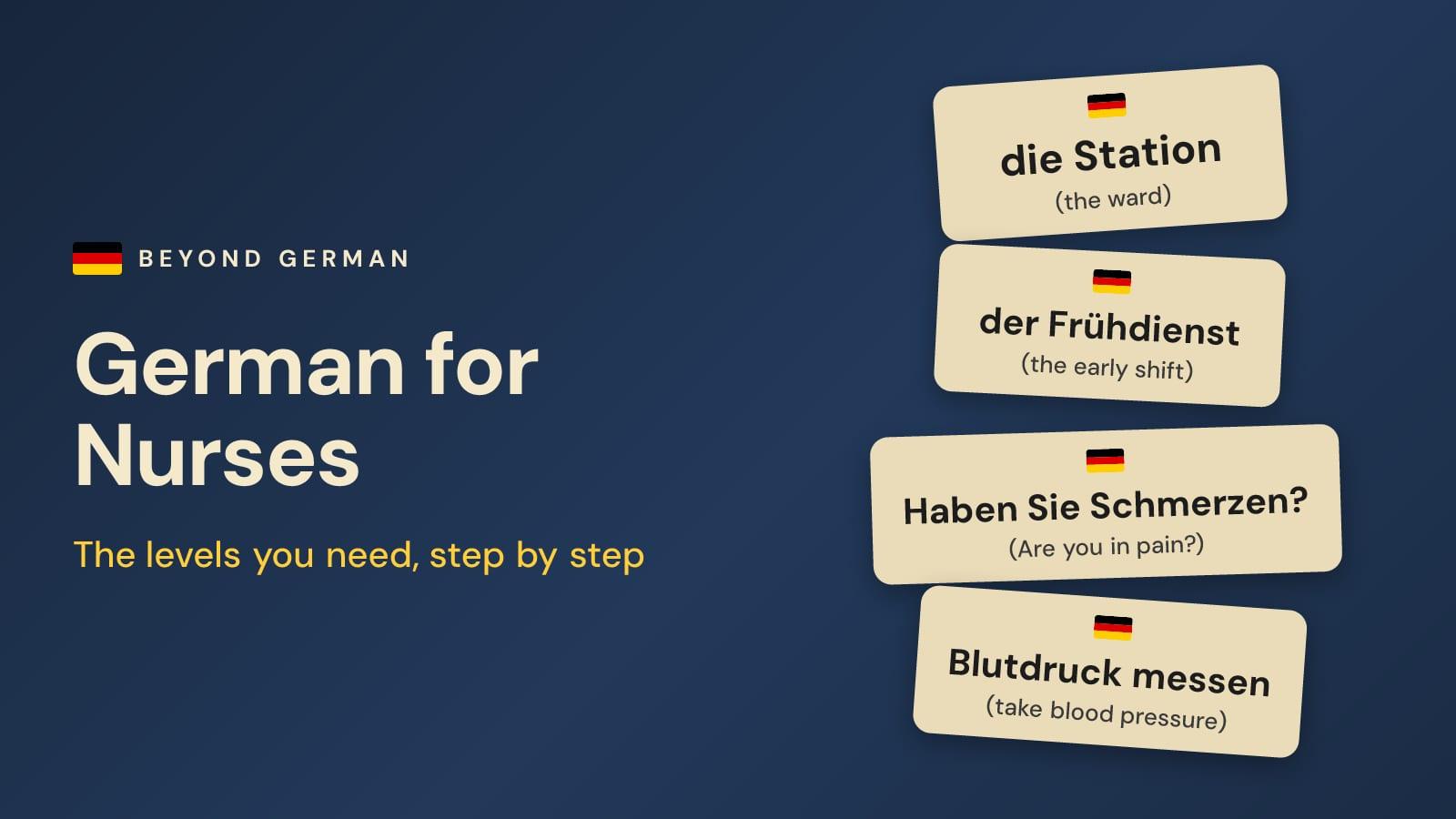
| die Station | ward |
| das Pflegeheim | care home |
| der Patient / die Patientin | patient (male / female) |
| die Pflegekraft | nurse, care worker (general term) |
| der Arzt / die Ärztin | doctor (male / female) |
| die Angehörigen | relatives, the patient's family |
Shifts and Routines
| German | English |
|---|---|
| die Schicht | shift |
| der Frühdienst | early shift |
| der Spätdienst | late shift |
| der Nachtdienst | night shift |
| der Dienstplan | rota, shift schedule |
| die Übergabe | handover |
| die Visite | ward round |
| die Dokumentation | documentation, records |
Care Tasks
| German | English |
|---|---|
| den Blutdruck messen | to take someone's blood pressure |
| Fieber messen | to take someone's temperature |
| das Medikament, die Medikamente | medicine, medication |
| die Spritze | injection |
| den Verband wechseln | to change the dressing |
| der Schmerz, die Schmerzen | pain (usually plural: Schmerzen) |
| die Klingel | call bell |
Talking With Patients
| German | English |
|---|---|
| Guten Morgen, mein Name ist Anna. Ich bin heute für Sie da. | Good morning, my name is Anna. I'm looking after you today. |
| Wie geht es Ihnen heute? | How are you feeling today? |
| Haben Sie Schmerzen? | Are you in pain? |
| Wo tut es weh? | Where does it hurt? |
| Wie stark sind Ihre Schmerzen auf einer Skala von 0 bis 10? | On a scale of 0 to 10, how bad is your pain? |
| Ich messe jetzt Ihren Blutdruck. | I'm going to take your blood pressure now. |
| Brauchen Sie Hilfe? | Do you need help? |
| Ich bringe Ihnen ein Glas Wasser. | I'll bring you a glass of water. |
| Ich helfe Ihnen beim Aufstehen. | I'll help you get up. |
| Bitte klingeln Sie, wenn Sie etwas brauchen. | Please ring if you need anything. |
With Colleagues
Wann ist die Übergabe? (When is handover?) Können Sie das bitte noch einmal sagen? (Could you say that again, please?) Wie schreibt man das? (How do you spell that?)
And a short handover, at about B1:
Herr Becker, Zimmer 4, hatte in der Nacht starke Schmerzen. Er hat um drei Uhr ein Schmerzmittel bekommen. Jetzt geht es ihm besser.
(Mr Becker, room 4, was in a lot of pain during the night. He was given a painkiller at three o'clock. He's feeling better now.)
Where Our A1 to B1 Course Fits
If you're starting from zero, our self-study online German course from A1 to B1 is built to take you from zero to B1: the level Triple Win asks for by the visa application, and your base for B2. It uses recorded everyday conversations, with practice for every part of the A1 exam (Start Deutsch 1), the telc and Goethe A2 exams, and telc Deutsch B1. To be clear about what it isn't: it doesn't cover B2 or nursing German, it has no tutor, it awards no certificate, and nobody can promise a pass.
Not sure where you're starting from? Take our free German level assessment.
Common Mistakes
Paying an Agency Large Fees
Fair recruitment is free for nurses, because the employer pays; that's a condition of the government's seal. If an agency asks you for a large fee, stop, ask about the seal and compare with Triple Win.
Stopping at B1
B1 may get you to Germany, but the licence needs B2. Keep studying from the day you arrive.
Booking the Wrong Certificate for Your State
Check your state's list first. And a B1 result on telc B1·B2 Pflege doesn't count for the licence.
Waiting Until You Arrive to Learn
Your first months are full: a new job, recognition, and paperwork such as registering your address (see German phrases for the Anmeldung at the Bürgeramt). Every level you reach at home makes that easier.
Using Du With Patients
Wrong: Hast du Schmerzen? Right: Haben Sie Schmerzen?
Wrong: Ich messe jetzt deinen Blutdruck. Right: Ich messe jetzt Ihren Blutdruck.
Der Blutdruck is masculine, so formal "your" in the accusative is Ihren, not Ihr.
Practice
Try these, then check the answers below:
- Make it right for an adult patient: Hast du Hunger?
- Fill the gap (to you, formal): Ich bringe ___ ein Glas Wasser.
- Say in German: Where does it hurt?
- Which shift starts in the morning: Frühdienst, Spätdienst or Nachtdienst?
- True or false: a B1 result on telc B1·B2 Pflege is enough for the nursing licence.
Answers: 1. Haben Sie Hunger? 2. Ihnen 3. Wo tut es weh? 4. der Frühdienst 5. False: only a B2 result counts.
Then check your basics with the A1 German quiz.
FAQ
What level of German do nurses need in Germany?
B2 for the nursing licence. You can come earlier: the recognition visas under § 16d (1) and (3) need at least A2, and Triple Win asks for B1 by the visa application. Which B2 certificates count depends on the state.
Is B1 enough to work as a nurse in Germany?
Not as a registered nurse: the licence needs B2, and no state we checked accepts B1 for it. While recognition runs, you can often work as a nursing assistant; no official German level is published for that.
Can I go to Germany with A2?
It's possible: A2 is the minimum for a visa for recognition measures (§ 16d (1)) or a recognition partnership (§ 16d (3)), if you meet the other conditions. Programmes can ask for more: Triple Win asks for B1. You'll still need B2 for the licence.
How long does it take to learn German for nursing?
Goethe's guideline is 350 to 650 lessons of 45 minutes from zero to B1, and 600 to 800 to B2. At an hour a day, our rough estimate is 9 to 16 months to B1, then several more months to B2. Triple Win's course to B1 takes about 9 months in class.
Is Triple Win free?
The main parts are free for nurses: the A1 to B1 course, placement, preparation and medical check. Employers pay a fee. Check the official page for current details.
Which B2 exam is best for nurses?
The one your state accepts. The lists we checked include general certificates (such as Goethe, telc or ÖSD B2) and nursing ones (such as telc B2 Pflege or Goethe-Test PRO Pflege), and NRW and Berlin also offer a nursing language exam. If several count, choose by dates, location and whether you'd rather prepare with general or nursing topics.
Level Up Your German
Join 1,000+ learners getting weekly tips, grammar shortcuts, and cultural insights.
Share this article
Continue Reading
Goethe B1 Word List (Wortliste): What's on It and How to Learn It
The official Goethe B1 Wortliste explained in English: what's on it, how to read the entries, how big it really is, and a free extract of 39 B1 words by situation.
Integration Course in Germany: How It Works, Cost and B1 Test
How Germany's integration course works in 2026: who can join, what it costs, the DTZ and Leben in Deutschland tests, and why B1 matters for your permit.
German B1 Exam: Goethe vs telc, Format and How to Prepare
Goethe or telc? Every part of the German B1 exam, pass marks and retakes, what citizenship and a settlement permit ask for, and a realistic plan to prepare.