
German at the Doctor: Phrases for Appointments & Symptoms
 Beyond German Team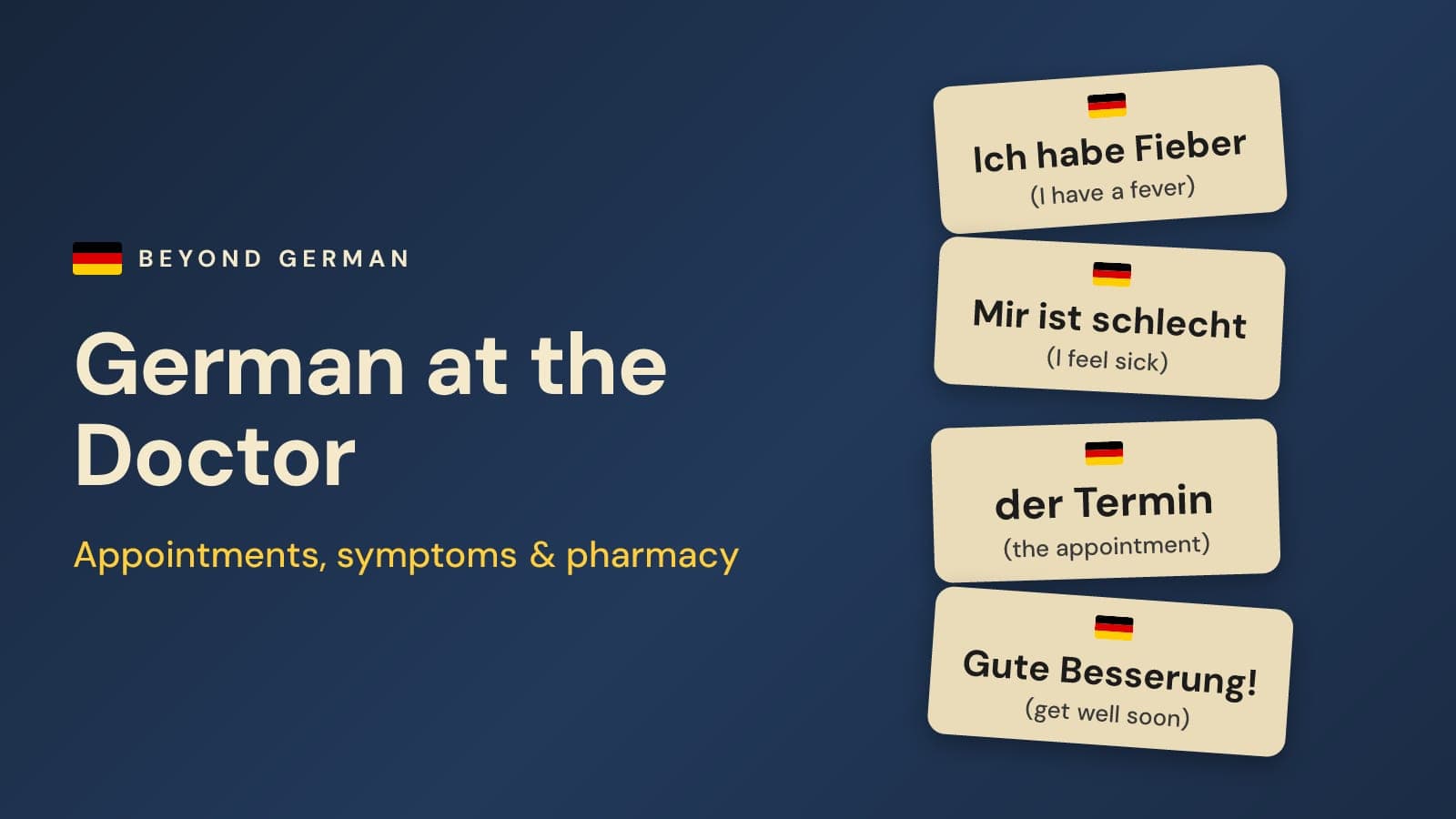
At a German doctor's, three phrases do most of the work: Ich hätte gern einen Termin (I'd like an appointment), Ich habe… for symptoms (Ich habe Fieber — I have a fever) and Mir tut … weh for pain (Mir tut der Kopf weh — My head hurts). Below is the German for every step of a visit, from the first phone call to the pharmacy.
This guide teaches language, not medicine. For health questions, ask a doctor or pharmacist, and in an emergency, call 112.
How to Make a Doctor's Appointment in German
For everyday health problems, you go to a doctor's practice (die Praxis), not a hospital, and you usually need an appointment (der Termin). Many practices let you book online, but calling is still common. A typical call:
| Who | German | English |
|---|---|---|
| Practice | Praxis Dr. Becker, guten Tag! | Dr. Becker's practice, hello! |
| You | Guten Tag, mein Name ist Sarah Miller. Ich bin neu hier und hätte gern einen Termin. | Hello, my name is Sarah Miller. I'm new here and I'd like an appointment. |
| Practice | Was haben Sie denn für Beschwerden? Ist es dringend? | What symptoms do you have? Is it urgent? |
| You | Ich habe seit einer Woche Husten. Es ist nicht so dringend. | I've had a cough for a week. It's not that urgent. |
| Practice | Geht es am Donnerstag um halb zehn? | Does Thursday at 9:30 work? |
| You | Ja, das passt. Vielen Dank! | Yes, that works. Thank you! |
| Practice | Bringen Sie bitte Ihre Versichertenkarte mit. | Please bring your health insurance card. |
| You | Mache ich. Auf Wiederhören! | Will do. Goodbye! (on the phone) |
Halb zehn means 9:30, not 10:30, because Germans count the half hour toward the next hour (see telling time in German). And Ich hätte gern… is the same polite "I'd like" you use in a café.
With Ist es dringend? (Is it urgent?), the receptionist decides how soon to fit you in: urgent cases are often seen the same day, while routine appointments can take weeks. Answer Ja, es ist dringend. or Nein, es ist nicht dringend.
More Phrases for the Phone
- Nehmen Sie noch neue Patienten auf? — Are you taking new patients?
- Haben Sie diese Woche noch einen Termin frei? — Do you have an appointment free this week?
- Ich muss meinen Termin leider absagen. — Unfortunately, I have to cancel my appointment.
At the Practice: Key Words
At the reception desk (die Anmeldung), say Guten Tag, ich habe um halb zehn einen Termin. — Hello, I have an appointment at 9:30. You'll probably hear:
- Ihre Versichertenkarte, bitte. — Your health insurance card, please.
- Sind Sie gesetzlich oder privat versichert? — Do you have public or private health insurance?
- Nehmen Sie bitte im Wartezimmer Platz. — Please take a seat in the waiting room.
| German | English |
|---|---|
| die Praxis (plural: die Praxen) | doctor's office, practice |
| das Wartezimmer | waiting room |
| die Versichertenkarte / die Gesundheitskarte | health insurance card |
| die Krankenkasse | public health insurer |
| der Hausarzt / die Hausärztin | family doctor, GP |
| der Facharzt / die Fachärztin | specialist |
| der Zahnarzt / die Zahnärztin | dentist |
| der HNO-Arzt / die HNO-Ärztin | ear, nose and throat doctor |
| die Überweisung | referral |
| die Beschwerden (plural) | symptoms, complaints |
A female doctor is die Ärztin: add -in and an umlaut. HNO stands for Hals, Nase, Ohren (throat, nose, ears).
Your Hausarzt is usually your first stop. Some specialists only see you with a referral, so ask when you book: Brauche ich eine Überweisung? — Do I need a referral? (Fun fact: Überweisung also means a bank transfer.)
Describing Symptoms: Ich habe…
Most symptoms go with haben: you have a headache, a fever, a cough, usually with no article. And the simplest sentence of all is Ich bin krank — I'm sick.
| German | English |
|---|---|
| Ich habe Kopfschmerzen. | I have a headache. |
| Ich habe Halsschmerzen. | I have a sore throat. |
| Ich habe Bauchschmerzen. | I have a stomachache. |
| Ich habe Fieber. | I have a fever. |
| Ich habe Husten. | I have a cough. |
| Ich habe Schnupfen. | I have a runny nose. |
| Ich habe Durchfall. | I have diarrhea. |
| Ich habe einen Ausschlag. | I have a rash. |
| Ich habe die Grippe. | I have the flu. |
| Ich bin erkältet. | I have a cold. |
| Ich bin allergisch gegen Penicillin. | I'm allergic to penicillin. |
Pain is usually plural, Schmerzen, with the body part in front: Kopf + Schmerzen = Kopfschmerzen. The same pattern gives you Rückenschmerzen (back pain) and Zahnschmerzen (toothache).
Mir ist schlecht: Saying How You Feel
For how you feel, German switches to the dative: mir ist + adjective, literally "to me it is…".
- Mir ist schlecht. — I feel sick. (nauseous)
- Mir ist schwindelig. — I feel dizzy.
- Mir ist kalt. — I'm cold.
Don't say Ich bin schlecht: it means "I'm bad". It's the same trap as Ich bin kalt, one of the classic German mistakes English speakers make. To simply say you're unwell: Ich fühle mich nicht gut. — I don't feel well.
Saying How Long: seit
The doctor will want to know how long you've had it. Use seit (since, for) with the present tense:
- Ich habe seit drei Tagen Fieber. — I've had a fever for three days.
- Ich habe seit gestern Bauchschmerzen. — I've had a stomachache since yesterday.
Seit always takes the dative, hence seit drei Tagen and seit einer Woche (see German dative prepositions).
Saying What Hurts: Mir tut … weh
To say that a body part hurts, use Mir tut … weh:
- Mir tut der Kopf weh. — My head hurts.
- Mir tut der Rücken weh. — My back hurts.
- Mir tun die Füße weh. — My feet hurt.
Three things make this work:
- The body part is the subject, so the verb agrees with it: der Kopf tut weh, but die Füße tun weh.
- The person in pain is in the dative: mir, dir, ihm, ihr. Meinem Sohn tut das Ohr weh. — My son's ear hurts.
- German says der/die/das, not "my", because mir already shows whose head it is.
Wehtun is a separable verb, so weh goes to the end: Es tut hier weh. — It hurts here. The doctor may ask Wo tut es weh? — Where does it hurt?
| German | Plural | English |
|---|---|---|
| der Kopf | die Köpfe | head |
| der Hals | die Hälse | neck, throat |
| der Rücken | die Rücken | back |
| die Schulter | die Schultern | shoulder |
| der Arm | die Arme | arm |
| die Hand | die Hände | hand |
| der Bauch | die Bäuche | belly, stomach |
| der Magen | die Mägen | stomach (the organ) |
| das Bein | die Beine | leg |
| das Knie | die Knie | knee |
| der Fuß | die Füße | foot |
| das Auge | die Augen | eye |
| das Ohr | die Ohren | ear |
| der Zahn | die Zähne | tooth |
Understanding the Doctor
Doctors say Sie to adult patients. These are the questions and instructions you're most likely to hear:
| German | English |
|---|---|
| Was fehlt Ihnen? | What seems to be the problem? |
| Seit wann haben Sie das? | How long have you had this? |
| Nehmen Sie regelmäßig Medikamente? | Do you take any medication regularly? |
| Haben Sie Allergien? | Do you have any allergies? |
| Machen Sie bitte den Oberkörper frei. | Please undress to the waist. |
| Legen Sie sich bitte hin. | Please lie down. |
| Tief einatmen … und ausatmen. | Breathe in deeply … and out. |
| Ich schreibe Ihnen ein Rezept. | I'll write you a prescription. |
| Ich überweise Sie zum Facharzt. | I'll refer you to a specialist. |
| Kommen Sie in einer Woche wieder. | Come back in a week. |
Was fehlt Ihnen? is literally "What is missing to you?" (the dative again). Machen Sie bitte den Oberkörper frei is literally "Please make your upper body free": take off what you're wearing above the waist.
If you don't understand, say so: Können Sie bitte langsamer sprechen? — Could you speak more slowly, please? Können Sie das bitte aufschreiben? — Could you write that down, please?
The Sick Note: die Krankschreibung
If you're too sick to work, the doctor can give you a sick note. Its official name is die Arbeitsunfähigkeitsbescheinigung (AU for short), but everyone says die Krankschreibung. You may also hear der gelbe Schein (the yellow slip), after the old paper form.
- Können Sie mich krankschreiben? — Can you give me a sick note?
- Wie lange bin ich krankgeschrieben? — How long is my sick note for?
- Ich bin bis Freitag krankgeschrieben. — I'm on sick leave until Friday.
Don't mix up two verbs: krankschreiben is what the doctor does, and sich krankmelden is what you do when you tell your employer you're sick: Ich muss mich leider krankmelden. — Unfortunately, I have to call in sick.
The basics (details depend on your contract):
- Tell your employer on your first sick day, ideally before work starts.
- By law you need a doctor's note if you're off sick for more than three calendar days, but your employer can ask for one from the first day. Ask HR if you're unsure.
- With public insurance, the practice sends the sick note electronically to your Krankenkasse, and your employer gets it from there.
At the Pharmacy: die Apotheke
Medicine comes from die Apotheke, the pharmacy with the red A sign. Even everyday painkillers are sold only there, not in supermarkets or drugstores. Three words matter most:
- das Rezept — prescription (and also "recipe")
- rezeptfrei — over the counter, no prescription needed
- verschreibungspflichtig — prescription-only
Since 2024, most prescriptions are electronic (das E-Rezept): at the pharmacy, you just hand over your health insurance card. With public insurance, you usually pay a small co-payment (die Zuzahlung) for prescription medicine.
- Ich möchte dieses Rezept einlösen. — I'd like to fill this prescription.
- Haben Sie etwas gegen Halsschmerzen? — Do you have something for a sore throat?
- Ist das rezeptfrei? — Can I get this without a prescription?
At night and on Sundays, one pharmacy in each area stays open (die Notdienstapotheke), and every pharmacy door shows which one.
Emergencies: 112 and 116117
| Number | What it's for |
|---|---|
| 112 | Life-threatening emergencies: ambulance (der Krankenwagen) and fire brigade. Free from any phone, and the same across the EU. |
| 110 | Police |
| 116117 | Non-emergency medical on-call service (der ärztliche Bereitschaftsdienst), for when your practice is closed and it can't wait, but isn't life-threatening |
- Rufen Sie einen Krankenwagen! — Call an ambulance!
- Ich brauche einen Arzt. — I need a doctor.
- Es ist ein Notfall. — It's an emergency.
- Wo ist die nächste Notaufnahme? — Where is the nearest emergency room?
On a 112 call, you'll hear Wo sind Sie? (Where are you?) and Was ist passiert? (What happened?). For more survival phrases, see our essential German phrases for beginners.
Gute Besserung! Wishing Someone Well
When someone is sick, say Gute Besserung! — Get well soon! It literally means "good improvement", and the usual answer is simply Danke!
- Werd schnell wieder gesund! — Get well soon! (to a friend)
- Ich wünsche Ihnen gute Besserung. — I hope you feel better soon. (formal, also in emails)
Common Mistakes
"Ich habe eine Kälte" for "I have a cold"
Die Kälte is cold weather. For the illness, say Ich bin erkältet. or Ich habe eine Erkältung. — I have a cold.
Using the Past Tense With seit
English says "I've had a fever for three days", so learners try Ich hatte Fieber für drei Tage. German uses the present tense with seit, because the fever is still going on: Ich habe seit drei Tagen Fieber.
"Mir tut die Füße weh"
The verb agrees with the body part, not with mir. One foot: Mir tut der Fuß weh. Two feet: Mir tun die Füße weh.
Going to the Drogerie for Medicine
A German Drogerie (chains like dm or Rossmann) sells toiletries, cosmetics and household products, not pharmacy medicine. For painkillers and most other medicine, go to the Apotheke.
Practice
Say these in German, then check your answers:
- I'd like an appointment.
- I have a sore throat.
- My back hurts.
- My feet hurt.
- I feel dizzy.
- I've had a cough since Monday.
Answers: 1. Ich hätte gern einen Termin. 2. Ich habe Halsschmerzen. 3. Mir tut der Rücken weh. 4. Mir tun die Füße weh. 5. Mir ist schwindelig. 6. Ich habe seit Montag Husten.
The dative does a lot of work at the doctor's: mir ist, mir tut, seit drei Tagen. If it still feels strange, review the German dative case, then test yourself with an A2 German quiz.
FAQ
How do you make a doctor's appointment in German?
Call the practice and say Ich hätte gern einen Termin. — I'd like an appointment. If you've never been there before, add Ich bin neu hier.
What number do I call for a doctor at night in Germany?
Call 116117, the medical on-call service, when your practice is closed and it can't wait until morning. In a life-threatening emergency, call 112.
What does "Gute Besserung" mean?
It means "Get well soon". Literally, it's "good improvement". The usual reply is simply Danke!
Level Up Your German
Join 1,000+ learners getting weekly tips, grammar shortcuts, and cultural insights.
Share this article
Continue Reading
Anmeldung in Germany: German Phrases for the Bürgeramt
Registering your address in Germany? The documents, Bürgeramt vocabulary with articles, the phrases you'll say and hear at the counter, a sample dialogue and what comes next.
Colors in German: Rot, Blau, Grün and How to Use Them
All the colors in German with pronunciation, light and dark shades, when colors take endings, how to ask Welche Farbe hat…?, and the color idioms Germans really use.

Merry Christmas in German: Frohe Weihnachten & Traditions
Learn how to say Merry Christmas and Happy New Year in German, plus the traditions from Advent and Nikolaus to Heiligabend and Silvester, with food and market words.