Bless You in German: What Gesundheit Means and How to Reply
 Beyond German Team
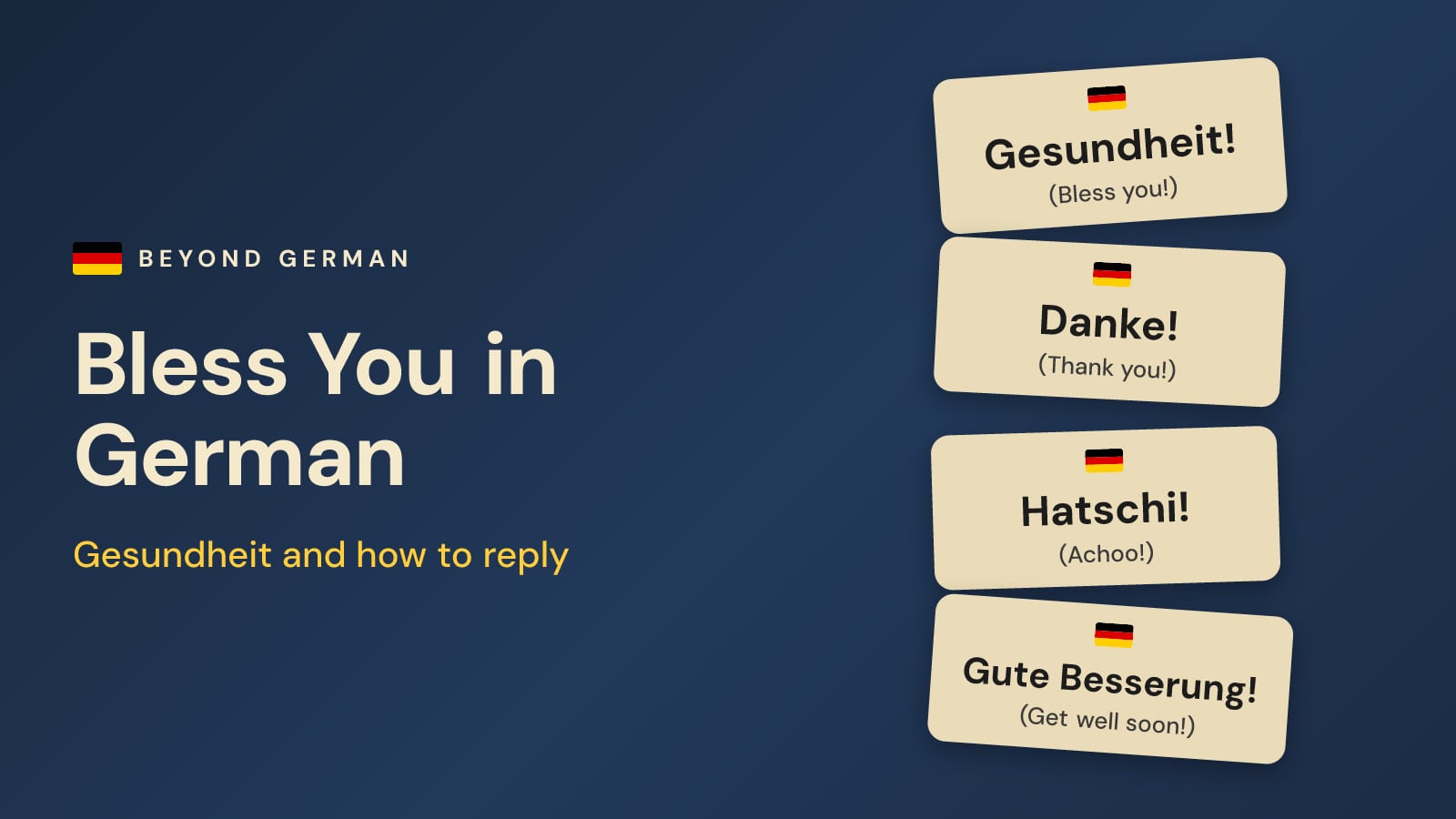
Bless you in German is Gesundheit (guh-ZOONT-hite). It literally means "health": when someone sneezes, you wish them good health. The usual reply is a simple Danke! (Thanks!)
Below: a quick table, what Gesundheit really means, how to reply, what to say when you sneeze yourself, when Germans skip it, why Americans say it too, and useful words for colds. Then mistakes, practice and quick answers.
Bless You in German: The Quick Answer
These are the words you need around a sneeze:
| German | English | When to say it |
|---|---|---|
| Gesundheit! | Bless you! (literally: health) | Someone sneezes |
| Danke! / Danke schön! | Thanks! / Thank you! | Someone says Gesundheit to you |
| Entschuldigung! | Excuse me! | You sneeze, especially in formal settings |
| Hatschi! | Achoo! | The sound of a sneeze |
| Gute Besserung! | Get well soon! | Someone has a cold or is ill |
| Bleib gesund! / Bleiben Sie gesund! | Stay healthy! Take care! | Saying goodbye, especially in cold season |
If you only learn one, learn Gesundheit. People understand it everywhere German is spoken.
What Does Gesundheit Mean?
How to Pronounce Gesundheit
Say guh-ZOONT-hite, with the stress on the middle syllable:
- ge is a short, soft "guh".
- sund sounds like "zoont": an s before a vowel sounds like English "z", the u is short, like the "oo" in "book", and a d at the end of a syllable sounds like "t".
- heit rhymes with "kite".
Literal Meaning: Health
Die Gesundheit means health. It's built from the adjective gesund (healthy) plus -heit, an ending that turns adjectives into nouns, a bit like English "-ness" or "-hood". Nouns with -heit are feminine, so they take die:
- gesund → die Gesundheit (healthy → health)
- krank → die Krankheit (sick → illness)
- frei → die Freiheit (free → freedom)
- schön → die Schönheit (beautiful → beauty)
So when you say Gesundheit! after a sneeze, you're simply wishing the person good health. Unlike English "bless you", there's nothing religious in it.
Gesundheit Beyond Sneezing
In everyday German, Gesundheit is just the normal word for health. You'll hear it, and the adjective gesund, in wishes and small talk:
- Hauptsache gesund! (The main thing is being healthy!) Often said about a new baby, or after someone has been ill.
- Gesundheit ist das Wichtigste. (Health is the most important thing.)
- Alles Gute und vor allem Gesundheit! (All the best and, above all, good health!) A classic birthday wish.
- Sport ist gut für die Gesundheit. (Exercise is good for your health.)
How to Reply to Gesundheit
Just say thanks:
- Danke! (Thanks!) The everyday answer.
- Danke schön! (Thank you!) A little warmer.
- Vielen Dank! (Thank you very much!) Polite, slightly more formal.
Formal or informal makes no difference: Gesundheit and Danke are the same words with du and Sie. Don't answer with Gesundheit or Gleichfalls (likewise), though: you're thanking someone for a wish, not returning it. More ways to say thanks are in our guide to thank you in German.
What to Say When You Sneeze
When you're the one sneezing, a quick Entschuldigung! (Excuse me!) is the polite move, at work and anywhere else. Among friends you'll also hear the clipped 'Tschuldigung! or simply Sorry!, which is common in casual German too.
Then carry on. If someone says Gesundheit, thank them; if nobody does, that's perfectly normal as well.
Should You Say Gesundheit? Etiquette in Germany
Here's the twist: many modern German etiquette guides (in German, such a guide is often just called ein Knigge) say that in formal settings it's more polite not to comment on a sneeze. The idea is discretion: a sneeze is a small bodily mishap, and pointing it out draws attention to it. Instead, the person who sneezed says Entschuldigung, and everyone moves on.
In practice, it depends on where you are:
- Formal settings (business meetings, job interviews, a dinner with clients): staying quiet is the polished choice. A quick Gesundheit isn't rude, though, and plenty of people still say it.
- Everyday life (friends, family, colleagues you know well, people on the bus): Gesundheit! is still very common and friendly.
- Several sneezes in a row: you don't have to say it every time. One Gesundheit is enough.
If you're unsure at work, follow what your colleagues do.
Sneezing Politely
Manners matter more than words. Turn away from people and sneeze into your elbow (in die Armbeuge niesen) or into a tissue (ein Taschentuch). Many people find constant sniffing more annoying than a quick, quiet nose-blow, so keep tissues handy when you have a cold. For more everyday customs, see our guide to cultural habits in Germany.
Is There a Literal "Bless You" in German?
Not one people use for sneezes. Gott segne dich (God bless you) is a religious blessing you might hear in church, not after a sneeze.
You may still meet a few older or regional forms:
- Helf Gott! or Helf dir Gott! (God help you!) Some people, often older ones, say this in southern Germany and Austria. It sounds old-fashioned, so you don't need to use it yourself.
- Gsundheit! How it often sounds in Switzerland, Austria and Bavaria, with the first e swallowed.
Why Do Americans Say Gesundheit?
If you're from the US, you may already know this word: many Americans say gesundheit after a sneeze, as an alternative to "bless you". English borrowed it from German in the early 20th century, and it stuck.
Two small differences in German: it's a noun, so it's written with a capital G, and it isn't just for sneezes: it's also the everyday word for health.
Gesundheit vs Prost: Sneezes, Not Toasts
Because Gesundheit means health, some learners raise a glass and say it. On its own, it only answers a sneeze. For a toast, say Prost! or Zum Wohl! The full phrase Auf deine Gesundheit! or Auf Ihre Gesundheit! (To your health!) does exist as a toast, but it sounds a little old-fashioned. Everything about raising a glass is in our guide to cheers in German.
Sneezes and Colds: Useful Vocabulary
| German | English |
|---|---|
| niesen | to sneeze |
| die Erkältung | a cold |
| erkältet sein | to have a cold |
| sich erkälten | to catch a cold |
| der Schnupfen | a runny or blocked nose, a head cold |
| der Heuschnupfen | hay fever |
| husten / der Husten | to cough / a cough |
| das Taschentuch | a tissue, a handkerchief |
| sich die Nase putzen | to blow your nose |
- Ich muss niesen! (I'm going to sneeze!)
- Ich bin seit Montag erkältet. (I've had a cold since Monday.)
- Ich glaube, ich habe mich erkältet. (I think I've caught a cold.)
- Mein Husten wird einfach nicht besser. (My cough just isn't getting better.)
- Ich habe Heuschnupfen, deshalb niese ich so oft. (I have hay fever, that's why I sneeze so often.)
- Entschuldigung, ich muss mir kurz die Nase putzen. (Excuse me, I just need to blow my nose.)
Niesen is a regular verb: ich niese, du niest, er niest, and in the perfect hat geniest. If it's more than a sneeze, our guide to German at the doctor has phrases for symptoms and appointments, and body parts in German helps you say what hurts: Mein Hals tut weh. (My throat hurts.)
Gesundheit in Real Life: Mini Dialogues
In a Meeting
Colleague: Hatschi! Oh, Entschuldigung. (Achoo! Oh, excuse me.)
Manager: Kein Problem. Gut, dann weiter mit Punkt drei. (No problem. Right, let's move on to point three.)
Nobody says Gesundheit here, and that's fine: the sneezer excuses themselves and the meeting goes on.
With a Friend
Friend: Hatschi! Hatschi! (Achoo! Achoo!)
You: Gesundheit! Bist du erkältet? (Bless you! Have you got a cold?)
Friend: Danke. Ja, ich habe Schnupfen. Hast du ein Taschentuch? (Thanks. Yes, my nose is running. Do you have a tissue?)
You: Klar, hier, bitte. Gute Besserung! (Sure, here you go. Get well soon!)
Notice hier, bitte: here bitte means "here you go". Our guide to please in German explains all its meanings.
On the Train
Passenger: Hatschi! (Achoo!)
You: Gesundheit! (Bless you!)
Passenger: Danke schön. (Thank you.)
With strangers, a quick Gesundheit is a small, friendly gesture. Saying nothing is fine too.
Common Mistakes
Translating "Bless You" Word for Word
Wrong: Gott segne dich! (after a sneeze) Right: Gesundheit!
Returning the Wish
Wrong: Danke, gleichfalls! (after someone says Gesundheit) Right: Danke!
Using Gesundheit as a Toast
Wrong: Gesundheit! (as glasses clink) Right: Prost! or Zum Wohl!
Mixing Up Gesund and Gesundheit
Wrong: Bleib Gesundheit! Right: Bleib gesund!
Gesund is the adjective (healthy); Gesundheit is the noun (health).
Writing It With a Small g
Wrong: gesundheit! Right: Gesundheit!
English writes gesundheit in lowercase, but German nouns always start with a capital letter.
Practice
Try these, then check the answers below:
- Your friend sneezes. What do you say?
- Someone says Gesundheit! to you. How do you reply?
- You sneeze during a job interview. What do you say?
- Translate: I have a cold.
- A colleague is going home sick. What do you wish her?
- Glasses go up at dinner. Gesundheit or Prost?
Answers: 1. Gesundheit! 2. Danke! or Danke schön! 3. Entschuldigung. 4. Ich bin erkältet. (or Ich habe eine Erkältung.) 5. Gute Besserung! 6. Prost! (or Zum Wohl!)
Keep going: see more examples on the Gesundheit word page and the Gute Besserung phrase page, then test yourself with the A1 German quiz.
FAQ
What does Gesundheit mean?
It means "health". Germans say it after a sneeze to wish you good health, the way English speakers say "bless you".
How do you respond to Gesundheit?
Say Danke! or Danke schön! That's all. Don't say Gesundheit back.
Is it rude to say Gesundheit in Germany?
No. Some etiquette guides suggest skipping it in formal settings like business meetings, where the person who sneezed simply says Entschuldigung. In everyday life, Gesundheit is common and friendly.
What do Germans say when someone sneezes?
Usually Gesundheit! The person who sneezed often says Entschuldigung! and answers a Gesundheit with Danke!
Why do Americans say Gesundheit?
English borrowed the word from German in the early 20th century, and it became a common alternative to "bless you" in the US. In German, it simply means "health".
How do you say bless you in German formally?
Gesundheit! works with everyone; there's no separate formal version. In a very formal meeting, the most polished choice is often to say nothing and let the person excuse themselves.

New from Beyond German
Learn every A1 word, with audio
The A1 Word Kit: 787 words sorted by real life in Germany, two example sentences each, and flashcards that remember for you.
See the kit · launch price €29Level Up Your German
Join 1,000+ learners getting weekly tips, grammar shortcuts, and cultural insights.
Share this article
Continue Reading

Goethe B1 Word List (Wortliste): What's on It and How to Learn It
The official Goethe B1 Wortliste explained in English: what's on it, how to read the entries, how big it really is, and a free extract of 39 B1 words by situation.
German for Nurses: Which Level You Need and How to Get There
Which German level nurses need for Germany: A2 for a recognition visa, B1 for Triple Win, B2 for the licence. Plus a study plan and 35 hospital words and phrases.
Cat in German: Katze, Kater, Kätzchen and Cat Idioms
Cat in German is die Katze. Learn Kater and Kätzchen, pronunciation, cat sounds, cat-owner words, why Kater also means hangover, and the best idioms.