Please in German: Bitte, All Its Meanings and How to Use It
 Beyond German Team
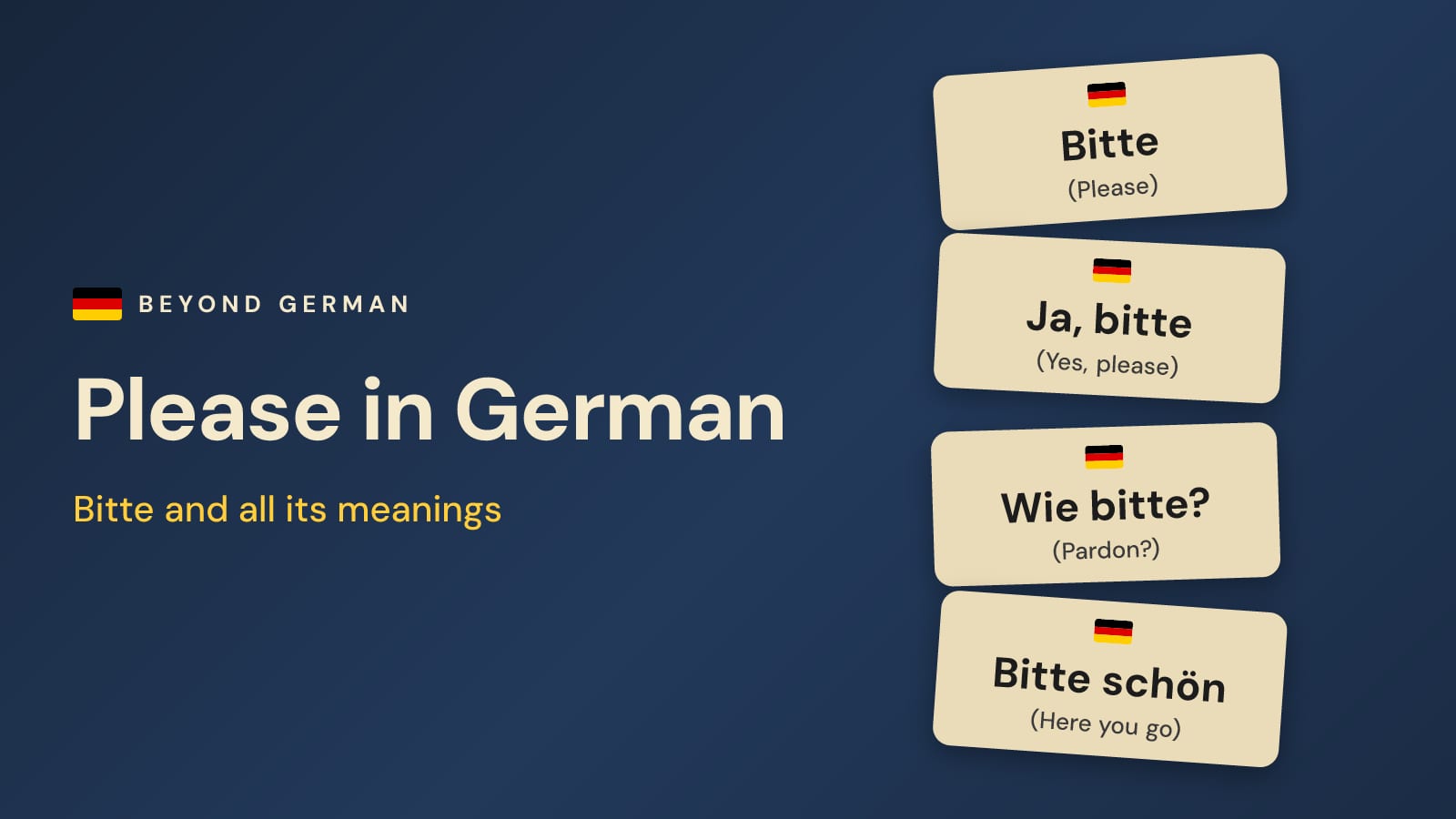
Please in German is bitte (BIT-uh). It's the word that makes any request polite, and the same little word also means "you're welcome", "here you go", "pardon?" and "go ahead".
Below: a quick table, where bitte goes in a sentence (and where the commas go), every meaning of bitte, yes please and no thanks, polite requests, signs and emails, and the verb bitten. Then mistakes, practice and quick answers.
Please in German: The Quick Answer
Here's bitte in its everyday jobs:
| German | English | When to say it |
|---|---|---|
| Bitte | Please | Any request, with anyone |
| Ja, bitte! | Yes, please! | Accepting an offer |
| Nein, danke. | No, thanks. | Turning down an offer |
| Bitte schön! / Bitte sehr! | You're welcome! Here you go! | Answering thanks, handing something over |
| Wie bitte? | Pardon? Sorry? | You didn't catch what someone said |
| Bitte? | Yes? How can I help? | Staff at a counter, someone at the door |
| Könnten Sie bitte…? | Could you please…? | Polite requests to strangers |
| Bitte, bitte! | Pretty please! | Playful begging with friends and family |
There's no separate formal word: bitte works with du and Sie alike.
How to Pronounce Bitte
Say BIT-uh: a short i as in "bit", a crisp t, and a soft, relaxed e like the "a" in "sofa". Some guides write it BIT-teh; either way, the final e is short and never sounds like "ee" or "ay".
Spelling tip: inside a sentence, bitte is written with a small b. It only takes a capital at the start of a sentence, or as the noun die Bitte (a request), which you'll meet below.
Where Does Bitte Go in a Sentence?
Like English "please", bitte is flexible. There are three common spots.
At the Start
Put bitte first, then the verb. This is common for instructions and invitations:
- Bitte setzen Sie sich. (Please take a seat.)
- Bitte warten Sie hier. (Please wait here.)
- Bitte komm nicht zu spät. (Please don't be late.)
In the Middle
In questions and requests, bitte usually comes right after the verb and any short pronouns like mir, dir or es:
- Können Sie mir bitte helfen? (Can you help me, please?)
- Kannst du bitte das Fenster zumachen? (Can you close the window, please?)
- Gibst du mir bitte das Salz? (Could you pass me the salt, please?)
- Mach bitte die Tür zu. (Please close the door.)
It can also follow the object: Kannst du das Fenster bitte zumachen? Both versions sound natural.
At the End
In short requests that aren't full sentences, bitte usually goes last. This is how you order in cafés, shops and stations:
- Ein Wasser, bitte. (A water, please.)
- Die Rechnung, bitte. (The bill, please.)
- Zahlen, bitte. (Check, please.)
- Einen Kaffee, bitte. (A coffee, please.)
Notice einen Kaffee: a short order like this hides an "I'd like", so masculine nouns take the accusative einen.
Commas Around Bitte
- Inside a normal sentence: no commas. Können Sie mir bitte helfen? Bitte setzen Sie sich.
- After a short request that isn't a full sentence: usually a comma before bitte. Die Rechnung, bitte. Ein Wasser, bitte.
- For emphasis: optional commas. If you stress bitte, you may set it off: Bitte, komm doch mit! (Please, do come along!)
What Does Bitte Mean? Every Meaning Explained
Bitte is one of the busiest words in German. Besides "please", it has several other jobs, and context and tone tell you which one it's doing.
You're Welcome
When someone says Danke! (Thanks!), the standard answer is Bitte! or the warmer Bitte schön! (BIT-uh SHURN, with no real r) or Bitte sehr! (BIT-uh ZAIR). All three mean "you're welcome". The other big option is Gern geschehen (my pleasure). For every reply and when to use it, see our guide to you're welcome in German.
Here You Go: Bitte schön and Bitte sehr
When you hand something over, German uses the same word: Bitte schön, Ihr Kaffee. (Here you go, your coffee.) or simply Hier, bitte. (Here you are.) That's why a quick visit to a bakery can contain four of them:
Baker: Bitte schön? (What can I get you?)
You: Zwei Brötchen, bitte. (Two rolls, please.)
Baker: Bitte sehr. Das macht eins zwanzig. (Here you go. That's 1.20 euros.)
You: Danke! (Thanks!)
Baker: Bitte! (You're welcome!)
Pardon? Wie bitte?
Didn't catch something? Wie bitte? (vee BIT-uh) is the polite way to ask someone to repeat. A plain Was? (What?) can sound blunt outside friends and family. A short, rising Bitte? works too.
- Entschuldigung, wie bitte? Können Sie das wiederholen? (Sorry, what was that? Can you repeat that?)
Yes? How Can I Help?
With a rising tone, Bitte? or Bitte schön? from a server or shop assistant means "What can I get you?" or "Who's next?". When you knock on an office door, you may hear Ja, bitte? (Yes? Come in.)
Go Ahead and After You
Holding a door, letting someone go first or giving permission: that's bitte too, often with a small hand gesture.
- Nach Ihnen, bitte. (After you.)
- Darf ich? (May I?) Bitte! (Go ahead!)
- Ist hier noch frei? (Is this seat free?) Ja, bitte. (Yes, go ahead.)
Yes, Please
Paired with ja, it accepts an offer: Ja, bitte! This one has a famous trap, so it gets its own section.
Yes Please and No Thanks in German
To accept an offer, say Ja, bitte! (Yes, please!) or Ja, gern! / Ja, gerne! (Yes, gladly!). Gern and gerne mean the same, and a one-word Gerne! works too. To decline, say Nein, danke. (No, thanks.)
Host: Möchtest du noch Kaffee? (Would you like some more coffee?)
You: Ja, gerne! (Yes, please!)
Host: Und noch ein Stück Kuchen? (And another piece of cake?)
You: Nein, danke, ich bin satt. (No, thanks, I'm full.)
The Danke Trap
Here's a classic surprise for English speakers: if someone offers you something and you just say Danke, many Germans will hear "No, thanks", and the coffee pot moves on. A nod or holding out your cup can change that, but words are safer. Want it? Say Ja, bitte or Gerne. Don't want it? Nein, danke leaves no doubt.
More natural answers are in our guide to yes and no in German, and the whole thanks family is in thank you in German.
Bitte With Attitude: Strong and Casual Uses
In everyday speech, bitte also carries emotion. Tone is everything here:
| German | English | Tone |
|---|---|---|
| Na bitte! | There you go! See? | Satisfied, a bit "told you so" |
| Aber bitte! / Aber gern! | Of course! Please do! | Warm, generous |
| Bitte?! | Excuse me?! | Shocked or indignant |
| Ich bitte dich! / Ich bitte Sie! | Oh, come on! Oh, please! | Exasperated, or brushing off an apology |
- Bitte, bitte, nur noch fünf Minuten! (Pretty please, just five more minutes!) Kids say it a lot; adults say it jokingly.
- Na bitte, geht doch! (There you go, it works!) When something finally works out.
- Darf ich mich zu Ihnen setzen? (May I join you?) Aber bitte! (Of course, please do!)
- Bitte?! Du hast mein Fahrrad verkauft? (Excuse me?! You sold my bike?)
- Ich bitte dich, das glaubst du doch selbst nicht! (Oh, come on, you don't believe that yourself!)
- Entschuldigen Sie die Störung. (Sorry to disturb you.) Aber ich bitte Sie, Sie stören doch nicht! (Oh, please, you're not disturbing me at all!)
Said sharply, Bitte?! is a protest. Said softly with a rising tone, it's a friendly "pardon?".
Polite Requests: Beyond Bitte
Bitte makes a request polite, and German adds extra softness with "could" and "would" forms. With strangers, at work or in shops, combine both:
- Könnten Sie mir bitte helfen? (Could you help me, please?)
- Würden Sie bitte das Fenster schließen? (Would you close the window, please?)
- Ich hätte gern einen Cappuccino, bitte. (I'd like a cappuccino, please.)
With friends, a direct Mach bitte das Licht aus. (Please turn off the light.) is perfectly friendly. With a stranger, the same imperative can sound like an order, so the question form is safer. Our guide on how to be polite in German covers könnte, würde, hätte gern and little softeners like mal in depth.
Bitte in Signs, Notices and Emails
On signs, German often puts bitte first and the verb at the end, in the infinitive. It's polite but firm. Notices and announcements use full sentences:
| German | English |
|---|---|
| Bitte nicht stören. | Please do not disturb. |
| Bitte nicht rauchen. | Please do not smoke. |
| Bitte nicht berühren. | Please do not touch. |
| Bitte klingeln. | Please ring the bell. |
| Bitte beachten Sie… | Please note… |
| Wir bitten um Ihr Verständnis. | Thank you for your understanding. |
You'll hear the last one in train announcements after a delay, along with Wir bitten um Entschuldigung. (We apologize.) Literally, the company "asks for" your understanding or forgiveness, using the verb bitten.
Bitte in Emails
In emails, bitte sits inside the request, just as in speech:
- Bitte senden Sie mir die Unterlagen bis Freitag. (Please send me the documents by Friday.)
- Könnten Sie mir bitte kurz Bescheid geben? (Could you let me know, please?)
When someone thanks you in writing, Gern geschehen! or Sehr gern! usually reads warmer than a one-word Bitte!, while Bitte schön! fits friendly messages. For greetings and sign-offs, see our guide to writing a formal email in German.
The Verb Bitten and the Noun die Bitte
Bitte comes from the verb bitten (to ask for, to request), and there's a noun too: die Bitte (a request, a favor), plural die Bitten.
- Ich habe eine Bitte. (I have a favor to ask.)
- Darf ich um Ihre Aufmerksamkeit bitten? (May I have your attention, please?)
- Kann ich dich um einen Gefallen bitten? (Can I ask you a favor?)
- Er hat mich um Hilfe gebeten. (He asked me for help.)
- Ich bitte Sie, hier zu warten. (I'm asking you to wait here.)
The pattern is jemanden um etwas bitten: the person you ask is in the accusative, and the thing you ask for follows um, also accusative. The key forms: ich bitte, du bittest, er bittet; simple past bat; perfect hat gebeten. In formal emails you'll also meet the noun in Mit der Bitte um Rückmeldung (literally "with the request for a reply"), a polite "please let me know".
Bitten or Fragen?
Both translate as "ask", and mixing them up is one of the most common learner mistakes:
- fragen = ask a question, ask for information: Darf ich Sie etwas fragen? (May I ask you something?)
- bitten = ask for something, ask someone to do something: Darf ich Sie um etwas bitten? (May I ask you a favor?)
A quick test: if you want information, use fragen. That's why asking for directions is nach dem Weg fragen. If you want an action or a thing, use bitten: um Hilfe bitten (to ask for help). And don't confuse bitten with two look-alikes: beten (to pray) and bieten (to offer).
Wie sagt man? Bitte and Danke From Childhood
Many German children learn their manners with a gentle prompt. When a child reaches for a cookie without a word, a parent asks Wie sagt man? (What do you say?), and the child answers Bitte! When the cookie arrives, the same question brings out Danke! Another favorite is Wie heißt das Zauberwort? (What's the magic word?)
Together with danke and Entschuldigung, bitte belongs to the small courtesy kit you'll use every day. Our list of essential German phrases for beginners has the rest, and for sneezes there's bless you in German.
Common Mistakes
Capitalizing Bitte Mid-Sentence
Wrong: Können Sie mir Bitte helfen? Right: Können Sie mir bitte helfen?
Inside a sentence, only the noun die Bitte (a request) takes a capital.
Answering an Offer With Just "Danke"
Wrong: Danke. (when you'd like more tea) Right: Ja, bitte! or Gerne!
Mixing Up Bitten and Fragen
Wrong: Ich frage dich um Hilfe. Right: Ich bitte dich um Hilfe.
Wrong: Er bittet, wo der Bahnhof ist. Right: Er fragt, wo der Bahnhof ist.
Saying "Was?" When You Didn't Hear
Wrong: Was? (to a stranger or a customer) Right: Wie bitte? or Entschuldigung, wie bitte?
Writing Bitte schon
Wrong: Bitte schon! Right: Bitte schön!
Schon means "already". If you can't type ö, write Bitte schoen.
Practice
Try these, then check the answers below:
- You're in a café and want a glass of water. Say it in three words.
- Put the words in order and add bitte: mir / du / helfen / kannst?
- Your host asks Möchtest du noch Tee? You'd love more. What do you say?
- The cashier says something you didn't catch. What do you say?
- Fill in fragen or bitten: Darf ich dich etwas ___? and Ich möchte dich um einen Gefallen ___.
- Your friend's laptop finally starts after ten tries, and she says Na bitte! What does she mean?
Answers: 1. Ein Wasser, bitte. 2. Kannst du mir bitte helfen? 3. Ja, bitte! or Ja, gerne! 4. Wie bitte? 5. fragen; bitten 6. "There you go!" or "See, it works!"
Keep going: see more examples on the Bitte phrase page, then test yourself with the A1 German quiz.
FAQ
What does bitte mean?
Bitte mostly means "please". It also means "you're welcome", "here you go", "go ahead" and, in Wie bitte?, "pardon?". Context and tone tell you which one.
Does bitte mean please or you're welcome?
Both. In a request it means please: Einen Tee, bitte. (A tea, please.) After someone thanks you, it means you're welcome: Danke! Bitte!
How do you say yes please in German?
Say Ja, bitte! or Ja, gerne! Avoid answering an offer with just Danke, which often means "no, thanks".
What is the difference between bitte and danke?
Bitte means please (and you're welcome); danke means thank you. They often come as a pair: Danke! (Thanks!) Bitte! (You're welcome!)
How do you say please in German formally?
The word stays the same: bitte. Formality comes from Sie and polite forms like Könnten Sie bitte…? (Could you please…?) or Würden Sie bitte…? (Would you please…?)
What does bitte schön mean?
It's a warmer bitte. It can mean "you're welcome", "here you go" when handing something over, or, with a rising tone from staff, "what can I get you?". Bitte sehr means the same.
New from Beyond German
Learn every A1 word, with audio
The A1 Word Kit: 787 words sorted by real life in Germany, two example sentences each, and flashcards that remember for you.
See the kit · launch price €29Level Up Your German
Join 1,000+ learners getting weekly tips, grammar shortcuts, and cultural insights.
Share this article
Continue Reading
Goethe B1 Word List (Wortliste): What's on It and How to Learn It
The official Goethe B1 Wortliste explained in English: what's on it, how to read the entries, how big it really is, and a free extract of 39 B1 words by situation.
German for Nurses: Which Level You Need and How to Get There
Which German level nurses need for Germany: A2 for a recognition visa, B1 for Triple Win, B2 for the licence. Plus a study plan and 35 hospital words and phrases.
Goethe A1 Exam: Start Deutsch 1 Format, Syllabus and Tips
Everything about the Goethe A1 exam (Start Deutsch 1): the four parts with examples, scoring, the A1 syllabus, fees and a realistic plan to prepare.