
Formal Email in German: Greetings, Phrases & 3 Sample Emails
 Beyond German Team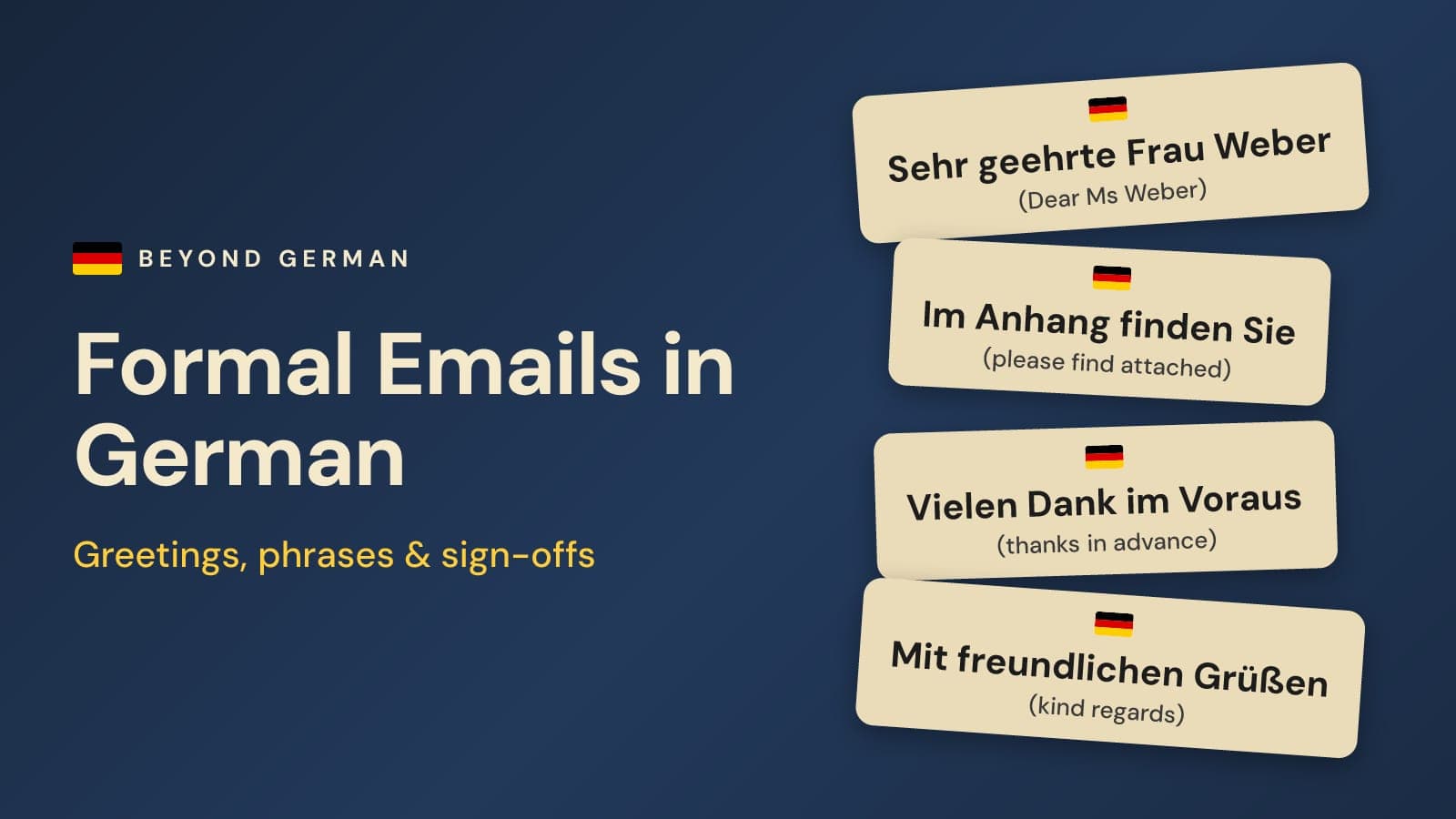
A formal email in German starts with Sehr geehrte Frau Becker, (to a woman) or Sehr geehrter Herr Becker, (to a man). If you don't know who will read it, write Sehr geehrte Damen und Herren, (Dear Sir or Madam). It ends with Mit freundlichen Grüßen (Kind regards) and your name, with no comma after Grüßen.
Two more rules trip up almost every learner: the line after the greeting starts in lowercase, and the formal Sie is always capitalized. Below you'll find the structure, greetings, sign-offs, useful phrases and three sample emails with translations.
The Structure of a Formal German Email
Stick to this fixed pattern, and your email will look professional even if your German isn't perfect yet.
| Part | German | Example |
|---|---|---|
| Subject line | der Betreff | Frage zu meiner Rechnung Nr. 4521 (Question about my bill no. 4521) |
| Greeting | die Anrede | Sehr geehrte Frau Becker, |
| Opening line | die Einleitung | vielen Dank für Ihre Nachricht. (thank you for your message.) |
| Main part | der Hauptteil | Your request or information, in short paragraphs |
| Closing line | der Schlusssatz | Ich freue mich auf Ihre Antwort. (I look forward to your reply.) |
| Sign-off | die Grußformel | Mit freundlichen Grüßen |
| Signature | die Signatur | Your full name, plus phone number or address if useful |
Keep the subject line specific and get to the point quickly: formal German emails are polite but direct.
German Email Greetings: Sehr geehrte, Guten Tag, Liebe, Hallo
Roughly from most to least formal:
| Greeting | Use it for | Tone |
|---|---|---|
| Sehr geehrte Frau Becker, | a woman whose name you know | very formal |
| Sehr geehrter Herr Becker, | a man whose name you know | very formal |
| Sehr geehrte Damen und Herren, | companies and authorities, when you don't have a name | very formal |
| Guten Tag Frau Becker, | business emails; a modern alternative to Sehr geehrte | formal, a bit friendlier |
| Liebe Frau Becker, / Lieber Herr Becker, | people you know well but still call Sie | warm |
| Hallo Frau Becker, | colleagues and contacts you've written to before | relaxed |
| Liebe Anna, / Lieber Tom, / Hallo Anna, | friends and colleagues you call du | informal |
Sehr geehrte or Sehr geehrter? Get the Ending Right
Geehrt ("honored") works like an adjective, and with no article in front, its ending has to show the gender:
- Sehr geehrte Frau Becker — die Frau, so -e
- Sehr geehrter Herr Becker — der Herr, so -er
- Sehr geehrte Damen und Herren — plural, so -e
Lieb- works the same way: Liebe Anna, Lieber Tom, Liebe Kolleginnen und Kollegen (Dear colleagues) and Liebes Team (das Team). Our guide to German adjective endings explains the system.
Two Recipients, Titles and Unknown Names
- Two people: greet each on a separate line, with a lowercase sehr on the second: Sehr geehrte Frau Becker,
sehr geehrter Herr Wagner, - Doctor titles: include them in formal writing: Sehr geehrte Frau Dr. Becker,
- Unsure how someone wants to be addressed? Use the full name without Frau or Herr: Guten Tag Alex Becker,
The Comma Rule: Lowercase After the Greeting
German puts a comma after the greeting, like English. The surprise: the next line (usually after a blank line) starts with a lowercase letter, because the greeting and the first sentence count as one sentence.
Sehr geehrte Frau Becker,
vielen Dank für Ihre schnelle Antwort. — Dear Ms. Becker, thank you for your quick reply.
Words that are always capitalized keep their capital: nouns, names and the formal Sie, Ihnen and Ihr.
Sehr geehrter Herr Wagner,
Ihre E-Mail habe ich erhalten. — Dear Mr. Wagner, I've received your email.
How to Start: Opening Lines
Say why you're writing in the first sentence. These openers are lowercase because they follow the greeting:
- ich schreibe Ihnen, weil ich eine Frage zu meiner Rechnung habe. — I'm writing to you because I have a question about my bill.
- ich schreibe Ihnen wegen meiner Bestellung vom 3. Oktober. — I'm writing to you about my order from October 3.
- vielen Dank für Ihre Nachricht. — Thank you for your message.
- wie telefonisch besprochen, sende ich Ihnen die Unterlagen. — As discussed on the phone, I'm sending you the documents.
After weil, the verb goes to the end (habe); see weil vs. denn vs. deshalb. For more thank-you phrases, read how to say thank you in German.
Useful Phrases for Formal Emails
| Situation | German | English |
|---|---|---|
| Request | Könnten Sie mir bitte die Unterlagen schicken? | Could you please send me the documents? |
| Request | Ich wäre Ihnen dankbar, wenn Sie mir bis Freitag Bescheid geben könnten. | I'd be grateful if you could let me know by Friday. |
| Attachment | Im Anhang finden Sie meinen Lebenslauf. | Please find my CV attached. |
| Attachment | Anbei sende ich Ihnen das ausgefüllte Formular. | Please find the completed form attached. |
| Follow-up | Ich wollte kurz nachfragen, ob Sie meine E-Mail vom 3. Oktober erhalten haben. | I just wanted to check whether you received my email from October 3. |
| Delay | Entschuldigen Sie bitte meine späte Antwort. | Please excuse my late reply. |
| Delay | Vielen Dank für Ihre Geduld. | Thank you for your patience. |
| Appointment | Ich möchte gern einen Termin vereinbaren. | I'd like to make an appointment. |
| Appointment | Würde Ihnen Dienstag um 10 Uhr passen? | Would Tuesday at 10 a.m. suit you? |
| Closing | Ich freue mich auf Ihre Antwort. | I look forward to your reply. |
| Closing | Für Rückfragen stehe ich Ihnen gern zur Verfügung. | If you have any questions, I'm happy to help. |
Könnten, wäre and würde are subjunctive forms: like "could" and "would", they soften a request. See our guide to polite requests in German, or Konjunktiv II for the grammar.
Sie, Ihnen, Ihr: Always Capitalize the Formal You
The formal "you" is capitalized everywhere in a sentence, and the lowercase forms mean something else:
| Formal (capitalized) | Lowercase |
|---|---|
| Sie — you | sie — she, they |
| Ihnen — (to) you | ihnen — (to) them |
| Ihr, Ihre — your | ihr, ihre — her, their (and ihr = you all) |
So Ich danke Ihnen. — I thank you. But Ich danke ihnen. — I thank them. Ihnen is the dative form, used after verbs like danken (to thank) and helfen (to help).
Two more traps: the reflexive sich always stays lowercase (Bitte melden Sie sich bei mir. — Please get in touch with me.), and the informal du, dich, dir and dein are normally lowercase, although you may capitalize them in emails and letters.
How to End a Formal Email: Mit freundlichen Grüßen and Other Sign-Offs
From most formal to most personal:
- Mit freundlichen Grüßen — Kind regards / Yours sincerely. The standard for job applications, authorities and first contact.
- Freundliche Grüße — Kind regards. Formal but a little lighter; common in business emails.
- Beste Grüße — Best regards. Professional but friendly, for people you've written to before.
- Viele Grüße — Best wishes. Neutral and friendly; fine with colleagues, du or Sie.
- Liebe Grüße — Warm wishes. Informal: friends, family, close colleagues. Never in a formal email.
Three rules:
- No comma. English writes "Kind regards," but in German, Mit freundlichen Grüßen stands alone, with your name on the next line.
- Grüßen with -n. Mit takes the dative case, and dative plural nouns add -n. Freundliche Grüße has no mit, so no -n.
- No abbreviations. MfG looks lazy in a formal email. LG and VG are fine in quick messages to friends.
For more sign-offs and spoken goodbyes, see our guide on how to say goodbye in German.
3 Sample Formal Emails in German (With Translations)
1. Short Job Application Email
Keep the email itself short: the details belong in your attached cover letter and CV.
Betreff: Bewerbung als Projektmanager
Sehr geehrte Frau Hoffmann,
hiermit bewerbe ich mich um die Stelle als Projektmanager, die Sie auf Ihrer Website ausgeschrieben haben. Ich habe sechs Jahre Erfahrung im Projektmanagement und arbeite zurzeit bei einer Logistikfirma in Hamburg.
Im Anhang finden Sie mein Anschreiben, meinen Lebenslauf und meine Zeugnisse. Über eine Einladung zu einem persönlichen Gespräch würde ich mich sehr freuen.
Mit freundlichen Grüßen
Daniel Brooks
Subject: Application for the project manager position. Dear Ms. Hoffmann, I would like to apply for the project manager position advertised on your website. I have six years of experience in project management and currently work for a logistics company in Hamburg. Please find attached my cover letter, CV, references and certificates. I would be delighted to be invited for an interview. Kind regards, Daniel Brooks
Got the interview? Prepare with our German job interview questions and answers.
2. Asking an Authority for an Appointment
For an office like the immigration office (die Ausländerbehörde), use Sehr geehrte Damen und Herren, and add your date of birth and file number (das Aktenzeichen) if you have one.
Betreff: Terminanfrage – Verlängerung meiner Aufenthaltserlaubnis
Sehr geehrte Damen und Herren,
meine Aufenthaltserlaubnis läuft am 15. Dezember ab. Deshalb möchte ich gern einen Termin zur Verlängerung vereinbaren. Leider konnte ich online keinen freien Termin finden.
Könnten Sie mir bitte einen Termin im November anbieten? Ich habe montags bis freitags vormittags Zeit. Bitte teilen Sie mir auch mit, welche Unterlagen ich mitbringen soll.
Vielen Dank im Voraus.
Mit freundlichen Grüßen
Daniel Brooks
Geburtsdatum: 14.03.1990
Subject: Appointment request – extending my residence permit. Dear Sir or Madam, my residence permit expires on December 15, so I would like to make an appointment to extend it. Unfortunately, I couldn't find a free appointment online. Could you please offer me an appointment in November? I'm available Monday to Friday in the mornings. Please also let me know which documents I should bring. Thank you in advance. Kind regards, Daniel Brooks, date of birth: March 14, 1990
Registering your address? Our guide to the Anmeldung at the Bürgeramt covers booking a Termin (appointment).
3. Asking Your Landlord for a Repair
To a landlord (der Vermieter) or property manager (die Hausverwaltung), describe the problem clearly and put your address in the subject line.
Betreff: Heizung defekt – Gartenstraße 8
Sehr geehrter Herr Wagner,
seit gestern funktioniert die Heizung in meiner Wohnung nicht mehr. Die Heizkörper im Wohnzimmer und im Schlafzimmer bleiben kalt, und in der Wohnung sind es nur noch 16 Grad.
Könnten Sie bitte so bald wie möglich einen Handwerker schicken? Ich bin diese Woche jeden Tag ab 15 Uhr zu Hause. Bitte geben Sie mir kurz Bescheid, wann der Handwerker kommt.
Vielen Dank für Ihre Hilfe.
Freundliche Grüße
Emily Carter
Subject: Heating broken – Gartenstraße 8. Dear Mr. Wagner, the heating in my apartment hasn't been working since yesterday. The radiators in the living room and bedroom stay cold, and it's only 16°C (61°F) in the apartment. Could you please send a repair person as soon as possible? I'm home every day this week from 3 p.m. Please let me know when the repair person is coming. Thank you for your help. Kind regards, Emily Carter
Looking for a new place? Our guide to apartment hunting in German has the vocabulary.
Common Mistakes
| Wrong | Right | Why |
|---|---|---|
| Sehr geehrte Herr Wagner, | Sehr geehrter Herr Wagner, | Herr is masculine: -er. |
| Sehr geehrter Frau Hoffmann, | Sehr geehrte Frau Hoffmann, | Frau is feminine: -e. |
| Sehr geehrte Frau Hoffmann, Vielen Dank … | Sehr geehrte Frau Hoffmann, vielen Dank … | After the comma, continue in lowercase. |
| Ich danke ihnen. | Ich danke Ihnen. | Lowercase ihnen means "them". |
| Sehr geehrte Frau Anna Hoffmann, | Sehr geehrte Frau Hoffmann, | Use Frau or Herr with the last name only. |
| Mit freundlichen Grüßen, | Mit freundlichen Grüßen | No comma after the sign-off. |
| Liebe Grüße (to an authority) | Mit freundlichen Grüßen | Liebe Grüße is for people you're close to. |
Practice: Fix the Email
Add the missing endings:
- Sehr geehrt__ Herr Schulz,
- Sehr geehrt__ Frau Klein,
- Sehr geehrt__ Damen und Herren,
- Lieb__ Team,
- Mit freundlich__ Grüß__
Answers: 1. geehrter 2. geehrte 3. geehrte 4. Liebes 5. freundlichen Grüßen
Now find the four mistakes in this email:
Sehr geehrte Herr Schulz,
Ich schreibe ihnen, weil ich einen Termin brauche.
Mit freundlichen Grüßen,
Anna Becker
Answers: geehrter (Herr is masculine), ich (lowercase after the comma), Ihnen (formal you) and no comma after Grüßen.
Then write your own email from one of the templates, and take the A2 German quiz.
FAQ
How do you start a formal email in German?
With Sehr geehrte Frau or Sehr geehrter Herr plus the last name and a comma, or Sehr geehrte Damen und Herren if you don't know the name. The next line starts in lowercase.
What does "Sehr geehrte Damen und Herren" mean?
Literally "very honored ladies and gentlemen". It's the German "Dear Sir or Madam", for companies or offices when you have no contact name.
Is there a comma after "Mit freundlichen Grüßen"?
No. The sign-off stands alone, with your name on the next line.
Can I write "Hallo" in a formal email?
Hallo Frau Becker is fine with people you're already in touch with. For job applications, authorities and first contact, use Sehr geehrte/Sehr geehrter or Guten Tag.
Level Up Your German
Join 1,000+ learners getting weekly tips, grammar shortcuts, and cultural insights.
Share this article
Continue Reading
Funny German Idioms: 25 Sayings With English Translations
From Ich verstehe nur Bahnhof to Schwein haben: 25 funny German idioms with literal translations, real meanings, English equivalents and example sentences.
How to Be Polite in German: Würde, Könnte, Hätte gern & More
Sound polite in German with Konjunktiv II: Ich hätte gern, Könnten Sie, Würden Sie and Dürfte ich, plus softening words, Sie vs. du, polite refusals and dialogues.
Animals in German: Names, Plurals, Sounds and Idioms
The most common animals in German, from der Hund and die Katze to der Igel, with articles, plurals, male and female forms, animal sounds and the idioms Germans love.