
Goodbye in German: Tschüss, Auf Wiedersehen & 30+ More Ways
 Beyond German Team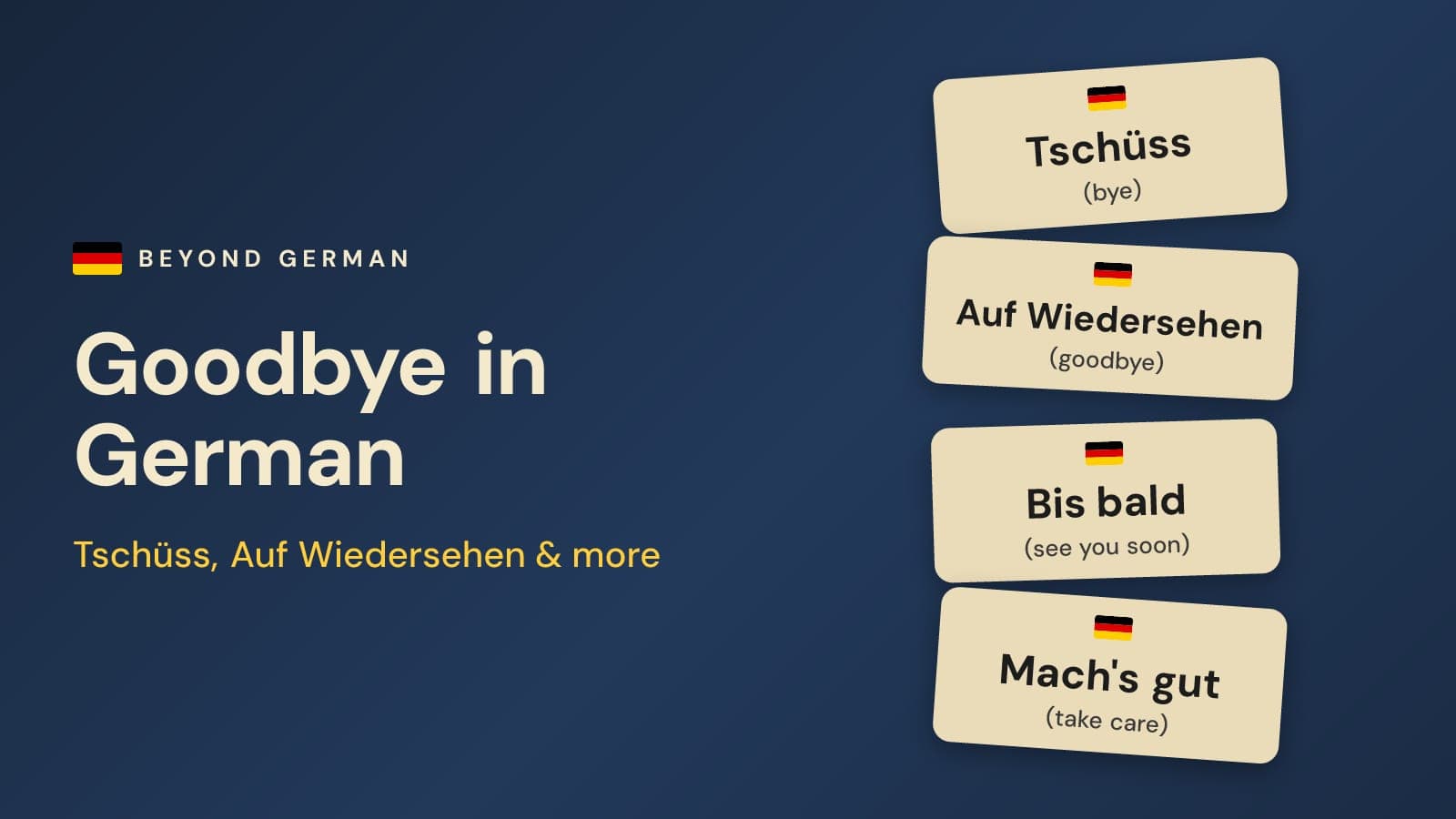
The two most common ways to say goodbye in German are Auf Wiedersehen (formal) and Tschüss (informal). Use Auf Wiedersehen with people you address as Sie, like officials or a job interviewer, and Tschüss with friends, family and in most everyday shops. On the phone, the formal goodbye is Auf Wiederhören.
Real goodbyes are usually more than one word, though: Germans add a "see you" (Bis morgen!) or a wish (Schönen Tag noch!), and Munich, Cologne and Vienna have words of their own. This guide covers all of it, plus email sign-offs.
Saying hello is the other half of the conversation, so if you haven't yet, read our guide to German greetings and 20 ways to say hello.
Auf Wiedersehen vs. Tschüss: Formal and Informal Goodbyes
| Goodbye | Literally | Formality | Use it with |
|---|---|---|---|
| Auf Wiedersehen | until we see each other again | Formal | Strangers, officials, interviewers, anyone you call Sie |
| Wiedersehen! | (short form) | Polite but relaxed | Shops, neighbors, the doctor's reception |
| Tschüss | bye | Informal, but used widely | Friends, family, colleagues, most shop staff |
| Ciao / Tschau | bye (from Italian) | Informal | Friends, especially younger people |
Auf Wiedersehen: The Safe Formal Choice
Auf Wiedersehen is built from wieder (again) and sehen (to see). It's never wrong with people you call Sie: after a job interview, at a government office or at a hotel reception.
- Vielen Dank für Ihre Hilfe. Auf Wiedersehen! — Thank you very much for your help. Goodbye!
- Auf Wiedersehen, Herr Becker, bis nächste Woche! — Goodbye, Mr. Becker, see you next week!
With friends, it sounds oddly stiff, like signing a text to your best friend "Yours sincerely".
Tschüss: The Everyday Goodbye
Tschüss is the goodbye you'll hear most often in Germany. It's informal, but not only for friends: cashiers, bakery staff and colleagues who call you Sie use it all the time. It sounds friendly, never rude.
- Tschüss, bis morgen! — Bye, see you tomorrow!
- Tschüss zusammen! — Bye, everyone!
The word started out in northern Germany (Low German adjüs) and goes back to French adieu. Friends and family also say the cute Tschüssi (bye-bye). In Bavaria and Austria, Tschüss is understood, but many locals prefer their own goodbyes (see below).
Ciao and Tschau
German borrowed Ciao from Italian; you'll also see it spelled the German way, Tschau. It's a very common casual goodbye, especially among younger people, so keep it for friends.
- Ciao, bis dann! — Bye, see you!
"See You…": Goodbyes With Bis
Bis means "until", so Bis morgen is literally "until tomorrow". Put a time after it and you have a goodbye that works with du and Sie alike.
| German | English | You'll meet again… |
|---|---|---|
| Bis gleich! | See you in a bit! | in a few minutes |
| Bis später! / Bis nachher! | See you later! | later today |
| Bis heute Abend! | See you tonight! | this evening |
| Bis morgen! | See you tomorrow! | tomorrow |
| Bis nächste Woche! | See you next week! | next week |
| Bis dann! | See you then! / See you! | at a time you've agreed on |
| Bis bald! | See you soon! | soon, no fixed date |
Careful: Bis später Means Later Today
In English, "see you later" is often just a friendly way to leave. In German, Bis später means you'll actually see each other later today. Say it on a Friday afternoon, and your colleague may wonder what you're doing tonight.
If you don't know when you'll meet again, use Bis bald (see you soon) or just Tschüss. If you've made plans, Bis dann is perfect, and if you'll see each other the next day, it's Bis morgen.
- Ich hole nur schnell einen Kaffee. Bis gleich! — I'm just grabbing a coffee. See you in a bit!
- Also um acht vor dem Kino? Super, bis dann! — So, eight o'clock outside the movie theater? Great, see you then!
Two more that don't need bis: Wir sehen uns! (See you!) and the more casual Man sieht sich! (See you around!).
Goodbye Wishes: Schönen Tag noch! and More
Germans love to end a conversation with a wish. In shops, at work and on the phone, the wish often replaces the goodbye.
| German | English | When to use it |
|---|---|---|
| Schönen Tag noch! | Have a nice day! | Morning or afternoon, anywhere |
| Schönen Abend! | Have a nice evening! | Late afternoon or evening |
| Schönes Wochenende! | Have a nice weekend! | On the last workday of the week |
| Schönen Feierabend! | Enjoy your evening! (after work) | To colleagues or staff when their workday ends |
| Mach's gut! | Take care! | Friends; formal: Machen Sie's gut! |
| Pass auf dich auf! | Look after yourself! | Close friends and family, often before a trip |
| Gute Reise! | Have a good trip! | Someone who's traveling |
| Gute Besserung! | Get well soon! | Someone who's sick |
| Gute Nacht! | Good night! | Late at night or before bed |
Why Schönen and Not Schöner?
Each wish is a shortened sentence: Ich wünsche Ihnen einen schönen Tag. — I wish you a nice day. Tag is the object of wünschen, so it's accusative: einen schönen Tag. Drop the first words and Schönen Tag! is left. The same goes for Schönen Abend (der Abend) and Schönes Wochenende (das Wochenende). The noch means "for the rest of the day".
Mach's gut and Pass auf dich auf
Mach's gut literally means "make it good" ('s is short for es). It's a warm, casual goodbye, like "take care". To a group, say Macht's gut!, and to someone you call Sie, Machen Sie's gut!
Pass auf dich auf! ("look after yourself") is more personal: for a friend before a long trip, or family at the end of a visit. Formal: Passen Sie auf sich auf!
How to Answer a Goodbye Wish
- Danke, gleichfalls! — Thanks, you too! (works with everyone)
- Danke, Ihnen auch! — Thanks, you too! (formal)
- Danke, dir auch! — Thanks, you too! (informal)
More replies like these are in our guide to saying "you're welcome", "likewise" and "you too" in German.
Auf Wiederhören: Saying Goodbye on the Phone
Auf Wiederhören means "until we hear each other again" (hören = to hear). It's the formal way to end a phone call with a doctor's office, a bank, customer service or a business contact.
- Dann haben Sie am Dienstag um zehn Uhr einen Termin. — So you have an appointment on Tuesday at ten.
- Perfekt, vielen Dank! Auf Wiederhören! — Perfect, thank you very much! Goodbye!
It's often shortened to Wiederhören! On the phone with friends, use your normal goodbyes: Tschüss, Ciao or Bis dann. Auf Wiedersehen on the phone isn't wrong, especially if you'll meet in person soon, but Auf Wiederhören is the standard.
Regional Goodbyes: Servus, Pfiat di, Tschö and More
Tschüss and Auf Wiedersehen work everywhere, but like greetings, goodbyes vary by region:
| Goodbye | Where | Formality | Good to know |
|---|---|---|---|
| Servus | Southern Germany (especially Bavaria) and Austria | Informal | Means both hello and goodbye |
| Pfiat di | Bavaria and Austria | Informal | From Behüt dich Gott ("God protect you"); to a group: Pfiat eich |
| Auf Wiederschauen | Bavaria and Austria | Polite | The southern Auf Wiedersehen; casually Wiederschaun |
| Ade | Southwestern Germany, especially Swabia | Everyday | From French adieu; sounds old-fashioned elsewhere |
| Adieu | Switzerland | Polite | Used with people you call Sie; friends say Tschau |
| Tschö | The Rhineland, especially Cologne | Informal | Playful version: Tschö mit ö! |
| Baba | Austria, especially Vienna | Very informal | Friends and family only |
Servus is the one you'll hear most in the south. For the southern hellos that go with these, like Grüß Gott, see the regional section of our German greetings guide.
- Servus, bis morgen! — Bye, see you tomorrow!
- Pfiat di, und pass auf dich auf! — Bye, and take care of yourself!
In the north, Moin is mainly a greeting; for goodbye, northerners usually say Tschüss. It's their word, after all.
Written Goodbyes: How to End an Email or Letter
In writing, match your sign-off to the relationship. From most formal to most personal:
| Sign-off | English equivalent | Formal or informal? | Use it for |
|---|---|---|---|
| Mit freundlichen Grüßen | Yours sincerely / Kind regards | Formal | Job applications, official letters, first contact |
| Freundliche Grüße | Kind regards | Formal, a bit lighter | Business emails |
| Beste Grüße | Best regards | Neutral, professional | Colleagues and clients you already know |
| Viele Grüße | Best wishes | Neutral, friendly | Almost anyone you've met, du or Sie |
| Herzliche Grüße | Warm regards | Warm | People you know well |
| Liebe Grüße | Love / Warm wishes | Informal | Friends, family, close colleagues |
In messages, friends shorten these to LG (Liebe Grüße) or VG (Viele Grüße). Never write MfG in a formal email, though: it looks lazy, almost rude. You may also see Hochachtungsvoll in old letters; today it sounds cold, so skip it.
Match the Sign-Off to the Greeting
- Sehr geehrte Frau Weber, (Dear Ms. Weber) → Mit freundlichen Grüßen
- Hallo Herr Weber, (Hello Mr. Weber) → Viele Grüße or Beste Grüße
- Liebe Anna, (Dear Anna) → Liebe Grüße
No Comma After the Sign-Off
English writes "Best regards," with a comma. German doesn't: the sign-off stands alone, and your name goes on the next line.
Ich freue mich auf Ihre Antwort.
Mit freundlichen Grüßen
Sarah Miller
(I look forward to your reply. Kind regards, Sarah Miller)
And why Grüßen with an -n? Because mit takes the dative, and nouns in the dative plural add -n. Viele Grüße has no mit, so no -n.
Cultural Notes: Shops, the Doctor's Office and Handshakes
Say Goodbye When You Leave a Shop
In Germany, walking out of a bakery, a small shop or a pharmacy without a word comes across as rude. A quick Tschüss! or Wiedersehen! is enough. At the checkout, the cashier will often say Schönen Tag noch! Answer Danke, Ihnen auch! and you'll sound like a local.
At the Doctor's Office
In many practices, especially outside big cities, patients say Guten Tag to the whole waiting room when they arrive and Auf Wiedersehen when they leave. At reception, the staff will usually send you off with Gute Besserung! (Get well soon!). The perfect reply: Danke, auf Wiedersehen!
Handshakes
In business and formal settings, Germans traditionally shake hands when they arrive and when they leave: short and firm, with eye contact. After a small meeting, people often shake hands again on the way out. Friends usually hug or just wave. Since the pandemic, some people skip handshakes, so let the other person lead. More unwritten rules are in our guide to cultural habits in Germany.
Common Mistakes When Saying Goodbye in German
| Wrong | Right | Why |
|---|---|---|
| Auf Widersehen | Auf Wiedersehen | Wieder means "again"; wider means "against". |
| Auf Wiederhören (face to face) | Auf Wiedersehen | Hören means "to hear", so it's for phone calls. |
| Bis später! (no plans to meet today) | Bis bald! / Tschüss! | Bis später means later today. |
| Schöner Tag! | Schönen Tag noch! | It's short for einen schönen Tag (accusative). |
| Gute Nacht! (leaving work at 6 p.m.) | Schönen Abend! | Gute Nacht is for late at night or bedtime. |
| Mit freundlichen Grüßen, (with a comma) | Mit freundlichen Grüßen | German sign-offs take no comma. |
| Liebe Grüße (to a company) | Mit freundlichen Grüßen | Liebe Grüße is for people you're close to. |
| Ciao! (after a job interview) | Auf Wiedersehen! | Too casual for formal situations. |
Practice: What Would You Say?
Pick a goodbye for each situation (often more than one works).
- You're leaving a bakery in Hamburg.
- You're ending a phone call with your doctor's office.
- Your colleague is going to lunch and will be back in 20 minutes.
- It's Friday afternoon, and you're leaving the office.
- You're signing off a job application.
- A friend in Munich is heading home after dinner.
Answers:
- Tschüss! or Schönen Tag noch!
- Auf Wiederhören!
- Bis gleich!
- Schönes Wochenende!
- Mit freundlichen Grüßen
- Servus! or Pfiat di! (Tschüss works too.)
Want more practice? Test your everyday German with the A1 German quiz. Then learn what to say between hello and goodbye: how to ask "How are you?" in German and how to answer.
FAQ
What's the difference between Auf Wiedersehen and Tschüss?
Auf Wiedersehen is formal, for people you call Sie. Tschüss is informal but used very widely, with friends and in most shops. When in doubt with a stranger, say Auf Wiedersehen.
What does Auf Wiederhören mean?
It means "until we hear each other again". It's the formal goodbye at the end of a phone call (and on the radio). Face to face, say Auf Wiedersehen instead.
Is Tschüss rude?
No. Tschüss is friendly and completely normal in everyday life, even with shop staff you'd call Sie. Just avoid it in very formal moments, like the end of a job interview.
Is it Tschüss, Tschüs or Tschüß?
Tschüss and Tschüs are both correct today, and Tschüss is the more common spelling. Tschüß was only ever a variant spelling and isn't standard today, so you'll mostly see it in older texts and on old signs.
How do you say "see you later" in German?
Say Bis später! or Bis nachher! if you'll meet again later today. For "see you soon", use Bis bald!, and for a time you've agreed on, Bis dann!
Level Up Your German
Join 1,000+ learners getting weekly tips, grammar shortcuts, and cultural insights.
Share this article
Continue Reading
Colors in German: Rot, Blau, Grün and How to Use Them
All the colors in German with pronunciation, light and dark shades, when colors take endings, how to ask Welche Farbe hat…?, and the color idioms Germans really use.

Merry Christmas in German: Frohe Weihnachten & Traditions
Learn how to say Merry Christmas and Happy New Year in German, plus the traditions from Advent and Nikolaus to Heiligabend and Silvester, with food and market words.
Happy Birthday in German: Alles Gute zum Geburtstag & Wishes
Learn how to say happy birthday in German, from Alles Gute zum Geburtstag to formal card wishes, plus belated wishes, the birthday song and why Germans never congratulate early.