
How Are You in German: Wie geht's? and How to Answer
 Beyond German Team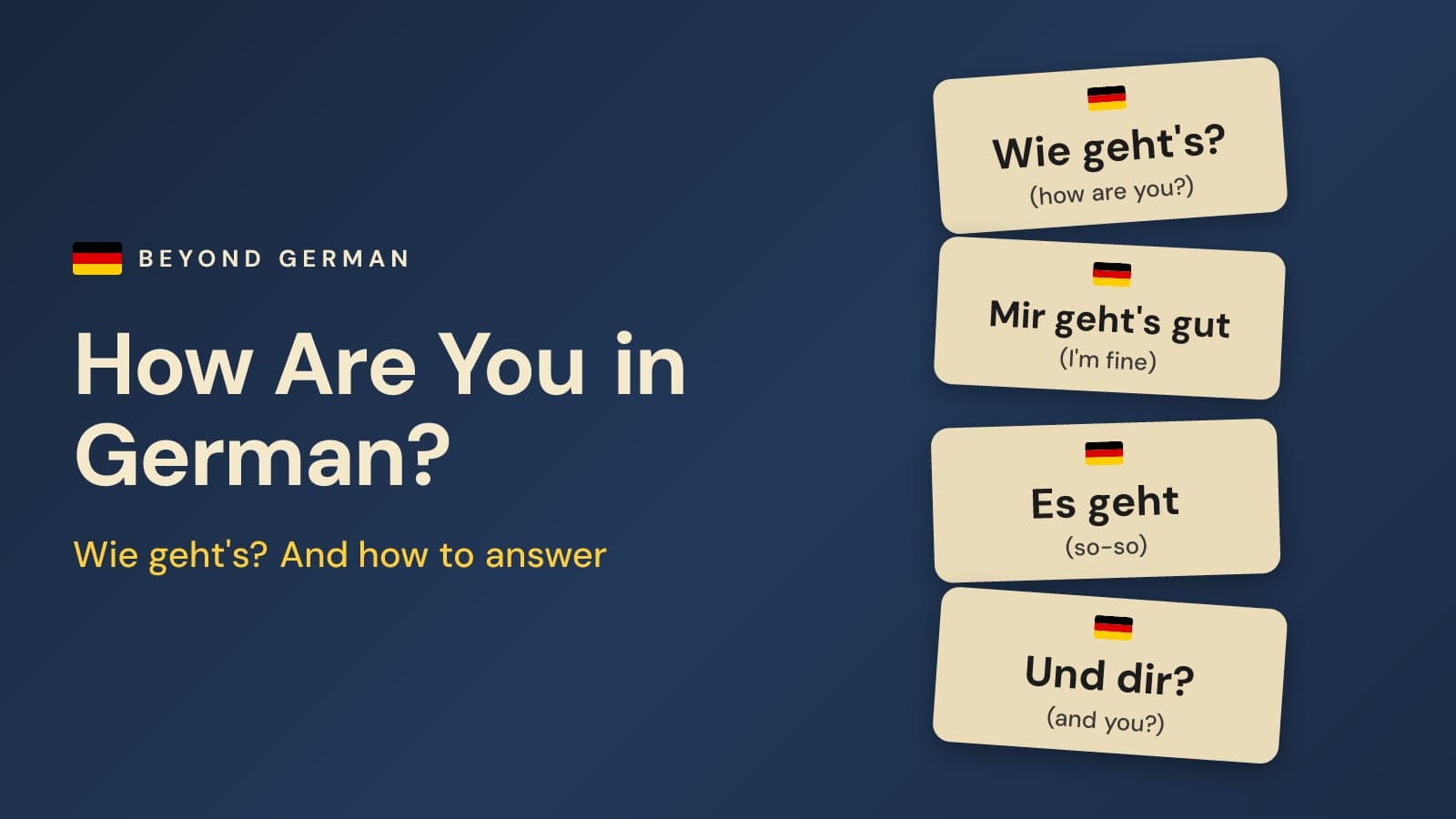
The most common way to say "How are you?" in German is Wie geht's?, short for Wie geht es dir? (informal). With people you address as Sie, ask Wie geht es Ihnen? The standard answer is Gut, danke. Und dir? (Good, thanks. And you?), or Und Ihnen? in formal situations.
Two things catch English speakers out. First, you answer Mir geht's gut, never Ich bin gut. Second, Germans treat the question as a real question, so be ready for a real answer. Below: how to ask, how to answer from "great" to "terrible", and why it all runs on the dative.
This post picks up where our guide to German greetings and 20 ways to say hello stops: you've said Hallo, so what comes next?
Wie geht es Ihnen? vs. Wie geht es dir? vs. Wie geht's?
| German | Formality | Ask… |
|---|---|---|
| Wie geht es Ihnen? | Formal | anyone you call Sie: clients, your landlord, older neighbors |
| Wie geht es dir? / Wie geht's dir? | Informal | one person you call du: friends, family, classmates |
| Wie geht es euch? | Informal | a group of friends |
| Wie geht's? | Casual | friends, colleagues, neighbors you chat with |
Literally, they all ask "How goes it (for you)?" The verb is gehen (to go), and the subject is a vague es (it), just like in English "How's it going?"
Wie geht es Ihnen? (Formal)
Wie geht es Ihnen? is the polite version. Notice the capital I: Ihnen means "you" (formal), while lowercase ihnen means "them". They sound identical, but in an email, Wie geht es ihnen? asks how they are.
- Guten Morgen, Herr Schmidt! Wie geht es Ihnen? — Good morning, Mr. Schmidt! How are you?
Wie geht es dir? and Wie geht's? (Informal)
With friends and family, ask Wie geht es dir? or, more naturally, Wie geht's dir? The shortest version, Wie geht's?, has no dative pronoun at all. It's casual, but because it avoids choosing between du and Sie, you'll also hear it between neighbors or colleagues who still say Sie. If in doubt with a Sie-person, Wie geht es Ihnen? is always safe.
- Hey Tom, wie geht's dir? — Hey Tom, how are you doing?
- Hallo ihr zwei! Wie geht's euch? — Hi, you two! How are you both?
Careful with word order: Geht es dir gut? is a yes/no question meaning "Are you OK?" It's what you ask someone who looks pale, not a greeting.
Casual Check-Ins: Na?, Alles klar?, Alles gut?, Was geht?
Between people who know each other, Wie geht's? often gets replaced by something even shorter. None of these expects a long answer.
| German | Meaning | Who uses it | Typical reply |
|---|---|---|---|
| Na? | Hey, how's it going? | People who know each other well | Na? or Gut, und dir? |
| Alles klar? | All good? | Friends and colleagues of any age | Ja, alles klar! |
| Alles gut? | All good? / You OK? | Almost anyone, casually | Ja, alles gut! |
| Wie läuft's? | How's it going? | Friends and colleagues | Ganz gut, und bei dir? |
| Was geht? | What's up? | Teens and young adults (slang) | Nicht viel. or Was geht? |
Na? is barely a word, yet it's one of the most common greetings among friends, family and coworkers who get along. It's often combined: Na, alles klar? or Na, wie geht's? Just don't use it with your boss or a stranger.
Alles gut? is also what you ask someone who just tripped ("You OK?"). Was geht? (or Was geht ab?) is slang: great with friends your age, odd at work.
- Na, alles klar bei dir? — Hey, everything good with you?
- Ja, alles gut. Und bei dir? — Yeah, all good. And you?
How to Answer Wie geht's? (From Great to Bad)
Here's the full scale. Short answers are completely normal; you don't need Mir geht's every time.
| Answer | English | What it signals |
|---|---|---|
| Mir geht's super! / Prima! | I'm great! / Great! | You're in a great mood |
| Mir geht's sehr gut. | I'm very well. | Things are going really well |
| Mir geht's gut. / Gut, danke. | I'm good. / Good, thanks. | The normal, safe answer |
| Ganz gut. | Pretty good. | Fine, nothing special |
| Es geht. / Geht so. | So-so. | Could be better |
| Nicht so gut. | Not so good. | Something's wrong |
| Mir geht's schlecht. | I'm not doing well. | You're having a hard time |
| Mir geht's richtig schlecht. / Mies. | I feel awful. / Lousy. | Really bad (casual) |
Two details are worth knowing. In ganz gut, ganz usually means "pretty", not "completely": it's a relaxed "pretty good". And Es geht doesn't mean "it goes"; it means "so-so". If someone answers Es geht or Nicht so gut, the natural follow-up is Oh, was ist los? — Oh, what's wrong?
Always Ask Back: Und dir? / Und Ihnen?
After you answer, return the question. Skipping it can sound like you're not interested. The classic formal reply is Danke, gut, followed by the question:
- Danke, gut. Und Ihnen? — Fine, thanks. And you? (formal)
- Gut, und dir? — Good, and you? (informal)
- Ganz gut. Und selbst? — Pretty good. And yourself? (casual)
The other person then says something like Auch gut, danke. (Good too, thanks.) or Mir auch! (Me too!) Notice it's mir, not ich. That's the dative again.
Why It's Mir, Dir and Ihnen: The Dative Explained
Word for word, Wie geht es dir? is "How goes it to you?" The subject is es, and the person it's going well or badly for is in the dative case. That's why the answer is Mir geht es gut, literally "It goes well for me". There's simply no slot for ich in this sentence.
| Pronoun | Dative | Example | English |
|---|---|---|---|
| ich | mir | Mir geht's gut. | I'm fine. |
| du | dir | Wie geht's dir? | How are you? |
| er | ihm | Ihm geht's besser. | He's doing better. |
| sie (she) | ihr | Ihr geht's super. | She's doing great. |
| wir | uns | Uns geht's gut. | We're fine. |
| ihr | euch | Wie geht's euch? | How are you all? |
| sie (they) | ihnen | Wie geht es ihnen? | How are they? |
| Sie (formal) | Ihnen | Wie geht es Ihnen? | How are you? |
Asking about other people works the same way, with dative endings on words like dein and Ihr:
- Wie geht es deiner Mutter? — How's your mother?
- Wie geht es Ihrem Mann? — How is your husband?
- Wie geht es deinen Eltern? — How are your parents?
Once you see the pattern, you'll spot it everywhere: Es tut mir leid (I'm sorry) and Mir ist kalt (I'm cold) also put the person in the dative.
Germans Mean It: Wie geht's? Is a Real Question
In English, especially in the US, "How are you?" is often just another way to say hi. In Germany, Wie geht's? is a genuine question, and you may get a genuine answer: a bad cold, a stressful week, a sick child. That isn't oversharing. It's exactly what you asked.
- Ask only if you have a minute to listen. Don't use it as a hello with cashiers or strangers; Hallo or Guten Tag is the normal greeting there.
- Feel free to answer honestly. Es geht or Nicht so gut is a perfectly normal reply. Nobody expects you to be great every day.
- At the doctor's, it's a medical question. When your doctor asks Wie geht es Ihnen?, say how you really feel.
Our greetings guide has a whole section on when to ask Wie geht es dir? and when not to, and our list of cultural habits in Germany explains the directness behind it.
The Classic Mistake: "Ich bin gut"
The most common mistake English speakers make is translating "I'm good" word for word: Ich bin gut. Germans will understand you, but it sounds strange, because Ich bin gut describes a quality (being good at something, or being a good person), not how you're feeling.
- Ich bin gut in Mathe. — I'm good at math.
- Mir geht's gut. — I'm doing well.
So when someone asks how you are, say Mir geht es gut, or just Gut, danke! We made a short video about exactly this mistake: Stop Saying "Ich bin gut" in German.
When Ich bin Is Correct
Ich bin works with adjectives that describe a temporary state: Ich bin müde (I'm tired), Ich bin krank (I'm sick) or Ich bin gestresst (I'm stressed). So this is a perfectly natural answer:
- Nicht so gut. Ich bin total müde. — Not great. I'm really tired.
In casual German, Ich bin gut drauf works too. It means "I'm in a good mood".
Example Dialogues
Formal: At the Office
- Guten Morgen, Frau Becker! Wie geht es Ihnen? — Good morning, Ms. Becker! How are you?
- Danke, sehr gut. Und Ihnen? — Very well, thank you. And you?
- Auch gut, danke. Ich habe nur gerade sehr viel zu tun. — Good too, thanks. I just have a lot on my plate right now.
Informal: Two Friends
- Hey Lena! Na, wie geht's? — Hey Lena! How's it going?
- Ehrlich gesagt nicht so gut. Ich bin total erkältet. — Honestly, not great. I have a terrible cold.
- Oh nein, das tut mir leid! Gute Besserung! — Oh no, I'm sorry! Get well soon!
- Danke! Und dir? — Thanks! And you?
- Mir geht's super. Ab morgen habe ich Urlaub! — I'm great. My vacation starts tomorrow!
Quick Check-In: Two Colleagues
- Na, alles klar? — Hey, all good?
- Ja, alles gut. Und bei dir? — Yeah, all good. You?
- Bei mir auch. Bis später! — Same here. See you later!
Need more ways to end a conversation? See our guide on how to say goodbye in German.
Common Mistakes With Wie geht's?
| Wrong | Right | Why |
|---|---|---|
| Ich bin gut. | Mir geht's gut. | Ich bin gut = I'm good at something, or a good person. |
| Wie geht es du? | Wie geht es dir? | The person goes in the dative: dir. |
| Wie bist du? | Wie geht's dir? | Wie bist du? asks what someone is like as a person. |
| Wie geht es ihnen? (to a client) | Wie geht es Ihnen? | Lowercase ihnen means "them". |
| Mir ist schlecht. (bad day) | Mir geht's schlecht. | Mir ist schlecht means "I feel sick" (nauseous). |
| Wie geht es Ihnen? (to a cashier) | Hallo! / Guten Tag! | It's a real question, not a hello. |
For more traps like these, see common German mistakes English speakers make.
Practice: Fill In the Dative
Complete each sentence with the right dative pronoun.
- Wie geht es ___? (du)
- Danke, ___ geht es gut. (ich)
- Guten Tag, Frau Klein! Wie geht es ___? (Sie)
- Wie geht es deinem Bruder? — ___ geht es besser. (er)
- Wie geht es euch? — ___ geht es super. (wir)
Answers:
- Wie geht es dir? — How are you?
- Danke, mir geht es gut. — Thanks, I'm fine.
- Guten Tag, Frau Klein! Wie geht es Ihnen? — Hello, Ms. Klein! How are you?
- Wie geht es deinem Bruder? — Ihm geht es besser. — How's your brother? He's doing better.
- Wie geht es euch? — Uns geht es super. — How are you guys? We're great.
Then keep going: test yourself with the A1 German quiz, and when you're ready for the next step in a conversation, learn how to introduce yourself in German.
FAQ
How do you answer "Wie geht's?"
The standard answer is Gut, danke. Und dir? (Good, thanks. And you?). If you're not doing well, Es geht (so-so) or Nicht so gut (not so good) are completely normal answers.
Is "Wie geht's?" formal or informal?
It's casual. With friends, use Wie geht's? or Wie geht es dir? With people you call Sie, the safe choice is Wie geht es Ihnen?
What does "Es geht" mean?
It means "so-so" or "it's okay". It signals that things could be better, so a friendly follow-up is Was ist los? (What's wrong?).
Can I say "Ich bin gut" in German?
Not as an answer to "How are you?" Ich bin gut means you're good at something or a good person. Say Mir geht's gut or simply Gut, danke.
Why is it "mir" and not "ich"?
Because in this phrase, the person is in the dative: literally, "it goes well for me". The same goes for dir, Ihnen and the other dative pronouns.
Level Up Your German
Join 1,000+ learners getting weekly tips, grammar shortcuts, and cultural insights.
Share this article
Continue Reading
Colors in German: Rot, Blau, Grün and How to Use Them
All the colors in German with pronunciation, light and dark shades, when colors take endings, how to ask Welche Farbe hat…?, and the color idioms Germans really use.
Merry Christmas in German: Frohe Weihnachten & Traditions
Learn how to say Merry Christmas and Happy New Year in German, plus the traditions from Advent and Nikolaus to Heiligabend and Silvester, with food and market words.
Happy Birthday in German: Alles Gute zum Geburtstag & Wishes
Learn how to say happy birthday in German, from Alles Gute zum Geburtstag to formal card wishes, plus belated wishes, the birthday song and why Germans never congratulate early.