Yes and No in German: Ja, Nein, Doch and Natural Alternatives
 Beyond German Team
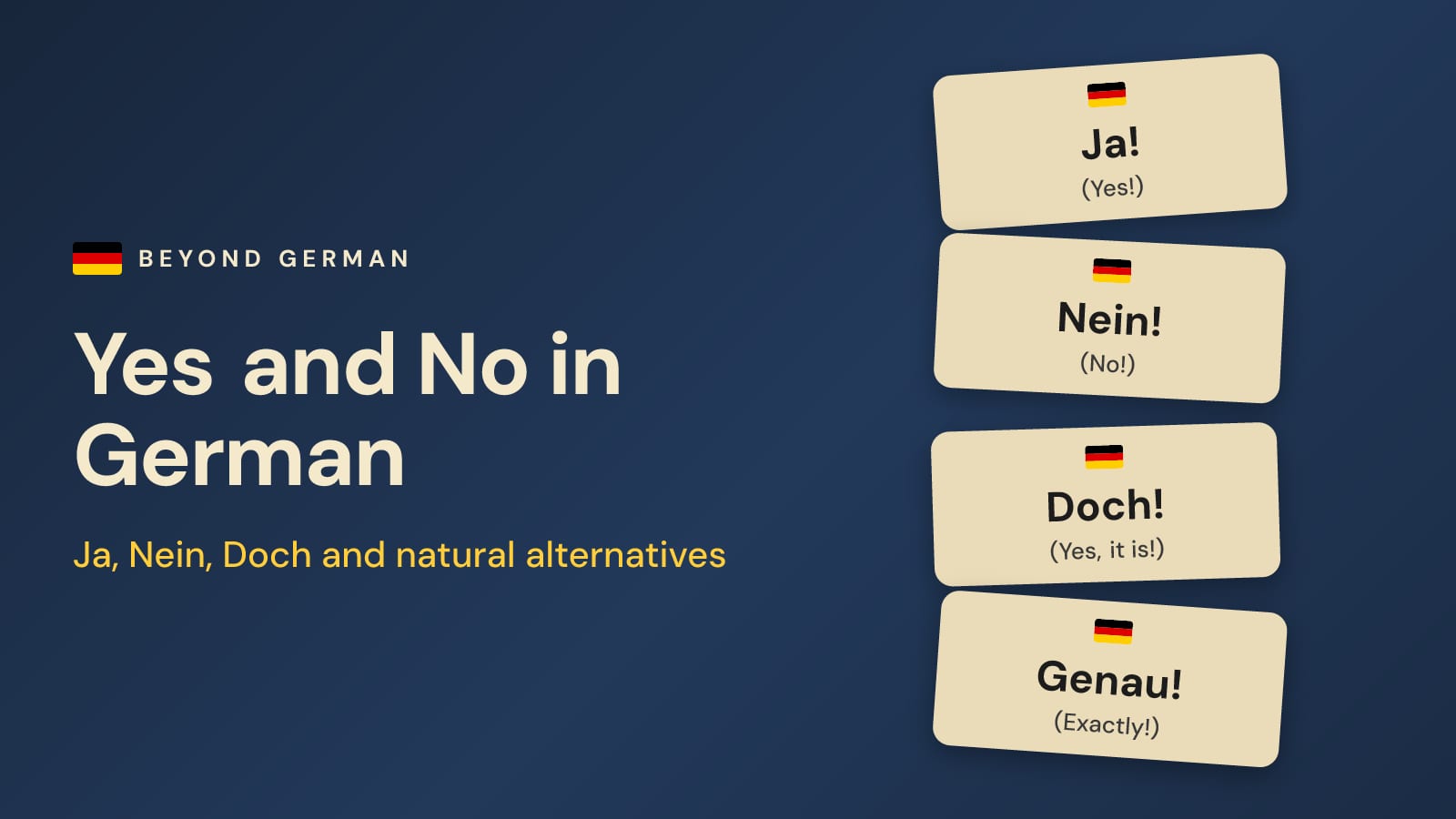
"Yes" in German is ja (YAH), and "no" is nein (NINE, exactly like the English number). German also has a third answer that English doesn't: doch (DOKH), a "yes" that contradicts a negative question, as in Kommst du nicht mit? Doch! (Aren't you coming along? Yes, I am!)
Below you'll find a quick-reference table, natural ways to say yes and no in every situation (casual, polite, enthusiastic and firm), how to answer negative questions correctly, and the mistakes English speakers make most often.
Yes and No in German: Quick Reference
| German | English | When to use |
|---|---|---|
| Ja | Yes | The standard yes, formal or casual |
| Nein | No | The standard no, formal or casual |
| Doch | Yes (I do, it is) | Contradicting a negative question or statement |
| Genau | Exactly, right | Agreeing with what someone just said |
| Klar / Na klar | Sure, of course | Friendly, casual agreement |
| Gerne | Gladly, I'd love to | Accepting an offer, invitation or request |
| Nee / Nö | Nah, nope | Casual speech and texts |
| Nein, danke | No, thank you | Politely turning down an offer |
| Leider nicht | Unfortunately not | A friendly, regretful no |
| Auf keinen Fall | No way, definitely not | A firm no |
| Jein | Yes and no | When the honest answer is both |
Ja, Nein and Doch: The Three Basic Answers
Ja: Yes
The German j sounds like an English y, so ja sounds like "yah". It works everywhere, from a job interview to a chat with friends:
- Sprechen Sie Englisch? Ja, ein bisschen. (Do you speak English? Yes, a little.)
- Möchten Sie eine Tüte? Ja, bitte. (Would you like a bag? Yes, please.)
Inside a sentence, ja is often not a "yes" at all but a small word that adds emphasis or surprise: Das ist ja super! (That's great!)
Nein: No
Nein is the standard, neutral "no". It isn't rude or harsh, and you can use it with anyone:
- Hast du heute Zeit? Nein, heute leider nicht. (Do you have time today? No, not today, unfortunately.)
- Nein, das ist falsch. (No, that's wrong.)
Doch: The Yes English Doesn't Have
When a question or statement is negative and you want to say the opposite, German doesn't use ja. It uses doch, said with the throaty ch of Scottish "loch":
- Du hast keine Zeit, oder? Doch, ich habe Zeit. (You don't have time, do you? Yes, I do.)
- Das stimmt nicht! Doch, das stimmt! (That's not true! Yes, it is!)
This is the most important nuance English speakers miss, and you'll find a full table further down. Doch also means "but" and works as a particle (Komm doch mit!), all covered in our guide on how to use doch in German. The Doch! phrase page has audio and more examples.
Other Ways to Say Yes in German
Casual Yes
- Jo: a relaxed "yeah", heard in casual speech in many regions.
- Jap or Jep: "yep".
- Joa: a slow, hesitant "yeah, I guess". War das Essen gut? Joa, ganz okay. (Was the food good? Yeah, it was okay.)
- Mhm: the same "uh-huh" as in English, to show you agree or are listening.
What about Jawohl (yah-VOHL)? It's a strong, emphatic yes that many people know from the military, where it works like "yes, sir". Today people mostly use it for emphasis or as a joke: Jawohl, Chef! (Yes, boss!) In an everyday chat, a plain Ja or Klar sounds more natural.
Agreeing: Genau, Stimmt, Klar and More
| German | English | Typical use |
|---|---|---|
| Genau (guh-NOW) | Exactly, right | Confirming what someone said; Germans use it constantly |
| Stimmt (SHTIMT) | True, that's right | Agreeing with a fact or a point |
| Richtig | Right, correct | Confirming that something is correct |
| Klar / Na klar | Sure, of course | Casual "obviously yes" |
| Sicher / Aber sicher | Sure, certainly | Friendly agreement |
| Natürlich | Of course | Neutral, fine in formal situations |
| Auf jeden Fall | Definitely | Strong agreement |
| Gerne / Gern | Gladly, I'd love to | Accepting offers, invitations and requests |
| Einverstanden | Agreed, deal | Accepting a plan or suggestion |
| Alles klar | All right, got it | Showing you understood |
| In Ordnung | All right, fine | Neutral, also at work |
| Okay / OK | Okay | Everywhere, just like in English |
- Wir treffen uns um acht, oder? Genau. (We're meeting at eight, right? Exactly.)
- Kannst du mir kurz helfen? Klar! (Can you help me for a second? Sure!)
- Möchtest du einen Tee? Gerne! (Would you like a tea? I'd love one!)
- Ich zahle heute und du nächstes Mal, okay? Einverstanden! (I'll pay today and you next time, okay? Deal!)
Gern and gerne mean exactly the same. Each of these has its own page with audio: genau, Na klar, natürlich and Auf jeden Fall. To say "I agree" in a full sentence, use Ich stimme zu or Da hast du recht. (You're right about that.)
Enthusiastic Yes
- Sehr gern! (I'd love to!)
- Unbedingt! (Absolutely!)
- Auf jeden Fall! (Definitely!)
- Na logo! (Sure thing!) Colloquial and a little playful.
Hast du Lust auf Kino? Unbedingt! (Do you feel like going to the movies? Absolutely!)
Polite and Formal Yes
With people you call Sie, at work or in a shop, a yes usually comes with a little extra:
- Ja, gerne. (Yes, gladly.)
- Ja, natürlich. (Yes, of course.)
- Selbstverständlich. (Certainly.) Very polite; you'll hear it a lot in customer service.
Können Sie mir die Rechnung per E-Mail schicken? Ja, selbstverständlich. (Could you send me the invoice by email? Yes, of course.)
For more on sounding friendly and respectful, see how to be polite in German.
Jein: Yes and No
Jein (YINE) blends ja and nein. It's informal, very common, and almost always followed by an explanation:
Hat dir der Film gefallen? Jein. Die Geschichte war gut, aber er war zu lang. (Did you like the movie? Yes and no. The story was good, but it was too long.)
Other Ways to Say No in German
Casual No: Nee and Nö
- Nee (NAY): the everyday spoken "nah". Nee, lass mal. (Nah, I'm good.)
- Nö (say "nay" with rounded lips): "nope". Depending on your tone, it sounds playful or a bit curt. Nö, keine Lust. (Nope, I don't feel like it.)
Both are fine with friends, family and colleagues you know well, in speech and in casual texts. Don't confuse nee with ne? at the end of a sentence, which means "right?": Das ist gut, ne? (That's good, isn't it?)
Polite No
- Nein, danke. (No, thank you.) The standard way to turn down an offer. Our guide to thank you in German has more ways to combine danke with a yes or a no.
- Leider nicht. (Unfortunately not.) Hast du am Wochenende Zeit? Leider nicht. (Are you free this weekend? Unfortunately not.)
- Danke, aber ich kann leider nicht. (Thanks, but I can't, unfortunately.)
- Lieber nicht. (Better not.) Noch ein Bier? Lieber nicht, ich muss noch fahren. (Another beer? Better not, I still have to drive.)
Soft or Unsure No
- Eher nicht. (Probably not.)
- Nicht wirklich. (Not really.)
- Ich glaube nicht. (I don't think so.)
And when the answer isn't yes or no because you simply don't know, say Keine Ahnung (No idea) or Ich weiß nicht. (I don't know.)
Strong No
- Auf keinen Fall! (No way! Definitely not!) The opposite of auf jeden Fall.
- Gar nicht. or Überhaupt nicht. (Not at all.) Störe ich? Nein, gar nicht! (Am I disturbing you? No, not at all!)
- Kommt nicht in Frage! (Out of the question!)
- Nie im Leben! (Not in a million years!) Casual.
How to Say No Politely in Germany
A short, clear Nein, danke. is completely normal in Germany and not rude. You don't need a long excuse; a friendly tone does the work. A few things help:
- Add leider (unfortunately) to sound warmer: Das geht leider nicht. (I'm afraid that won't work.)
- Offer an alternative: Heute kann ich leider nicht, aber vielleicht nächste Woche? (I can't today, unfortunately, but maybe next week?)
- Don't say no to be polite if you actually mean yes. If you turn down a second helping, your host may simply believe you and not offer again.
- Be careful with a plain Danke. As an answer to an offer, it's often understood as "No, thanks". To accept, say Ja, bitte or Ja, gerne.
Body language works as in English: nodding means yes, shaking your head means no.
Nein vs Nicht vs Kein
English uses "no" in many places where German needs a different word. Nein stands on its own, as an answer or a reaction. Inside a sentence, you need nicht or kein:
| Word | Meaning | Example |
|---|---|---|
| nein | no (as an answer) | Nein, ich komme nicht. (No, I'm not coming.) |
| nicht | not | Ich bin nicht müde. (I'm not tired.) |
| kein | no, not a, not any (before nouns) | Ich habe kein Auto. (I don't have a car.) |
That's why many English "no + noun" phrases use kein in German: Kein Problem (No problem), Keine Ahnung (No idea) and Keine Zeit (No time). For the full rules and where nicht goes in a sentence, read nicht vs kein.
Answering Negative Questions: Ja, Nein or Doch?
After a negative question (one with nicht or kein), answer doch if the positive is true and nein if the negative is true. A plain ja is unclear here, so avoid it.
| Question | Answer: yes, I am / do | Answer: no, I'm not / don't |
|---|---|---|
| Hast du keinen Hunger? (Aren't you hungry?) | Doch, ich habe Hunger. | Nein, ich habe keinen Hunger. |
| Kommst du nicht mit? (Aren't you coming along?) | Doch, ich komme mit. | Nein, ich komme nicht mit. |
| Bist du nicht müde? (Aren't you tired?) | Doch, ich bin müde. | Nein, ich bin nicht müde. |
| Hast du die E-Mail nicht bekommen? (Didn't you get the email?) | Doch, ich habe sie bekommen. | Nein, ich habe sie nicht bekommen. |
Compare a normal question: Hast du Hunger? Ja, ich habe Hunger. (Are you hungry? Yes, I am.) Here doch would be wrong, because there's nothing negative to contradict.
Doch works the same way after negative statements: Du magst keinen Kaffee. Doch! (You don't like coffee. Yes, I do!)
Short Answers That Sound Native
- Ja, gern. (Yes, I'd like that.)
- Ja, klar. (Yes, sure.)
- Nein, leider nicht. (No, unfortunately not.)
- Ich glaube schon. (I think so.)
- Ich glaube nicht. (I don't think so.)
- Kann sein. (Could be.)
- Vielleicht. (Maybe.)
- Mal sehen. (We'll see.)
- Wahrscheinlich. (Probably.)
One more native touch: a single Schon works as a hesitant "well, yes", usually followed by aber: Ist die Wohnung teuer? Schon, aber sie ist sehr schön. (Is the apartment expensive? Well, yes, but it's very nice.)
Common Mistakes
Answering Ja to a Negative Question
Wrong: Hast du keinen Hunger? Ja! (when you mean "yes, I'm hungry") Right: Doch, ich habe Hunger!
Using Nein Inside a Sentence
Wrong: Ich habe nein Zeit. Right: Ich habe keine Zeit. (I don't have time.)
Wrong: Ich bin nein müde. Right: Ich bin nicht müde. (I'm not tired.)
Saying Danke When You Mean "Yes, Please"
Wrong: Noch einen Kaffee? Danke! (when you want one) Right: Ja, bitte! or Ja, gerne!
Using Jawohl in a Casual Chat
Sounds odd: Willst du ein Stück Pizza? Jawohl. Natural: Ja, gern! or Klar!
It isn't wrong, but it sounds like you're answering an officer, so friends will hear it as a joke.
Writing Nee or Nö in Formal Messages
Wrong (email to a landlord): Nee, Dienstag passt mir nicht. Right: Dienstag passt mir leider nicht. (Unfortunately, Tuesday doesn't work for me.)
Practice
Try these, then check the answers below:
- A friend asks: Hast du keine Lust? You do want to come. Answer in one word.
- A waiter asks: Möchten Sie noch etwas? You don't want anything else. Answer politely.
- Fix the sentence: Ich habe nein Geld.
- Accept this invitation with enthusiasm: Kommst du am Samstag zu meiner Party?
- A colleague says: Die Besprechung ist um zehn, oder? Confirm that it's right.
- Say "I don't think so" in German.
Answers: 1. Doch! 2. Nein, danke. 3. Ich habe kein Geld. 4. Unbedingt! or Ja, sehr gern! 5. Genau. or Stimmt. 6. Ich glaube nicht.
Keep going: learn more survival answers in our essential German phrases for beginners, and test yourself with the A1 German quiz.
FAQ
How do you say yes in German?
Ja (YAH). To agree with something, Germans also say genau, klar or stimmt, and to accept an offer, gerne. After a negative question, "yes" is doch.
How do you say no in German?
Nein (NINE). In casual speech you'll also hear nee and nö. Inside a sentence, English "no" or "not" becomes nicht or kein: Ich habe keine Zeit. (I have no time.)
What does doch mean in German?
As an answer, doch is a "yes" that contradicts a negative question or statement: Du kommst nicht, oder? Doch! (You're not coming, are you? Yes, I am!) In a sentence, it can also mean "but" or add emphasis.
Is "nee" rude in German?
No. Nee is simply informal, like "nah" in English, and very common in speech. In formal situations and formal writing, use nein.
What does "jein" mean?
Jein is a mix of ja and nein and means "yes and no". It's informal, and you usually explain right after it.
How do you say "no thank you" in German?
Nein, danke. It's polite in every situation. For a warmer version, say Nein, vielen Dank. To turn down an invitation, try Danke, aber ich kann leider nicht.
New from Beyond German
Learn every A1 word, with audio
The A1 Word Kit: 787 words sorted by real life in Germany, two example sentences each, and flashcards that remember for you.
See the kit · launch price €29Level Up Your German
Join 1,000+ learners getting weekly tips, grammar shortcuts, and cultural insights.
Share this article
Continue Reading
Goethe B1 Word List (Wortliste): What's on It and How to Learn It
The official Goethe B1 Wortliste explained in English: what's on it, how to read the entries, how big it really is, and a free extract of 39 B1 words by situation.
German for Nurses: Which Level You Need and How to Get There
Which German level nurses need for Germany: A2 for a recognition visa, B1 for Triple Win, B2 for the licence. Plus a study plan and 35 hospital words and phrases.
Goethe A1 Exam: Start Deutsch 1 Format, Syllabus and Tips
Everything about the Goethe A1 exam (Start Deutsch 1): the four parts with examples, scoring, the A1 syllabus, fees and a realistic plan to prepare.