
Doch in German: Meaning, How to Use It & Doch vs Ja
 Beyond German Team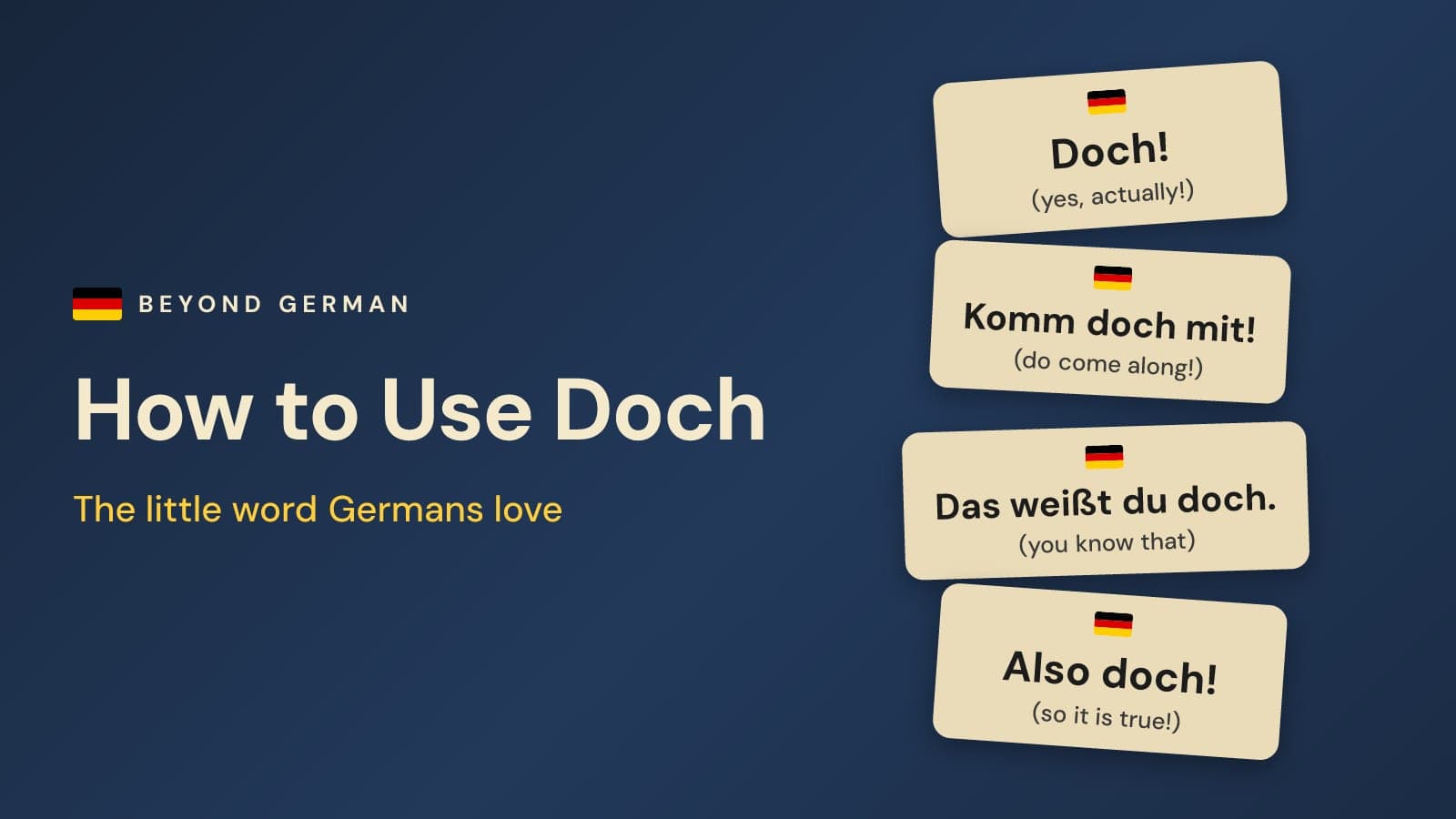
Doch has three main jobs in German. As an answer, it's a "yes" that contradicts a negative question or statement: „Kommst du nicht?“ – „Doch!“ — "Aren't you coming?" "Yes, I am!" As a conjunction, it means "but". And as a small, unstressed particle, it adds tone: it urges (Komm doch mit!), reminds (Das weißt du doch!), protests or wishes.
That makes doch one of the most common words in spoken German, and one of the hardest to translate. Below you'll find every use with examples, plus ja doch, doch noch, also doch, how stress changes the meaning, and doch vs. ja.
Doch at a Glance
| Use | Example | English |
|---|---|---|
| Contradicting "yes" | „Hast du keinen Hunger?“ – „Doch!“ | "Aren't you hungry?" "Yes, I am!" |
| "But" (conjunction) | Es war spät, doch niemand wollte gehen. | It was late, but nobody wanted to leave. |
| Urging, softening | Komm doch mit! | Why don't you come along? |
| Reminding | Das weißt du doch! | You know that! |
| Surprise | Das ist doch Lisa! | Hey, that's Lisa! |
| Protest | Das stimmt doch nicht! | But that's not true! |
| Wishes | Wenn er doch käme! | If only he would come! |
| "After all" (stressed) | Er ist DOCH gekommen. | He came after all. |
An easy way to tell them apart: the answer stands alone or before a comma, the conjunction starts a clause, and the particle usually sits after the verb.
1. Doch as an Answer: "Yes" to a Negative Question
In English, "yes" does two jobs. German splits them: ja says yes to a positive question, and doch says yes to a negative one. Nein works just like "no".
| Question | Yes | No |
|---|---|---|
| Hast du Hunger? — Are you hungry? | Ja. | Nein. |
| Hast du keinen Hunger? — Aren't you hungry? | Doch! | Nein. |
| Kommst du nicht mit? — Aren't you coming? | Doch, ich komme mit. | Nein, ich komme nicht mit. |
| Du hast keine Zeit, oder? — You don't have time, do you? | Doch, ich habe Zeit. | Nein, leider nicht. |
Why not just say ja? After a negative question, ja is unclear: does it mean "yes, I'm coming" or "yes, right, I'm not"? Doch leaves no doubt. (If you speak French, it works just like si.) Negative questions use nicht or kein; if you mix those two up, see nicht vs. kein.
Contradicting a Negative Statement
Doch also pushes back against negative statements:
- „Das schaffst du nie.“ – „Doch, das schaffe ich!“ — "You'll never manage that." "Yes, I will!"
- „Du hast nicht abgewaschen.“ – „Doch, habe ich!“ — "You didn't do the dishes." "Yes, I did!"
- „Schmeckt es dir nicht?“ – „Doch, doch, sehr gut!“ — "Don't you like it?" "Oh yes, it's very good!"
Kids argue like this all the time: „Doch!“ – „Nein!“ – „Doch!“ It's the German "Did too!" "Did not!" To contradict a positive statement, use nein: „Du bist müde.“ – „Nein, bin ich nicht!“ — "You're tired." "No, I'm not!"
2. Doch as a Conjunction: "But" or "However"
At the start of a clause, doch means "but", "however" or "yet", much like aber. Usually it's a coordinating conjunction, so it sits in "position 0" and doesn't count for word order. The clause after it is a normal main clause, with the verb in second place (see German word order basics). Doch can also take position 1 itself: Es war spät, doch wollte niemand gehen. Both are correct.
[Main clause], doch + [main clause with the VERB in position 2]- Wir wollten grillen, doch dann fing es an zu regnen. — We wanted to have a barbecue, but then it started to rain.
- Das Hotel war teuer. Doch das Frühstück war fantastisch. — The hotel was expensive. But the breakfast was fantastic.
Two differences from aber:
- Doch sounds more written. In conversation, aber is far more common; in stories and the news, doch is everywhere.
- Doch stays at the front. Aber can move into the clause: Ich wollte anrufen, ich hatte aber keine Zeit. Move doch there, and it becomes the particle from section 3.
Unlike weil or obwohl, doch never sends the verb to the end. That only happens in subordinate clauses. For more ways to say "but" and "although", including sondern, see obwohl vs. trotzdem.
3. Doch as a Particle: Adding Tone
Most of the time, doch is a modal particle: a small, unstressed word that changes the tone of a sentence, not its facts. Das ist teuer states a fact. Das ist doch teuer! adds "come on, surely you can see that". Leave the particle out and the sentence is still correct, just flatter.
The particle never starts a sentence. In a main clause, it comes after the conjugated verb and any pronouns, and before nicht: Das ist doch nicht schlimm.
Softening or Urging Commands: Komm doch mit!
In a command, doch turns an order into encouragement, like "why don't you…?" or "go on":
- Komm doch mit! — Why don't you come along?
- Setz dich doch! — Have a seat!
- Frag doch Anna! — Why don't you ask Anna?
- Ruf mich doch mal an! — Give me a call sometime!
Adding mal makes it more casual. With Sie, Nehmen Sie doch Platz! (Please, have a seat!) is a warm invitation. To ask a stranger for a favor, though, a question like Könnten Sie…? works better (see how to be polite in German).
With an impatient voice, especially next to endlich (finally), the same word pushes hard: Hör doch endlich auf! — Will you stop it already!
Reminding: Das weißt du doch!
In a statement, doch points to something the listener already knows, or should know. English uses "you know", "remember?" or "after all":
- Das weißt du doch! — You know that!
- Wir waren doch schon mal hier. — We've been here before, remember?
- Heute ist doch Sonntag. — But it's Sunday today. (So the shops are closed.)
- Ich kann nicht, ich muss doch arbeiten. — I can't, I have to work, you know.
- Ich hab's dir doch gesagt! — I told you so!
Two extras: with gleich, it means "again" when you're trying to remember (Wie war doch gleich Ihr Name? — What was your name again?). And in a statement with rising intonation, it asks for confirmation: Du kommst doch morgen, oder? — You're coming tomorrow, right?
Surprise and Insistence: Das gibt's doch nicht!
Doch also adds emotion: surprise, disbelief or protest. In English, a stronger tone of voice does the same job:
- Das ist doch Lisa! — Hey, that's Lisa!
- Das gibt's doch nicht! — No way! / I don't believe it!
- Das ist doch nicht dein Ernst! — You can't be serious!
- Du kannst doch nicht einfach gehen! — You can't just leave!
- Das ist doch nicht so schlimm. — Come on, it's not that bad.
As the last one shows, it can comfort, too. Sayings use it as well: Ich bin doch nicht von gestern! — I wasn't born yesterday! More in our funny German idioms.
Wishes: Wenn er doch käme!
With the Konjunktiv II, doch (often with nur) turns a wish into a sigh: "if only…". Start with wenn, which sends the verb to the end, or start with the verb itself:
- Wenn er doch käme! — If only he would come!
- Wenn ich doch nur mehr Zeit hätte! — If only I had more time!
- Hätte ich doch nur mehr Zeit! — If only I had more time!
- Wäre ich doch zu Hause geblieben! — If only I'd stayed at home!
In everyday speech, you'll often hear würde + infinitive instead: Wenn er doch nur kommen würde! — If only he would come!
4. Ja doch, Doch noch and Also doch
Doch often teams up with other small words. Learn these three as fixed chunks:
| Combination | Meaning | Example |
|---|---|---|
| ja doch | 1. Impatient "yes, yes!" 2. "Anyway", with a resigned shrug | „Kommst du?“ – „Ja doch!“ — "Are you coming?" "Yes, yes, I'm coming!" Das bringt ja doch nichts. — It's pointless anyway. |
| doch noch | "After all", "in the end", when it looked like it wouldn't happen | Wir haben den Zug doch noch erreicht. — We caught the train after all. |
| also doch | "So … after all": a suspicion turns out true, or someone changes their mind | Du kommst also doch mit? — So you're coming after all? Also doch! — I knew it! |
Remember that also means "so", never "also". For that, German says auch.
5. How Stress and Tone Change the Meaning
With doch, how you say it matters as much as where you put it. First, stress:
- Unstressed, it's the particle: Er ist doch gekommen. — But he did come! (to someone who thinks he didn't)
- Stressed, it means "after all": Er ist DOCH gekommen. — He came after all. (although nobody expected him to)
Second, tone. In commands and exclamations, the same sentence can sound warm or annoyed:
| Sentence | Said warmly | Said sharply |
|---|---|---|
| Komm doch mit! | Why don't you come along? | Oh, just come along already! |
| Setz dich doch! | Do sit down! | Sit down, will you? |
| Mach doch, was du willst. | Do whatever you like. | Fine, do what you want, then! |
| Das ist doch Peter! | Hey, it's Peter! | It's Peter! (Don't you recognize him?) |
Rule of thumb: the friendlier your voice, the friendlier the doch. If you're unsure how it will land, add bitte or mal.
6. Doch vs. Ja: What's the Difference?
As answers, the rule is simple: ja says yes to a positive question, and doch says yes to a negative one. As particles, both point to things the speaker and listener already know. The difference: ja assumes you agree, while doch pushes back against something the listener said or did.
| With ja | With doch | The difference |
|---|---|---|
| Das weißt du ja. — You know that, of course. | Das weißt du doch! — You know that! (So why ask?) | Ja is a neutral reminder; doch is a mild reproach. |
| Das ist ja toll! — Oh, that's great! | Das ist doch toll! — But that's great! | Ja reacts to news; doch counters someone's doubts. |
| Komm ja nicht zu spät! — Don't you dare be late! | Komm doch mit! — Why don't you come along? | In commands, a stressed ja warns; doch encourages. |
Common Mistakes With Doch
| Wrong | Right | Why |
|---|---|---|
| „Hast du Hunger?“ – „Doch!“ | „Hast du Hunger?“ – „Ja!“ | Doch only answers negative questions. |
| „Hast du keinen Hunger?“ – „Ja.“ | „Hast du keinen Hunger?“ – „Doch!“ | After a negative question, ja is unclear. |
| Komm mit doch! | Komm doch mit! | The particle goes in the middle, before the prefix mit. |
| …, doch ich keine Zeit hatte. | …, doch ich hatte keine Zeit. | Doch isn't like weil: the verb stays in position 2. |
| Das ist kein Tee, doch Kaffee. | Das ist kein Tee, sondern Kaffee. | To correct a negation, use sondern. |
| Geben Sie mir doch die Rechnung! (to a waiter) | Könnten Sie mir bitte die Rechnung bringen? | A command with doch can sound pushy to strangers. |
For more, see our list of common German mistakes English speakers make.
Practice: Ja, Nein or Doch?
Answer 1–4 with ja, nein or doch so that each answer means what's in brackets. Then say 5–9 in German with doch.
- „Hast du Zeit?“ (Yes, I do.)
- „Hast du keine Zeit?“ (Yes, I do.)
- „Kommst du nicht mit?“ (No, I'm not coming.)
- „Du kannst nicht schwimmen, oder?“ (Yes, I can.)
- Make it friendlier: Setz dich!
- You know that!
- If only I had more time!
- We caught the train after all.
- Join with "but": Das Wetter war schlecht. Wir hatten viel Spaß.
Answers:
- Ja, ich habe Zeit.
- Doch, ich habe Zeit.
- Nein, ich komme nicht mit.
- Doch, ich kann schwimmen.
- Setz dich doch!
- Das weißt du doch!
- Wenn ich doch nur mehr Zeit hätte! / Hätte ich doch nur mehr Zeit!
- Wir haben den Zug doch noch erreicht.
- Das Wetter war schlecht, doch wir hatten viel Spaß. — The weather was bad, but we had a lot of fun.
Ready for more? Test yourself in the B1 German quiz, or practice the "if only" wishes with our Konjunktiv II guide.
FAQ
What does doch mean in German?
As an answer, it's "yes" to a negative question. As a conjunction, it means "but". As an unstressed particle, it adds tone, like "come on", "you know" or "if only". Stressed, it means "after all".
What's the difference between doch and ja?
As answers, ja says yes to a positive question and doch to a negative one. As particles, both refer to shared knowledge, but doch adds a contrast or a mild reproach.
Is doch rude?
Not by itself. Among friends, Komm doch mit! sounds warm. Said sharply, or in a command to a stranger, it can sound impatient. Your tone decides.
Can I use doch instead of aber?
At the start of a clause, yes, though doch sounds more written. Aber is more flexible, because it can also move into the middle of the clause.
Level Up Your German
Join 1,000+ learners getting weekly tips, grammar shortcuts, and cultural insights.
Share this article
Continue Reading
Hobbies in German: Was machst du gern? Freizeit Vocabulary
How to talk about hobbies in German: ask Was machst du in deiner Freizeit?, answer with gern, lieber and am liebsten, and learn Freizeit vocabulary by category.
Directions in German: Links, Rechts, Geradeaus & How to Ask
How to ask for directions in German (Wie komme ich zum Bahnhof?), understand links, rechts and geradeaus, plus city vocabulary, two dialogues and common mistakes.
Rooms in German: House & Furniture Vocabulary With Plurals
Rooms, furniture and appliances in German with articles and plurals, plus how to describe your home, which floor the Erdgeschoss is, and why Germans air their rooms.