
Funny German Idioms: 25 Sayings With English Translations
 Beyond German Team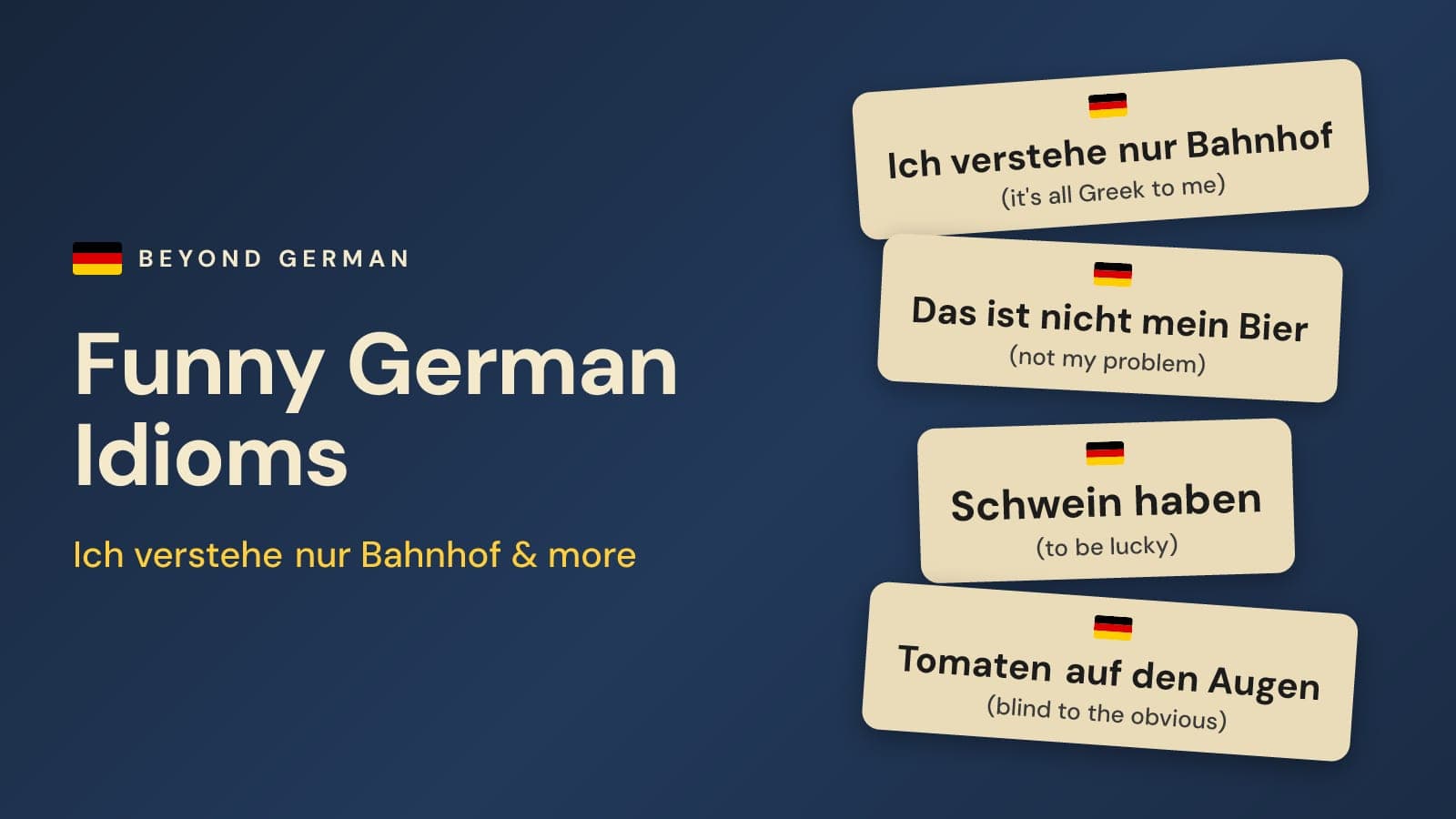
German idioms are full of sausages, pigs and train stations, and they rarely translate word for word. Ich verstehe nur Bahnhof ("I only understand train station") means "It's all Greek to me", and Schwein haben ("to have pig") means to be lucky.
Here are 25 funny German idioms by theme, each with its literal translation, real meaning, English equivalent and an example sentence. Then: when to use them, common mistakes and a quick practice round.
Everyday Idioms You'll Hear All the Time
1. Ich verstehe nur Bahnhof
Literally: I only understand train station. Meaning: I don't understand a thing. English equivalent: It's all Greek to me.
The usual explanation: World War I soldiers, sick of the fighting, only wanted to hear one word, Bahnhof, where the train home would leave.
- Der Arzt hat mir alles erklärt, aber ich habe nur Bahnhof verstanden. — The doctor explained everything, but it was all Greek to me.
2. Den Nagel auf den Kopf treffen
Literally: to hit the nail on the head. Meaning: to describe something exactly right. English equivalent: to hit the nail on the head.
A freebie: same picture as in English.
- Mit diesem Kommentar hast du den Nagel auf den Kopf getroffen. — You hit the nail on the head with that comment.
3. Ich bin fix und fertig
Literally: I'm fixed and finished. Meaning: I'm completely exhausted. English equivalent: I'm wiped out (UK: knackered).
Plain Ich bin fertig can also mean "I'm done" (see common German mistakes English speakers make), but fix und fertig clearly means worn out.
- Nach dem Umzug war ich fix und fertig. — After the move, I was completely wiped out.
4. etwas auf dem Kasten haben
Literally: to have something on the box. Meaning: to be smart or very capable. English equivalent: to know your stuff.
It usually comes with was, viel or einiges (something, a lot, quite a bit).
- Frag Lena, sie hat echt was auf dem Kasten. — Ask Lena, she really knows her stuff.
5. Ich bin doch nicht von gestern
Literally: I'm not from yesterday. Meaning: I'm not naive; you can't fool me. English equivalent: I wasn't born yesterday.
The little word doch adds a "come on" tone.
- Ein neues Handy für 20 Euro? Ich bin doch nicht von gestern! — A new phone for 20 euros? I wasn't born yesterday!
6. Tote Hose
Literally: dead trousers. Meaning: nothing's happening; the place is dead. English equivalent: It's dead in here.
The opposite of Da steppt der Bär. The punk band Die Toten Hosen is named after it.
- Sonntagabends ist in unserem Dorf tote Hose. — On Sunday evenings, our village is dead.
Food Idioms: Sausage, Beer and Porridge
Food is serious business in Germany: die Wurst (sausage) alone stars in three idioms. For the basics, see our guide to German food and drink.
7. Das ist mir wurst (or wurscht)
Literally: That's sausage to me. Meaning: I don't care; it makes no difference to me. English equivalent: It's all the same to me.
A more colorful Ist mir egal. The form wurscht is the colloquial, originally southern pronunciation, and since both work like egal, they're written lowercase: Das ist mir wurst.
- Pizza oder Pasta? Das ist mir wurst, ich habe einfach Hunger. — Pizza or pasta? I don't care, I'm just hungry.
8. Jetzt geht's um die Wurst
Literally: Now it's about the sausage. Meaning: this is the decisive moment. English equivalent: It's now or never.
It probably goes back to village fairs, where the prize in contests was often a sausage.
- Das ist das letzte Spiel der Saison. Jetzt geht's um die Wurst! — It's the last game of the season. It's now or never!
9. Alles hat ein Ende, nur die Wurst hat zwei
Literally: Everything has an end, only the sausage has two. Meaning: everything ends eventually. English equivalent: All good things must come to an end.
- Der Urlaub ist vorbei. Tja, alles hat ein Ende, nur die Wurst hat zwei. — The vacation is over. Oh well, all good things must come to an end.
10. Das ist nicht mein Bier
Literally: That's not my beer. Meaning: that's not my problem or my business. English equivalent: Not my circus, not my monkeys.
It works the other way round, too: Das ist dein Bier! means "That's your problem!"
- Wenn er seine Miete nicht bezahlt, ist das nicht mein Bier. — If he doesn't pay his rent, that's not my problem.
11. Butter bei die Fische!
Literally: Butter with the fish! Meaning: get to the point; say what you really mean. English equivalent: Spit it out!
It's northern German, and the grammar is "wrong" (standard: bei den Fischen). Don't fix the idiom, but don't copy bei die anywhere else.
- Jetzt mal Butter bei die Fische: Kommst du mit oder nicht? — Come on, spit it out: are you coming or not?
12. Um den heißen Brei herumreden
Literally: to talk around the hot porridge. Meaning: to avoid the real topic. English equivalent: to beat around the bush.
Picture a cat circling hot porridge, too scared to eat. Germans value directness (one of the cultural habits in Germany newcomers notice first), so you'll hear this one a lot.
- Hör auf, um den heißen Brei herumzureden. Was ist passiert? — Stop beating around the bush. What happened?
13. Kohldampf haben
Literally: to have cabbage steam. Meaning: to be very hungry. English equivalent: to be starving.
No cabbage involved: in old thieves' slang, both halves of the word most likely meant "hunger". It's a much stronger Ich habe Hunger.
- Ich habe seit heute Morgen nichts gegessen. Ich habe Kohldampf! — I haven't eaten anything since this morning. I'm starving!
14. jemandem auf den Keks gehen
Literally: to go on someone's cookie. Meaning: to annoy someone. English equivalent: to get on someone's nerves.
The annoyed person is in the dative: mir, dir, ihm.
- Mein Nachbar bohrt jeden Sonntag. Das geht mir echt auf den Keks. — My neighbor drills every Sunday. It really gets on my nerves.
Animal Idioms: Pigs, Bears and Tomcats
In German idioms, pigs bring luck (marzipan pigs are a classic New Year's gift) and a tomcat is the last thing you want the morning after. For the animals themselves, see animals in German.
15. Schwein haben
Literally: to have pig. Meaning: to be lucky, usually by pure chance. English equivalent: to get lucky.
You'll mostly hear it in the past: Schwein gehabt! (That was lucky!)
- Der Zug hatte Verspätung, deshalb habe ich ihn noch erwischt. Schwein gehabt! — The train was late, so I still caught it. Lucky me!
16. Ich glaub, mein Schwein pfeift!
Literally: I think my pig is whistling! Meaning: I can't believe it (usually annoyed). English equivalent: You've got to be kidding me!
Its cousin, for pure surprise: Ich glaub, mich knutscht ein Elch! (I think a moose is kissing me!)
- Die Miete steigt schon wieder? Ich glaub, mein Schwein pfeift! — The rent's going up again? You've got to be kidding me!
17. Da steppt der Bär
Literally: The bear tap-dances there. Meaning: there's a lot going on; it's a great party. English equivalent: It's going to be a blast!
- Kommst du am Samstag auch zur Party? Da steppt der Bär! — Are you coming to the party on Saturday too? It's going to be a blast!
18. einen Kater haben
Literally: to have a tomcat. Meaning: to be hungover. English equivalent: to have a hangover.
The cat is a mix-up: Kater most likely comes from Katarrh (catarrh). Bonus: Muskelkater ("muscle tomcat") means sore muscles.
- Nach der Hochzeit hatte ich einen fürchterlichen Kater. — After the wedding, I had a terrible hangover.
19. Das Leben ist kein Ponyhof
Literally: Life isn't a pony farm. Meaning: life isn't always easy or fun. English equivalent: Life isn't all fun and games.
- Du musst am Wochenende arbeiten? Tja, das Leben ist kein Ponyhof. — You have to work on the weekend? Well, life isn't all fun and games.
Body Idioms: Eyes, Noses and Short Legs
German loves body parts in idioms almost as much as sausage. Need the words first? See body parts in German.
20. Tomaten auf den Augen haben
Literally: to have tomatoes on your eyes. Meaning: to miss something that's right in front of you. English equivalent: Are you blind?
- Hast du Tomaten auf den Augen? Die Ampel war rot! — Are you blind? The light was red!
21. die Nase voll haben
Literally: to have your nose full. Meaning: to be fed up. English equivalent: to be sick and tired of something.
Add von + dative for what you're fed up with.
- Ich habe die Nase voll von diesem Regen! — I'm sick and tired of this rain!
22. Die Daumen drücken (Ich drücke dir die Daumen)
Literally: to press the thumbs. Meaning: to wish someone luck. English equivalent: to keep your fingers crossed.
Instead of crossing their fingers, Germans tuck their thumbs inside their fists and squeeze. The person you're rooting for is in the dative. Plain "good luck" is Viel Glück.
- Morgen hast du die Prüfung? Ich drücke dir die Daumen! — Your exam is tomorrow? I'll keep my fingers crossed for you!
23. Hals- und Beinbruch!
Literally: Neck and leg break! Meaning: good luck! English equivalent: Break a leg!
It sounds brutal but works just like "break a leg". One popular theory: it's a German twist on the Yiddish blessing hatslokhe un brokhe (success and blessing).
- Du hast heute dein Vorstellungsgespräch? Hals- und Beinbruch! — You've got your job interview today? Break a leg!
24. Lügen haben kurze Beine
Literally: Lies have short legs. Meaning: lies don't get far; the truth comes out. English equivalent: The truth will out.
- Er hat sich krankgemeldet und dann Fotos vom Strand gepostet. Lügen haben kurze Beine! — He called in sick and then posted photos from the beach. The truth always comes out!
25. jemanden auf den Arm nehmen
Literally: to take someone on your arm. Meaning: to tease or fool someone for fun. English equivalent: to pull someone's leg.
Same joke, different body part: English pulls your leg, German picks you up like a little kid.
- Du hast im Lotto gewonnen? Du willst mich doch auf den Arm nehmen! — You won the lottery? You're pulling my leg!
When to Use German Idioms
Almost all of these are colloquial: great with friends and colleagues you're on du terms with, but not for a job interview, a formal email or the Bürgeramt.
| Tone | Idioms | Use them… |
|---|---|---|
| Neutral | den Nagel auf den Kopf treffen, die Daumen drücken, Hals- und Beinbruch, Lügen haben kurze Beine | almost anywhere, even with your boss |
| Casual | most of the rest, from Ich verstehe nur Bahnhof to einen Kater haben | with friends and in everyday chat |
| Handle with care | Das ist mir wurst, Das ist nicht mein Bier, Hast du Tomaten auf den Augen? | only jokingly, since they can sound rude |
One well-timed idiom gets you a smile. Five in a row sound like you swallowed a textbook.
Common Mistakes With German Idioms
| Wrong | Right | Why |
|---|---|---|
| Brich dir ein Bein! | Hals- und Beinbruch! / Toi, toi, toi! | "Break a leg" doesn't translate word for word. |
| Du gehst mich auf den Keks. | Du gehst mir auf den Keks. | The annoyed person is in the dative. |
| Ich bin ein Schwein. (for "I'm lucky") | Ich habe Schwein gehabt. | Ich bin ein Schwein means "I'm a pig." |
| Das ist nicht mein Bier. (to your boss) | Dafür bin ich leider nicht zuständig. | Too casual for work. See Ich bin für… zuständig. |
Practice: Which Idiom Fits?
Pick an idiom for each situation, then check the answers.
- A friend explains her tax return. You don't understand a word.
- Your brother has his driving test tomorrow.
- You find a 20-euro note on the street.
- A colleague talks for five minutes without getting to the point.
- You arrive at a party, and nobody's there.
Answers:
- Ich verstehe nur Bahnhof. — It's all Greek to me.
- Ich drücke dir die Daumen! — I'll keep my fingers crossed for you!
- Schwein gehabt! — That was lucky!
- Butter bei die Fische! — Spit it out!
- Hier ist ja tote Hose. — It's dead in here.
Keep going:
- Browse more everyday expressions in our German phrase library.
- Test your vocabulary with the A2 German quiz.
FAQ
What is the most famous German idiom?
Probably Ich verstehe nur Bahnhof ("I only understand train station"), the German "It's all Greek to me". Schwein haben (to be lucky) and Das ist nicht mein Bier (not my problem) are close behind.
How do you say "break a leg" in German?
Say Hals- und Beinbruch! or Toi, toi, toi! Before an exam, Ich drücke dir die Daumen works too.
Does "Das kommt mir spanisch vor" mean "It's all Greek to me"?
No. Das kommt mir spanisch vor ("That seems Spanish to me") means something seems odd or suspicious. For "I don't understand", use Ich verstehe nur Bahnhof.
Level Up Your German
Join 1,000+ learners getting weekly tips, grammar shortcuts, and cultural insights.
Share this article
Continue Reading
How to Be Polite in German: Würde, Könnte, Hätte gern & More
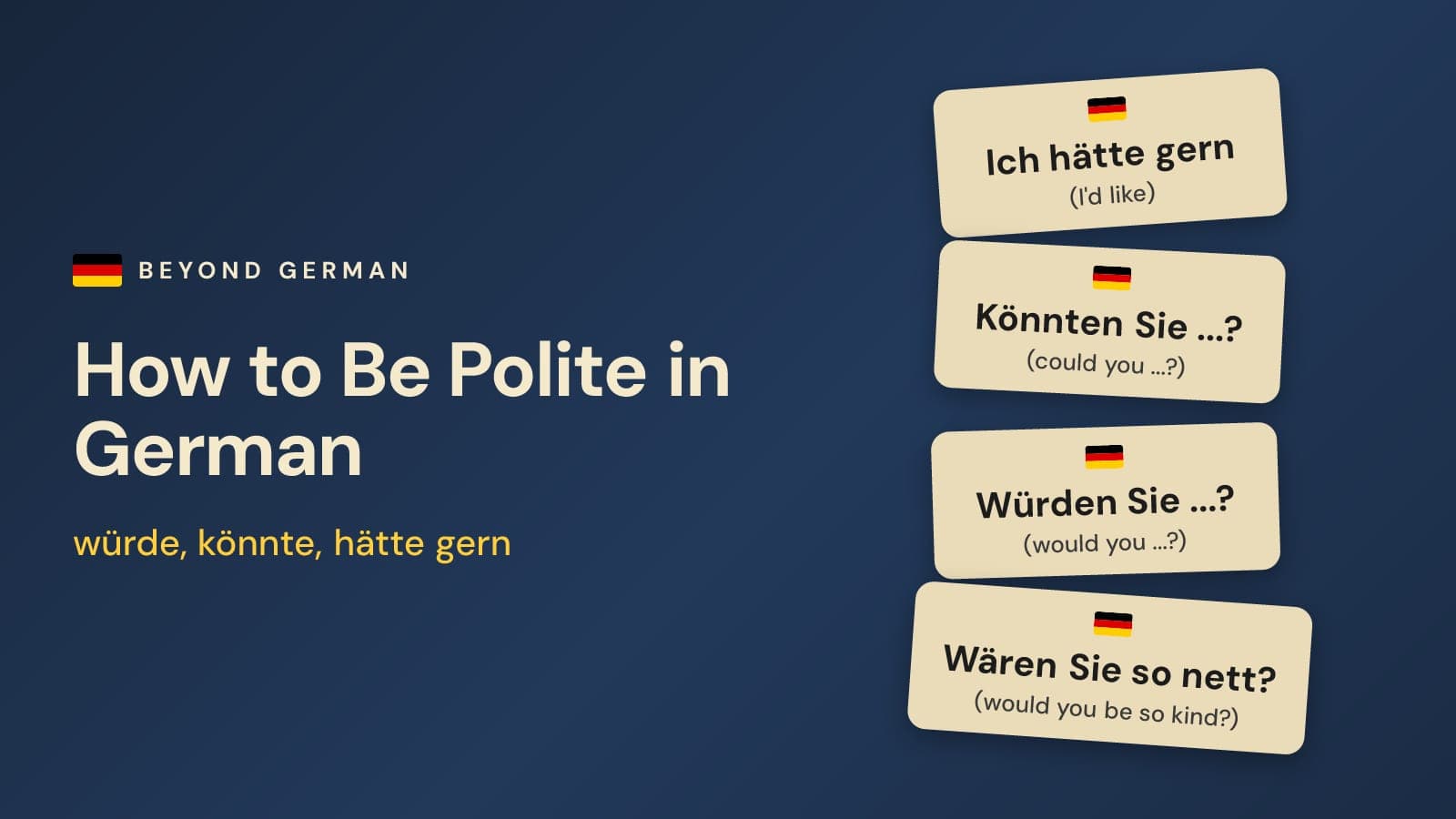
Sound polite in German with Konjunktiv II: Ich hätte gern, Könnten Sie, Würden Sie and Dürfte ich, plus softening words, Sie vs. du, polite refusals and dialogues.
Animals in German: Names, Plurals, Sounds and Idioms
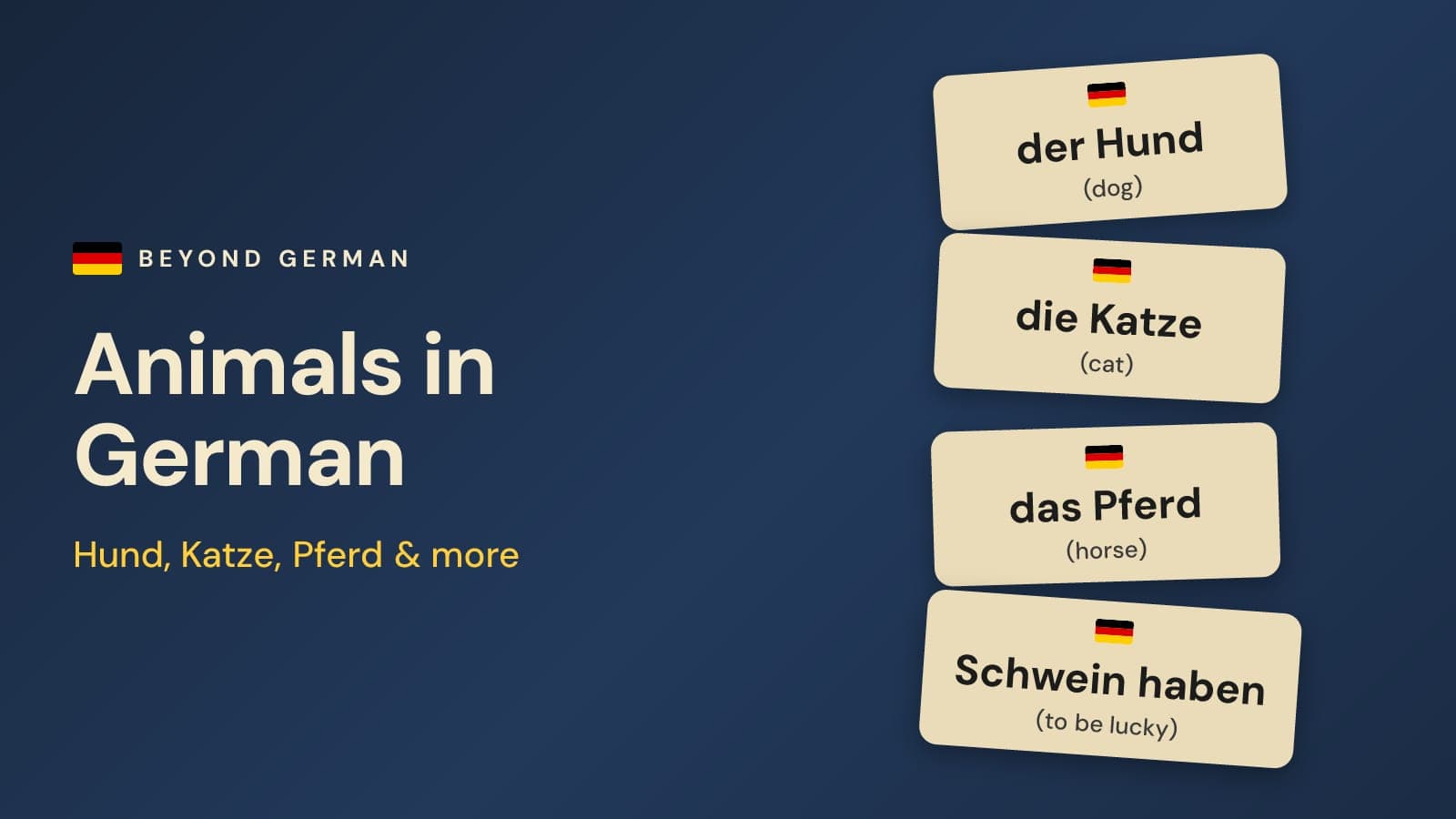
The most common animals in German, from der Hund and die Katze to der Igel, with articles, plurals, male and female forms, animal sounds and the idioms Germans love.
Body Parts in German: Vocabulary With Articles & Plurals
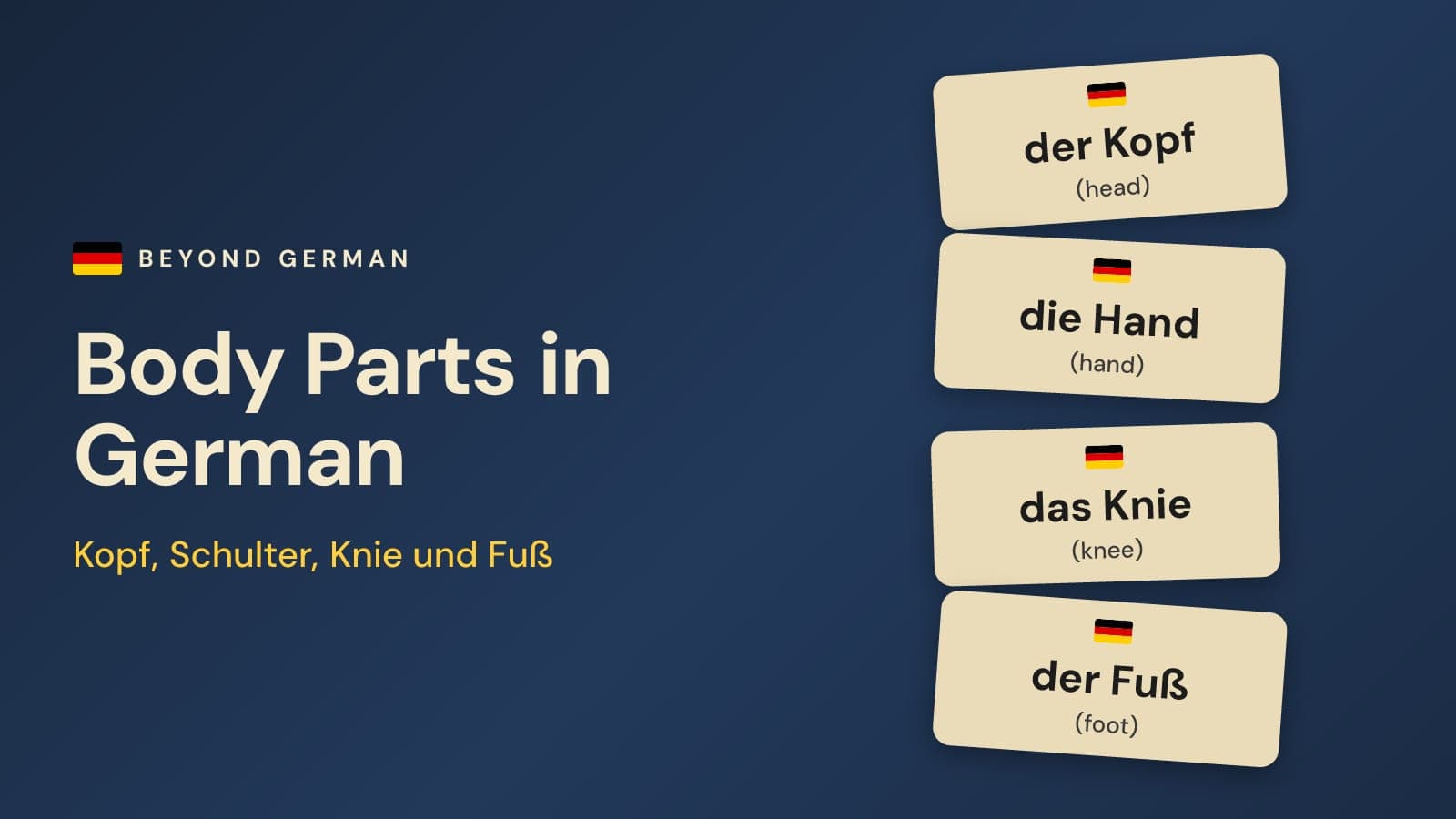
All the body parts in German with articles and plurals, how to say what hurts, the German "Head, Shoulders, Knees and Toes" song and everyday body idioms.