Cat in German: Katze, Kater, Kätzchen and Cat Idioms
 Beyond German Team
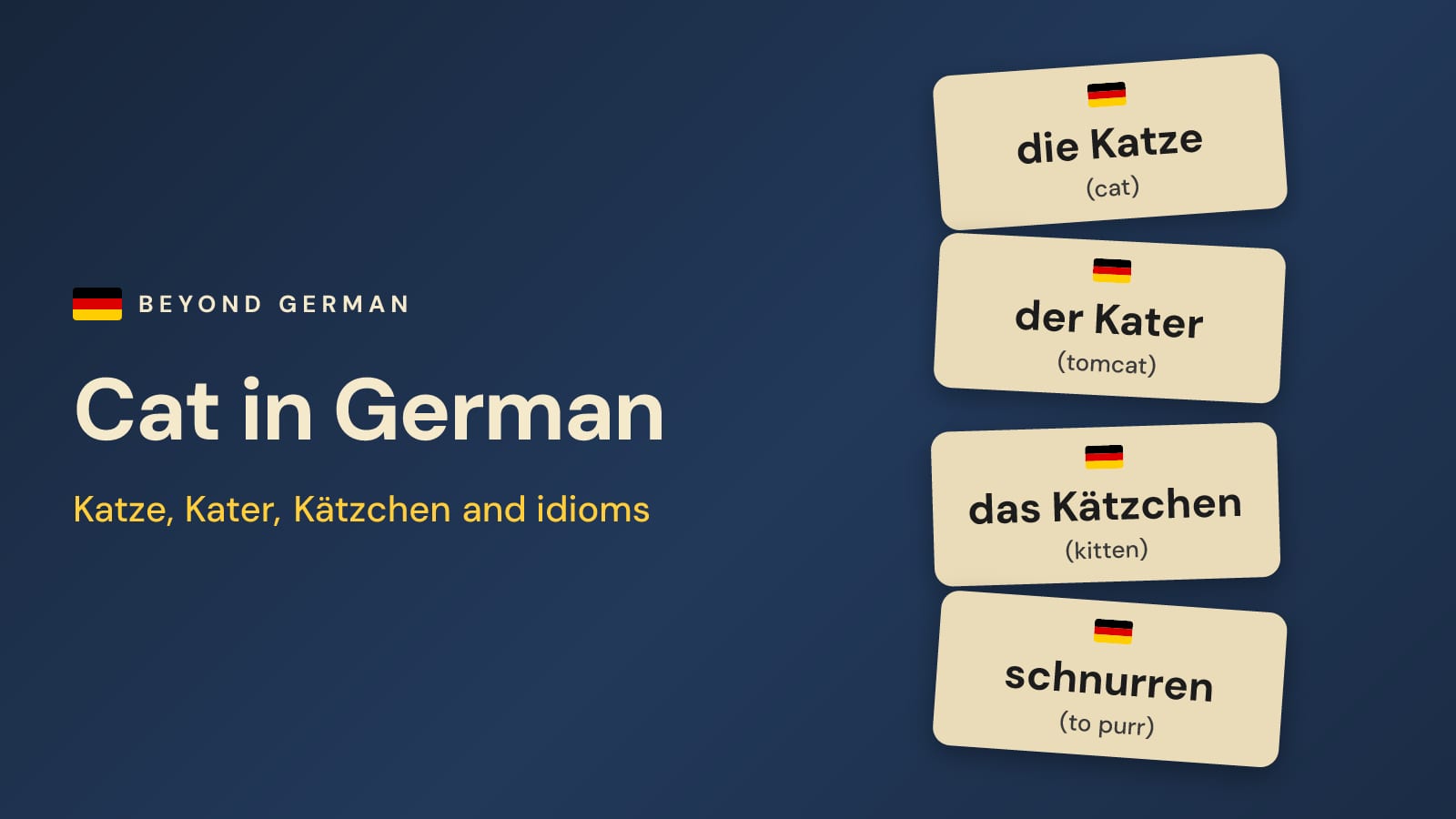
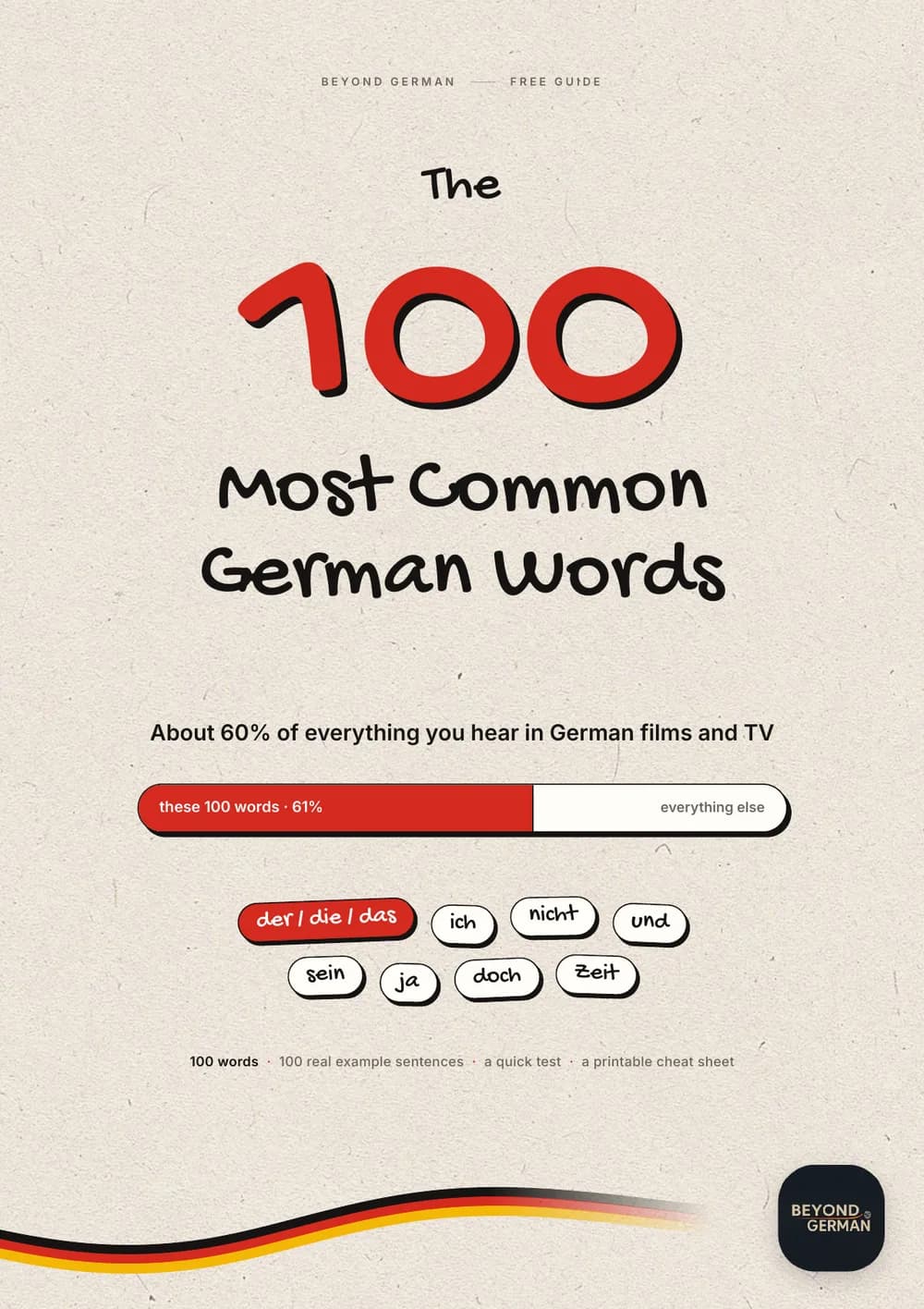
Cat in German is die Katze (KAT-seh), plural die Katzen. It's the everyday word for any cat, male or female. A male cat is der Kater (KAH-ter), and a kitten is das Kätzchen (KETS-hyen).
Below: a quick table, pronunciation, why it's die Katze but das Kätzchen, cat sounds, cat-owner German, why a German with a Kater may not own a cat at all, and the best idioms. Then mistakes, practice and quick answers.
Cat in German: The Quick Answer
These are the cat words you'll hear most:
| German | English | When to use it |
|---|---|---|
| die Katze | cat | Any cat; also a female cat |
| der Kater | tomcat, male cat | Male cats (also means a hangover) |
| das Kätzchen | kitten | Young or small cats |
| das Katzenbaby | kitten | Casual and cute |
| die Mieze, die Miezekatze | kitty | Informal, affectionate |
| der Stubentiger | "living-room tiger" | Playful word for a pet cat |
| die Samtpfote | "velvet paw" | Affectionate, a bit poetic |
| die Hauskatze | domestic cat | Neutral; the species |
If you only learn one, learn die Katze: it's correct for any cat you meet.
How to Pronounce Katze
Say KAT-seh. It sounds almost like English "cats" with a soft "uh" on the end. Three things to get right:
- tz sounds like "ts", as in "cats". The German z makes the same sound: Zeit (time) sounds like "tsite".
- The a is short, like the "a" in "father" said quickly.
- The final e is a soft "uh", never silent.
Two related words sound a little different:
- Kater (KAH-ter): a long a and a single t.
- Kätzchen (KETS-hyen): the ä sounds like the "e" in "bet", and the ch is the soft one from ich, a bit like the "h" in "huge".
Our guide to the German alphabet and pronunciation covers ä, z and both ch sounds.
Die Katze, der Kater, das Kätzchen: Gender and Plurals
Die Katze: Any Cat
Katze is a feminine noun, so it's die Katze whether the cat is male or female, and the pronoun is sie where English says "it" or "she":
- Wo ist die Katze? Sie schläft auf dem Sofa. (Where's the cat? She's asleep on the sofa.)
The pronoun follows the word, not the animal. Owners of a male cat often switch to er once they say der Kater or use his name: Oskar? Er liegt im Garten. (Oskar? He's lying in the garden.)
Der Kater: Male Cat
Der Kater (plural die Kater) is a male cat or tomcat. Female cats need no extra word: they're simply die Katze. So the question at the vet is: Ist das ein Kater oder eine Katze? (Is it a male or a female?)
- Unser Kater heißt Oskar. (Our tomcat is called Oskar.)
Das Kätzchen: Why Kitten Is Neuter
Kätzchen is Katze plus the diminutive ending -chen ("little"). Diminutives with -chen are always neuter, and the vowel usually gets an umlaut: die Katze becomes das Kätzchen. Our guide to der, die, das rules has more endings that tell you the gender.
The plural doesn't change: ein Kätzchen, zwei Kätzchen. You'll also hear das Katzenbaby (plural die Katzenbabys), and when a cat has a litter, Germans say she had Junge (young ones):
- Unsere Katze hat vier Junge bekommen. (Our cat had four kittens.)
Fun fact: Kätzchen are also the soft, furry catkins on willow trees, the Weidenkätzchen.
Plurals and "I Have a Cat"
| Singular | Plural | I have one |
|---|---|---|
| die Katze | die Katzen | Ich habe eine Katze. |
| der Kater | die Kater | Ich habe einen Kater. |
| das Kätzchen | die Kätzchen | Ich habe ein Kätzchen. |
Haben takes the accusative, so only the masculine changes: ein becomes einen. The plural Katzen follows a common pattern: feminine nouns ending in -e add -n. See German plural rules for the rest.
Cute and Playful Words for Cats
German has plenty of affectionate cat words:
- die Mieze (MEE-tseh) and die Miezekatze: kitty, puss. Informal and sweet. Keep it for cats: as old slang for a young woman, Mieze sounds dated and condescending.
- der Stubentiger (SHTOO-ben-tee-ger): literally "living-room tiger", from the old-fashioned word die Stube (living room, parlor). A playful word for a house cat.
- die Samtpfote (ZAMT-pfoh-teh): "velvet paw". Affectionate and a little poetic.
- das Büsi: a Swiss German word for a cat or kitty.
Cat Sounds and What Cats Do
A German cat says miau (mee-OW), and the verb is miauen. Here's what else cats do all day:
| German | English | Example |
|---|---|---|
| miauen | to meow | Die Katze miaut. (The cat is meowing.) |
| schnurren | to purr | Sie schnurrt auf meinem Schoß. (She's purring on my lap.) |
| fauchen | to hiss | Er faucht, wenn er Angst hat. (He hisses when he's scared.) |
| kratzen | to scratch | Sie kratzt am Sofa. (She's scratching the sofa.) |
| jagen | to hunt, to chase | Er jagt Mäuse. (He hunts mice.) |
| schlafen | to sleep | Sie schläft den ganzen Tag. (She sleeps all day.) |
| sich putzen | to groom itself | Die Katze putzt sich. (The cat is washing itself.) |
| streicheln | to pet, to stroke | Darf ich die Katze streicheln? (May I pet the cat?) |
Schnurren (SHNOOR-en) and fauchen (FOW-khen, with the throaty ch of Bach) almost sound like the noises they describe.
One more verb matters: animals fressen, people essen. Die Katze frisst. (The cat is eating.) Note the stem change: sie frisst.
How to Call a Cat in German
English speakers say "here, kitty kitty". Germans call Miez, miez, miez! (MEETS) or use the cat's name: Komm, Mieze! (Come here, kitty!) Luna, komm her! (Luna, come here!)
Also handy: Die Katze hat mich gekratzt. (The cat scratched me.) Ich bin allergisch gegen Katzen. (I'm allergic to cats.)
Talking About Your Cat
Pets are easy small talk:
- Hast du Haustiere? (Do you have any pets?) Das Haustier is literally a "house animal".
- Ja, ich habe eine Katze. (Yes, I have a cat.)
- Meine Katze heißt Luna. (My cat's name is Luna.)
- Sie ist drei Jahre alt. (She's three years old.)
- Sie ist schwarz-weiß. (She's black and white.)
- Unser Kater ist rot getigert. (Our tomcat is a ginger tabby.)
- Sie ist total verschmust. (She's super cuddly.)
- Bist du ein Katzenmensch oder ein Hundemensch? (Are you a cat person or a dog person?)
For fur colors, our guide to colors in German has the words you need. And if you're more of a dog person: dog is der Hund, and our guide to animals in German covers dogs and many more animals (Tier means animal).
Indoor Cat or Outdoor Cat?
German cat owners use two handy words:
- die Wohnungskatze: an indoor cat that lives only in the apartment. Luna ist eine reine Wohnungskatze. (Luna is strictly an indoor cat.)
- der Freigänger: an outdoor cat that comes and goes as it likes. Unser Kater ist ein Freigänger und kommt nur zum Fressen nach Hause. (Our tomcat is an outdoor cat and only comes home to eat.)
Careful: die Hauskatze usually means "domestic cat" (as opposed to a wild cat), not "indoor cat".
Here's a typical chat with a neighbor:
Neighbor: Ist das Ihre Katze? (Is that your cat?)
You: Ja, das ist Luna. (Yes, that's Luna.)
Neighbor: Die ist aber süß! (She's so cute!)
You: Danke! Könnten Sie sie am Wochenende füttern? Ich bin nicht da. (Thanks! Could you feed her this weekend? I'm away.)
Neighbor: Na klar, gern. (Of course, happy to.)
Cat Owner Vocabulary
Everything you need for life with a cat, with articles:
| German | English |
|---|---|
| das Katzenfutter | cat food |
| das Nassfutter, das Trockenfutter | wet food, dry food |
| der Napf | bowl |
| das Katzenklo | litter box |
| die Katzenstreu | cat litter |
| der Kratzbaum | cat tree, scratching post |
| das Katzenspielzeug | cat toy, cat toys |
| die Katzenminze | catnip |
| die Katzenklappe | cat flap |
| die Transportbox | cat carrier |
| das Halsband | collar |
| der Tierarzt, die Tierärztin | vet |
And the cat itself: das Fell (fur), die Pfote (paw), die Kralle (claw), der Schwanz (tail) and die Schnurrhaare (whiskers).
- Ich mache jeden Tag das Katzenklo sauber. (I clean the litter box every day.)
- Wir müssen morgen mit Luna zum Tierarzt. (We have to take Luna to the vet tomorrow.)
- Die Katze schläft lieber im Karton als auf dem Kratzbaum. (The cat would rather sleep in the box than on the cat tree.)
Der Kater: Tomcat, Hangover and Muskelkater
Ich habe einen Kater can mean "I have a tomcat". But on the morning after a party, it means I have a hangover:
- Nach der Party hatte ich einen fürchterlichen Kater. (After the party I had a terrible hangover.)
Context makes it clear. Dictionaries trace this Kater to old student slang, probably a playful twist on Katarrh (catarrh, a heavy cold). So if the Prost flows too freely (see our guide to cheers in German), you may wake up with a Kater, no cat required.
Two more words belong here:
- der Katzenjammer: literally "cats' wailing". The miserable, regretful mood after a big night, or after any big excitement fades.
- der Muskelkater (MOOS-kel-kah-ter): sore muscles after exercise, literally a "muscle tomcat". It often comes without an article: Ich habe Muskelkater in den Beinen. (My legs are sore.)
German Cat Idioms
These are the cat sayings you'll actually hear:
| German | Literally | Meaning |
|---|---|---|
| die Katze im Sack kaufen | to buy the cat in the sack | to buy something without checking it first |
| die Katze aus dem Sack lassen | to let the cat out of the sack | to reveal a secret or a plan |
| wie die Katze um den heißen Brei herumschleichen | to creep around the hot porridge like a cat | to beat around the bush |
| für die Katz sein | to be for the cat | to be for nothing, in vain |
| mit jemandem Katz und Maus spielen | to play cat and mouse with someone | the same as in English |
| ein Katzensprung | a cat's jump | a stone's throw, very close |
| eine Katzenwäsche | a cat's wash | a quick, minimal wash |
| Da beißt sich die Katze in den Schwanz. | That's where the cat bites its own tail. | It's a vicious circle. |
| Bei Nacht sind alle Katzen grau. | At night all cats are gray. | In the dark, differences don't show. |
| Wenn die Katze aus dem Haus ist, tanzen die Mäuse. | When the cat's out of the house, the mice dance. | When the cat's away, the mice will play. |
| wie Hund und Katze | like dog and cat | always fighting, like cats and dogs |
Here they are in action:
- Kauf nicht die Katze im Sack: Mach erst eine Probefahrt! (Don't buy blind: take a test drive first!)
- Am Ende hat sie die Katze aus dem Sack gelassen: Sie zieht nach Wien. (In the end she let the cat out of the bag: she's moving to Vienna.)
- Hör auf, um den heißen Brei herumzureden! (Stop beating around the bush!) This shorter version, without the cat, is the one you'll hear most.
- Die ganze Arbeit war für die Katz. (All that work was for nothing.)
- Der Bahnhof ist nur einen Katzensprung entfernt. (The station is just a stone's throw away.)
- Ohne Erfahrung kein Job, ohne Job keine Erfahrung: Da beißt sich die Katze in den Schwanz. (No experience, no job; no job, no experience: it's a vicious circle.)
Notice the short form Katz in für die Katz and Katz und Maus: it survives in these fixed phrases, but on its own the standard word is Katze. And "it's raining cats and dogs"? German leaves the animals out: Es regnet in Strömen. For more sayings, see our collection of funny German idioms.
Common Mistakes
Saying der Katze
Wrong: Der Katze schläft. Right: Die Katze schläft.
Katze is feminine. You will see der Katze, but only as the dative or genitive: Ich gebe der Katze Futter. (I give the cat some food.)
Using die for One Kitten
Wrong: die Kätzchen (for one kitten) Right: das Kätzchen
Die Kätzchen is the plural.
Dropping the Final e
Wrong: Ich habe eine Katz. Right: Ich habe eine Katze.
You may hear Katz in southern German and Austrian dialects, but standard German says Katze.
Calling a Female Cat Kater
Wrong: Unser Kater hat Junge bekommen. Right: Unsere Katze hat Junge bekommen.
A Kater is male, so he can't have kittens.
Forgetting the Umlaut
Wrong: Katzchen Right: Kätzchen
No ä on your keyboard? Write ae: Kaetzchen.
Saying essen for Cats
Wrong: Die Katze isst. Right: Die Katze frisst.
In standard German, animals fressen and people essen.
Practice
Try these, then check the answers below:
- Add the article: ___ Katze, ___ Kater, ___ Kätzchen.
- Give the plurals: eine Katze, zwei ___ and ein Kätzchen, zwei ___.
- Fill the gap: Die Katze liegt auf meinem Schoß und ___. (purrs)
- Translate: My cat's name is Luna.
- The morning after a party, your friend groans: Ich habe einen Kater. Does she have a new pet?
- Use an idiom to say the station is very close.
Answers: 1. die Katze, der Kater, das Kätzchen 2. Katzen, Kätzchen 3. schnurrt 4. Meine Katze heißt Luna. 5. Almost certainly not: she has a hangover. 6. Der Bahnhof ist nur einen Katzensprung entfernt.
Keep going: see more examples on the Katze word page, browse more animal words, then test yourself with the A1 German quiz.
FAQ
What is the German word for cat?
Die Katze (KAT-seh), plural die Katzen. It's feminine and works for any cat, male or female.
What is a male cat called in German?
Der Kater (KAH-ter), plural die Kater. A female cat is simply die Katze.
How do you say kitten in German?
Das Kätzchen (KETS-hyen), plural die Kätzchen. Casual German also says das Katzenbaby.
What does Kater mean in German?
It has two meanings: a male cat and a hangover. Ich habe einen Kater the morning after a party means "I have a hangover". Muskelkater means sore muscles after exercise.
Why is it die Katze but das Kätzchen?
The diminutive ending -chen makes a noun neuter, whatever its original gender. So die Katze becomes das Kätzchen, just as der Hund becomes das Hündchen.
What sound does a cat make in German?
A German cat says miau (mee-OW). The verb is miauen: Die Katze miaut. (The cat is meowing.) Purring is schnurren, and hissing is fauchen.
New from Beyond German
Learn every A1 word, with audio
The A1 Word Kit: 787 words sorted by real life in Germany, two example sentences each, and flashcards that remember for you.
See the kit · launch price €29Level Up Your German
Join 1,000+ learners getting weekly tips, grammar shortcuts, and cultural insights.
Share this article
Continue Reading

Goethe B1 Word List (Wortliste): What's on It and How to Learn It
The official Goethe B1 Wortliste explained in English: what's on it, how to read the entries, how big it really is, and a free extract of 39 B1 words by situation.
German for Nurses: Which Level You Need and How to Get There
Which German level nurses need for Germany: A2 for a recognition visa, B1 for Triple Win, B2 for the licence. Plus a study plan and 35 hospital words and phrases.
Goethe A1 Exam: Start Deutsch 1 Format, Syllabus and Tips
Everything about the Goethe A1 exam (Start Deutsch 1): the four parts with examples, scoring, the A1 syllabus, fees and a realistic plan to prepare.