
German Alphabet and Pronunciation: How to Say Every Letter
 Beyond German Team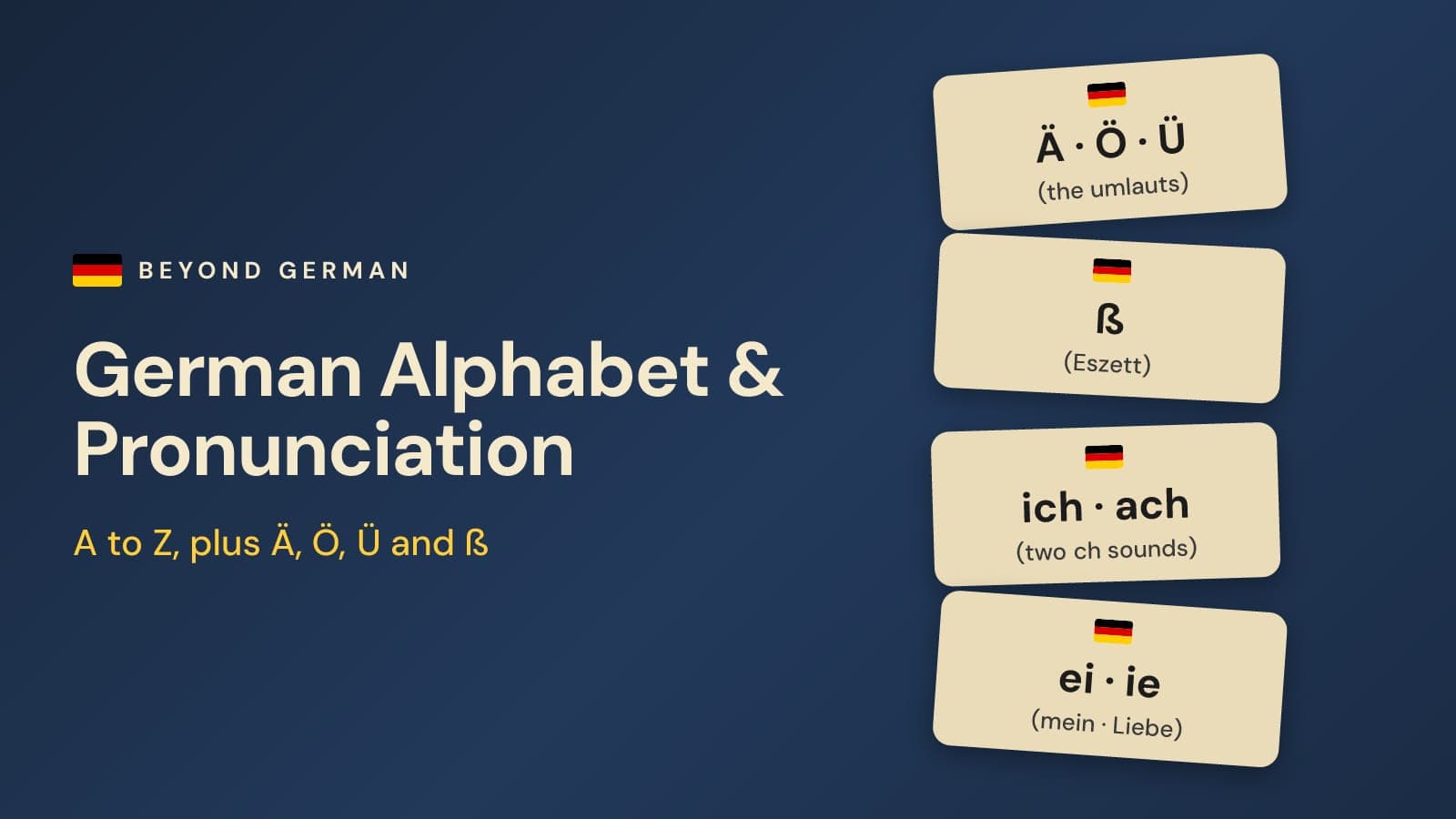
The German alphabet has the same 26 letters as English, plus four extras: ä, ö, ü and ß. The letters look familiar, but many sound different: w sounds like English v, v like f, z like ts and j like y. The good news is that German spelling is very regular, so once you know the rules, you can read almost any word aloud.
Below: every letter's name and sound, spelling out loud, the tricky sounds, word stress and when to write ß. Getting the sounds right is step one in our beginner's roadmap for learning German, and our Pronunciation Lab lets you hear and practice each one.
The German Alphabet: Letter Names and Sounds
The name is what you say when spelling; the sound is how the letter sounds in words (English comparisons are approximate).
| Letter | Name | Sound in words | Example |
|---|---|---|---|
| A a | a ("ah") | "ah" as in "father" | Abend |
| B b | be ("beh") | b; p at the end of a word | Brot, gelb |
| C c | ce ("tseh") | k or ts (mostly in loanwords) | Café, Celsius |
| D d | de ("deh") | d; t at the end of a word | du, Hund |
| E e | e ("eh") | "ay" (long), "e" in "bed" (short), "uh" (unstressed) | Tee, Bett, bitte |
| F f | ef ("eff") | f | fünf |
| G g | ge ("geh") | g in "go"; k at the end of a word | gut, Tag |
| H h | ha ("hah") | h; silent after a vowel | Haus, gehen |
| I i | i ("ee") | "ee" (long), "i" in "bit" (short) | Kino, Kind |
| J j | jot ("yot") | y in "yes" | ja |
| K k | ka ("kah") | k, even before n | Knie |
| L l | el ("ell") | l in "leaf" | lang |
| M m | em ("em") | m | Milch |
| N n | en ("en") | n | neun |
| O o | o ("oh") | "oh" (long), "o" in British "hot" (short) | Brot, kommen |
| P p | pe ("peh") | p | Post |
| Q q | qu ("koo") | always qu, said "kv" | Quatsch |
| R r | er ("air") | throaty r; "uh" after a vowel | rot, Bier |
| S s | es ("ess") | z before a vowel, otherwise s | Sonne, Haus |
| T t | te ("teh") | t (th is also t) | Tee, Theater |
| U u | u ("oo") | "oo" in "food" (long), "u" in "put" (short) | gut, Mutter |
| V v | vau ("fow") | f; v in some loanwords | Vater, Video |
| W w | we ("veh") | v | Wasser |
| X x | ix ("iks") | ks | Taxi |
| Y y | Ypsilon ("ÜP-see-lon") | like ü; like English in English words | Typ, Handy |
| Z z | zett ("tset") | ts | Zeit |
| Ä ä | ä, or a-Umlaut | "e" in "bed" | Männer |
| Ö ö | ö, or o-Umlaut | "ay" with rounded lips | schön |
| Ü ü | ü, or u-Umlaut | "ee" with rounded lips | müde |
| ß | Eszett ("ess-TSET") or scharfes S | s in "kiss" | Straße |
German has almost no silent letters: you pronounce the k in Knie, the p in Psychologie and the final e in bitte. The main exception is h after a vowel, which just makes the vowel long.
How to Spell Out Loud in German
You'll spell your name all the time: on the phone, at the doctor's or when you register at the Bürgeramt. Two questions to expect:
- Wie schreibt man das? — How do you spell that?
- Können Sie das bitte buchstabieren? — Could you spell that, please?
Germans spell with the letter names from the table. To avoid mix-ups on a bad line (m or n? b or p?), they add a word from the spelling alphabet: M wie Martha, "M as in Martha". Many people still use the traditional names, but in 2022 the standards body DIN switched to German cities. One reason: in 1934, the Nazis had removed Jewish names like David and Nathan, and their replacements (Dora, Nordpol) stayed in the table for decades. Both versions are understood (Austria and Switzerland have their own).
| Letter | Traditional | Since 2022 |
|---|---|---|
| A | Anton | Aachen |
| Ä | Ärger | Umlaut Aachen |
| B | Berta | Berlin |
| C | Cäsar | Chemnitz |
| D | Dora | Düsseldorf |
| E | Emil | Essen |
| F | Friedrich | Frankfurt |
| G | Gustav | Goslar |
| H | Heinrich | Hamburg |
| I | Ida | Ingelheim |
| J | Julius | Jena |
| K | Kaufmann | Köln |
| L | Ludwig | Leipzig |
| M | Martha | München |
| N | Nordpol | Nürnberg |
| O | Otto | Offenbach |
| Ö | Ökonom | Umlaut Offenbach |
| P | Paula | Potsdam |
| Q | Quelle | Quickborn |
| R | Richard | Rostock |
| S | Samuel (also Siegfried) | Salzwedel |
| ß | Eszett | Eszett |
| T | Theodor | Tübingen |
| U | Ulrich | Unna |
| Ü | Übermut (also Übel) | Umlaut Unna |
| V | Viktor | Völklingen |
| W | Wilhelm | Wuppertal |
| X | Xanthippe | Xanten |
| Y | Ypsilon | Ypsilon |
| Z | Zacharias (also Zeppelin) | Zwickau |
- Mein Name ist Meyer: M wie Martha, E wie Emil, Y wie Ypsilon, E wie Emil, R wie Richard. — My name is Meyer: M as in Martha, E as in Emil, Y as in Ypsilon, E as in Emil, R as in Richard.
That matters: Meyer, Meier, Maier and Mayer all sound the same. In email addresses, @ is "at" and a dot is Punkt. Didn't catch something? Wie bitte? is the polite way to ask again.
Long and Short Vowels
Every German vowel has a long and a short version, and the difference can change the meaning: Miete (rent) vs. Mitte (middle), Ofen (oven) vs. offen (open), Staat (state) vs. Stadt (city). Long vowels are pure: Tee is "tay" without the little y-glide English adds. The spelling usually tells you which you need:
| Spelling | Vowel | Examples |
|---|---|---|
| Double vowel (aa, ee, oo) | Long | Haar, Tee, Boot |
| Vowel + h | Long | fahren, Sohn, Uhr |
| ie | Long | Liebe, vier |
| Vowel + ß | Long | Straße, groß |
| Vowel + double consonant | Short | Bett, kommen, Wasser |
| Vowel + ck or tz | Short | Zucker, Katze |
Unstressed -e at the end of a word is never silent: bitte is "BIT-tuh" and Name is "NAH-muh".
Umlauts: Ä, Ö and Ü
The two dots change the sound, and often the meaning: schon (already) vs. schön (beautiful), zahlen (to pay) vs. zählen (to count). Umlauts also mark many plurals (der Apfel – die Äpfel); see our German plural rules.
- ä sounds like the "e" in "bed": Männer, Äpfel. When long, as in Käse, it's close to "air" without the r.
- ö: say "ay", keep your tongue still and round your lips: schön, hören. For short ö (können), start from the "e" in "bed".
- ü: say "ee", keep your tongue still and round your lips as if to whistle: über, müde. For short ü (fünf), start from the "i" in "bit".
The classic test is Kuchen, Küche, Kirche: cake, kitchen, church. If those three sound different, you've got it.
Vowel Pairs: ei vs. ie, eu/äu and au
The trick for ei and ie: say the English name of the second letter. So Wein (wine) sounds like "vine", and Wien (Vienna) like "veen".
| Spelling | Sounds like | Examples |
|---|---|---|
| ei (also ai) | "eye" | mein, drei, Mai |
| ie | "ee" | Bier, vier, Liebe |
| eu, äu | "oy" in "boy" | neu, Deutsch, Häuser |
| au | "ow" in "how" | Haus, Frau, auch |
- In Wien trinke ich Wein, kein Bier. — In Vienna, I drink wine, not beer.
Consonants That Sound Different From English
ch: The ich-Laut and the ach-Laut
German ch has two sounds, and the vowel before it decides which one:
- ach-Laut after a, o, u and au: a raspy sound at the back of the mouth, like Scottish "loch": acht, Nacht, Buch, auch.
- ich-Laut after all other vowels and after consonants: a soft hiss like the "h" in "huge", with more breath: ich, nicht, Milch, Mädchen.
To find it, whisper "yes" and stretch the y; it's neither "ish" nor "ick". And chs is "ks": sechs.
- Ich koche acht Eier. — I'm boiling eight eggs.
sch, sp and st
sch is English "sh" (Schule, Tisch). At the start of a word or word part, sp and st become "shp" and "sht": sprechen, Sport, Stadt, verstehen. Elsewhere, they sound as in English: Fenster, ist.
w, v, z and Other Surprises
| Spelling | Sounds like | Examples |
|---|---|---|
| w | English v | Wasser, wie |
| v | f (v in many loanwords) | Vater, viel / Video |
| z, tz | ts | Zeit, Katze |
| j | English y | ja, Jahr |
| s + vowel | z (often s in the south) | Sonne, lesen |
| ph | f | Alphabet |
| -tion | "tsyohn" | Information |
Volkswagen packs two of these into one word: "FOLKS-vah-gen".
- Wie viel Wasser trinkst du? — How much water do you drink?
Final Devoicing: Why Hund Ends in a t
At the end of a word or syllable, b, d and g become p, t and k: Hund ends in a t sound, gelb in a p, Tag in a k. That's why Rad (wheel) and Rat (advice) sound identical. Add an ending and the original sound comes back: Hunde ("HUN-duh"), Tage ("TAH-guh").
- Am Abend geht das Kind mit dem Hund in den Wald. — In the evening, the child goes into the forest with the dog.
The German r
Before a vowel, the standard German r is made at the back of the throat, like a light gargle: rot, Brot. To find it, say the ch in Bach and add your voice. A rolled r, common in parts of Bavaria, Austria and Switzerland, is fine too.
After a vowel, the r usually softens to "uh", and -er at the end of a word sounds like "uh": Bier ("BEE-uh"), Vater ("FAH-tuh"). Avoid an American "er" here.
-ig at the End of a Word
In standard German, a final -ig sounds like ich: richtig, billig, König. Add an ending and the g returns: die Könige. In southern Germany, Austria and Switzerland, you'll often hear "-ik", which is fine too. Numbers are full of -ig, so our German numbers guide makes good practice.
- Das ist richtig billig! — That's really cheap!
Word Stress Rules
German stress is fairly predictable (stressed syllables in capitals):
| Rule | Examples |
|---|---|
| Native words: first syllable | SPRE-chen, AR-bei-ten |
| be-, ge-, er-, ver-, zer-, ent- are never stressed | be-SU-chen, ver-STE-hen |
| Separable prefixes are stressed | AN-ru-fen, AUF-ste-hen |
| Compounds: first part | KRAN-ken-haus, BAHN-hof |
| Many foreign words: last syllable | Mu-SIK, Stu-DENT, Al-pha-BET |
| -ieren and -ei are stressed | stu-DIE-ren, Bä-cke-REI |
Stress can even change the meaning: UMfahren means "to knock down" (with a car), umFAHren "to drive around". Our guide to separable verbs explains why.
ß or ss? When to Use Each
ß always sounds like the s in "kiss". For this sharp s, whether you write ß or ss depends on the vowel before it:
- After a long vowel or a diphthong (ei, au, eu), write ß: Straße, groß, Fuß, heißen, weiß.
- After a short vowel, write ss: Wasser, Fluss, dass, muss.
That's why one verb can switch: wissen (short i), ich weiß (diphthong), ich wusste (short u). The rule comes from the 1996 spelling reform, so older texts still show daß and muß.
- Ich weiß, dass das Wasser heiß ist. — I know that the water is hot.
It matters: in Maßen means "in moderation", in Massen "in huge amounts". A few more facts: ß never starts a word, Switzerland doesn't use it at all (Strasse), and in capitals it's usually written SS, though a capital ẞ has been official since 2017.
Common Pronunciation Mistakes
| Word | Mistake | Say it like |
|---|---|---|
| Wasser | English w | "VAS-suh" |
| Wein, Wien | Mixing them up | "vine", "veen" |
| ich | "ick" or "ish" | A soft hiss, as in "huge" |
| Vater | An American "er" at the end | "FAH-tuh" |
| Hund | A d at the end | A t at the end |
| bitte, Name | A silent final e | "BIT-tuh", "NAH-muh" |
| Straße | Reading ß as B | "SHTRAH-suh" |
Practice: How to Train Your Pronunciation
You learn pronunciation by listening and copying, not by reading rules. A routine that works:
- Listen and repeat with the Pronunciation Lab, which drills umlauts, ch and r with audio.
- Shadow real speech: play a sentence, pause, and repeat it with the same rhythm.
- Drill minimal pairs: Wein/Wien, schon/schön, Mutter/Mütter, Miete/Mitte.
- Spell out loud your name, street and email address with the spelling alphabet.
- Use everyday phrases: start with German greetings like Grüß Gott and Tschüss, then introduce yourself in German out loud.
- Try a tongue twister: Fischers Fritz fischt frische Fische. — Fischer's Fritz fishes fresh fish.
FAQ
How many letters are in the German alphabet?
26, the same as English. Ä, ö, ü and ß come on top, so you'll sometimes see "30". In dictionaries, ä is sorted with a, ö with o, ü with u, and ß with ss.
Is German pronunciation hard for English speakers?
Less than you'd think. German spelling is far more regular than English, so words are almost always pronounced the way they're written. Only a few sounds (ü, ö, ch and the r) need real practice.
What does "Umlaut" mean?
Roughly "sound change": the dots show that the vowel's sound has shifted. They started as a small e written above the vowel, which is why ä, ö and ü can also be written ae, oe and ue.
How do I type ä, ö, ü and ß?
On a phone, hold down a, o, u or s. On a Mac, press Option+U and then the vowel for an umlaut, and Option+S for ß. Otherwise, add a German keyboard layout or write ae, oe, ue and ss.
Level Up Your German
Join 1,000+ learners getting weekly tips, grammar shortcuts, and cultural insights.
Share this article
Continue Reading
Colors in German: Rot, Blau, Grün and How to Use Them
All the colors in German with pronunciation, light and dark shades, when colors take endings, how to ask Welche Farbe hat…?, and the color idioms Germans really use.
Merry Christmas in German: Frohe Weihnachten & Traditions
Learn how to say Merry Christmas and Happy New Year in German, plus the traditions from Advent and Nikolaus to Heiligabend and Silvester, with food and market words.
Happy Birthday in German: Alles Gute zum Geburtstag & Wishes
Learn how to say happy birthday in German, from Alles Gute zum Geburtstag to formal card wishes, plus belated wishes, the birthday song and why Germans never congratulate early.