
German Plural Rules: How to Make Plurals in German
 Beyond German Team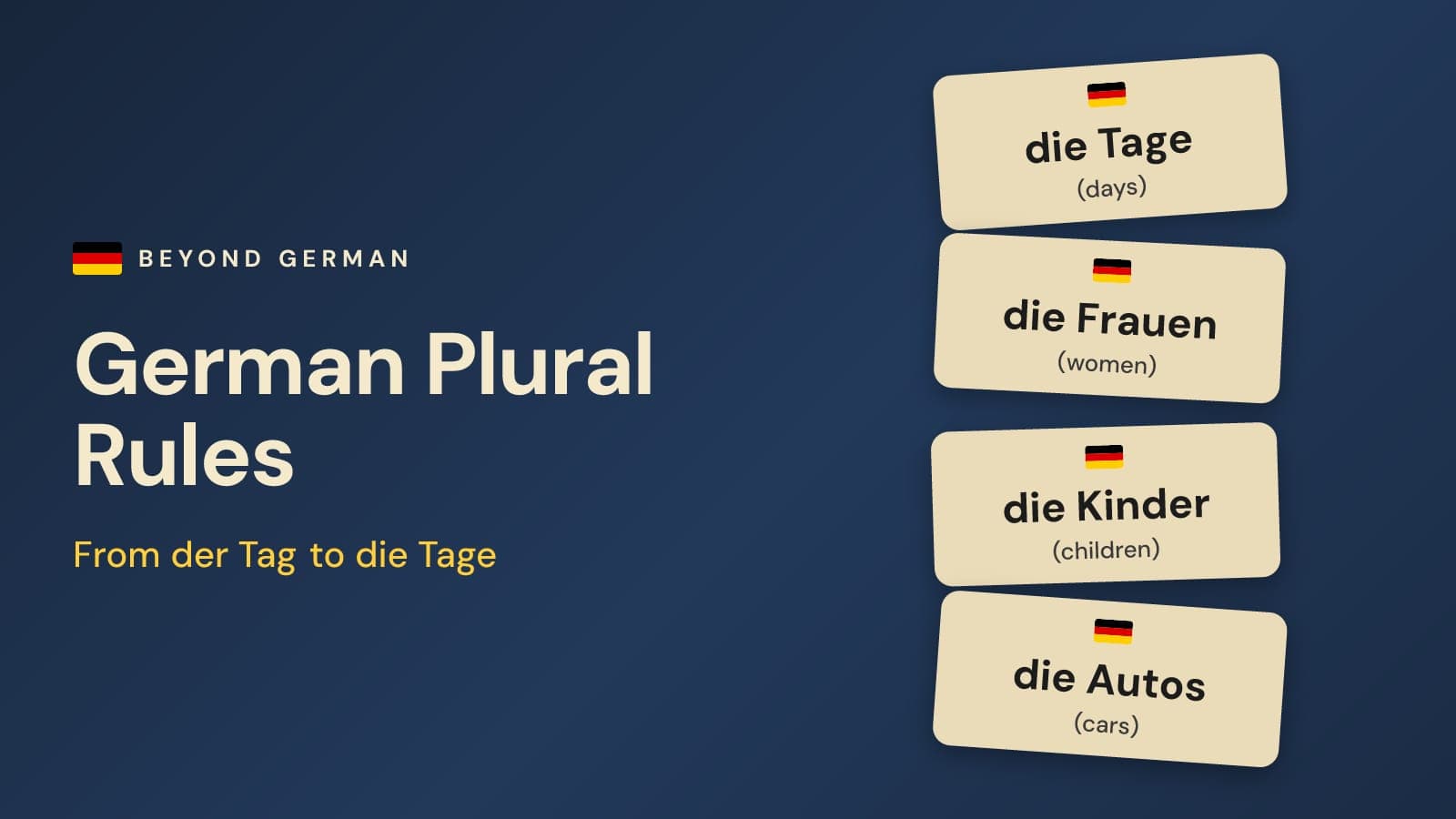
German nouns form their plurals in five main ways: they add -e, -(e)n, -er or -s, or they add nothing at all, and many also take an umlaut (der Baum – die Bäume). Which pattern a noun follows depends mostly on its gender and its ending, so a few rules let you predict most plurals. The article is the easy part: in the plural, it's always die.
Because gender is the key to the plural, this guide is the companion to our der, die, das rules for guessing noun gender. Start there if you're unsure of a noun's gender, then drill each pattern with real nouns in our German plural patterns tool.
The 5 German Plural Patterns at a Glance
Very reliable: rare exceptions. Reliable: a short list of exceptions. Tendency: a good first guess, nothing more.
| Pattern | Mainly for | Examples | Reliability |
|---|---|---|---|
| 1. -e (often with umlaut) | Masculine nouns | der Tag – die Tage, der Baum – die Bäume | Reliable (umlaut unpredictable) |
| 2. -(e)n | Feminine nouns | die Frau – die Frauen, die Lampe – die Lampen | Very reliable |
| 3. -er (umlaut where possible) | One-syllable neuter nouns | das Kind – die Kinder, das Haus – die Häuser | Tendency |
| 4. No ending (sometimes umlaut) | Masculine and neuter nouns in -er, -el, -en; all nouns in -chen, -lein | der Lehrer – die Lehrer, der Vater – die Väter | Very reliable |
| 5. -s | Foreign words, abbreviations, words ending in a vowel | das Auto – die Autos, das Handy – die Handys | Reliable |
Only patterns 1, 3 and 4 add an umlaut (a, o, u, au → ä, ö, ü, äu). -(e)n and -s plurals never do.
1. -e (Often With Umlaut): Most Masculine Nouns
Most masculine nouns add -e (those in -er, -el and -en follow pattern 4). Many also take an umlaut, and no rule tells you which, so learn the umlaut with the word:
- No umlaut: der Tag – die Tage, der Hund – die Hunde, der Tisch – die Tische
- With umlaut: der Baum – die Bäume, der Zug – die Züge, der Stuhl – die Stühle, der Arzt – die Ärzte
The same -e appears in many neuter nouns (das Jahr – die Jahre), in nouns ending in -nis, which double the s (das Ergebnis – die Ergebnisse), and in a small group of short feminine nouns, always with an umlaut: die Hand – die Hände, die Stadt – die Städte.
- Die Züge nach Hamburg sind heute voll. — The trains to Hamburg are full today.
2. -(e)n: Almost All Feminine Nouns
This is the most reliable plural in German. Feminine nouns ending in -e, -el or -er add just -n; all others add -en. There's never an umlaut.
- die Lampe – die Lampen, die Straße – die Straßen
- die Regel – die Regeln, die Schwester – die Schwestern
- die Frau – die Frauen, die Zeitung – die Zeitungen
Nouns in -in double the n: die Lehrerin – die Lehrerinnen. A few masculine and neuter nouns take -(e)n too: das Bett – die Betten, das Auge – die Augen, der See – die Seen.
The feminine exceptions are the short nouns from pattern 1 (die Hände), nouns in -nis (die Erlaubnisse), die Mutter – die Mütter, die Tochter – die Töchter and some foreign words (die Oma – die Omas).
- Meine Freundinnen wohnen alle in Köln. — My (female) friends all live in Cologne.
3. -er With Umlaut: Many Short Neuter Nouns
Many one-syllable neuter nouns add -er, and this pattern has one rule with no exceptions: if the vowel can take an umlaut, it does.
- No umlaut possible: das Kind – die Kinder, das Bild – die Bilder
- With umlaut: das Haus – die Häuser, das Buch – die Bücher, das Land – die Länder, das Wort – die Wörter
Some masculine nouns take -er too (der Mann – die Männer, der Wald – die Wälder), but feminine nouns never do.
It's only a tendency: many short neuter nouns take -e instead (das Tier – die Tiere, das Brot – die Brote).
- Die Häuser in unserer Straße sind sehr alt. — The houses on our street are very old.
4. No Ending: Nouns in -er, -el, -en, -chen and -lein
Masculine and neuter nouns ending in -er, -el or -en, and all nouns in -chen and -lein, look the same in the plural. Some masculine ones add an umlaut:
- Same form: der Lehrer – die Lehrer, das Zimmer – die Zimmer, das Mädchen – die Mädchen
- With umlaut: der Vater – die Väter, der Bruder – die Brüder, der Apfel – die Äpfel, der Garten – die Gärten
People and devices that do something (der Fahrer, der Drucker) never take an umlaut. Many family words follow this pattern; see our family vocabulary with plurals.
The article and the verb show the plural:
- Der Lehrer ist nett. Die Lehrer sind nett. — The teacher is nice. The teachers are nice.
Watch out: feminine nouns in -er and -el follow pattern 2 (die Kartoffel – die Kartoffeln); only Mutter and Tochter belong here. Rare exceptions: der Bauer – die Bauern, der Muskel – die Muskeln.
5. -s: Foreign Words, Abbreviations and Words Ending in a Vowel
English speakers reach for -s first, but only a few percent of German nouns use it, mostly words that don't look German:
- Words ending in -a, -i, -o, -u or -y: das Auto – die Autos, das Handy – die Handys, das Kino – die Kinos
- English and French loanwords: das Hotel – die Hotels, das Café – die Cafés, der Job – die Jobs
- Abbreviations and short forms: die CD – die CDs, die Uni – die Unis
Two details: words in -y just add -s (die Babys, die Partys, never "Babies"), and English words in -er follow pattern 4 (der Computer – die Computer). Some vowel-final words skip -s, like die Firma – die Firmen (see below).
- Die Hotels in der Altstadt sind teuer. — The hotels in the old town are expensive.
The Plural Article Is Always die (and the Dative Adds -n)
The good news: gender disappears in the plural. Every plural takes die, and words like meine and keine are the same for all genders. Only the case changes the article:
| Case | Article | Example |
|---|---|---|
| Nominative | die | Die Kinder spielen. — The children are playing. |
| Accusative | die | Ich sehe die Kinder. — I see the children. |
| Dative | den + noun + -n | Ich spiele mit den Kindern. — I'm playing with the children. |
| Genitive | der | das Zimmer der Kinder — the children's room |
That dative -n is easy to forget: mit den Freunden, in den Häusern, von meinen Eltern. Plurals that already end in -n or -s don't add another: mit den Frauen, in den Hotels. Our German dative case guide explains when you need the dative, for example after the dative prepositions mit, bei and von.
Note that ein has no plural: ein Kind, but just Kinder (or keine Kinder).
- Hast du Kinder? Ja, ich habe zwei Kinder. — Do you have children? Yes, I have two children.
Weak Nouns: -n Everywhere
Weak nouns are masculine nouns that add -(e)n in the plural and in every singular case except the nominative:
- Male people and animals ending in -e: der Junge – die Jungen (casually: die Jungs), der Kollege – die Kollegen, der Kunde – die Kunden, der Löwe – die Löwen
- Foreign words for people in -ent, -ant, -ist: der Student – die Studenten, der Praktikant – die Praktikanten, der Tourist – die Touristen
- A few others: der Mensch – die Menschen, der Nachbar – die Nachbarn, der Herr – die Herren
Because the singular takes -n too, only the article tells you whether there's one or more:
- Ich kenne den Studenten. — I know the student.
- Ich kenne die Studenten. — I know the students.
Nouns With No Plural, or Only a Plural
Singular Only
Mass nouns like das Obst (fruit), das Gemüse (vegetables), die Milch, das Geld (money) and das Gepäck (luggage) have no everyday plural. To count them, add a word: drei Gepäckstücke (three pieces of luggage), viele Obstsorten (many kinds of fruit). More food words with articles are in our German food and drink vocabulary.
Plural Only
Some nouns exist only in the plural: die Leute (people), die Eltern (parents), die Geschwister (siblings), die Ferien (school or university holidays) and die Kosten (costs). Leute has no singular: for one person, say eine Person or ein Mensch.
- In den Ferien besuchen wir meine Eltern. — During the holidays, we're visiting my parents.
Where English and German Disagree
Some English plurals are singular in German: die Brille (glasses), die Hose (trousers, pants), die Schere (scissors). And some English uncountables are usually plural in German: die Möbel (furniture), die Informationen (information), die Nachrichten (the news).
- Die Möbel sind neu. — The furniture is new.
Irregular and Latin/Greek Plurals
Many loanwords, especially from Latin and Greek, swap their ending for -en, and a few keep a Latin plural in -a:
| Singular | Plural | English |
|---|---|---|
| das Museum | die Museen | museum |
| das Zentrum | die Zentren | center |
| das Thema | die Themen | topic |
| die Firma | die Firmen | company |
| das Datum | die Daten | date (die Daten also means "data") |
| das Konto | die Konten | bank account |
| das Visum | die Visa (or Visen) | visa |
| das Praktikum | die Praktika | internship |
- Für die Reise brauchen wir zwei Visa. — We need two visas for the trip.
A few nouns even have two plurals with different meanings: die Bank becomes die Bänke (benches) or die Banken (banks).
Compound Nouns: The Last Part Decides
A compound takes its plural from its last part, just like its gender: das Krankenhaus – die Krankenhäuser, der Bahnhof – die Bahnhöfe, das Wörterbuch – die Wörterbücher.
How to Learn German Plurals
The most useful habit: never learn Tisch; learn der Tisch, die Tische. Put all three on your flashcards and say them aloud together.
Textbooks show the plural in a short code: ¨ means "add an umlaut", and a dash on its own means "no ending":
| Entry | Plural |
|---|---|
| der Tag, -e | die Tage |
| der Baum, -¨e | die Bäume |
| die Lampe, -n | die Lampen |
| das Haus, -¨er | die Häuser |
| der Lehrer, - | die Lehrer |
| der Vater, -¨ | die Väter |
| das Auto, -s | die Autos |
Then drill one pattern at a time, and count things around you out loud: ein Stuhl, zwei Stühle; eine Tasse, zwei Tassen.
Common Mistakes With German Plurals
The plural errors we see most (more in our list of common German mistakes English speakers make):
| Wrong | Right | Why |
|---|---|---|
| zwei Tischs | zwei Tische | -s is mainly for foreign words. |
| die Hause | die Häuser | Haus takes -er, and -er plurals add an umlaut whenever they can. |
| mit den Kinder | mit den Kindern | The dative plural adds -n. |
| die Babies, die Computers | die Babys, die Computer | Loanwords follow German rules: -y just adds -s, and -er nouns take no ending. |
| zehn Euros | zehn Euro | After a number, Euro stays singular, like zwei Kilo. See our guide to German numbers and prices. |
| Meine Brille sind kaputt. | Meine Brille ist kaputt. | Die Brille (glasses) is singular in German. |
Practice: Make These Nouns Plural
Use the five patterns to form the plural of each noun.
- der Brief (letter)
- die Tasche (bag)
- das Kleid (dress)
- der Fernseher (TV set)
- das Radio (radio)
- die Wohnung (apartment)
- der Polizist (police officer)
- die Ärztin (female doctor)
Answers:
- die Briefe (masculine: -e)
- die Taschen (feminine in -e: -n)
- die Kleider (short neuter: -er)
- die Fernseher (masculine in -er: no ending)
- die Radios (ends in -o: -s)
- die Wohnungen (feminine: -en)
- die Polizisten (weak noun: -en)
- die Ärztinnen (-in: -innen)
Want more practice?
- Drill each plural type, exceptions included, in the plural patterns tool.
- Test your nouns and articles in the A1 German quiz.
- Review the article basics in our der, die, das grammar guide.
FAQ
Is there a rule for German plurals?
No single rule, but reliable patterns: gender plus ending predicts most plurals. For the rest, learn the plural with the noun.
What is the plural of der, die and das?
All three become die: der Tag, die Frau, das Kind → die Tage, die Frauen, die Kinder. In the dative it's den (plus -n on the noun), in the genitive der.
What is the most common plural ending in German?
-(e)n. Nearly half of all German nouns use it, including almost every feminine noun and every noun in -ung, -heit and -keit.
Why do some German plurals have an umlaut?
It's left over from old plural endings with an i-sound, which pulled the vowel toward the front of the mouth. English has the same leftovers: man – men, foot – feet, mouse – mice, just like Mann – Männer, Fuß – Füße, Maus – Mäuse.
Level Up Your German
Join 1,000+ learners getting weekly tips, grammar shortcuts, and cultural insights.
Share this article
Continue Reading
Colors in German: Rot, Blau, Grün and How to Use Them
All the colors in German with pronunciation, light and dark shades, when colors take endings, how to ask Welche Farbe hat…?, and the color idioms Germans really use.
I Love You in German: Ich liebe dich vs. Ich hab dich lieb
Learn when to say Ich liebe dich and when to say Ich hab dich lieb, plus German pet names, romantic phrases, texting codes like HDL and Valentine's Day customs.
Great and Awesome in German: Super, Toll, Ausgezeichnet & More
Super, toll, klasse or ausgezeichnet? Learn the German words for great, awesome, excellent and cool, from neutral to slang, plus compliments for people, food and looks.