Is German Hard to Learn? An Honest Answer for English Speakers
 Beyond German Team
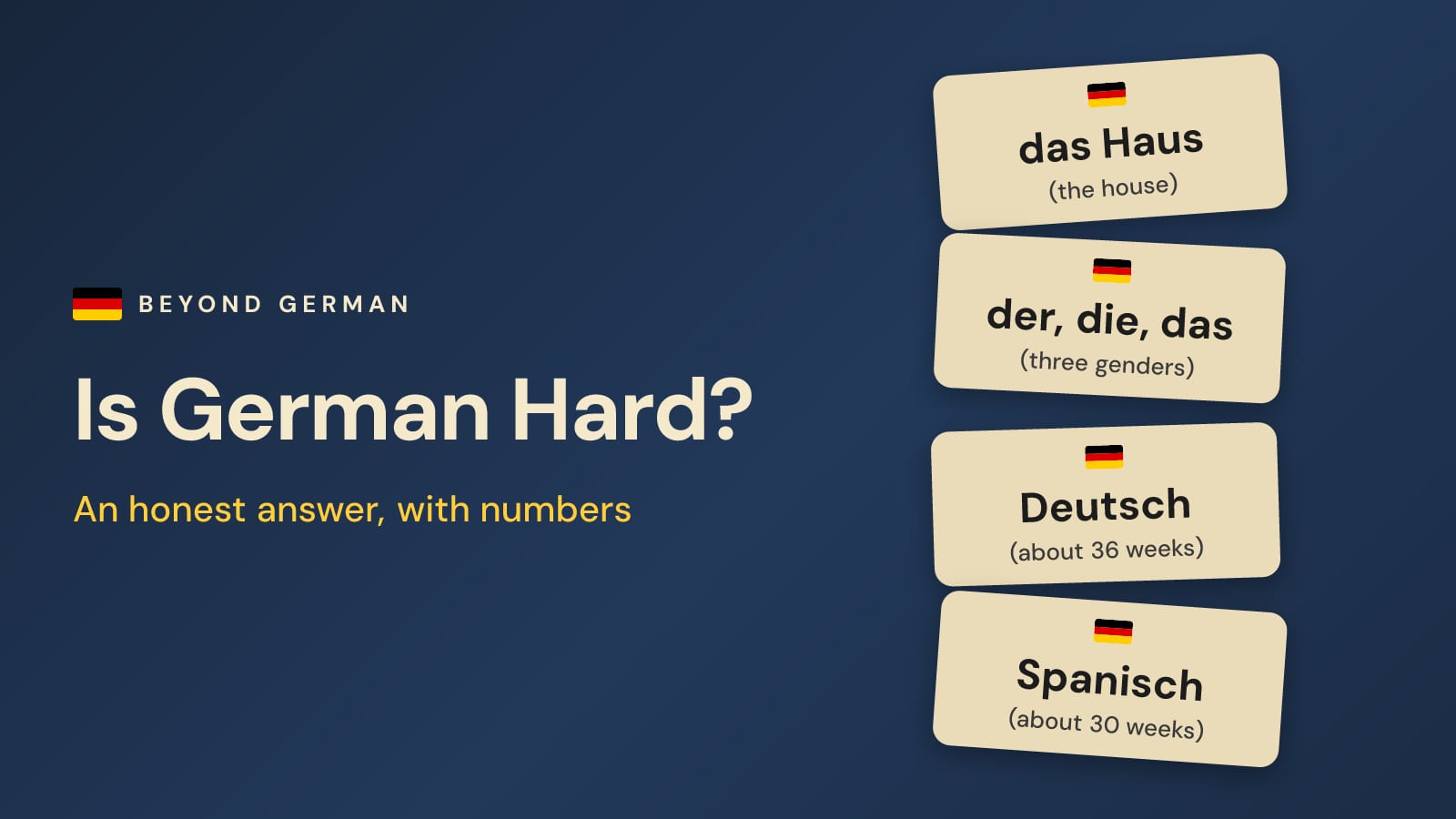
German is not one of the hardest languages for English speakers. It sits right in the middle: a little harder than Spanish, French or Dutch, easier than Russian, and far easier than Japanese or Arabic. The US Foreign Service Institute, which trains American diplomats, plans about 36 weeks of full-time study to bring an English speaker to professional German, against 24 to 30 weeks for Spanish, French and Dutch, and 88 weeks for Japanese.
Most of the difficulty comes from a short list of grammar points: three genders, four cases and a few word order rules. They are real, but they are predictable, and you meet them one at a time. Meanwhile, the easy parts of German start helping you on day one, because English and German are close relatives.
Below you'll find the official numbers, what's genuinely easy, what's genuinely hard (with the trick for each), how long each level takes, and the habits that make German feel much easier than its reputation.
How Hard Is German? The Official Numbers
The most quoted measure comes from the Foreign Service Institute (FSI). It groups languages by how long its English-speaking students usually need to reach professional working level, with about 23 hours of class and 17 hours of self-study a week:
| Language | FSI category | Full-time weeks | Class hours |
|---|---|---|---|
| Dutch, Danish, Swedish, Italian | I | 24 | 552 |
| Spanish, French | I | 30 | 690 |
| German | II | about 36 | about 828 |
| Russian, Polish, Turkish, Greek | III | about 44 | about 1,012 |
| Japanese, Korean, Arabic, Mandarin | IV | 88 | 2,200 |
Two things to keep in mind. First, you may see an older figure of 30 weeks and 750 hours for German in other articles; the FSI's current list says about 36 weeks. Second, these numbers are for a very high goal: speaking well enough to work as a diplomat. Getting comfortable with everyday German takes a fraction of that time, as the timeline further down shows.
What Makes German Easier Than You Think
You Already Know Hundreds of German Words
English and German grew from the same Germanic root, and the oldest, most everyday words still look alike. Many are identical or nearly so:
| German | English |
|---|---|
| das Haus | house |
| die Hand | hand |
| der Name | name |
| der Garten | garden |
| das Glas | glass |
| die Butter | butter |
| warm, alt, jung, neu | warm, old, young, new |
| singen, finden, kommen, lernen | sing, find, come, learn |
Even the words that look different often follow regular sound patterns. Once you know them, a lot of German vocabulary suddenly becomes guessable:
| English sound | German sound | Examples |
|---|---|---|
| th | d | three → drei, thing → Ding, thick → dick |
| d | t | day → Tag, drink → trinken, door → Tür |
| t | z, s or ss | ten → zehn, water → Wasser, eat → essen |
| p | f, ff or pf | sleep → schlafen, ship → Schiff, apple → Apfel |
On top of that, German has borrowed plenty of English (das Team, der Computer, cool), and English has borrowed German (kindergarten, angst, rucksack). Watch out for a few false friends, though: das Gift means poison, and bekommen means to get, not to become. Our list of common German mistakes English speakers make covers the rest.
You Can Read German the Way It's Written
English spelling is famously unreliable: think of though, through and tough. German is far more consistent. Learn a handful of rules (ei sounds like "eye", ie like "ee", w like "v", sch like "sh") and you can read most new words aloud correctly. You also keep the same alphabet, plus four extras: ä, ö, ü and ß. Our guide to the German alphabet and pronunciation covers every letter.
Everyday German Gets by With Few Tenses
English has continuous forms everywhere (I am learning, I was eating). German doesn't: Ich lerne Deutsch. means both "I learn German" and "I'm learning German". In conversation, you mostly need the present and the perfect tense, plus a few simple past forms like war (was) and hatte (had). The present also covers the future when a time word makes it clear:
- Ich fliege morgen nach Berlin. (I'm flying to Berlin tomorrow.)
- Ich habe gestern Pizza gegessen. (I ate pizza yesterday.) This is the perfect tense, the everyday past in spoken German.
Long Words Are Just Building Blocks
German's long words look scary, but they are usually small words you already know, glued together. The last word says what the thing is, and the words before it say what kind:
- der Handschuh = hand + shoe: a glove
- der Kühlschrank = cool + cupboard: a fridge
- das Krankenhaus = sick + house: a hospital
Bonus: the last part also decides the article. Der Schrank gives der Kühlschrank, and das Haus gives das Krankenhaus.
What Makes German Hard (and the Trick for Each)
Here is the honest list. Each point is a real hurdle, and each one has a way around it:
| Hard part | Why it trips you up | What makes it manageable |
|---|---|---|
| Der, die, das | Every noun has a gender, and it's often not logical | Learn each noun with its article; use the endings that predict gender |
| Four cases | Articles change with a noun's role in the sentence | In the accusative, only the masculine article changes |
| Word order | Verbs move to second place or to the very end | Three fixed patterns cover most sentences |
| Adjective endings | Endings change with gender, case and article | Learn them late; people understand you without them |
| Plurals | There are several plural patterns, not just "add -s" | Learn the plural together with the noun |
| New sounds | ü, ö, ch and the German r don't exist in English | A week of ear training at the start pays off for years |
1. Der, Die, Das: Three Genders
Every German noun is masculine (der), feminine (die) or neuter (das), and the gender is often not logical: das Mädchen (the girl) is neuter. This is the part most learners find hardest.
The fix is simple but strict: never learn a noun without its article. And use the patterns that are reliable. Nouns formed with -ung, -heit, -keit and -schaft are feminine (die Zeitung, die Freiheit), and nouns made with the small-thing endings -chen and -lein are neuter (das Brötchen, das Mädchen). Our der, die, das rules show which endings you can trust.
2. Four Cases
German marks a noun's role in the sentence by changing the article. That's why word order can move around without changing the meaning:
- Der Hund sieht den Mann. (The dog sees the man.)
- Den Mann sieht der Hund. (The dog sees the man, with the stress on "the man".)
It sounds like a lot, but it arrives in small steps. At A1, you mostly use the nominative and the accusative, and in the accusative only the masculine article changes (der becomes den, ein becomes einen). The dative follows with words like mit and bei, and in everyday speech the genitive is often replaced by von. The German cases overview puts all four on one page.
3. Word Order: Where the Verb Goes
German verbs have fixed seats. In a normal sentence, the conjugated verb is the second element, even if something other than the subject comes first:
- Ich lerne heute Deutsch. (I'm learning German today.)
- Heute lerne ich Deutsch. (Today I'm learning German.)
After words like weil (because) or dass (that), the verb goes to the very end. And in a normal sentence, separable verbs split in two, with their small first part at the end:
- Ich lerne Deutsch, weil ich in Berlin arbeite. (I'm learning German because I work in Berlin.)
- Ich rufe dich morgen an. (I'll call you tomorrow.) The verb is anrufen.
Those three patterns cover most sentences you'll ever say. See German word order for the full picture and separable verbs for the third one.
4. Adjective Endings
Adjectives before a noun take endings that depend on gender, case and article: ein guter Kaffee, der gute Kaffee, mit gutem Kaffee. Even advanced learners slip here. The good news: a wrong ending almost never stops anyone from understanding you, so you can leave this topic for A2 and B1. When you're ready, German adjective endings made simple breaks it down.
5. Plurals
English mostly adds -s. German has several patterns: das Auto, die Autos; der Hund, die Hunde; das Kind, die Kinder; die Frau, die Frauen; der Apfel, die Äpfel. Learn each noun as a set (article, noun, plural) and plurals stop being a separate problem. The German plural rules show the patterns that do repeat.
6. Sounds English Doesn't Have
ü and ö, the two sounds of ch (soft in ich, rough in ach) and the German r need some practice. Spend your first week listening and copying short words out loud, and they'll feel normal sooner than you expect.
Is German Harder Than Spanish or French?
A little, on average, and mainly at the start. Spanish and French have two genders and no case endings on articles, so beginners can build correct sentences sooner. That's why the FSI plans about 30 weeks for them and about 36 for German.
German gives some of that back later. Its everyday vocabulary is closer to English, its spelling is more regular than French, and its verbs have fewer forms to learn than Spanish verbs. The result: German asks for more patience in the first months, and then gets steadily easier.
How Long Does It Take to Learn German?
It depends on hours, not months. The Goethe-Institut estimates the total hours of instruction you need to complete each level. Here are the levels and their hours:
| Level | What you can do | Total hours |
|---|---|---|
| A1 | Introduce yourself, order food, ask simple questions | 60-150 |
| A2 | Handle everyday tasks and simple conversations | 150-260 |
| B1 | Get by in most daily situations; the level asked for German citizenship | 260-490 |
| B2 | Work in German and follow most conversations | 450-600 |
The hours are cumulative: the B1 row counts everything from your first word. Here is what that means in months, depending on how much time you have each day:
| Level | 30 min a day | 1 hour a day | 2 hours a day |
|---|---|---|---|
| A1 | 4-10 months | 2-5 months | 1-2.5 months |
| A2 | 10-17 months | 5-9 months | 2.5-4.5 months |
| B1 | 17-33 months | 9-16 months | 4.5-8 months |
| B2 | 30-40 months | 15-20 months | 7.5-10 months |
For comparison, Germany's integration courses plan 600 lessons of 45 minutes, about 450 hours, to take learners from zero to B1. Living in Germany or speaking German every day moves you faster; long breaks slow you down. For a phase-by-phase plan, see our beginner's roadmap from A1 to B1.
How to Make German Easier
The learners who find German "not that bad" usually do the same few things:
- Learn nouns as a set. Article, noun and plural together: der Tisch, die Tische. It takes seconds per word and saves months later.
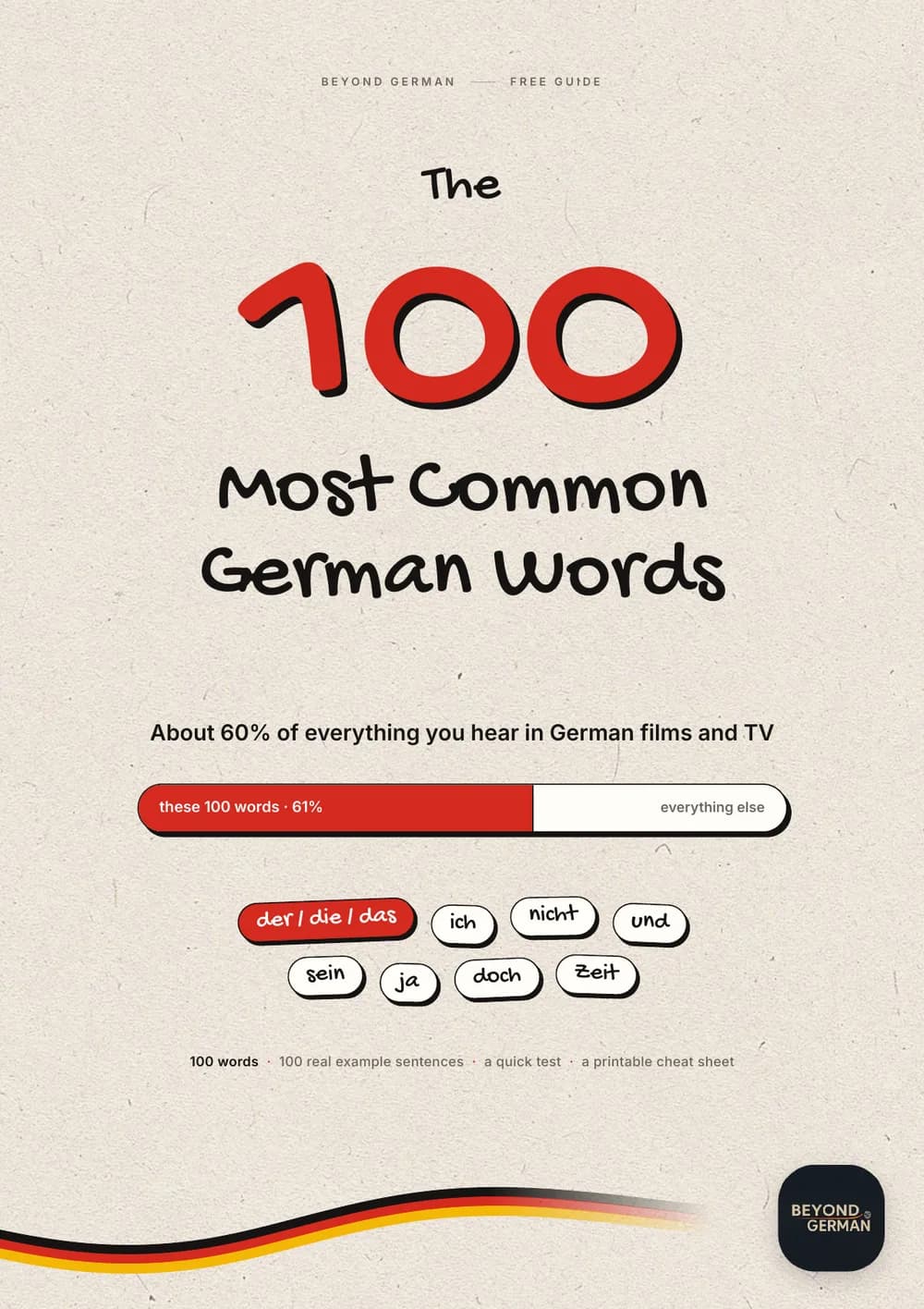
- Start with the most common words. A small core of words does most of the work in everyday German. Our free PDF of the 100 most common German words is a good first step, and how many words you need for A1 shows the full target.
- Learn phrases before rules. Ich hätte gern einen Kaffee. (I'd like a coffee.) works long before you can explain its grammar. Start with these German sentence patterns for beginners.
- Take grammar in a sensible order. Present tense and word order first, then the accusative, modal verbs and the perfect tense, and only then the dative and adjective endings.
- Listen every day. Even ten minutes of German audio trains your ear for the sounds and the rhythm.
- Speak from the first week. Read sentences aloud, talk to yourself, repeat after audio. Speaking early makes every later step easier.
- Review a little, often. Thirty minutes a day beats four hours on Sunday. Here's how to memorize German vocabulary so it sticks.
Common Mistakes That Make German Feel Harder
Learning Nouns Without Their Article
Wrong: Tisch = table. Right: der Tisch, die Tische = the table, the tables.
Adding the article later means learning every noun twice.
Translating Word for Word From English
Wrong: Wie bist du? Right: Wie geht es dir? (How are you?)
Wrong: Ich bin kalt. Right: Mir ist kalt. (I'm cold.)
Learn whole phrases for everyday situations instead of building them from English.
Trying to Master Everything at A1
Adjective endings, the genitive and most of the simple past can wait. Beginners who try to learn every table at once usually quit; beginners who learn what they need right now keep going.
Waiting Until Your German Is Perfect
Nobody speaks without mistakes at first. A sentence with a wrong ending still gets you your coffee, and every attempt makes the next one easier.
Your Next Step
- Find your level: the free German level test has 45 questions, gives your result right away and needs no sign-up.
- Get a plan: the study plan generator builds a weekly schedule for your goal and your time.
- Test yourself: try the A1 German quiz to see how much you already know.
- Want one path from zero to B1? Our self-study course from zero to B1 takes you through real situations in Germany and practice for each part of the exams. Join the waitlist to hear when it opens.
Keep learning:
- Goethe A1 Exam: Start Deutsch 1 Format, Syllabus and Tips
- German B1 Exam: Goethe vs telc, Format and How to Prepare
- German for Nurses: Which Level You Need and How to Get There
- Integration Course in Germany: How It Works, Cost and B1 Test
FAQ
Is German easy to learn for English speakers?
Easier than its reputation. German shares a lot of basic vocabulary with English and is spelled very regularly. The hard parts are genders, cases and word order, and you can learn them step by step.
Is German harder than Spanish?
Slightly. The FSI plans about 36 weeks of full-time study for German and 30 for Spanish. German grammar asks more at the start, while its vocabulary is closer to English.
How long does it take to learn German?
With about an hour a day, most learners reach A1 in 2 to 5 months and B1 in 9 to 16 months, based on the Goethe-Institut's estimate of 260 to 490 hours for B1.
What is the hardest part of German?
For most learners, it's remembering der, die or das and the case endings that come with them. Learning every noun with its article from day one solves most of it.
Can I learn German on my own?
Yes, up to B1 many people do, with a clear plan, daily listening and regular speaking practice, for example with a language partner.
Level Up Your German
Join 1,000+ learners getting weekly tips, grammar shortcuts, and cultural insights.
Share this article
Continue Reading
Goethe A1 Exam: Start Deutsch 1 Format, Syllabus and Tips
Everything about the Goethe A1 exam (Start Deutsch 1): the four parts with examples, scoring, the A1 syllabus, fees and a realistic plan to prepare.
Cat in German: Katze, Kater, Kätzchen and Cat Idioms
Cat in German is die Katze. Learn Kater and Kätzchen, pronunciation, cat sounds, cat-owner words, why Kater also means hangover, and the best idioms.
Grandma in German: Oma, Opa, Großmutter and Grandparents
Grandma in German is Oma and grandpa is Opa. Learn the formal words, plurals, cases, great-grandparents, card phrases and expressions with Oma.