How Many Words Do You Need for A1 German?
 Beyond German Team
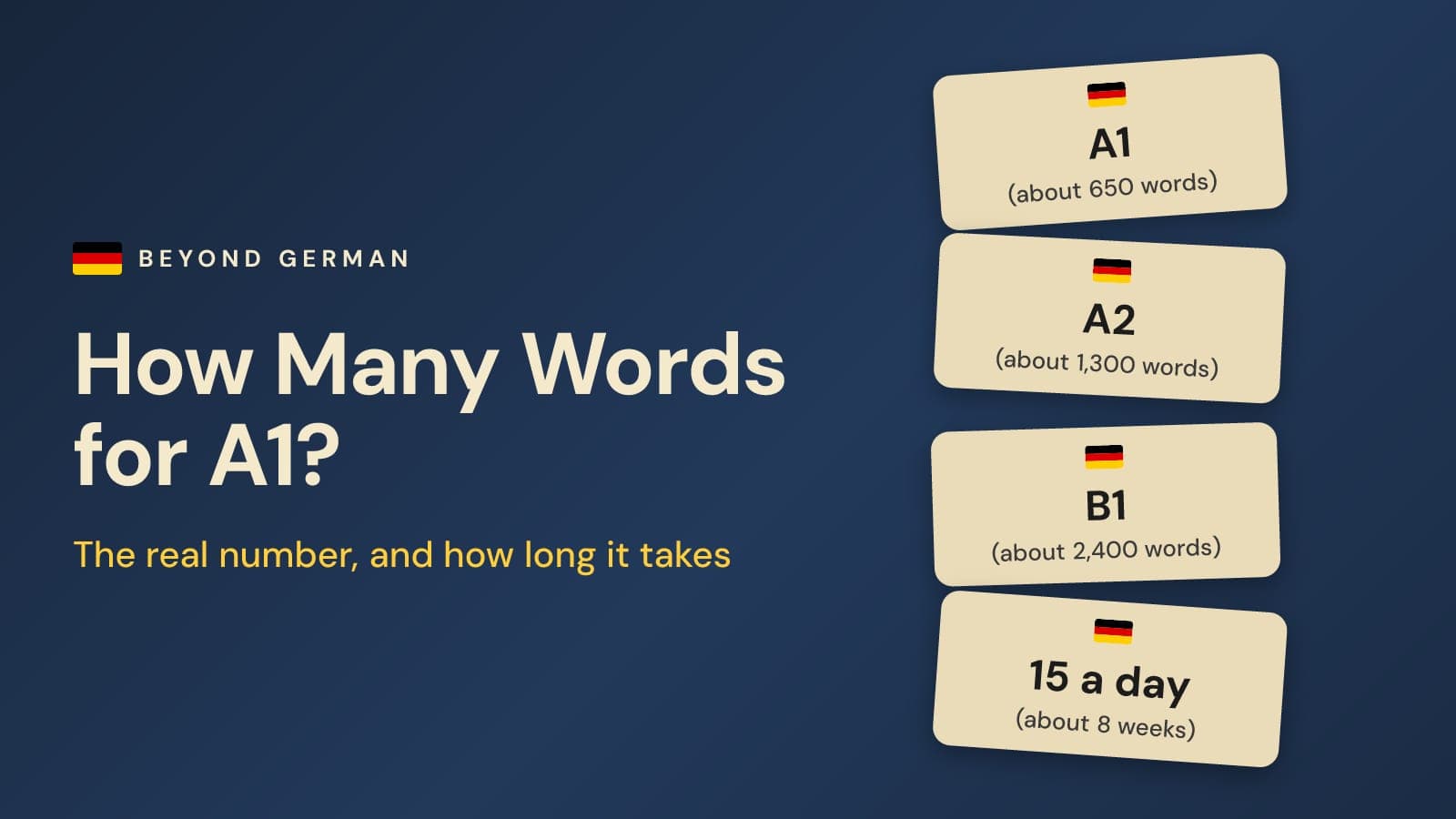
For A1 German you need about 650 words. That's the number the Goethe-Institut gives for its A1 exam, and it says you should be able to use about half of them yourself and recognise the rest. In practice, a solid A1 vocabulary is 700 to 800 words once you add the numbers, months and everyday words that come on top. With 15 new words a day, that's about two months of work.
Below you'll find the official numbers for A1, A2 and B1, what an A1 vocabulary actually looks like, which words to learn first, and how long it really takes.
The Official Numbers: A1, A2 and B1
The Common European Framework (CEFR), which defines the levels A1 to C2, doesn't say how many words each level needs. It describes what you can do. The clearest numbers come from the word lists the Goethe-Institut publishes for its exams:
| Level | Words on the Goethe list | What you can do |
|---|---|---|
| A1 | about 650 | Introduce yourself, shop, order food, ask the way, fill in a simple form |
| A2 | about 1,300 | Talk about your day and your past, handle routine tasks at work and at offices |
| B1 | about 2,400 | Get through most everyday situations, give your opinion, follow clear speech on familiar topics |
The A2 and B1 numbers are totals, so they include the words from the levels below. Roughly speaking, your vocabulary doubles from A1 to A2 and nearly doubles again to B1.
For a full tour of the A1 list itself (its topics, word groups and how to read it), see our guide to the Goethe A1 word list.
Recognising vs. Using: What "Knowing" 650 Words Means
A1 has two kinds of vocabulary, and mixing them up is why many learners feel they "know nothing" after weeks of study.
- Passive vocabulary (all ~650 words): you understand the word when you hear or read it. You see Ausgang on a sign and know it's the exit.
- Active vocabulary (about half, ~300 to 350 words): you can say or write the word yourself, with the right article and a usable form. You can ask Wo ist der Ausgang? without thinking for ten seconds.
So the honest A1 goal is: understand around 650 words and use around 300. The 300 you use should be the ones from your own life. Someone working in a hospital needs der Termin (appointment) actively from week one; a student may need der Kurs and die Prüfung first.
What an A1 Vocabulary Looks Like
When we built the A1 Word Kit, we took every word on the Goethe A1 list, added the word groups and a few everyday words you need in Germany from day one (like Pfand, the bottle deposit), and ended up with 787 words. Here's how they split by type:
| Word type | Words | Share | Examples |
|---|---|---|---|
| Nouns | 394 | 50% | der Bahnhof, die Miete, das Brötchen |
| Verbs | 159 | 20% | sein, haben, fahren, abholen |
| Adjectives | 86 | 11% | groß, müde, teuer |
| Adverbs | 59 | 7.5% | hier, heute, gern |
| Pronouns | 22 | 3% | ich, wir, mein, dieser |
| Set phrases | 20 | 2.5% | Guten Tag!, Wie bitte?, Kein Problem. |
| Prepositions | 20 | 2.5% | in, auf, unter, zwischen |
| Numbers | 17 | 2% | eins, zwölf, zwanzig, hundert |
| Articles, conjunctions and others | 10 | 1.5% | der/die/das, kein, und, aber |
Two things stand out:
- Half of A1 is nouns. Every one of them comes with der, die or das, and most have a plural. If you learn nouns without their article, you're learning half of A1 only halfway. Start with our list of 100 common German nouns with articles and plurals.
- The small words are few but everywhere. Pronouns, prepositions, articles and conjunctions make up less than a tenth of the list, yet you'll use some of them in every single sentence.
Which Words to Learn First
Not all 650 words are equal. A handful get you through the first conversations in Germany, and the rest build on them. If you're starting from zero, learn these 20 in your first week:
| German | English | German | English |
|---|---|---|---|
| Guten Tag! | Hello! | ich | I |
| Tschüss! | Bye! | sein (ich bin) | to be |
| danke | thanks | haben (ich habe) | to have |
| bitte | please; you're welcome | möchten (ich möchte) | would like |
| ja / nein | yes / no | brauchen | to need |
| Entschuldigung! | Excuse me! / Sorry! | wo? | where? |
| Wie bitte? | Sorry? / Pardon? | was? | what? |
| nicht | not | wie viel? | how much? |
| hier | here | heute | today |
| der Name | name | kommen (ich komme aus …) | to come (from) |
With these and a few more words, you can already manage real moments:
- Wie viel kostet das? How much is this?
- Wo wohnen Sie? Where do you live?
- Ich komme aus Syrien. I'm from Syria.
- Brauchst du Hilfe? Do you need help?
After that, go situation by situation: numbers and prices, then the bakery and café, shopping, getting around town, your flat. Our guides to essential German phrases and the 100 most common German verbs are good next steps.
How Long Does It Take to Learn A1 Vocabulary?
It depends on how many new words you add each day. Here's the simple maths for about 790 words, with a rough daily time that includes reviewing older words:
| New words a day | Time for ~790 words | Rough daily time |
|---|---|---|
| 10 | about 11 weeks | 15 minutes |
| 15 | about 8 weeks | 20 minutes |
| 20 | about 6 weeks | 30 minutes |
| 30 | about 4 weeks | 45 minutes or more |
For most people with a job or a family, 10 to 15 new words a day is the sweet spot. More than that, and the reviews pile up faster than you can do them. Rest days are fine; skipping reviews for a week isn't.
Vocabulary is only part of A1, of course. You'll also need basic grammar (present tense, word order, der/die/das) and lots of listening. Our beginner's roadmap shows how it all fits together.
Is 650 Words Enough to Pass the A1 Exam?
Yes, if you know them well. The Goethe-Zertifikat A1: Start Deutsch 1 has four parts (listening, reading, writing and speaking, which you do in a small group), and you pass with 60 out of 100 points. The exam is built on the word list. Texts can contain the odd word that isn't on it, but only where you don't need that word to answer.
What trips people up isn't usually a missing word. It's recognising a word they "know" when it's spoken fast, or forgetting the article when they need to say it. That's why listening and saying words out loud matter as much as the number of words.
Count Phrases, Not Just Words
A lot of A1 German works in fixed chunks you learn as a whole. You don't need to analyse Wie bitte? or Kein Problem.; you just need to say them at the right moment. A few examples from everyday life:
- Kein Problem, ich warte gern. No problem, I'm happy to wait.
- Danke für heute. Bis bald! Thanks for today. See you soon!
- Entschuldigung, ist hier noch frei? Excuse me, is this seat free?
Each of these counts as "one item" on your list, but it does the work of a whole sentence. Learning words inside sentences like these is also the fastest way to remember them; we show how in how to memorize German vocabulary.
Common Mistakes
- Chasing a big number. 300 words you can use beat 1,000 you half-recognise.
- Learning nouns without articles and plurals. Half of A1 is nouns. Learn die Rechnung, die Rechnungen, not just "Rechnung = bill".
- Learning from alphabetical lists. Group words by situation instead: everything you need at the doctor's, at the bakery, at the Bürgeramt.
- Never listening. If you've only seen a word, you may not recognise it when someone says it.
- Adding new words but skipping review. Without review, many new words fade within days.
Your Next Step
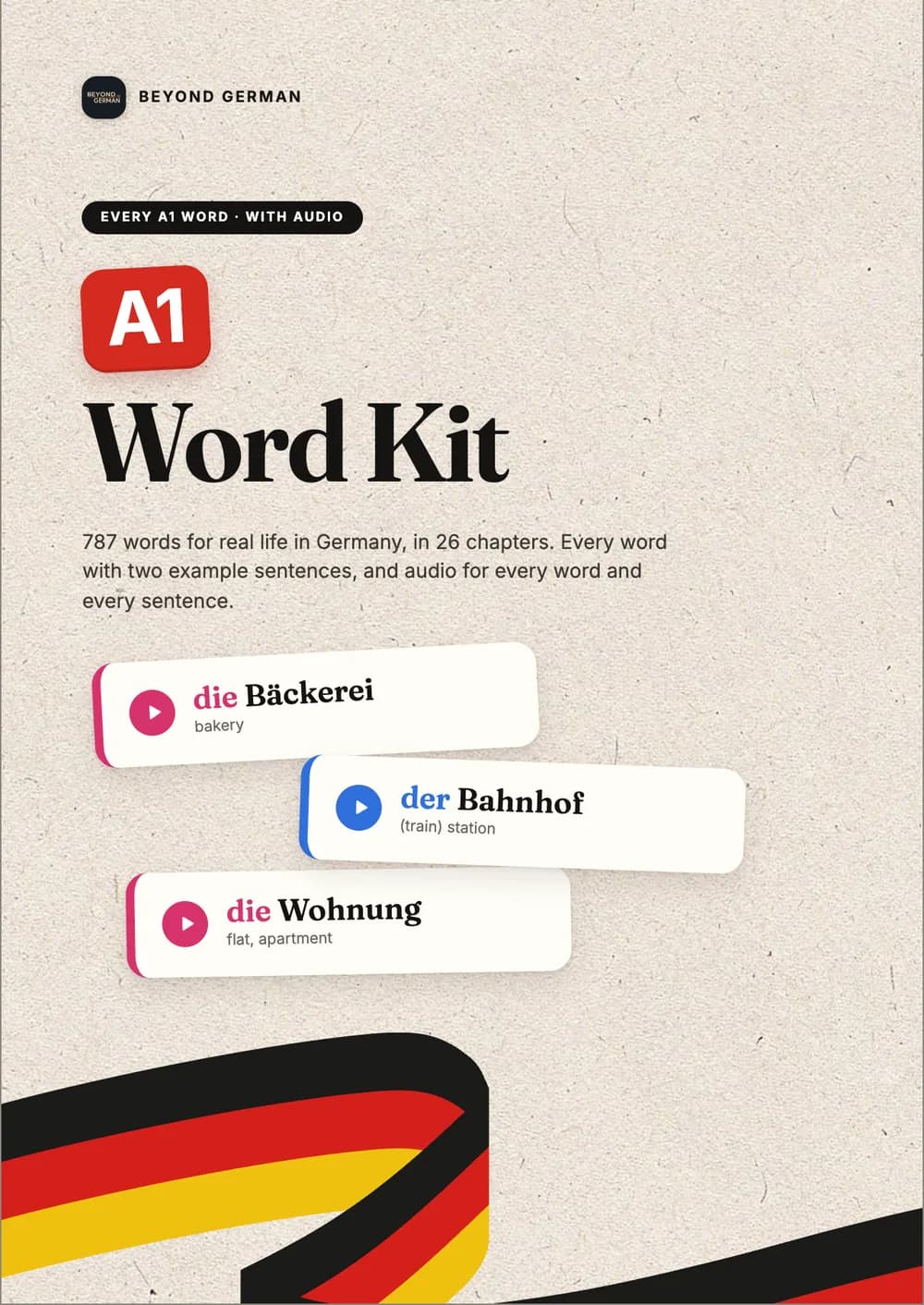
If you want all of A1 in one place, the A1 Word Kit has every word on the Goethe A1 list plus the everyday extras: 787 words in 26 real-life chapters, each with its article and plural or verb forms, two example sentences with English, and audio. The flashcards in your account handle the review schedule for you.
Or start small with the free 100-word sample: four chapters with all the audio, for just your name and email. Then check where you stand with our A1 quiz or the German level test.
FAQ
How many words do you need for A2 and B1 German?
About 1,300 words for A2 and about 2,400 for B1, according to the Goethe-Institut's word lists for those exams. Both numbers include the words from the lower levels.
How many German words should I learn a day?
10 to 15 new words a day works for most people, with 15 to 20 minutes of practice. That gets you through A1 vocabulary in two to three months without the reviews piling up.
Can I learn A1 vocabulary in a month?
It's possible at around 25 to 30 new words a day, but it takes 45 minutes or more daily and a strict review routine. If you have an exam date, it's doable; if not, a steadier pace sticks better.
Do I need to learn every word on the A1 list?
You should recognise all of them, but you only need to use about half actively. Focus your active practice on the words from your own daily life.
New from Beyond German
Learn every A1 word, with audio
The A1 Word Kit: 787 words sorted by real life in Germany, two example sentences each, and flashcards that remember for you.
See the kit · launch price €29Level Up Your German
Join 1,000+ learners getting weekly tips, grammar shortcuts, and cultural insights.
Share this article
Continue Reading
How to Memorize German Vocabulary So It Actually Sticks
Seven habits that make German words stick: learn by situation, with articles, in sentences and out loud, then test yourself and review on a schedule.
Common German Nouns With Articles and Plurals: 100 A1 Words
100 common German nouns for A1 with der, die or das, the plural and English, sorted by real life: home, food, town, work, the doctor's and the Bürgeramt.
Goethe A1 Word List: What's on It and How to Learn It
What's on the official Goethe A1 word list (Wortliste), how to read it, a free 40-word extract with English, and the fastest way to learn every word.