How to Memorize German Vocabulary So It Actually Sticks
 Beyond German Team
The fastest way to memorize German vocabulary is to learn fewer words, more completely: learn words by situation instead of from long lists, learn each noun with its article and plural, put every word into a sentence, say it out loud, test yourself before you look, and review on a schedule (the next day, a few days later, a week later). Twenty minutes a day with that method beats an hour of rereading lists.
Below are the seven habits that make German words stick, a simple daily routine, and the mistakes that make most learners forget what they studied last week.
Why German Words Don't Stick
If you've ever learned 30 words on a Sunday and remembered five by Thursday, nothing is wrong with your memory. Your brain keeps what it uses and drops what it doesn't. A word you read once, in a list, with no situation attached, looks unused, so it fades.
German adds two extra problems. Nearly every noun has a gender you can't see (der, die or das), and many words change their form: fahren becomes er fährt, der Zug becomes die Züge. Learn only "Zug = train" and you've learned a third of the word.
The good news: two of the most reliable findings about memory are on your side. Words you try to recall stick better than words you reread, and words you review spread out over time stick better than words you cram. The habits below are built on exactly that.
1. Learn Words by Situation, Not by Alphabet
Your memory files things by meaning. Ten words you need at the bakery support each other; ten words that start with B don't. So learn in small sets that belong to one moment:
| At the bakery | English |
|---|---|
| die Bäckerei, die Bäckereien | bakery |
| das Brötchen, die Brötchen | bread roll |
| das Brot, die Brote | bread, loaf |
| der Kuchen, die Kuchen | cake |
| die Butter | butter |
| der Kaffee, die Kaffees | coffee |
| die Rechnung, die Rechnungen | bill, check |
| das Trinkgeld | tip |
Then picture yourself using them: Vier Brötchen, bitte. (Four rolls, please.) Ein Brötchen mit Butter, bitte. (A roll with butter, please.) When you're actually at the counter, the whole set comes back together.
This is also why the official Goethe A1 word list is hard to learn from directly: it's alphabetical. Regroup it by situation first.
2. Learn the Whole Word, Not Just the Translation
Decide once what "knowing a word" means, and learn that from day one. It's much harder to add an article to a word you've already memorized without one.
| Word type | What to learn | Example |
|---|---|---|
| Noun | article + plural | der Bahnhof, die Bahnhöfe |
| Verb | the er/sie form + the perfect | fahren: er fährt, ist gefahren |
| Separable verb | where the prefix goes | abholen: er holt ab, hat abgeholt |
| Adjective | its opposite | teuer (expensive) / billig (cheap) |
| Phrase | when you'd say it | Wie bitte? (when you didn't catch something) |
For nouns, the article is the part people skip, and it's the part you'll need most: it decides zum Bahnhof vs. zur Haltestelle. Practise with our list of 100 common German nouns with articles and plurals, and use the tips in der, die, das rules for the patterns. For verbs, the separable verbs guide explains why abholen splits in two.
3. Put Every Word in a Sentence About Your Life
A word on its own is a fact. A word in a sentence about you is a memory. For every new word, make one short sentence you could really say:
- Ich wohne in Berlin. I live in Berlin.
- Ich arbeite als Koch. I work as a cook.
- Ich fahre mit dem Fahrrad zur Arbeit. I cycle to work.
- Am Samstag schlafe ich lange. On Saturday I sleep in.
Keep the sentences simple and true. If you need sentence frames to start from, our German sentence patterns for beginners give you 20 of them.
4. Hear It, Then Say It Out Loud
Many learners can read a word but don't recognise it when someone says it fast, especially words with ü, ö, ch or a long compound like die Haltestelle. So listen to every word before you learn it, and then say it out loud, ideally the whole unit: "die Haltestelle, die Haltestellen".
Saying a word gives your memory one more way in, and it trains your mouth for the moment you need the word, so a word you've said a few times comes out faster. If the sounds are new to you, start with our guide to the German alphabet and pronunciation.
5. Test Yourself Before You Look
Rereading feels productive, but it mostly tests whether you recognise a word. Real conversations ask you to produce it. So test yourself in the direction that's harder:
- Look at the English: the bill.
- Say the German, with the article, before you check: die Rechnung.
- Only then look, and mark whether you got it.
The moment of effort, even when you get it wrong, is what makes the word stick. Getting it wrong and then seeing the answer is part of learning, not a failure.
6. Review on a Schedule (Spaced Repetition)
Review each word just as you're about to forget it, then wait a bit longer each time. A simple schedule that works well:
| Review | When |
|---|---|
| 1st | later the same day |
| 2nd | the next day |
| 3rd | 3 days later |
| 4th | a week later |
| 5th | 2 weeks later |
| 6th | a month later |
If you get a word wrong, it goes back to the start. Words you know well quickly move to long gaps, so your daily reviews stay short.
You can do this with paper flashcards in a box with dividers, or with a flashcard app that schedules the reviews for you. The tool matters less than doing it every day.
7. Use New Words the Same Day
Give every new set a job within 24 hours:
- Label things at home with sticky notes: der Schrank, das Fenster, der Kühlschrank.
- Write three sentences about your day with today's words.
- Talk to yourself while you cook or walk: "Ich brauche Milch. Die Milch ist im Kühlschrank."
- Use them on real people: at the bakery, with a tandem partner, in your course.
A 20-Minute Daily Routine
Here's the whole method in one session you can repeat every day:
| Minutes | What you do |
|---|---|
| 0 to 5 | Review the cards that are due today (English first, say the German) |
| 5 to 10 | Listen to 10 to 15 new words from one situation and repeat each one out loud |
| 10 to 15 | Make one sentence about your life for each new word |
| 15 to 20 | Test yourself on the new words, then add them to your review cards |
That's enough to learn the whole A1 vocabulary in about two months; see how many words you need for A1 German for the numbers. For a routine that also covers listening, reading and speaking, read a simple daily routine to learn German faster.
Common Mistakes
- Rereading lists. It feels like studying, but you're only practising recognition. Test yourself instead.
- Learning nouns without the article. Adding it later is twice the work, and the wrong article sticks.
- Too many new words, too few reviews. 50 new words a day soon means well over 100 reviews a day. Start with 10 to 15.
- Translating word for word. Ich habe Hunger is "I'm hungry", not "I have hunger". Learn the German sentence as a whole.
- Collecting apps instead of using one. Pick one system and stick with it for a month.
- Studying words you'll never use. Start with your own life: your job, your flat, your city.
Practice: Try the Method Now
Take these five words from the "your flat" situation and run them through steps 2 to 5:
- die Wohnung, die Wohnungen: flat, apartment
- die Miete, die Mieten: rent
- der Schlüssel, die Schlüssel: key
- der Vermieter, die Vermieter: landlord
- mieten (er mietet, hat gemietet): to rent
Make one true sentence with each, say them out loud, then cover the list and test yourself from the English. Tomorrow, test yourself again before you learn anything new. Then check your level with the A1 German quiz.
Let the Kit Do the Sorting
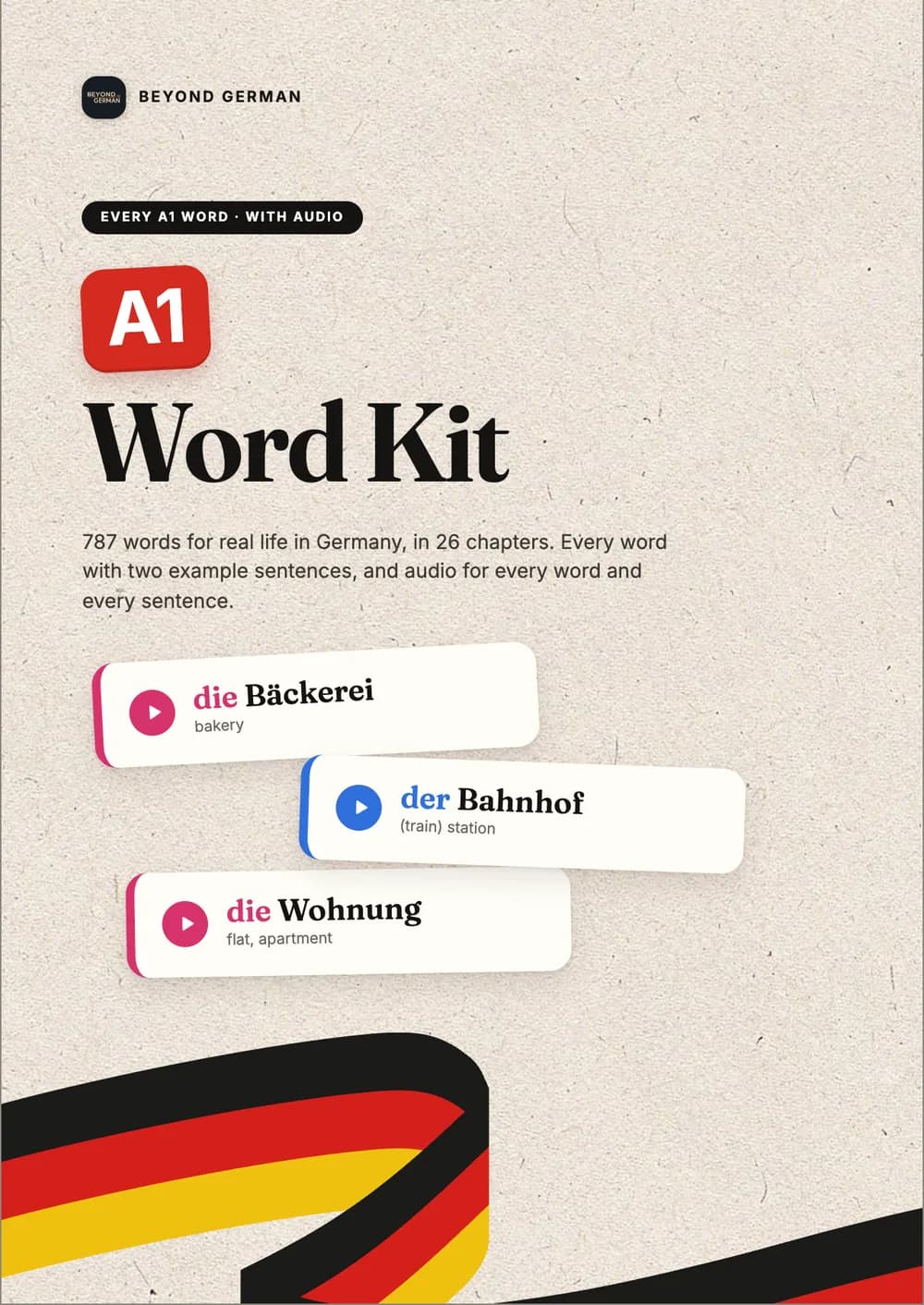
The A1 Word Kit is built around this method. It has all the words on the Goethe A1 list plus everyday extras, 787 in total, already grouped into 26 real-life situations. Every noun has its article and plural, every verb its key forms, and every word has two example sentences with English and audio in a natural German AI voice. The flashcards in your account run the review schedule for you, bringing each word back just before you'd forget it.
To see how it feels, get the free 100-word sample with all its audio: four chapters, from first conversations to getting around town.
FAQ
How can I memorize German vocabulary fast?
Learn 10 to 15 words a day from one situation, with articles and plurals, say them out loud in sentences, test yourself from English to German and review on a schedule. Speed comes from not having to relearn words you forgot.
How long does it take to learn 1,000 German words?
At 15 new words a day with daily reviews, about ten weeks. At 10 a day, a little over three months. Either pace is realistic next to a job.
Are flashcards good for learning German?
Yes, if each card has the whole word (article and plural, or verb forms), a sentence and ideally audio, and if you review them on a schedule. A card that only says "Zug = train" teaches very little German.
Does writing words down help?
It helps with spelling and makes you slow down, so it's worth doing for new words. But writing alone isn't enough: you also need to hear the word, say it and test yourself on it.
New from Beyond German
Learn every A1 word, with audio
The A1 Word Kit: 787 words sorted by real life in Germany, two example sentences each, and flashcards that remember for you.
See the kit · launch price €29Level Up Your German
Join 1,000+ learners getting weekly tips, grammar shortcuts, and cultural insights.
Share this article
Continue Reading
Common German Nouns With Articles and Plurals: 100 A1 Words
100 common German nouns for A1 with der, die or das, the plural and English, sorted by real life: home, food, town, work, the doctor's and the Bürgeramt.
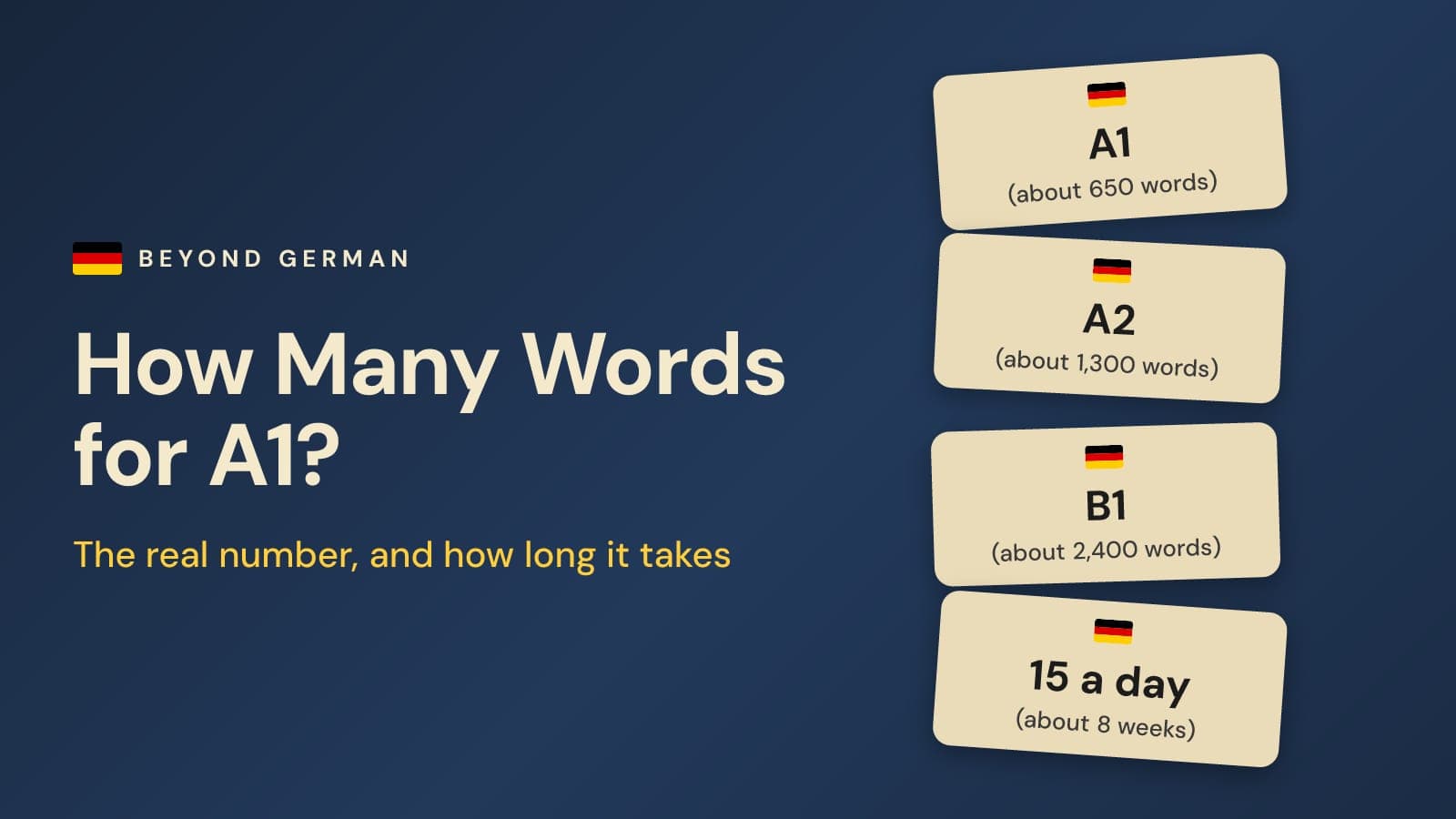
How Many Words Do You Need for A1 German?
About 650 words for A1, 1,300 for A2 and 2,400 for B1. What an A1 vocabulary really looks like, which words to learn first and how long it takes.
Goethe A1 Word List: What's on It and How to Learn It
What's on the official Goethe A1 word list (Wortliste), how to read it, a free 40-word extract with English, and the fastest way to learn every word.