
Der, Die, Das Rules: How to Guess German Noun Gender
 Beyond German Team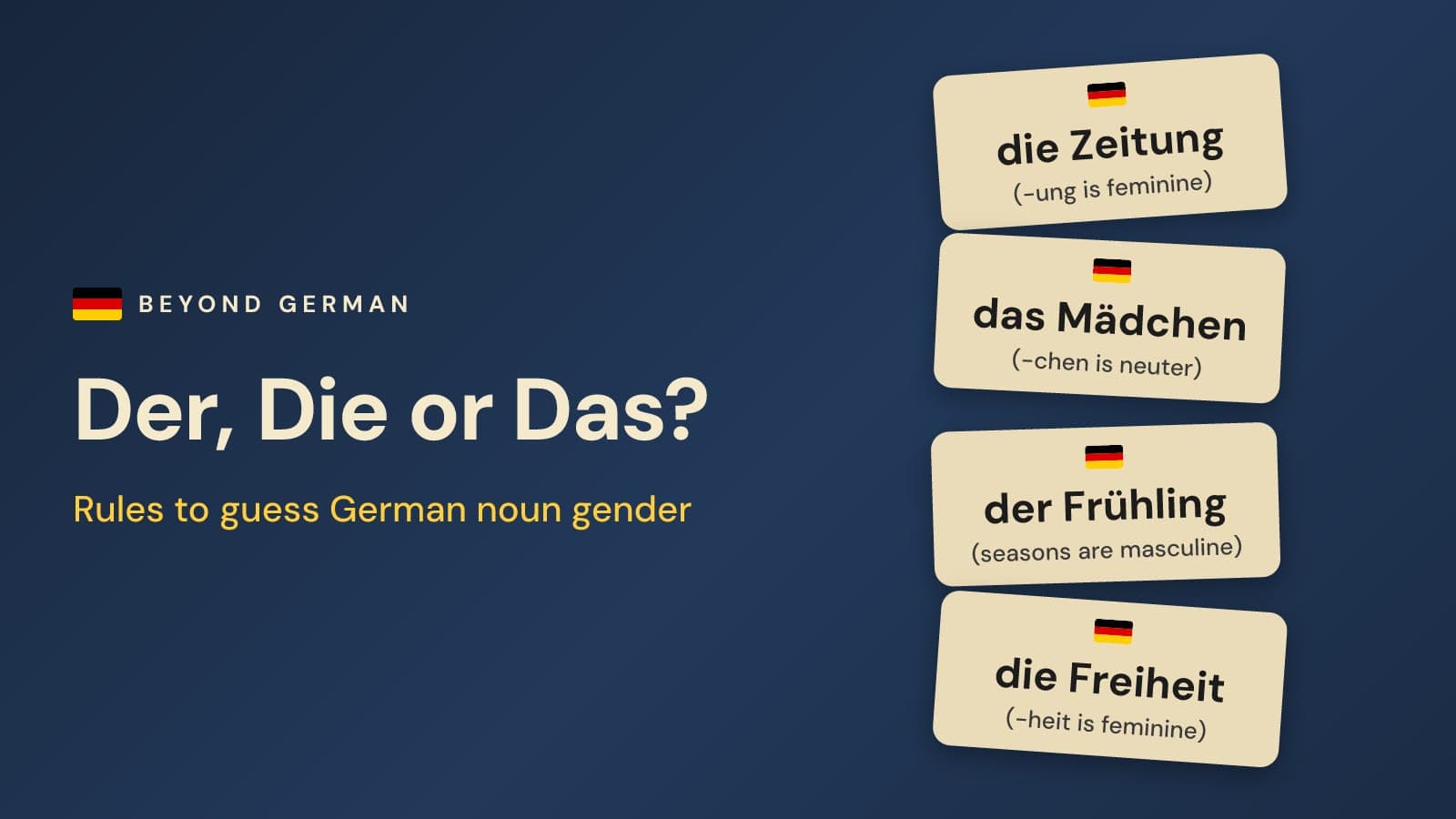
No single rule tells you whether a German noun is der, die or das, but there are plenty of clues. A noun's ending (-ung, -chen, -ismus), its meaning (days, metals, male people) and, in compounds, its last part often give the gender away. Some rules are close to 100% reliable; others are tendencies with exceptions you need to know.
This post is about guessing the gender of nouns you haven't learned yet. For the basics (the three articles, ein and eine, and the plural article die), start with our der, die, das guide to German articles and gender.
The Quick Checklist: How to Guess a Noun's Gender
When you meet a new noun, ask these questions in order:
- Is it a compound? Only the last part counts: der Haustürschlüssel gets its der from der Schlüssel.
- Is it male or female? Men and male animals are usually der, women and female animals die, unless the word ends in -chen or -lein (das Mädchen).
- Does it have a telling ending? -ung means die, -ismus means der, -chen means das.
- Does it belong to a meaning group? Days and months are der; metals and colors are das.
- Nothing fits? Then you have to memorize it, using the strategies below.
In the tables, Always means no common exceptions, Almost always means one or two, Usually means a short list, and Tendency means a good guess, nothing more.
Feminine Nouns (die): The Most Reliable Endings
Feminine has the strongest endings of all. They're suffixes, pieces added to build a noun (wohnen → die Wohnung, frei → die Freiheit). Short words that just happen to end the same way don't count.
| Ending | Examples | Reliability | Watch out for |
|---|---|---|---|
| -ung | die Wohnung, die Zeitung, die Rechnung | Always | Not suffixes: der Sprung, der Schwung |
| -heit, -keit, -schaft, -tät | die Freiheit, die Möglichkeit, die Freundschaft, die Universität | Always | — |
| -ion | die Information, die Nation, die Religion | Almost always | das Stadion, der Spion |
| -ik | die Musik, die Politik, die Technik | Almost always | das Plastik (plastic), der Streik |
| -ei | die Bäckerei, die Polizei, die Partei | Almost always | Not suffixes: das Ei, der Brei; also der Papagei |
| -enz, -anz | die Konferenz, die Distanz, die Toleranz | Almost always | Not suffixes: der Tanz, der Glanz |
| -ie | die Familie, die Energie, die Biologie | Almost always | das Knie, das Genie |
| -ur | die Natur, die Kultur, die Temperatur | Usually | das Abitur, der Flur; people in -eur are masculine (der Friseur) |
| -in (female) | die Lehrerin, die Freundin, die Löwin | Always | Not a female ending: das Benzin, der Termin |
| -e | die Lampe, die Straße, die Schule | Usually | der Name, der Käse, das Auge (see below) |
The -e Rule and Its Exceptions
Most nouns ending in an unstressed -e are feminine (die Lampe, die Woche), but this very useful rule has three groups of exceptions:
- Male people and animals, where meaning beats the ending: der Junge, der Kollege, der Kunde, der Löwe.
- A few other masculine words: der Name, der Käse, der Gedanke.
- Some neuter words: das Auge, das Ende, plus Ge- words like das Gebäude and das Gemüse.
The rule doesn't cover a long -ee, which is mixed: der Tee, der Schnee, but die Idee.
- Die Bäckerei an der Ecke hat die besten Brötchen. — The bakery on the corner has the best rolls.
- Der Junge heißt Max. — The boy's name is Max.
Masculine Nouns (der): Meaning Groups and Endings
Masculine has fewer airtight endings, but several big meaning groups that work even on words you've never seen.
| Clue | Examples | Reliability | Watch out for |
|---|---|---|---|
| Days, months, seasons, times of day | der Montag, der Januar, der Sommer, der Abend | Almost always | die Nacht; das Frühjahr (spring), from das Jahr |
| Compass points | der Norden, der Süden, der Osten, der Westen | Always | — |
| Weather | der Regen, der Schnee, der Wind, der Nebel | Usually | das Wetter, das Gewitter, die Wolke |
| -ling | der Schmetterling, der Liebling, der Frühling | Always | Not the suffix: English words like das Bowling |
| -ismus | der Tourismus, der Optimismus | Always | — |
| -or | der Motor, der Professor, der Autor | Almost always | das Tor, das Labor |
| -ig, -ich | der König, der Honig, der Teppich | Almost always | das Reich |
| -ant, -ent (people) | der Praktikant, der Student, der Präsident | Always | Things are mixed: das Talent |
| -er (doer of a verb) | der Lehrer, der Bäcker, der Drucker | Always | Other -er nouns: die Mutter, das Fenster |
| Car brands | der BMW, der Audi, der Mercedes | Always | Motorbikes are usually feminine: die BMW (the bike) |
| Alcoholic drinks | der Wein, der Sekt, der Schnaps, der Whisky | Usually | das Bier (and das Pils) |
The -er rule only covers the person or machine that does an action: lehren (to teach) → der Lehrer, drucken (to print) → der Drucker. For car brands, think of der Wagen (car).
All the day, month and season names are in our guide to days of the week and months in German, and drinks with their articles are in our German food and drink vocabulary.
- Der Regen hört gleich auf. — The rain is about to stop.
- Ich nehme einen Wein und mein Freund nimmt ein Bier. — I'll have a wine and my friend will have a beer. (einen = masculine, ein = neuter)
Neuter Nouns (das): Two Safe Rules and Many Tendencies
Neuter has two rules you can trust blindly, -chen/-lein and verbs used as nouns, plus a set of solid tendencies.
| Clue | Examples | Reliability | Watch out for |
|---|---|---|---|
| -chen, -lein | das Mädchen, das Brötchen, das Fräulein | Always | Not diminutives: der Kuchen, der Knochen |
| Verbs used as nouns | das Essen, das Leben, das Schwimmen | Always | Other -en nouns: der Garten, der Wagen |
| Colors, languages | das Rot, das Blau, das Deutsch, das Englisch | Always | — |
| Metals | das Gold, das Silber, das Eisen | Usually | der Stahl, die Bronze (both alloys) |
| -ment | das Dokument, das Instrument, das Medikament | Almost always | der Moment, der Zement |
| -um | das Zentrum, das Museum, das Studium | Usually | der Konsum, der Irrtum, der Reichtum; native words like der Baum, der Raum |
| -ma | das Thema, das Klima, das Drama | Usually | die Firma; female people like die Oma |
| -nis | das Ergebnis, das Zeugnis, das Geheimnis | Usually | die Erlaubnis, die Kenntnis, die Wildnis |
| Ge- nouns | das Gebirge, das Gepäck, das Gespräch | Tendency | der Geschmack, der Gedanke, die Geschichte |
| Hotels, cafés, cinemas | das Hotel, das Café, das Kino, das Adlon | Usually | Names that are German nouns keep their gender: der Bayerische Hof |
- -chen and -lein make a small version of something, and that version is always neuter: die Katze → das Kätzchen. Der Kuchen isn't a small version of anything.
- Verbs as nouns: capitalize any infinitive and you get a neuter noun, so every verb in our list of the 100 most common German verbs can also be a das noun.
- Ge- nouns often name a group (das Gebirge, mountain range, from der Berg) or the result of an action (das Gespräch, conversation). A feminine suffix always beats Ge-: die Gesellschaft.
- Dein Deutsch ist wirklich gut! — Your German is really good!
- Das Adlon ist ein berühmtes Hotel in Berlin. — The Adlon is a famous hotel in Berlin.
Compound Nouns: The Last Part Decides
A compound noun takes the gender of its last part, because the last part says what the thing is. A Haustürschlüssel is a kind of key:
- das Haus + die Tür + der Schlüssel → der Haustürschlüssel (front door key)
- das Haus + die Aufgabe → die Hausaufgabe (homework)
- schlafen + das Zimmer → das Schlafzimmer (bedroom)
Hast du den Haustürschlüssel gesehen? — Have you seen the front door key?
This rule is very dependable. Rare exceptions: der Mittwoch comes from die Woche, but days are masculine; die Antwort is feminine even though das Wort is neuter.
Natural Gender vs. Grammatical Gender
For people, grammatical gender usually matches the real one (der Vater, die Mutter, der Arzt, die Ärztin). But German gender is grammar, not biology:
- das Mädchen (girl) is neuter because of -chen. It started out as a diminutive of die Magd (maid).
- das Kind (child) and das Baby are neuter, whether boy or girl.
- die Person is feminine and der Mensch (human being) masculine, whoever they refer to.
- Das Mädchen heißt Lena. Es ist sieben Jahre alt. — The girl's name is Lena. She's seven years old.
- Mein Bruder ist eine sehr nette Person. — My brother is a very nice person.
The article for Mädchen is always das, but for the pronoun many Germans use sie, especially a sentence or two later. Both are accepted. For family words with their articles, see our German family members vocabulary.
Same Word, Different Gender
With these nouns, a wrong article changes what you say:
| Word | One article | The other article |
|---|---|---|
| See | der See — lake | die See — sea (die Nordsee) |
| Leiter | der Leiter — leader, manager | die Leiter — ladder |
| Steuer | das Steuer — steering wheel | die Steuer — tax |
| Band | der Band — volume (book); das Band — ribbon | die Band — band (music) |
| Schild | das Schild — sign | der Schild — shield |
Im Sommer fahren wir an die See. — In summer, we go to the seaside.
The plurals often differ too: two ladders are zwei Leitern, but two leaders are zwei Leiter.
Memory Strategies for Nouns No Rule Covers
Learn Every Noun With Its Article and Plural
Never learn Tisch; learn der Tisch, die Tische. You need both forms anyway, and the plural carries clues: a noun that adds -er in the plural (das Kind, die Kinder) is never feminine, while most feminine nouns take -(e)n (die Lampen). Our German plural patterns page groups nouns by plural type.
Color-Code Everything
Give each gender a color (say blue for der, red for die, green for das) and use it on every flashcard and note. Soon you'll "see" the color when you think of the word.
Drill Patterns, Not Just Words
Our article patterns tool shows how reliable each ending is across thousands of real nouns and lets you drill one pattern at a time, exceptions included.
When You Have to Guess Blind
One-syllable nouns lean masculine (der Tisch, der Weg), but plenty aren't (das Haus, die Stadt). Use this only as a last resort.
Common Mistakes With Noun Gender
The gender mistakes we see most often (more in our list of common German mistakes English speakers make):
| Wrong | Right | Why |
|---|---|---|
| die Name | der Name | A masculine -e exception, like der Käse and der Junge. |
| Lena ist eine nette Mädchen. | Lena ist ein nettes Mädchen. | -chen is always neuter, even for a girl, and the adjective ending follows. |
| das Haustürschlüssel | der Haustürschlüssel | The last part (der Schlüssel) decides, not the first. |
| die Buch (from die Bücher) | das Buch, die Bücher | Every plural takes die, so it tells you nothing about the singular. |
| der Bahn (from "mit der Bahn") | die Bahn | Articles change with the case: after mit, die becomes der. Learn the nominative. |
Practice: Guess the Gender
Use the rules above to guess the gender of these nouns, even the ones you haven't learned yet.
- Gesundheit (health)
- Kätzchen (kitten)
- Tourismus (tourism)
- Rechnung (bill)
- Medikament (medicine)
- Fernseher (TV set)
- Kühlschrank (fridge)
- Schwimmen (swimming)
- Käse (cheese)
- Ergebnis (result)
Answers:
- die Gesundheit (-heit)
- das Kätzchen (-chen)
- der Tourismus (-ismus)
- die Rechnung (-ung)
- das Medikament (-ment)
- der Fernseher (-er from the verb fernsehen)
- der Kühlschrank (compound: der Schrank)
- das Schwimmen (verb used as a noun)
- der Käse (an -e exception)
- das Ergebnis (-nis)
Want more practice?
- Drill each ending, exceptions included, in the article patterns tool.
- Test your articles in the A1 German quiz.
- Review the article basics in our der, die, das grammar guide.
Keep learning:
FAQ
How do you know if a noun is der, die or das?
Check for clues: the last part of a compound, natural gender, a telling ending like -ung or -chen, or a meaning group like days or metals. If nothing applies, learn the noun with its article and plural.
Do I really need to get the gender right?
Germans will usually understand you anyway. But gender decides the article in every case and the adjective endings, and for a few words (der See vs. die See) it changes the meaning. Get your most frequent nouns right first.
What gender are English words in German?
Many take the gender of a German word with a similar meaning: die E-Mail (like die Nachricht), die App (like die Anwendung). English -ing words are usually neuter (das Meeting, das Training), though der Pudding is an exception.
Why does German have three genders?
German inherited them from older languages. Old English had masculine, feminine and neuter nouns too, but English lost grammatical gender centuries ago. Gender is a grammar category, not a statement about the thing itself, which is why a table can be masculine and a girl neuter.
Level Up Your German
Join 1,000+ learners getting weekly tips, grammar shortcuts, and cultural insights.
Share this article
Continue Reading
Colors in German: Rot, Blau, Grün and How to Use Them
All the colors in German with pronunciation, light and dark shades, when colors take endings, how to ask Welche Farbe hat…?, and the color idioms Germans really use.
I Love You in German: Ich liebe dich vs. Ich hab dich lieb
Learn when to say Ich liebe dich and when to say Ich hab dich lieb, plus German pet names, romantic phrases, texting codes like HDL and Valentine's Day customs.
Great and Awesome in German: Super, Toll, Ausgezeichnet & More
Super, toll, klasse or ausgezeichnet? Learn the German words for great, awesome, excellent and cool, from neutral to slang, plus compliments for people, food and looks.