
German Adjective Endings Made Simple: Charts & Shortcuts
 Beyond German Team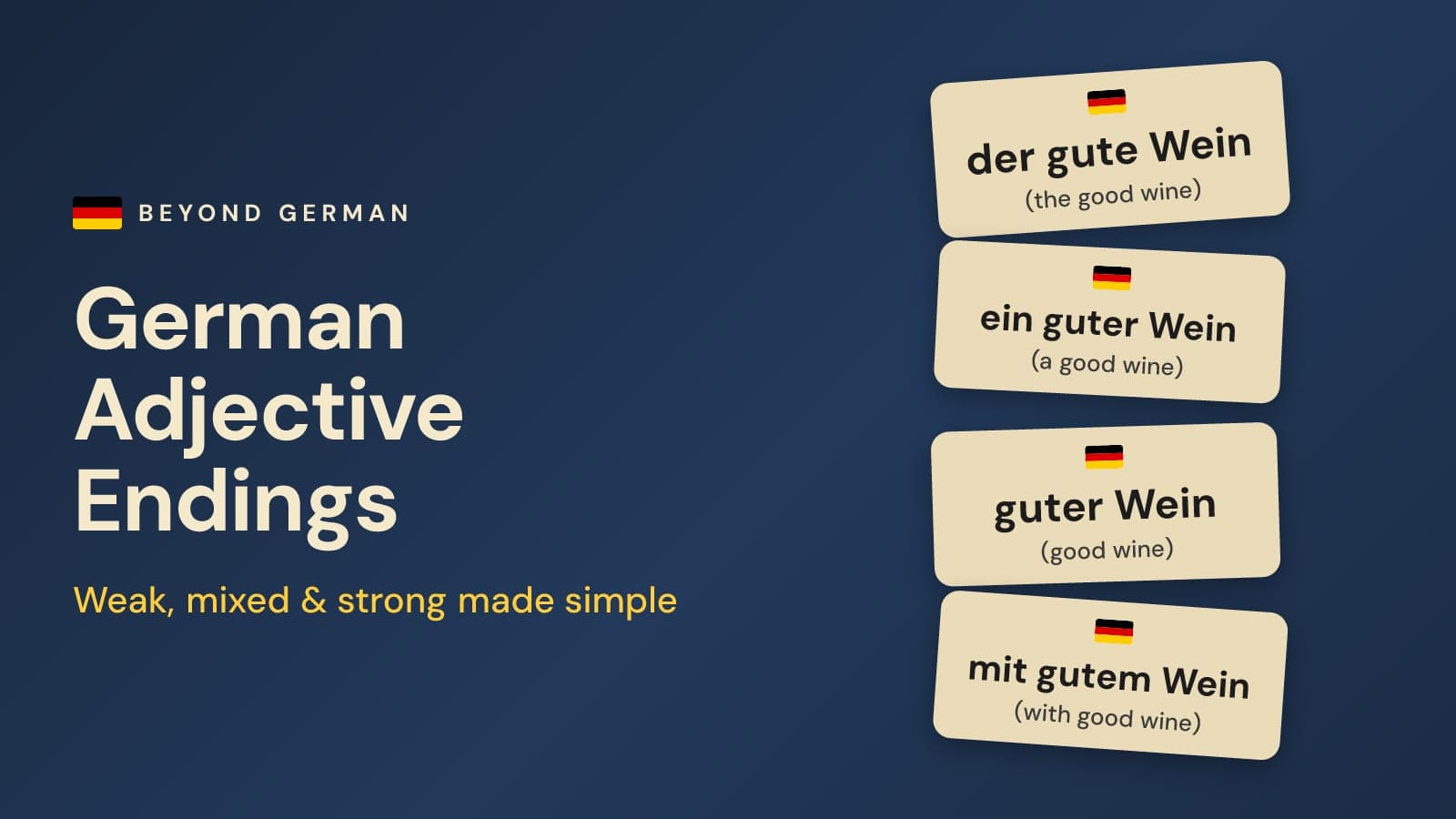
German adjectives take an ending only when they come directly before a noun: Das ist ein neues Auto. — That's a new car. After sein (to be), they take none: Das Auto ist neu. — The car is new. The ending itself depends on what comes before the adjective: after der, die, das it's always -e or -en, after ein-words it's the same except in three spots, and with no article, the adjective almost always borrows the ending of der, die or das.
This is the cheat-sheet version: the logic behind the endings, three charts, five shortcuts and practice with answers. For a compact reference to bookmark, see our German adjective endings guide.
Step 1: Is There a Noun Right After It?
Only adjectives in front of a noun take endings. After sein, werden or bleiben, and when they describe a verb, they stay in their dictionary form:
| No ending | With an ending |
|---|---|
| Der Kaffee ist kalt. — The coffee is cold. | Ich mag keinen kalten Kaffee. — I don't like cold coffee. |
| Die Wohnung ist neu. — The apartment is new. | Wir haben eine neue Wohnung. — We have a new apartment. |
| Das Hotel ist teuer. — The hotel is expensive. | Das ist ein teures Hotel. — That's an expensive hotel. |
| Sie singt schön. — She sings beautifully. | Sie hat eine schöne Stimme. — She has a beautiful voice. |
Notice that teuer usually drops an e before the ending: teures. And the ending stays even when the noun is only implied: „Welcher Mantel?“ – „Der schwarze.“ — "Which coat?" "The black one."
The Big Idea: Someone Has to Show the Gender
German shows a noun's gender and case on the words in front of it. Usually the article does the job: der says "masculine, nominative". When the article already shows that, the adjective can relax with a short -e or -en. When the article shows nothing, or isn't there, the adjective steps in with the ending der, die or das would have had:
- der neue Mantel — der shows masculine, so neu just adds -e.
- ein neuer Mantel — ein could be masculine or neuter, so neu takes the -r from der.
- heißer Kaffee — no article, so the adjective carries the -r itself.
That's the whole system in one sentence: the signal appears once, on the article or on the adjective. Before you pick an ending, ask three questions:
- Is there a noun right after the adjective? If not, no ending.
- What's the noun's gender and case? Learn every noun with its article (our der, die, das rules help you guess) and work out its job in the sentence (see the German cases overview).
- What comes before the adjective? A der-word, an ein-word or nothing? That tells you which chart to use.
Chart 1: After der, die, das (Weak Endings)
Use this chart after the definite article and the words that work like it: dieser (this), jeder (every), welcher (which), jener (that), mancher (some), solcher (such) and alle (all). These der-words already show gender and case, so the adjective only needs -e or -en.
| Case | Masculine | Feminine | Neuter | Plural |
|---|---|---|---|---|
| Nominative | der neue Mantel | die neue Jacke | das neue Hemd | die neuen Schuhe |
| Accusative | den neuen Mantel | die neue Jacke | das neue Hemd | die neuen Schuhe |
| Dative | dem neuen Mantel | der neuen Jacke | dem neuen Hemd | den neuen Schuhen |
| Genitive | des neuen Mantels | der neuen Jacke | des neuen Hemdes | der neuen Schuhe |
The pattern: -e in five spots: the three singular nominatives, plus the feminine and neuter accusative (where die and das don't change). Everywhere else, it's -en.
- Der neue Chef ist sehr nett. — The new boss is very nice.
- Ich nehme den roten Pullover. — I'll take the red sweater.
- Wir treffen uns im neuen Café. — We're meeting at the new café. (im = in dem)
- Alle neuen Mitarbeiter bekommen einen Laptop. — All new employees get a laptop.
Chart 2: After ein, kein, mein (Mixed Endings)
Use this chart after ein, kein and the possessives mein, dein, sein, ihr, unser, euer and Ihr. It's chart 1 with three changes, in the three spots where ein has no ending of its own:
| Case | Masculine | Feminine | Neuter | Plural |
|---|---|---|---|---|
| Nominative | ein neuer Mantel | eine neue Jacke | ein neues Hemd | meine neuen Schuhe |
| Accusative | einen neuen Mantel | eine neue Jacke | ein neues Hemd | meine neuen Schuhe |
| Dative | einem neuen Mantel | einer neuen Jacke | einem neuen Hemd | meinen neuen Schuhen |
| Genitive | eines neuen Mantels | einer neuen Jacke | eines neuen Hemdes | meiner neuen Schuhe |
- Masculine nominative: ein doesn't show masculine, so the adjective adds -er, the ending of der: ein neuer Mantel.
- Neuter nominative and accusative: ein doesn't show neuter, so the adjective adds -es, the ending of das: ein neues Hemd.
Ein has no plural, so the plural column uses meine (keine works the same way). After a plural ein-word, the ending is always -en.
- Das ist ein guter Plan. — That's a good plan.
- Ich habe einen neuen Job. — I have a new job.
- Mein altes Handy ist kaputt. — My old phone is broken.
- Er wohnt mit seinem besten Freund zusammen. — He lives with his best friend.
- Wir haben keine großen Pläne. — We don't have any big plans.
Chart 3: No Article (Strong Endings)
With no article at all, the adjective does all the work. You need this chart for uncountable nouns like Kaffee or Wasser, for plurals without an article, and after numbers and words like viele (many), einige (some), mehrere (several), wenige (few) and ein paar (a few).
| Case | Masculine | Feminine | Neuter | Plural |
|---|---|---|---|---|
| Nominative | heißer Kaffee | heiße Milch | heißes Wasser | heiße Getränke |
| Accusative | heißen Kaffee | heiße Milch | heißes Wasser | heiße Getränke |
| Dative | heißem Kaffee | heißer Milch | heißem Wasser | heißen Getränken |
| Genitive | heißen Kaffees | heißer Milch | heißen Wassers | heißer Getränke |
The pattern: the adjective copies the ending of the definite article: der → heißer, die → heiße, das → heißes, dem → heißem. The only exception is the masculine and neuter genitive, which takes -en because the noun already ends in -s. You'll rarely need that one anyway.
- Frisches Brot schmeckt am besten. — Fresh bread tastes best.
- Ich trinke morgens schwarzen Tee. — I drink black tea in the morning.
- Wir suchen eine Wohnung mit großem Balkon. — We're looking for an apartment with a big balcony.
- Ich habe viele nette Leute kennengelernt. — I've met lots of nice people.
- Zwei große Pizzas, bitte! — Two large pizzas, please!
You Already Know Strong Endings
Many greetings are strong endings in disguise. They're short for Ich wünsche dir… (I wish you…), so the noun is an accusative object without an article:
- Guten Morgen! Guten Tag! — der Morgen, der Tag: masculine accusative → -en
- Gute Nacht! — die Nacht: feminine → -e
- Schönes Wochenende! — das Wochenende: neuter → -es
- Frohe Weihnachten! — plural → -e
Letters use the nominative: Lieber Tom, Liebe Anna, Liebes Team, Sehr geehrte Damen und Herren. And the classic sign-off Mit freundlichen Grüßen is a dative plural: -en. More in our guide to formal emails in German.
The Cheat Sheet: 5 Shortcuts
You can't flip through three charts mid-conversation. These five shortcuts cover most of what you'll say:
- No noun after it, no ending. Das Auto ist neu. Er fährt schnell.
- After der, die, das in the nominative singular: always -e. Der neue Chef, die neue Chefin, das neue Büro. Die and das keep the -e in the accusative, too.
- When in doubt, say -en. It's the most common ending by far: after an article, it fills 22 of the 32 slots in charts 1 and 2. It covers every dative and genitive after an article (think dative prepositions like mit dem neuen Auto), every plural after an article, and every masculine accusative in all three charts: den roten Pullover, einen roten Pullover, roten Wein.
- After ein-words, add the missing signal. Only three spots differ from chart 1: ein neuer Mantel (masculine nominative) and ein neues Hemd (neuter nominative and accusative).
- No article? Copy der, die, das. der → heißer Kaffee, das → heißes Wasser, dem → mit heißem Wasser. Only the rare masculine and neuter genitive takes -en instead: ein Glas guten Weins.
Two adjectives in a row? Both take the same ending: ein langer, kalter Winter — a long, cold winter.
Adjectives That Don't Take Endings
A few adjectives keep the same form whatever the gender or case:
- Some colors: rosa and lila take no ending in standard German: ein rosa Kleid — a pink dress; mit der lila Jacke — with the purple jacket. Our guide to colors in German explains which other colors behave like this, and the -farben trick for writing.
- Super, klasse, prima: Das war ein super Abend! — That was a great evening! (More in great and awesome in German.)
- City names + -er: der Kölner Dom — Cologne Cathedral; im Kölner Dom — in Cologne Cathedral; die Berliner Mauer — the Berlin Wall.
Common Mistakes With Adjective Endings
| Wrong | Right | Why |
|---|---|---|
| Das Auto ist neues. | Das Auto ist neu. | No noun after it, no ending. |
| der neuer Mantel | der neue Mantel | Der already shows masculine. |
| ein neue Mantel | ein neuer Mantel | Ein doesn't, so the adjective must. |
| Ich habe einen neue Job. | Ich habe einen neuen Job. | Masculine accusative is always -en. |
| mit meinem alte Freund | mit meinem alten Freund | After an article, the dative is always -en. |
| die neue Schuhe | die neuen Schuhe | After an article, the plural is always -en. |
| mit heißen Wasser | mit heißem Wasser | No article: copy the -m of dem. |
| viele neuen Freunde | viele neue Freunde | Viele isn't an article, so the ending is strong. |
| ein dunkeles Zimmer | ein dunkles Zimmer | Adjectives in -el drop the e: dunkel → dunkl-. |
| ein hoches Haus | ein hohes Haus | Hoch becomes hoh- before a noun. |
Practice: Fill In the Endings
Add the right ending, or none at all. Ask the three questions from above for each one.
- Der alt___ Mann wohnt allein.
- Ich habe einen neu___ Job.
- Das ist ein schön___ Haus.
- Wir wohnen in einer klein___ Wohnung.
- Ich trinke gern heiß___ Tee.
- Die Kinder spielen mit dem rot___ Ball.
- Frisch___ Obst ist gesund.
- Das Wetter ist heute schön___.
- Er hat viele gut___ Ideen.
- Sie trägt ein lila___ Kleid.
Answers:
- Der alte Mann wohnt allein. — The old man lives alone. (der, nominative → -e)
- Ich habe einen neuen Job. — I have a new job. (masculine accusative → -en)
- Das ist ein schönes Haus. — That's a beautiful house. (ein + neuter → -es)
- Wir wohnen in einer kleinen Wohnung. — We live in a small apartment. (dative → -en)
- Ich trinke gern heißen Tee. — I like drinking hot tea. (no article, masculine accusative → -en)
- Die Kinder spielen mit dem roten Ball. — The children are playing with the red ball. (dative → -en)
- Frisches Obst ist gesund. — Fresh fruit is healthy. (no article, das Obst → -es)
- Das Wetter ist heute schön. — The weather is nice today. (after sein: no ending)
- Er hat viele gute Ideen. — He has lots of good ideas. (after viele: strong -e)
- Sie trägt ein lila Kleid. — She's wearing a purple dress. (lila takes no ending in standard German)
Keep going: the adjective endings reference has all three tables on one page, our top 50 German adjectives give you more words to practice with, and the B1 German quiz tests you on all of it.
FAQ
How many adjective endings are there in German?
Just five: -e, -en, -er, -es and -em. The charts only show which one goes where.
What's the difference between weak, mixed and strong endings?
It's about what comes before the adjective. Weak endings (-e, -en) follow der-words, which already show gender and case. Mixed endings follow ein-words. Strong endings appear when there's no article, and they look like the endings of der, die, das.
Do adjectives after sein take endings?
No: Das Auto ist neu. Die Suppe ist heiß. Endings only appear when the adjective stands directly before a noun.
Which ending comes after viele, einige or zwei?
A strong ending, because these words aren't articles: viele neue Freunde, zwei kleine Kinder. After alle, which works like die, use the weak ending: alle neuen Freunde.
Level Up Your German
Join 1,000+ learners getting weekly tips, grammar shortcuts, and cultural insights.
Share this article
Continue Reading
Hobbies in German: Was machst du gern? Freizeit Vocabulary
How to talk about hobbies in German: ask Was machst du in deiner Freizeit?, answer with gern, lieber and am liebsten, and learn Freizeit vocabulary by category.
Directions in German: Links, Rechts, Geradeaus & How to Ask
How to ask for directions in German (Wie komme ich zum Bahnhof?), understand links, rechts and geradeaus, plus city vocabulary, two dialogues and common mistakes.
Rooms in German: House & Furniture Vocabulary With Plurals
Rooms, furniture and appliances in German with articles and plurals, plus how to describe your home, which floor the Erdgeschoss is, and why Germans air their rooms.