
Colors in German: Rot, Blau, Grün and How to Use Them
 Beyond German Team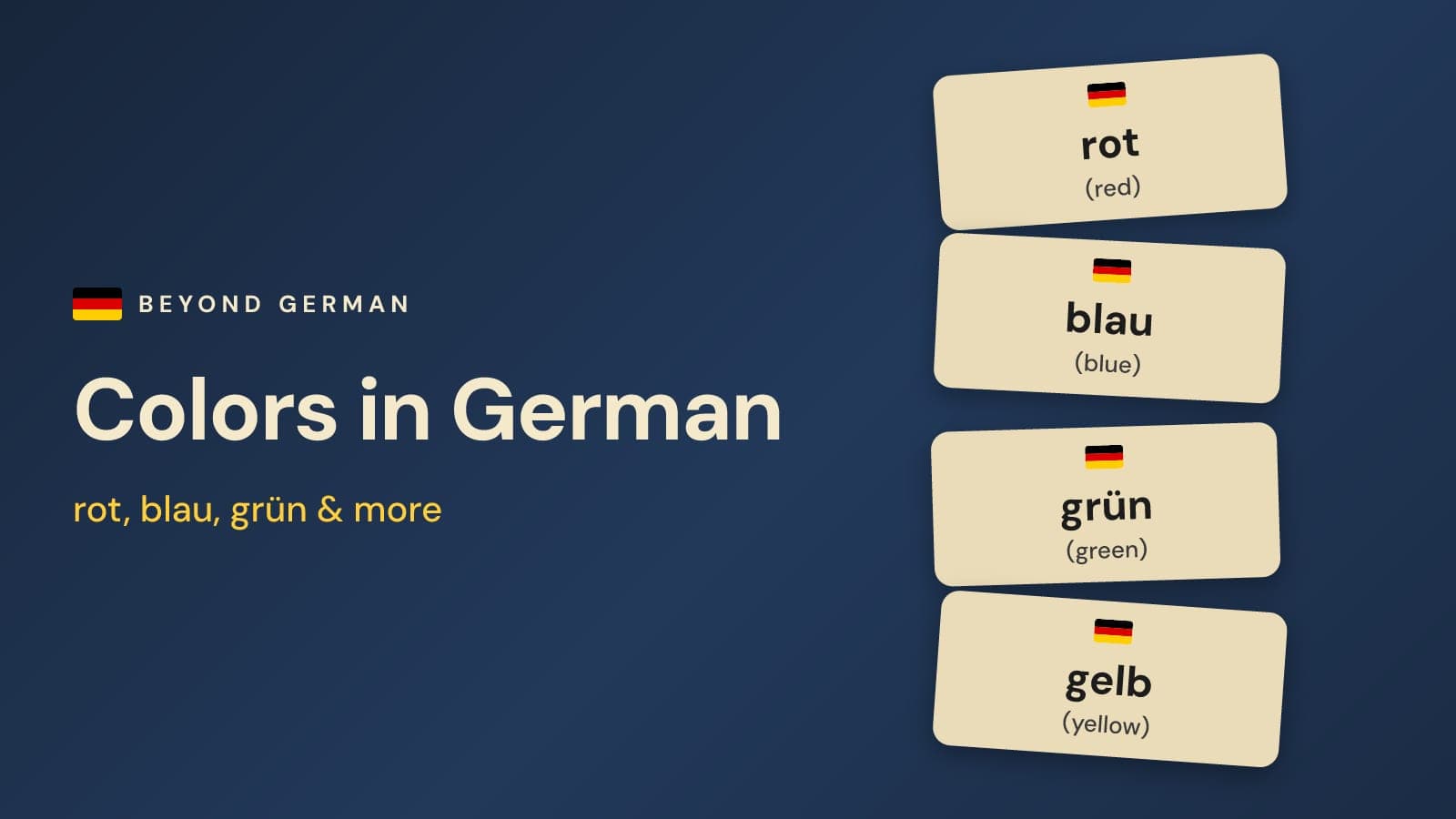
The basic colors in German are rot (red), blau (blue), gelb (yellow), grün (green), schwarz (black) and weiß (white). As adjectives, colors are lowercase and take endings before a noun (ein rotes Auto, a red car). As nouns, they're capitalized and always neuter: das Rot, das Blau.
Below you'll find 15 colors with pronunciation, plus shades, adjective endings, color idioms and the colors of the German flag.
The Colors in German
The German word for color is die Farbe (plural die Farben). It also means paint.
| English | German | Sounds like | Example |
|---|---|---|---|
| red | rot | "roht" | Die Tomate ist rot. — The tomato is red. |
| orange | orange | "oh-RAHNSH" | Die Orange ist orange. — The orange is orange. |
| yellow | gelb | "gelp" | Die Banane ist gelb. — The banana is yellow. |
| green | grün | "green" with rounded lips | Das Gras ist grün. — The grass is green. |
| blue | blau | rhymes with "now" | Der Himmel ist blau. — The sky is blue. |
| purple | lila / violett | "LEE-lah" / "vee-oh-LET" | Die Blume ist lila. — The flower is purple. |
| pink | rosa / pink | "ROH-zah" / as in English | Das Schwein ist rosa. — The pig is pink. |
| brown | braun | like "brown" | Der Bär ist braun. — The bear is brown. |
| black | schwarz | "shvarts" | Die Katze ist schwarz. — The cat is black. |
| white | weiß | like "vice" | Der Schnee ist weiß. — The snow is white. |
| gray | grau | rhymes with "now" | Die Maus ist grau. — The mouse is gray. |
| beige | beige | "baysh" | Die Wand ist beige. — The wall is beige. |
| turquoise | türkis | "tür-KEES" | Das Wasser ist türkis. — The water is turquoise. |
| gold | golden (das Gold) | "GOL-den" | Sie trägt eine goldene Kette. — She's wearing a gold chain. |
| silver | silbern (das Silber) | "ZIL-bern" | Er hat einen silbernen Ring. — He has a silver ring. |
- Lila or violett? Both mean purple. Lila is the everyday word (strictly, a light lilac shade); violett is a deeper violet and sounds a little more formal.
- Rosa or pink? Rosa is soft pink, pink is bright, hot pink.
- Gold and silver: the nouns are das Gold and das Silber, the adjectives golden and silbern. For things that are only gold- or silver-colored, Germans often say goldfarben or silberfarben.
Two sounds need practice: the ü in grün (say "ee" with rounded lips) and the ß in weiß, a sharp s. Our guide to the German alphabet and pronunciation covers both.
Light and Dark Shades: hellblau, dunkelgrün
To make a color lighter or darker, put hell- (light) or dunkel- (dark) in front of it. The result is one word, all lowercase: hellblau (light blue), dunkelgrün (dark green). A few other building blocks work the same way:
| Pattern | Meaning | Examples |
|---|---|---|
| hell- + color | light … | hellblau, hellgrün, hellgrau |
| dunkel- + color | dark … | dunkelblau, dunkelgrün, dunkelrot |
| blass- + color | pale … | blassblau, blassrosa |
| knall- + color (informal) | bright, loud … | knallrot, knallgelb |
| thing + color | as … as the thing | himmelblau (sky blue), zitronengelb (lemon yellow), schneeweiß (snow white), pechschwarz (pitch black) |
| color + -lich | …ish | rötlich (reddish), bläulich (bluish), gelblich (yellowish), grünlich (greenish) |
| color + color | a mix of both | blaugrün (blue-green), graublau (gray-blue) |
Shades take endings like any other color:
- Ich suche ein hellblaues Hemd. — I'm looking for a light blue shirt.
- Sie trägt eine dunkelgrüne Jacke. — She's wearing a dark green jacket.
Notice the umlaut in rötlich and bläulich. A hyphen means two separate colors side by side, not a mix: ein schwarz-weißes Foto is a black-and-white photo, while blaugrün is one blended shade. On their own, hell means bright and dunkel means dark: Im Winter wird es früh dunkel. — In winter it gets dark early.
Colors as Nouns: das Rot, in Blau
When you talk about a color itself instead of describing something, the color becomes a noun. Then it's capitalized and always neuter: das Rot, das Blau, das Grün. This is one of the few German gender rules with no exceptions (more clues like it in our guide to der, die, das rules).
- Blau ist meine Lieblingsfarbe. — Blue is my favorite color.
- Das Kleid gibt es auch in Rot. — The dress also comes in red.
- Die Ampel zeigt Rot. — The traffic light is red.
- Mir gefällt das helle Grün. — I like the light green.
A quick test: when the color stands on its own after an article (das Rot) or a preposition (in Blau), or in die Farbe Blau, it's a noun, so capitalize it. When it describes a noun (das rote Auto, Das Auto ist rot.), it's an adjective and stays lowercase.
Colors as Adjectives: ein rotes Auto, die blaue Tür
Directly before a noun, a color is an adjective and takes an ending, just like groß or neu. After sein (to be) or werden (to become), it takes no ending at all.
- Ich habe ein rotes Auto. — I have a red car. (das Auto)
- Die blaue Tür ist offen. — The blue door is open. (die Tür)
- Er kauft einen schwarzen Mantel. — He's buying a black coat. (der Mantel, accusative)
- Sie hat braune Augen. — She has brown eyes. (plural)
- Das Auto ist rot. — The car is red. (no ending after sein)
- Er wird rot. — He's blushing. (literally: he's turning red)
The ending depends on the noun's gender, its case and the article. Our guide to German adjective endings explains the full system, and our top 50 German adjectives give you more words to practice with.
Colors Without Endings: rosa, lila, orange, beige
A few colors borrowed from other languages traditionally take no ending in standard German, even before a noun: rosa, lila, orange and beige (Duden treats pink the same way).
- ein rosa Kleid — a pink dress
- ein lila Hemd — a purple shirt
- ein orange Auto — an orange car
- ein beige Sofa — a beige sofa
In everyday speech you'll hear endings anyway (ein lilanes Kleid, ein rosanes Kleid), but dictionaries mark these forms as colloquial. For orange and beige, though, Duden now also accepts ein oranges Kleid and ein beiges Kleid. To be safe in writing, add -farben (-colored), which takes normal endings: ein rosafarbenes Kleid, eine lilafarbene Bluse. Or use violett, which declines like any color: eine violette Bluse.
How to Ask About Colors: Welche Farbe hat…?
To ask what color something is, German uses haben (to have): Welche Farbe hat…? literally means "Which color has…?"
- Welche Farbe hat dein Auto? — What color is your car?
Es ist grau. — It's gray. - Welche Farbe haben deine Augen? — What color are your eyes?
Ich habe grüne Augen. — I have green eyes. - Was ist deine Lieblingsfarbe? — What's your favorite color?
Meine Lieblingsfarbe ist Gelb. — My favorite color is yellow.
When shopping, build on Haben Sie…? (Do you have…?):
- Haben Sie das auch in Schwarz? — Do you have this in black too?
- Gibt es den Pullover auch in einer anderen Farbe? — Does the sweater come in another color?
For hair, use blond, not gelb: Sie hat blonde Haare. — She has blond hair. Red hair is rote Haare, just like in English.
German Color Idioms
German color idioms rarely mean what an English speaker would guess. These are the ones you'll hear most:
| Idiom | Meaning | Example |
|---|---|---|
| blau sein | to be drunk | Er war gestern total blau. — He was totally drunk yesterday. |
| schwarzfahren | to ride a bus or train without a ticket | Wer schwarzfährt, muss Strafe zahlen. — If you ride without a ticket, you pay a fine. |
| grün hinter den Ohren sein | to be young and inexperienced ("wet behind the ears") | Der neue Kollege ist noch grün hinter den Ohren. — The new colleague is still wet behind the ears. |
| rotsehen | to see red, to become furious | Wenn jemand lügt, sehe ich rot. — When someone lies, I see red. |
| ins Schwarze treffen | to hit the bull's-eye, to get it exactly right | Mit dem Geschenk hast du ins Schwarze getroffen. — You got the present exactly right. |
| das Blaue vom Himmel versprechen | to promise the moon (things you can't deliver) | Vor der Wahl versprechen Politiker gern das Blaue vom Himmel. — Before an election, politicians like to promise the moon. |
| die Schwarzmalerei (verb: schwarzmalen) | painting things blacker than they are, doom and gloom | Das ist doch Schwarzmalerei! — You're being far too pessimistic! |
- Careful with blau: in English, "feeling blue" means sad, but Ich bin blau means "I'm drunk." If you're sad, say Ich bin traurig.
- Why schwarz? In schwarzfahren, schwarz means illegal or off the books, as in der Schwarzmarkt (black market) and die Schwarzarbeit (undeclared work).
- Das Schwarze is the black center of a shooting target, so ins Schwarze treffen is the German bull's-eye.
- Spelling: rotsehen and schwarzfahren are one word but split in a sentence: ich sehe rot, er fährt schwarz.
Three more you'll come across:
- blaumachen — to skip work or school without a good reason: Ich mache heute blau. — I'm skipping work today.
- ein blaues Auge — a black eye (not a blue one!). Mit einem blauen Auge davonkommen means to get off lightly.
- schwarz auf weiß — in writing: Das will ich schwarz auf weiß haben. — I want that in writing.
Schwarz-Rot-Gold: The Colors of the German Flag
The German flag is black, red and gold, from top to bottom. Germany's constitution, the Grundgesetz, says it in one sentence:
Die Bundesflagge ist schwarz-rot-gold. — The federal flag is black, red and gold. (Article 22)
Note that it's gold, never gelb, even though the bottom stripe looks yellow. As a noun, the colors are Schwarz-Rot-Gold; before a noun, the adjective is schwarz-rot-golden: die schwarz-rot-goldene Fahne — the black, red and gold flag.
The colors stood for a united, democratic Germany as early as the Hambach Festival of 1832 and the revolution of 1848. The Weimar Republic made them the national colors in 1919, and the Federal Republic chose them again in 1949. Austria's flag, by the way, is rot-weiß-rot.
Common Mistakes With Colors
| Wrong | Right | Why |
|---|---|---|
| Das Auto ist rotes. | Das Auto ist rot. | No ending after sein. |
| ein rot Auto | ein rotes Auto | Before a noun, colors need an ending. |
| der Blau | das Blau | Colors as nouns are always neuter. |
| in blau | in Blau | After a preposition, the color is a noun: capitalize it. |
| hell blau | hellblau | Shades are written as one word. |
| Ich bin blau. (meaning sad) | Ich bin traurig. | Blau sein means drunk. |
| gelbe Haare | blonde Haare | Hair is blond, not yellow. |
| Schwarz-Rot-Gelb | Schwarz-Rot-Gold | The flag's third color is always gold. |
For more traps like these, see our list of common German mistakes English speakers make.
Practice: Colors in German
Colors are everywhere, so practice them daily:
- Name what you see. On your way to work, describe things in full sentences: Der Bus ist gelb. Die Tür ist rot.
- Describe your outfit. Every morning, say what you're wearing: Heute trage ich eine blaue Jeans und ein weißes T-Shirt. — Today I'm wearing blue jeans and a white T-shirt. That's daily ending practice for free.
- Play "I spy" in German. The German version goes: Ich sehe was, was du nicht siehst, und das ist rot. — I see something you don't see, and it's red.
- Learn colors with a noun. Memorize ein rotes Auto and die blaue Tür, not just rot and blau, so the endings come automatically.
Now fill in the gaps. Add an ending only where one is needed:
- Ich habe ein schwarz___ Fahrrad.
- Die Tür ist blau___.
- Er trägt einen grün___ Pullover.
- Sie hat ein rosa___ Kleid.
- Wir haben eine weiß___ Katze.
- Das Kleid gibt es auch in ___ (rot).
Answers:
- ein schwarzes Fahrrad (das Fahrrad)
- blau (no ending after sein)
- einen grünen Pullover (der Pullover, accusative)
- ein rosa Kleid (traditionally no ending)
- eine weiße Katze (die Katze)
- in Rot (a noun after in)
Then test yourself in our A1 German quiz.
FAQ
What are the basic colors in German?
Rot (red), blau (blue), gelb (yellow), grün (green), schwarz (black) and weiß (white), plus orange, lila (purple), rosa (pink), braun (brown) and grau (gray).
Are colors capitalized in German?
Only when they're nouns: das Blau, in Blau, die Farbe Blau. As adjectives they're lowercase: Der Himmel ist blau.
What gender are colors in German?
Always neuter: das Rot, das Grün, das Weiß.
How do you say light blue and dark green in German?
Hellblau and dunkelgrün, each written as one word. Before a noun they take endings like any color: ein hellblaues Hemd, eine dunkelgrüne Jacke.
Level Up Your German
Join 1,000+ learners getting weekly tips, grammar shortcuts, and cultural insights.
Share this article
Continue Reading
Merry Christmas in German: Frohe Weihnachten & Traditions
Learn how to say Merry Christmas and Happy New Year in German, plus the traditions from Advent and Nikolaus to Heiligabend and Silvester, with food and market words.
Happy Birthday in German: Alles Gute zum Geburtstag & Wishes
Learn how to say happy birthday in German, from Alles Gute zum Geburtstag to formal card wishes, plus belated wishes, the birthday song and why Germans never congratulate early.
I Love You in German: Ich liebe dich vs. Ich hab dich lieb
Learn when to say Ich liebe dich and when to say Ich hab dich lieb, plus German pet names, romantic phrases, texting codes like HDL and Valentine's Day customs.