
Clothes in German: Clothing Vocabulary With Articles & Plurals
 Beyond German Team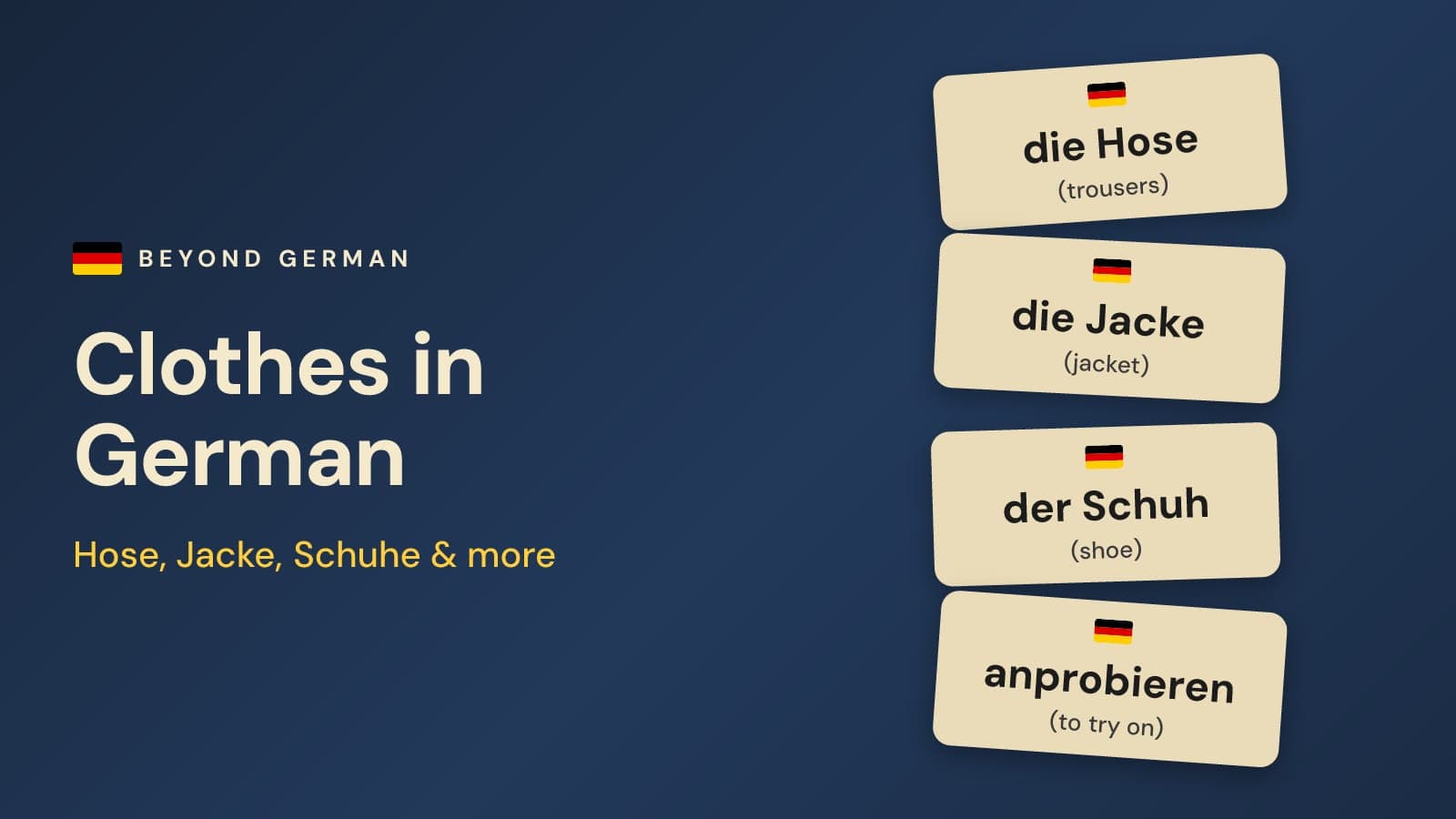
Clothes in German are die Kleidung, or die Klamotten in casual speech. A shirt is das Hemd (a T-shirt is das T-Shirt), pants are die Hose, and a jacket is die Jacke. Note that die Hose is singular: German treats one pair of pants as one thing.
Below you'll find the most useful clothing words with their articles and plurals, the verbs for getting dressed, phrases for the fitting room, how German sizes work and the difference between passen and stehen.
German Clothing Vocabulary With Articles and Plurals
Always learn clothing words with their article. One pattern helps: most clothing words ending in -e are feminine (die Jacke, die Bluse, die Socke, die Mütze). Borrowed words like das T-Shirt and der Pullover simply have to be memorized.
Tops: das Hemd, das T-Shirt, der Pullover
| German | Plural | English |
|---|---|---|
| das Hemd | die Hemden | shirt (with buttons) |
| das T-Shirt | die T-Shirts | T-shirt |
| die Bluse | die Blusen | blouse |
| der Pullover | die Pullover | sweater, jumper |
| der Pulli | die Pullis | sweater (casual) |
| die Strickjacke | die Strickjacken | cardigan |
So how do you say "shirt" in German? A shirt with a collar and buttons is das Hemd, while a T-shirt is just ein T-Shirt. Er trägt ein weißes Hemd. — He's wearing a white shirt. Pulli is the short form of Pullover, and it's what most people say.
Pants, Skirts and Dresses: die Hose, der Rock, das Kleid
| German | Plural | English |
|---|---|---|
| die Hose | die Hosen | pants, trousers |
| die Jeans | die Jeans | jeans |
| die kurze Hose | die kurzen Hosen | shorts |
| der Rock | die Röcke | skirt |
| das Kleid | die Kleider | dress |
| die Strumpfhose | die Strumpfhosen | tights, pantyhose |
One pair is one Hose. Pants, jeans and tights are plural in English, but in German one pair is singular: Die Hose ist zu lang. — The pants are too long. Ich brauche eine neue Jeans. — I need a new pair of jeans. The plural means several pairs: Ich habe drei Hosen gekauft. — I bought three pairs of pants.
Jackets, Coats and Suits: die Jacke, der Mantel, der Anzug
| German | Plural | English |
|---|---|---|
| die Jacke | die Jacken | jacket |
| der Mantel | die Mäntel | coat |
| die Regenjacke | die Regenjacken | rain jacket |
| der Anzug | die Anzüge | suit |
| die Krawatte | die Krawatten | tie |
A Mantel is a long coat; a Jacke stops around the hips. Zur Hochzeit trägt er einen Anzug und eine Krawatte. — He's wearing a suit and tie to the wedding.
Shoes, Socks and Underwear
| German | Plural | English |
|---|---|---|
| der Schuh | die Schuhe | shoe |
| der Stiefel | die Stiefel | boot |
| der Turnschuh | die Turnschuhe | sneaker, trainer |
| die Sandale | die Sandalen | sandal |
| der Hausschuh | die Hausschuhe | slipper |
| die Socke | die Socken | sock |
| die Unterwäsche | — | underwear |
| die Unterhose | die Unterhosen | underpants |
Like English "underwear," die Unterwäsche has no plural. And wear clean socks when you visit: in many German homes you take your shoes off at the door, and your host may offer you Hausschuhe.
Accessories: der Schal, die Mütze, der Hut
| German | Plural | English |
|---|---|---|
| der Schal | die Schals | scarf |
| die Mütze | die Mützen | knit hat, beanie, cap |
| der Hut | die Hüte | hat (with a brim) |
| der Handschuh | die Handschuhe | glove |
| der Gürtel | die Gürtel | belt |
A Mütze is soft, like a beanie or a baseball cap; a Hut has a brim and holds its shape. And yes, Handschuh literally means "hand shoe."
Verbs for Clothes: anziehen, ausziehen, sich umziehen, tragen
| German | English | Example |
|---|---|---|
| anziehen | to put on | Ich ziehe die Jacke an. — I'm putting my jacket on. |
| sich anziehen | to get dressed | Ich ziehe mich an. — I'm getting dressed. |
| ausziehen | to take off | Zieh bitte die Schuhe aus. — Please take your shoes off. |
| sich umziehen | to get changed | Ich ziehe mich schnell um. — I'll quickly get changed. |
| tragen | to wear | Sie trägt ein rotes Kleid. — She's wearing a red dress. |
| anhaben | to have on | Was hast du heute an? — What are you wearing today? |
| anprobieren | to try on | Ich möchte die Hose anprobieren. — I'd like to try on the pants. |
All of these except tragen are separable verbs. The prefix jumps to the end of the sentence (Ich ziehe die Jacke an.), and in the perfect tense -ge- slips in between: Ich habe mich schon umgezogen. — I've already changed. (One exception: anprobiert, because -ieren verbs never take ge-.) Our guide to German separable verbs explains all the rules.
Anziehen or tragen? Anziehen is the action of putting something on; tragen is the state of wearing it. Ich ziehe einen Mantel an. — I'm putting on a coat. Ich trage einen Mantel. — I'm wearing a coat. Tragen changes its vowel (du trägst, sie trägt), and it also means "to carry."
Two more things native speakers do:
- When they name the item, they often add mir or dir: Zieh dir eine Jacke an! — Put a jacket on! Ich ziehe mir die Schuhe an. — I'm putting my shoes on.
- Without sich, umziehen means to move house: Wir ziehen nach Berlin um. — We're moving to Berlin.
Shopping for Clothes in German
These phrases cover a typical trip to a clothing store, from the first "Can I help you?" to the checkout:
- Kann ich Ihnen helfen? — Can I help you? (what the salesperson says)
- Danke, ich schaue nur. — Thanks, I'm just looking.
- Ich suche einen Pullover. — I'm looking for a sweater.
- Welche Größe haben Sie? — What size are you?
- Ich habe Größe 38. / Ich trage M. — I'm a size 38. / I wear a medium.
- Haben Sie das eine Nummer größer? — Do you have this a size bigger?
- Haben Sie das auch in Schwarz? — Do you have this in black too?
- Kann ich das anprobieren? — Can I try this on?
- Wo ist die Umkleidekabine? — Where's the fitting room?
- Die Hose ist zu eng / zu weit / zu lang / zu kurz. — The pants are too tight / too loose / too long / too short.
- Was kostet der Mantel? — How much is the coat?
- Ich nehme ihn. — I'll take it.
- Kann ich das umtauschen? — Can I exchange this?
Look at Ich nehme ihn: "it" has to match the gender of the item. Der Mantel → Ich nehme ihn. Die Jacke → Ich nehme sie. Das Hemd → Ich nehme es. For plurals like die Schuhe, it's sie again.
Passen vs. Stehen: Does It Fit or Does It Suit You?
Where English says "fit" and "suit," German uses passen and stehen, and both put the person in the dative (mir, dir, Ihnen):
| Verb | Meaning | Example |
|---|---|---|
| passen | to be the right size | Die Schuhe passen mir nicht. — The shoes don't fit me. |
| stehen | to look good on someone | Das Kleid steht dir super. — That dress looks great on you. |
| passen zu | to go with | Der Gürtel passt nicht zu den Schuhen. — The belt doesn't go with the shoes. |
| gefallen | to be liked | Der Mantel gefällt mir. — I like the coat. |
The clothes are always the subject, and you're the dative: literally, "the shoes don't fit to me." That's why the verb matches the clothes: die Schuhe passen, die Hose passt. And something can fit without suiting you: Die Jacke passt, aber sie steht mir nicht. — The jacket fits, but it doesn't suit me.
Clothing Sizes in Germany
Germany uses EU sizes. Letter sizes exist too, said the German way: S ("ess"), M ("em"), L ("el"), XL ("iks-el"). For women's clothing, these are the approximate equivalents:
| Germany / EU | UK | US |
|---|---|---|
| 34 | 6 | 2 |
| 36 | 8 | 4 |
| 38 | 10 | 6 |
| 40 | 12 | 8 |
| 42 | 14 | 10 |
| 44 | 16 | 12 |
- Men's suits and jackets use even numbers like 48, 50 and 52. Subtract 10 for the US/UK chest size: a German 50 is about a 40.
- Men's shirts go by collar size in centimeters (die Kragenweite): 41 is about a 16-inch collar.
- Jeans use the same inch sizes as in the US and UK: W32/L34 (Weite and Länge).
- Shoes use EU sizes: a women's US 7 (UK 5) is about EU 38, and a men's US 10 (UK 9) is about EU 43. To ask, say Welche Schuhgröße haben Sie? — What's your shoe size?
Sizes vary between brands, and French and Spanish labels run one size up (a German 36 is a French 38), so try things on before you buy.
Colors and Clothes: ein rotes Kleid, einen schwarzen Mantel
To describe an outfit, put a color in front of the clothing word. The color takes an ending, and because tragen, anziehen and kaufen take the accusative, only the masculine form differs from the nominative:
| Noun | Das ist… (nominative) | Ich trage… (accusative) |
|---|---|---|
| der Mantel | ein schwarzer Mantel | einen schwarzen Mantel |
| die Jacke | eine blaue Jacke | eine blaue Jacke |
| das Kleid | ein rotes Kleid | ein rotes Kleid |
| die Schuhe (plural) | braune Schuhe | braune Schuhe |
Patterns work the same way: gestreift (striped), kariert (checked, plaid) and gepunktet (polka-dot). Er trägt ein kariertes Hemd. — He's wearing a plaid shirt. For all the color words, including the ones that traditionally take no ending (like rosa and lila), see our guide to colors in German.
What to Wear for the Weather
German weather can change fast, so people often dress in layers, a style Germans call der Zwiebellook (the onion look). Here's what to wear when:
| Weather | Ich trage… |
|---|---|
| Es regnet. — It's raining. | eine Regenjacke, Gummistiefel (rubber boots) |
| Es ist kalt. — It's cold. | einen Mantel, eine Mütze, einen Schal, Handschuhe |
| Es ist windig. — It's windy. | einen Pulli, eine Jacke |
| Es ist heiß. — It's hot. | ein T-Shirt, eine kurze Hose, Sandalen |
- Zieh dir eine Jacke an, es ist kalt draußen! — Put a jacket on, it's cold outside!
- Im Winter trage ich immer eine Mütze. — In winter, I always wear a hat.
For the weather words themselves, from es regnet to Glatteis, see our guide to weather in German.
Common Mistakes With Clothes in German
| Wrong | Right | Why |
|---|---|---|
| Ich trage Hosen. (one pair) | Ich trage eine Hose. | One pair is singular. |
| Ich ziehe meine Jacke. | Ich ziehe meine Jacke an. | Don't drop the separable prefix. |
| Ich ziehe einen Mantel an. (meaning "I'm wearing a coat") | Ich trage einen Mantel. | Anziehen = put on, tragen = wear. |
| Die Hose passt mich. | Die Hose passt mir. | Passen and stehen take the dative. |
| Der Mantel? Ich nehme es. | Der Mantel? Ich nehme ihn. | "It" matches the noun's gender. |
| eine Kleidung | ein Kleidungsstück | Kleidung is uncountable, like "clothing." |
Two false friends to watch out for: der Smoking is a tuxedo, and der Slip means briefs or panties, not a slip.
Practice: Clothes in German
Make it a habit: every morning, describe what you're wearing. Heute trage ich einen grauen Pulli, eine schwarze Hose und weiße Turnschuhe. — Today I'm wearing a gray sweater, black pants and white sneakers.
Then fill in the gaps:
- Ich brauche eine neue ___. (pants)
- Kann ich das ___? (try on)
- Die Schuhe ___ mir nicht. Sie sind zu klein.
- Das Kleid ___ dir wirklich gut.
- Ich ziehe ___ schnell um.
- Der Mantel ist schön. Ich nehme ___.
Answers:
- Ich brauche eine neue Hose.
- Kann ich das anprobieren?
- Die Schuhe passen mir nicht.
- Das Kleid steht dir wirklich gut.
- Ich ziehe mich schnell um.
- Ich nehme ihn. (der Mantel)
Ready for more? Test yourself with our A1 German quizzes.
FAQ
How do you say "shirt" in German?
A shirt with buttons is das Hemd (plural: die Hemden). A T-shirt is das T-Shirt, and a blouse is die Bluse.
Is "Hose" singular or plural in German?
Singular. Die Hose is one pair of pants: Die Hose ist neu. The plural, die Hosen, means several pairs.
What's the difference between anziehen and tragen?
Anziehen means to put on (the action), tragen means to wear (the state). Ich ziehe einen Mantel an — I'm putting on a coat. Ich trage einen Mantel — I'm wearing a coat.
What's the German word for clothes?
Die Kleidung is the standard word, and like "clothing," it's uncountable. Casually, Germans say die Klamotten. Die Kleider can also mean clothes in general, as in the saying Kleider machen Leute (clothes make the man).
How do German clothing sizes work?
Germany uses EU sizes. A women's German 38 is about a UK 10 or US 6, men's suit sizes are roughly your chest size in inches plus 10, and a men's US 10 shoe is about EU 43.
Level Up Your German
Join 1,000+ learners getting weekly tips, grammar shortcuts, and cultural insights.
Share this article
Continue Reading
Funny German Idioms: 25 Sayings With English Translations
From Ich verstehe nur Bahnhof to Schwein haben: 25 funny German idioms with literal translations, real meanings, English equivalents and example sentences.
German Word Order: Verb-Second Rule, Verb at the End & TeKaMoLo
German word order in 7 rules: verb second, verb first in yes/no questions, verb last after weil and dass, the verb bracket, TeKaMoLo, object order and where nicht goes.
How to Be Polite in German: Würde, Könnte, Hätte gern & More
Sound polite in German with Konjunktiv II: Ich hätte gern, Könnten Sie, Würden Sie and Dürfte ich, plus softening words, Sie vs. du, polite refusals and dialogues.