
Weather in German: Wie ist das Wetter? Words, Phrases & Idioms
 Beyond German Team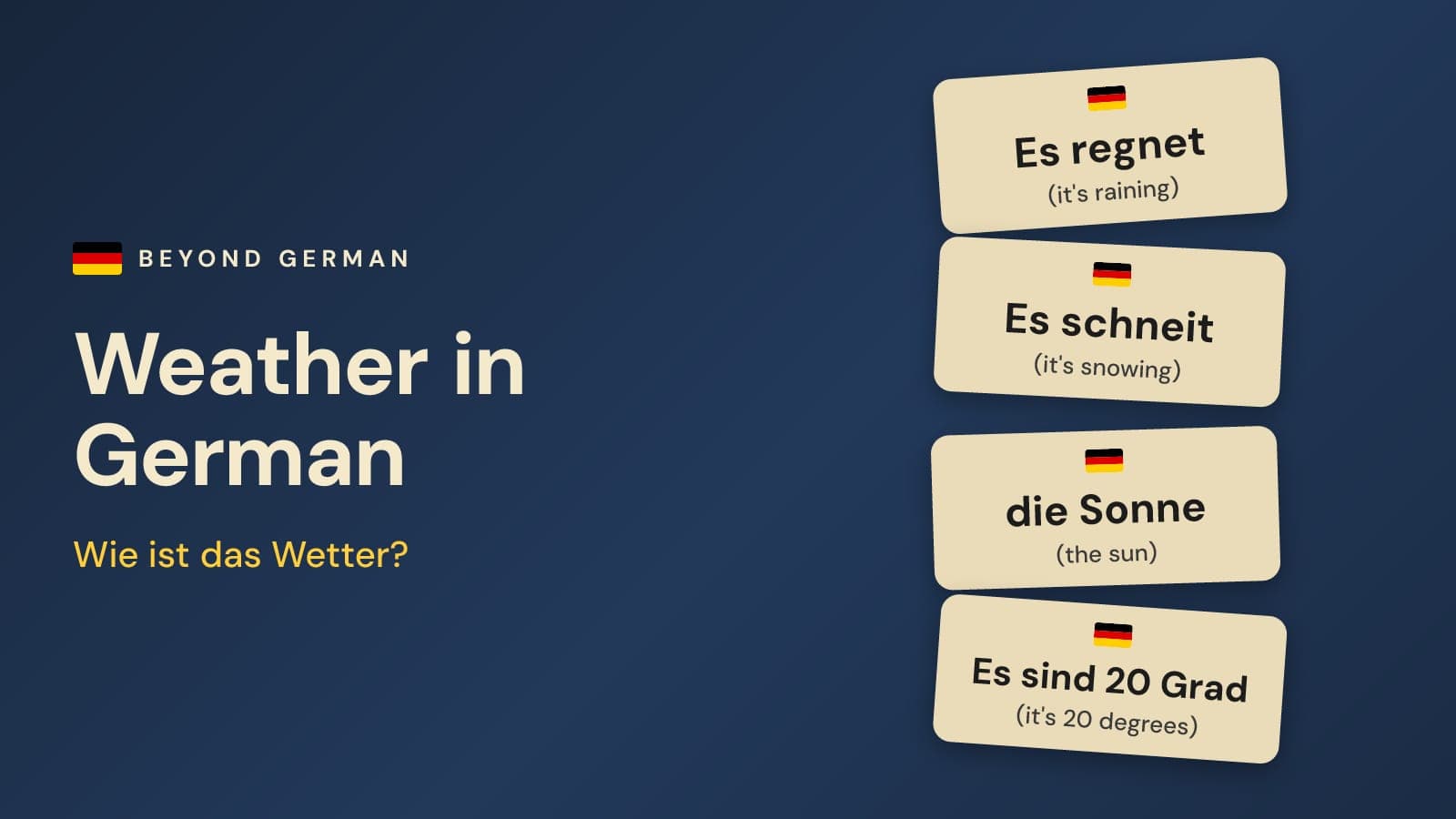
The German word for weather is das Wetter, and the question you'll hear most is Wie ist das Wetter? (What's the weather like?). The answer usually starts with es (it): Es regnet (It's raining), Es schneit (It's snowing) or Es ist sonnig (It's sunny).
Below you'll find weather verbs, nouns with their articles, temperatures, forecast words, small talk and idioms, plus why Germans say Mir ist kalt, never Ich bin kalt.
How to Ask About the Weather in German
The standard question is Wie ist das Wetter? It works with friends and strangers alike, and you can add a time or a place:
- Wie ist das Wetter heute? — What's the weather like today?
- Wie wird das Wetter morgen? — What will the weather be like tomorrow?
- Wie soll das Wetter am Wochenende werden? — What's the weather supposed to be like this weekend?
- Regnet es noch? — Is it still raining?
For the future, German uses werden (to become): Wie wird das Wetter morgen? is literally "How becomes the weather tomorrow?" To pass on the forecast, use sollen: Morgen soll es regnen. — It's supposed to rain tomorrow. That soll means "according to the forecast," so you're not making any promises.
Es regnet, es schneit: Weather Verbs With es
Like English, German describes most weather with es (it). The difference: German has no "-ing" form, so es regnet means both "it rains" and "it's raining."
| German | English | Past (Perfekt) |
|---|---|---|
| es regnet | it's raining | es hat geregnet |
| es schneit | it's snowing | es hat geschneit |
| es nieselt | it's drizzling | es hat genieselt |
| es donnert | it's thundering | es hat gedonnert |
| es blitzt | there's lightning | es hat geblitzt |
| es hagelt | it's hailing | es hat gehagelt |
| es friert | it's freezing (below 0 °C) | es hat gefroren |
They all form the perfect tense with haben: Gestern hat es den ganzen Tag geregnet. — Yesterday it rained all day.
When a sentence starts with something else, es moves behind the verb, because the verb always comes second: Heute regnet es. — It's raining today.
Es ist + adjective: sonnig, bewölkt, windig
Everything else uses es ist + an adjective. Many of these are simply a noun + -ig: die Sonne → sonnig, der Wind → windig, der Nebel → neblig.
- Es ist sonnig. — It's sunny.
- Es ist bewölkt. — It's cloudy.
- Es ist windig. — It's windy.
- Es ist neblig. — It's foggy.
- Es ist schwül. — It's humid and muggy.
- Es ist glatt. — It's slippery (icy roads and sidewalks).
- Es ist kalt / kühl / warm / heiß. — It's cold / cool / warm / hot.
For sunshine, Germans also say Die Sonne scheint. — The sun is shining.
Weather Nouns With Articles: der Regen, die Sonne, das Gewitter
Learn each noun with its article. A dash means the word isn't normally used in the plural.
| German | Plural | English |
|---|---|---|
| der Regen | — | rain |
| der Schnee | — | snow |
| die Sonne | — | sun |
| die Wolke | die Wolken | cloud |
| der Wind | die Winde | wind |
| der Nebel | die Nebel | fog |
| das Gewitter | die Gewitter | thunderstorm |
| der Sturm | die Stürme | storm, gale |
| der Hagel | — | hail |
| der Blitz | die Blitze | (flash of) lightning |
| der Donner | — | thunder |
| das Glatteis | — | black ice |
| der Himmel | — | sky |
| der Regenschirm | die Regenschirme | umbrella |
Notice how many are masculine? Rain, snow, hail, fog, wind and storms are all der words, and so are the seasons. The exceptions are die Sonne, die Wolke, das Gewitter, das Wetter itself and das Glatteis, which takes its gender from das Eis (compounds always follow their last part).
Gewitter or Sturm? English "storm" covers both, but German doesn't. A Gewitter is a thunderstorm, with thunder, lightning and usually heavy rain. A Sturm is all about wind: a gale that can knock down trees.
To say that weather is on its way, use es gibt (there is) + accusative:
- Heute Abend gibt es ein Gewitter. — There's going to be a thunderstorm this evening.
- Morgen gibt es Schnee. — There'll be snow tomorrow.
- Am Wochenende gibt es viel Sonne. — There'll be lots of sun this weekend.
Temperatures in German: Es sind 20 Grad
Germany, Austria and Switzerland use Celsius, so Germans rarely bother to say "Celsius" out loud:
- Es sind 20 Grad. — It's 20 degrees (68 °F).
- Es sind minus 5 Grad. — It's minus 5 degrees.
- Es sind 5 Grad unter null. — It's 5 degrees below zero.
- Wie viel Grad sind es? — What's the temperature?
Three details to get right:
- Sind, not ist. 20 Grad is plural, so the verb is plural too. In southern Germany and Austria, you'll also hear Es hat 20 Grad.
- Grad never changes. It's 30 Grad, not 30 Grade, just like drei Euro.
- A comma is the decimal point. 20,5 °C is read zwanzig Komma fünf Grad.
For the numbers themselves, see German numbers 1–100. Here's how the temperatures feel:
| Celsius | Fahrenheit | In German |
|---|---|---|
| −10 °C | 14 °F | Es ist eiskalt. — It's freezing cold. |
| 0 °C | 32 °F | Es friert. — It's freezing. |
| 10 °C | 50 °F | Es ist kühl. — It's cool. |
| 20 °C | 68 °F | Es ist angenehm. — It's pleasant. |
| 25 °C | 77 °F | Es ist warm. — It's warm. |
| 30 °C | 86 °F | Es ist heiß. — It's hot. |
| 35 °C | 95 °F | Es ist brütend heiß. — It's sweltering. |
Quick trick for US readers: double the Celsius figure and add 30. 20 °C is about 70 °F.
Mir ist kalt: Saying How the Weather Feels
To say you feel cold, German doesn't use ich bin. It uses mir (to me), the dative of ich: Mir ist kalt means "I'm cold," literally "to me it is cold."
| The weather | How you feel |
|---|---|
| Es ist kalt. — It's cold. | Mir ist kalt. — I'm cold. |
| Es ist warm. — It's warm. | Mir ist warm. — I'm warm. |
| Es ist heiß. — It's hot. | Mir ist heiß. — I'm hot. |
Ich bin kalt describes your personality (cold and unfeeling), and Ich bin heiß means "I'm hot" as in sexy. Neither is what you want to tell your coworkers.
For other people, swap mir for another dative pronoun: Ist dir kalt? — Are you cold? Or use the verb frieren: Ich friere. — I'm freezing. The same pattern gives you Mir ist langweilig (I'm bored), and our guide to common German mistakes English speakers make explains the whole mir ist family.
See this mistake in action in our short video: Stop saying "Ich bin heiß" in German.
Seasons and Weather: im Frühling, im Sommer
The seasons, die Jahreszeiten, are all masculine, so "in summer" is im Sommer (in + dem). Months work the same way, as our guide to days of the week, months and seasons in German shows.
| Season | German | Typical weather |
|---|---|---|
| spring | der Frühling | Im Frühling ist das Wetter oft wechselhaft. — In spring, the weather is often changeable. |
| summer | der Sommer | Im Sommer ist es warm und manchmal schwül. — In summer, it's warm and sometimes muggy. |
| fall, autumn | der Herbst | Im Herbst ist es oft neblig und windig. — In the fall, it's often foggy and windy. |
| winter | der Winter | Im Winter ist es kalt, aber Schnee ist nicht garantiert. — In winter, it's cold, but snow isn't guaranteed. |
If you're hoping for weiße Weihnachten (a white Christmas): in most of lowland Germany, it's the exception rather than the rule.
How to Read a German Weather Forecast
The forecast is die Wettervorhersage, and the weather report on TV or radio is der Wetterbericht. Forecasts use a clipped style with few verbs, so these key words get you most of the way:
| Forecast word | Meaning |
|---|---|
| heiter bis wolkig | sunny spells, partly cloudy |
| stark bewölkt | mostly cloudy |
| bedeckt | overcast |
| der Schauer | shower |
| zeitweise / örtlich | at times / in places |
| der Niederschlag | precipitation (rain, snow or hail) |
| die Regenwahrscheinlichkeit | chance of rain |
| die Höchstwerte / die Tiefstwerte | highs / lows |
| gefühlt | feels like |
| die Unwetterwarnung | severe weather warning |
Here's what a typical forecast looks like:
Morgen im Norden stark bewölkt und zeitweise Regen. Im Süden heiter bis wolkig und trocken. Höchstwerte zwischen 14 und 19 Grad. In der Nacht Tiefstwerte zwischen 6 und 1 Grad, im Süden örtlich Bodenfrost. — Tomorrow, mostly cloudy in the north with rain at times. Sunny spells and dry in the south. Highs between 14 and 19 degrees. Overnight lows between 6 and 1 degrees, with ground frost in places in the south.
Weather Small Talk in German
Weather is the safest small-talk topic in Germany, and a little complaining about it is perfectly normal. These lines work with neighbors, colleagues and strangers:
- Schönes Wetter heute, oder? — Nice weather today, isn't it?
- Endlich scheint die Sonne! — The sun's finally out!
- Ist das heute kalt! — Boy, is it cold today!
And here's a typical phone call with a friend in another city:
- Na, wie ist das Wetter bei euch? — So, what's the weather like where you are?
- Grau und nass. Es regnet seit drei Tagen. — Gray and wet. It's been raining for three days.
- Bei uns sind es 25 Grad! — It's 25 degrees here!
- Ihr Glücklichen! — Lucky you!
Notice seit + present tense: English says "has been raining," but German uses the present because the rain hasn't stopped.
When it's cold, someone will tell you Zieh dir was Warmes an! — Put something warm on! As the German saying goes: Es gibt kein schlechtes Wetter, nur falsche Kleidung. — There's no bad weather, only the wrong clothes. For the words you need, see our guide to clothes in German.
German Weather Idioms
Germans have a colorful word for almost every kind of weather. These are the ones you'll hear most:
| Idiom | Literally | Meaning |
|---|---|---|
| Es regnet in Strömen. | It's raining in streams. | It's pouring. |
| Es regnet wie aus Eimern. | It's raining as if from buckets. | It's bucketing down. |
| das Schmuddelwetter | grubby weather | cold, wet, gray weather |
| das Aprilwetter | April weather | sun, rain and hail in one afternoon |
| das Kaiserwetter | emperor's weather | glorious sunshine and a blue sky |
| das Sauwetter | sow weather | lousy, awful weather (informal) |
| eine Affenhitze | a monkey heat | sweltering heat (informal) |
- No cats and dogs. German rain comes in buckets and streams. Informally, you can also say Es schüttet! — It's pouring!
- Aprilwetter has its own saying: Der April macht, was er will. — April does whatever it wants.
- Kaiserwetter is said to go back to the sunny weather at public celebrations for the emperor (der Kaiser).
- Sau- (sow) is an informal intensifier: Was für ein Sauwetter! — What lousy weather! Saukalt means freezing cold.
Some weather idioms aren't about weather at all: aus allen Wolken fallen (to be stunned), auf Wolke sieben schweben (to be on cloud nine) and ein Sturm im Wasserglas (a storm in a teacup). Find more in our collection of funny German idioms.
Common Mistakes With Weather in German
| Wrong | Right | Why |
|---|---|---|
| Ich bin kalt. | Mir ist kalt. | Ich bin kalt describes your personality. |
| Es ist regnend. | Es regnet. | German has no -ing form; the verb carries the meaning. |
| Heute es regnet. | Heute regnet es. | The verb comes second, so es moves behind it. |
| 20 Grade | 20 Grad | Grad doesn't change after a number. |
| der Wetter | das Wetter | Wetter is neuter. |
| Es gibt einen Sturm. (meaning thunder and lightning) | Es gibt ein Gewitter. | A Sturm is strong wind; thunder and lightning make a Gewitter. |
| Es regnet Katzen und Hunde. | Es regnet in Strömen. | The English idiom doesn't exist in German. |
Practice: Weather in German
Each morning, look out the window and describe the weather in two sentences: Heute ist es bewölkt. Es sind 12 Grad. Then switch your weather app to German, so the vocabulary comes to you.
Now translate these sentences into German:
- It's snowing.
- It's minus 3 degrees.
- I'm cold.
- It's windy today. (Start with heute.)
- What will the weather be like tomorrow?
- There's going to be a thunderstorm.
Answers:
- Es schneit.
- Es sind minus 3 Grad.
- Mir ist kalt.
- Heute ist es windig.
- Wie wird das Wetter morgen?
- Es gibt ein Gewitter. (or: Es wird ein Gewitter geben.)
Then test yourself in our A1 German quizzes.
FAQ
How do you say "What's the weather like?" in German?
Wie ist das Wetter? For tomorrow, ask Wie wird das Wetter morgen?
Is Wetter der, die or das?
Das Wetter. It's neuter and isn't normally used in the plural.
How do you say "It's raining" in German?
Es regnet. For heavy rain, say Es regnet in Strömen or, informally, Es schüttet.
What's the difference between Gewitter and Sturm?
A Gewitter is a thunderstorm, with thunder and lightning. A Sturm is a storm with very strong wind, with or without rain.
How do you give the temperature in German?
Use es sind + number + Grad: Es sind 20 Grad. Below zero, add minus: Es sind minus 5 Grad.
Level Up Your German
Join 1,000+ learners getting weekly tips, grammar shortcuts, and cultural insights.
Share this article
Continue Reading
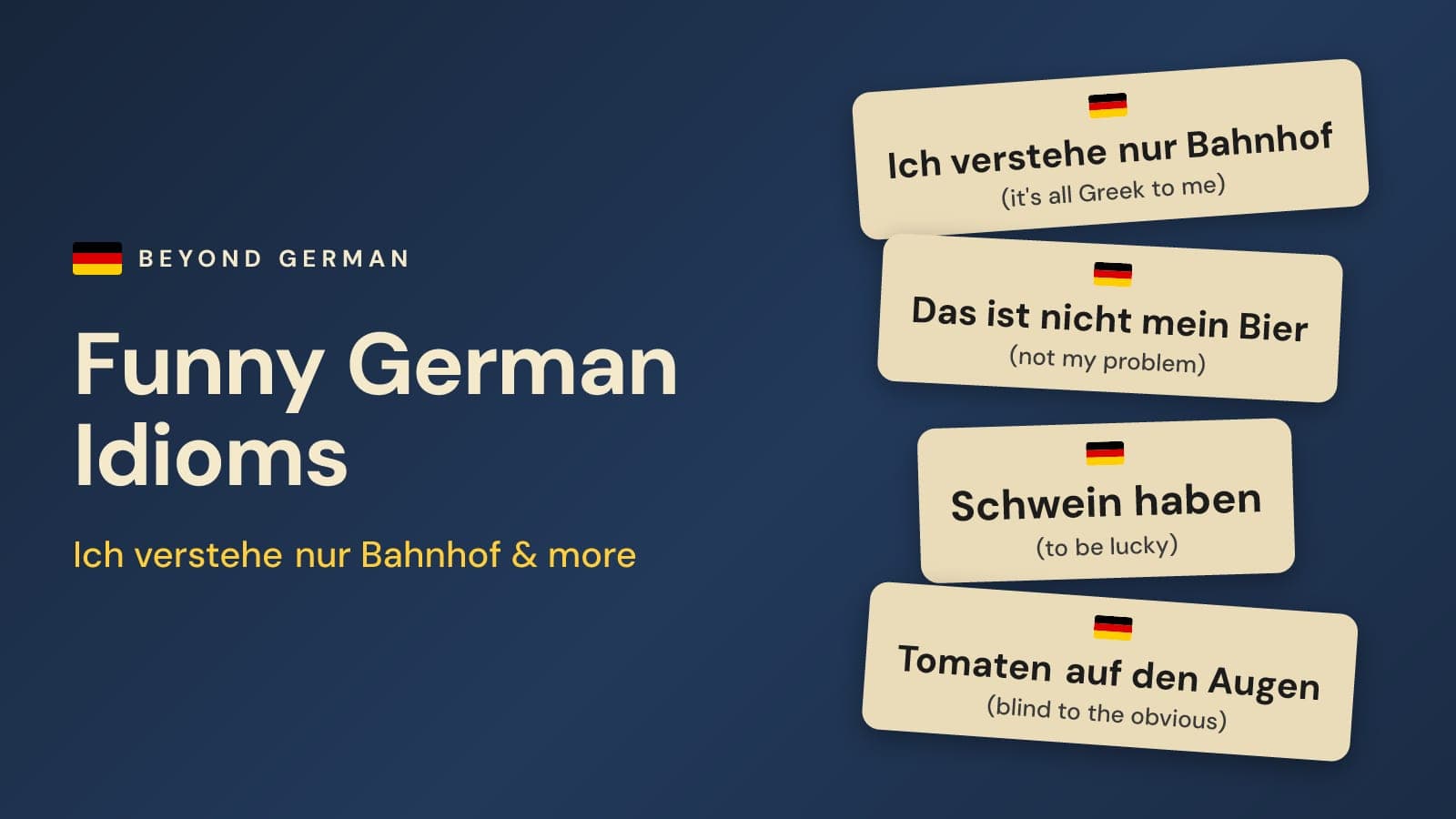
Funny German Idioms: 25 Sayings With English Translations
From Ich verstehe nur Bahnhof to Schwein haben: 25 funny German idioms with literal translations, real meanings, English equivalents and example sentences.
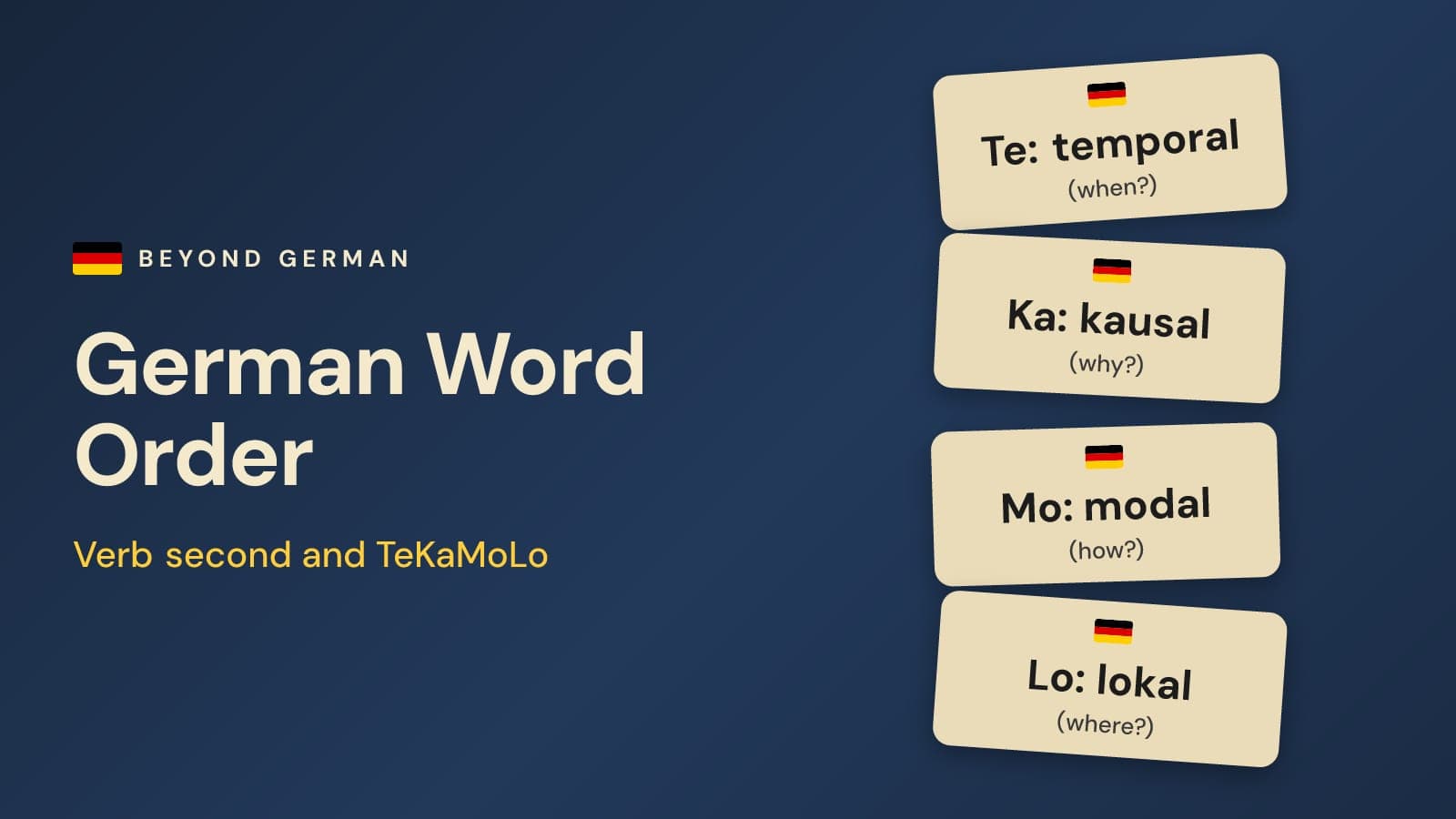
German Word Order: Verb-Second Rule, Verb at the End & TeKaMoLo
German word order in 7 rules: verb second, verb first in yes/no questions, verb last after weil and dass, the verb bracket, TeKaMoLo, object order and where nicht goes.
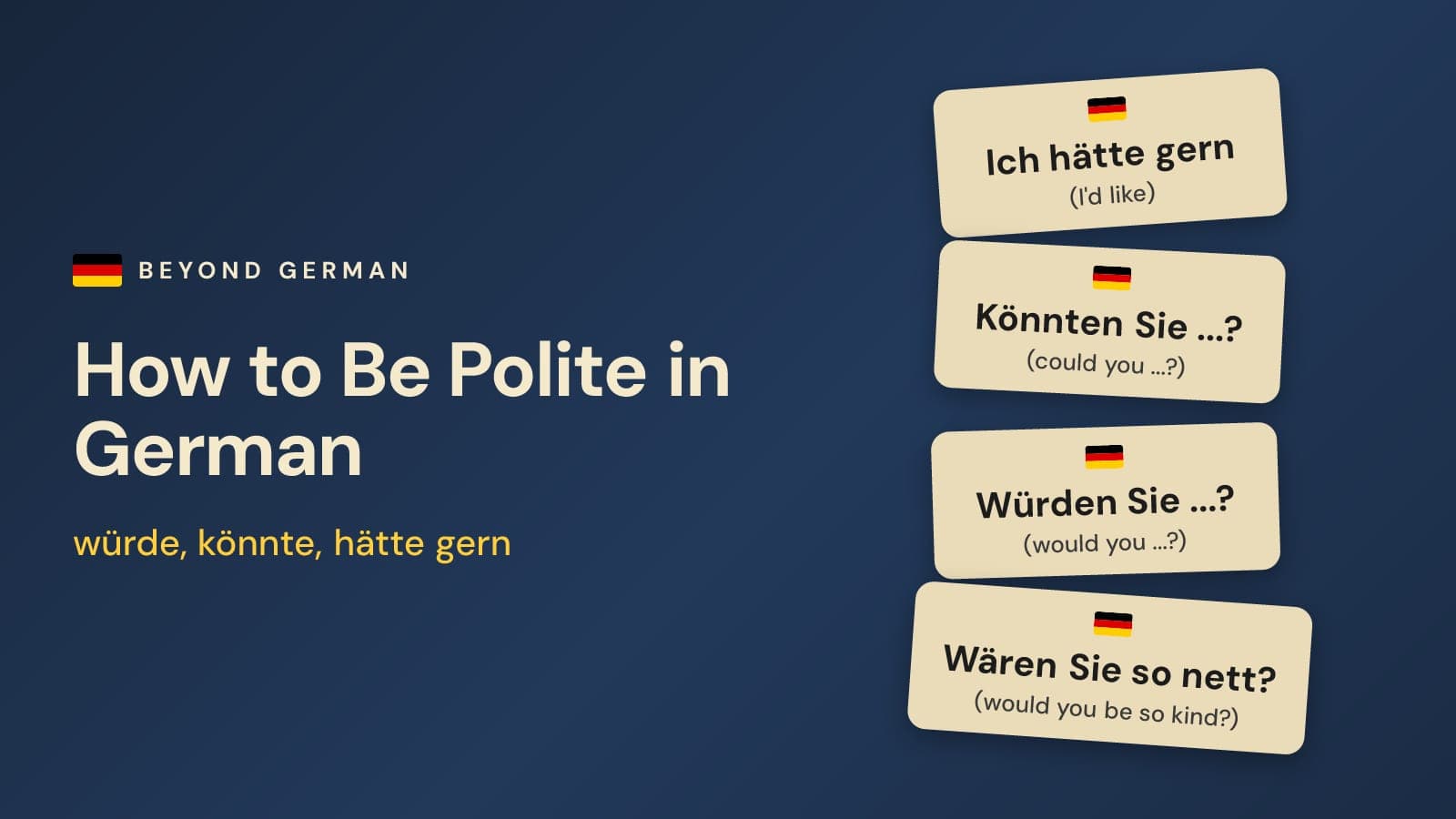
How to Be Polite in German: Würde, Könnte, Hätte gern & More
Sound polite in German with Konjunktiv II: Ich hätte gern, Könnten Sie, Würden Sie and Dürfte ich, plus softening words, Sie vs. du, polite refusals and dialogues.