
Days of the Week in German, Months and How to Say the Date
 Beyond German Team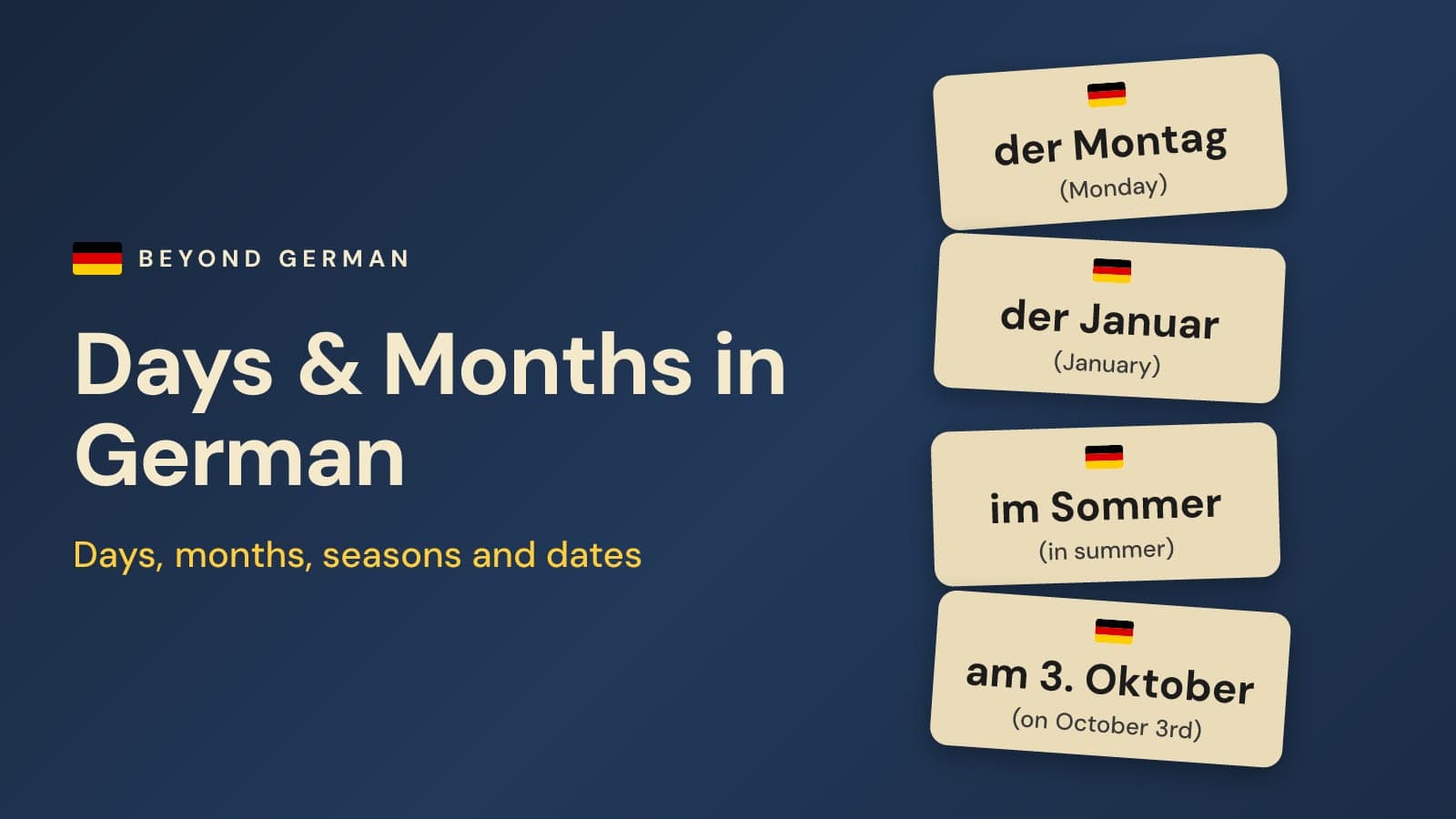
The days of the week in German are Montag (Monday), Dienstag (Tuesday), Mittwoch (Wednesday), Donnerstag (Thursday), Freitag (Friday), Samstag (Saturday) and Sonntag (Sunday). The months run from Januar to Dezember and look a lot like English. All of them are masculine (der), and to say the date you use an ordinal number: am 3. Oktober, spoken am dritten Oktober.
Below you'll find both lists with abbreviations and pronunciation tips, plus seasons, dates, years, holidays and handy words like übermorgen. Days and months usually come with a preposition (am Montag, im Mai), so keep our complete guide to German time prepositions (am, um, im, in, vor, nach) close at hand.
The Days of the Week in German
| English | German | Short | Sounds like |
|---|---|---|---|
| Monday | der Montag | Mo. | MOHN-tahk |
| Tuesday | der Dienstag | Di. | DEENS-tahk |
| Wednesday | der Mittwoch | Mi. | MIT-vokh |
| Thursday | der Donnerstag | Do. | DON-ers-tahk |
| Friday | der Freitag | Fr. | FRY-tahk |
| Saturday | der Samstag | Sa. | ZAHMS-tahk |
| Sunday | der Sonntag | So. | ZON-tahk |
- They're all masculine. Most end in -tag (day), and der Tag is masculine. Even der Mittwoch is masculine, although die Woche (week) is feminine. Months and seasons follow the same pattern, one of the easy wins among the der, die, das gender rules.
- The final g sounds like k: Montag ends in "-tahk". In northern Germany, you'll also hear "-tach".
- The w in Mittwoch sounds like English v, and the ch is the throaty sound in Bach.
- Abbreviations are two letters plus a period. You'll see them on opening hours: Mo.–Fr. 8–20 Uhr, Sa. 9–16 Uhr.
To ask what day it is, say Welcher Tag ist heute? The answer has no article: Heute ist Freitag. — Today is Friday.
Where the Names Come From
English and German day names share their roots, which makes them easier to remember:
- Sonntag (sun day) and Montag (moon day) match English exactly.
- Donnerstag is Thor's day, just like Thursday. In Old High German, Thor was called Donar, and der Donner still means thunder.
- Freitag and Friday are both named after the goddess Frija (Frigg in Norse myths).
- Mittwoch means "midweek". English kept the god Woden in Wednesday; German swapped him for a neutral name.
Samstag or Sonnabend?
Saturday has two names, and both are standard German. Samstag comes from the Sabbath and is used everywhere, especially in the south and west, in Austria and in Switzerland. Sonnabend literally means "Sunday eve" and is common in northern and eastern Germany. If you learn only one, make it Samstag. Both share the abbreviation Sa.
Am Montag vs. montags
This small difference matters a lot:
- am Montag = on Monday (one particular Monday)
- montags = on Mondays (every Monday, as a habit)
Montags is an adverb, so it's lowercase, like abends and morgens. The noun Montag is always capitalized. Here are the day expressions you'll use most:
| Expression | Meaning | Example |
|---|---|---|
| am Montag | on Monday | Am Montag fängt mein Kurs an. — My course starts on Monday. |
| montags | on Mondays | Montags ist das Museum geschlossen. — The museum is closed on Mondays. |
| jeden Montag | every Monday | Ich gehe jeden Montag schwimmen. — I go swimming every Monday. |
| am Montagabend | on Monday evening | Am Montagabend habe ich frei. — I'm free on Monday evening. |
| von Montag bis Freitag | from Monday to Friday | Ich arbeite von Montag bis Freitag. — I work Monday to Friday. |
| ab Montag | from Monday on | Ab Montag bin ich im Urlaub. — I'm on vacation from Monday. |
| nächsten Montag | next Monday | Nächsten Montag habe ich Geburtstag. — My birthday is next Monday. |
| letzten Montag | last Monday | Letzten Montag war ich krank. — I was sick last Monday. |
Why am? It's short for an dem, and you'll meet it again with dates (am 3. Oktober). Clock times take um and months take im; our guide to German time prepositions explains the whole system.
The Months in German
| English | German | Sounds like |
|---|---|---|
| January | der Januar | YAH-noo-ar |
| February | der Februar | FAY-broo-ar |
| March | der März | merts |
| April | der April | ah-PRIL |
| May | der Mai | my |
| June | der Juni | YOO-nee |
| July | der Juli | YOO-lee |
| August | der August | ow-GOOST |
| September | der September | zep-TEM-ber |
| October | der Oktober | ok-TOH-ber |
| November | der November | no-VEM-ber |
| December | der Dezember | deh-TSEM-ber |
- Use im with months: im Januar, im Mai (im = in dem). Never "in Januar".
- Watch the stress: German says ah-PRIL and ow-GOOST, stressing the second syllable.
- März has an umlaut. If you can't type ä, write Maerz, never "Marz".
- Juno and Julei: Juni and Juli sound almost the same, so on the phone many Germans say Juno and Julei to keep them apart, just like zwo for zwei.
Jänner: January in Austria
In Austria, Januar is usually der Jänner ("YEN-ner"). It's standard Austrian German, so you'll see it on calendars, in newspapers and in official letters: im Jänner. Austrians understand Januar too, so you don't need to switch.
Seasons in German: im Sommer
The seasons (die Jahreszeiten) are masculine too, so they also take im:
- der Frühling (spring) → im Frühling
- der Sommer (summer) → im Sommer
- der Herbst (fall, autumn) → im Herbst
- der Winter (winter) → im Winter
- Im Sommer fahren wir an die Ostsee. — In summer, we go to the Baltic Sea.
- Im Herbst wird es früh dunkel. — In the fall, it gets dark early.
- Im Winter fahre ich gern Ski. — In winter, I like to go skiing.
You'll also hear das Frühjahr for spring: im Frühjahr. It's the only season word that isn't masculine.
How to Say the Date in German
Dates use ordinal numbers (first, second, third). Up to 19, add -te to the number; from 20 on, add -ste. Watch the irregular ones: erste, dritte, siebte and achte. Our guide to German numbers covers ordinals in more detail.
| Written | What the date is | When something happens |
|---|---|---|
| 1. Mai | der erste Mai | am ersten Mai |
| 2. Juni | der zweite Juni | am zweiten Juni |
| 3. Oktober | der dritte Oktober | am dritten Oktober |
| 7. März | der siebte März | am siebten März |
| 8. August | der achte August | am achten August |
| 19. Juli | der neunzehnte Juli | am neunzehnten Juli |
| 20. April | der zwanzigste April | am zwanzigsten April |
| 31. Dezember | der einunddreißigste Dezember | am einunddreißigsten Dezember |
Der dritte Oktober vs. am dritten Oktober
The ending depends on what you're doing with the date:
- Heute ist der dritte Oktober. — Today is October 3rd. (what the date is)
- Wir fliegen am dritten Oktober. — We're flying on October 3rd. (when something happens)
Am is short for an dem, which puts the ordinal in the dative case and gives it an -en ending. In writing, both look the same: the period in 3. simply marks an ordinal.
To ask the date, say Der Wievielte ist heute? or Welches Datum ist heute? You'll also hear the answer Wir haben den dritten Oktober. — It's October 3rd. (Haben takes the accusative, hence den.)
Writing the Date: 03.10.2026
Germans write the day first, then the month, then the year, with periods in between: 03.10.2026, 3.10.2026 or 3. Oktober 2026. US readers, careful: 03.10. is October 3, not March 10.
Reading a date aloud, you can name the month (der dritte Oktober) or use a second ordinal (der dritte Zehnte, "the third of the tenth"). At the top of letters, you'll often see the place and date: Berlin, den 3. Oktober 2026.
Saying Years
Years like 1999 are split into hundreds, as in English, but German keeps the word hundert. From 2000 on, you say the full number:
- 1999 — neunzehnhundertneunundneunzig
- 1989 — neunzehnhundertneunundachtzig
- 2026 — zweitausendsechsundzwanzig
There's no "in" before a year: use the year on its own or say im Jahr. Die Mauer fiel 1989. — The Berlin Wall fell in 1989. Put everything together and a full date sounds like this: Heute ist Samstag, der 3. Oktober 2026 (der dritte Oktober zweitausendsechsundzwanzig).
German Holidays and Special Days
| Holiday | Date | What people say |
|---|---|---|
| Neujahr (New Year's Day) | 1. Januar | Frohes neues Jahr! |
| Ostern (Easter) | March or April | Frohe Ostern! |
| Tag der Deutschen Einheit (German Unity Day) | 3. Oktober | Schönen Feiertag! |
| Heiligabend (Christmas Eve) | 24. Dezember | Frohe Weihnachten! |
| Weihnachten (Christmas) | 25. und 26. Dezember | Frohe Weihnachten! |
| Silvester (New Year's Eve) | 31. Dezember | Guten Rutsch! |
- Tag der Deutschen Einheit is Germany's national holiday. It marks reunification on 3 October 1990.
- Ostern: Good Friday (Karfreitag) and Easter Monday (Ostermontag) are public holidays across Germany.
- Weihnachten: presents are usually opened on the evening of the 24th, and both the 25th and the 26th are public holidays.
- Silvester isn't a public holiday, but it's a big night of parties and fireworks. Guten Rutsch! literally wishes you a good "slide" into the new year.
Weihnachten, Ostern and Silvester usually go without an article and take an or zu, not im: an Weihnachten (more common in the south) or zu Weihnachten (more common in the north). On public holidays and Sundays, most shops are closed, one of the cultural habits in Germany that surprises newcomers most.
Relative Time Words: heute, morgen, gestern
| German | English |
|---|---|
| vorgestern | the day before yesterday |
| gestern | yesterday |
| heute | today |
| morgen | tomorrow |
| übermorgen | the day after tomorrow |
| diese Woche | this week |
| nächste Woche | next week |
| letzten Monat | last month |
| nächstes Jahr | next year |
| am Wochenende | on the weekend |
- Übermorgen fliege ich nach Wien. — I'm flying to Vienna the day after tomorrow.
- Nächste Woche habe ich Urlaub. — I'm on vacation next week.
- Letzten Monat sind wir umgezogen. — We moved last month.
- Was machst du am Wochenende? — What are you doing on the weekend?
Why letzten Monat but letzte Woche and letztes Jahr? Time expressions without a preposition are in the accusative case, so the ending follows the noun's gender: der Monat → letzten Monat, die Woche → letzte Woche, das Jahr → letztes Jahr.
One trap: morgen means tomorrow, but der Morgen means morning. "Tomorrow morning" is morgen früh.
Common Mistakes With Days, Months and Dates
1. Using in with days, months and seasons
Wrong: in Montag, in Januar, in Sommer. Right: am Montag, im Januar, im Sommer.
Days take am; months and seasons take im.
2. Capitalizing montags
Wrong: Ich arbeite Montags. Right: Ich arbeite montags.
The noun Montag is capitalized; the adverb montags isn't.
3. Forgetting the ordinal ending
Wrong: am drei Oktober, am dritte Oktober. Right: am dritten Oktober.
Dates need an ordinal, and after am it ends in -en.
4. Reading 03.10. as March 10
Wrong: 03.10. = March 10. Right: 03.10. = October 3.
German dates always go day, month, year.
5. Using die or das with days and months
Wrong: die Montag, das Januar. Right: der Montag, der Januar.
Days, months and seasons are masculine. The only exception is das Frühjahr.
Practice
Translate into German, then check your answers.
- on Friday
- on Fridays
- in March
- in winter
- Today is May 1st.
- on May 1st
- the day after tomorrow
- 1999 (as a year)
Answers:
- am Freitag
- freitags
- im März
- im Winter
- Heute ist der erste Mai.
- am ersten Mai
- übermorgen
- neunzehnhundertneunundneunzig
Ready for more? Test yourself with the A1 German quizzes, then learn telling time in German so you can say exactly when: am Freitag um halb acht (on Friday at 7:30).
FAQ
What are the days of the week in German?
Montag (Monday), Dienstag (Tuesday), Mittwoch (Wednesday), Donnerstag (Thursday), Freitag (Friday), Samstag or Sonnabend (Saturday) and Sonntag (Sunday). German calendars start the week on Monday.
What are the months in German?
Januar, Februar, März, April, Mai, Juni, Juli, August, September, Oktober, November and Dezember. They're all masculine and take im: im Mai. In Austria, January is usually Jänner.
How do you say the date in German?
Use an ordinal number plus the month: Heute ist der dritte Oktober. To say when something happens, use am and an -en ending: am dritten Oktober. In writing, that's 3. Oktober or 03.10.
How do you say years in German?
Years like 1999 are split into hundreds: neunzehnhundertneunundneunzig. From 2000 on, you say the full number: 2026 is zweitausendsechsundzwanzig. Don't put "in" in front of a year: Ich bin 1999 geboren. — I was born in 1999.
What's the difference between am Montag and montags?
Am Montag means on one particular Monday; montags means every Monday. Am Montag bin ich in Berlin. — I'm in Berlin on Monday. Montags habe ich Deutschkurs. — I have German class on Mondays.
Level Up Your German
Join 1,000+ learners getting weekly tips, grammar shortcuts, and cultural insights.
Share this article
Continue Reading
Common German Mistakes English Speakers Make (+ False Friends)
Why 'Ich bin heiß' gets laughs and 'Ich will' doesn't mean 'I will': 15 common German mistakes English speakers make, plus the false friends to watch out for.
Telling Time in German: What Time Is It? (Halb Acht Explained)
Learn how to tell time in German: ask Wie spät ist es?, use the 24-hour clock, master Viertel nach and Viertel vor, and see why halb acht means 7:30.
German Two-Way Prepositions (Wechselpräpositionen) Explained
The nine German two-way prepositions (an, auf, hinter, in, neben, über, unter, vor, zwischen): when they take the accusative or dative, with verb pairs and examples.