
Hobbies in German: Was machst du gern? Freizeit Vocabulary
 Beyond German Team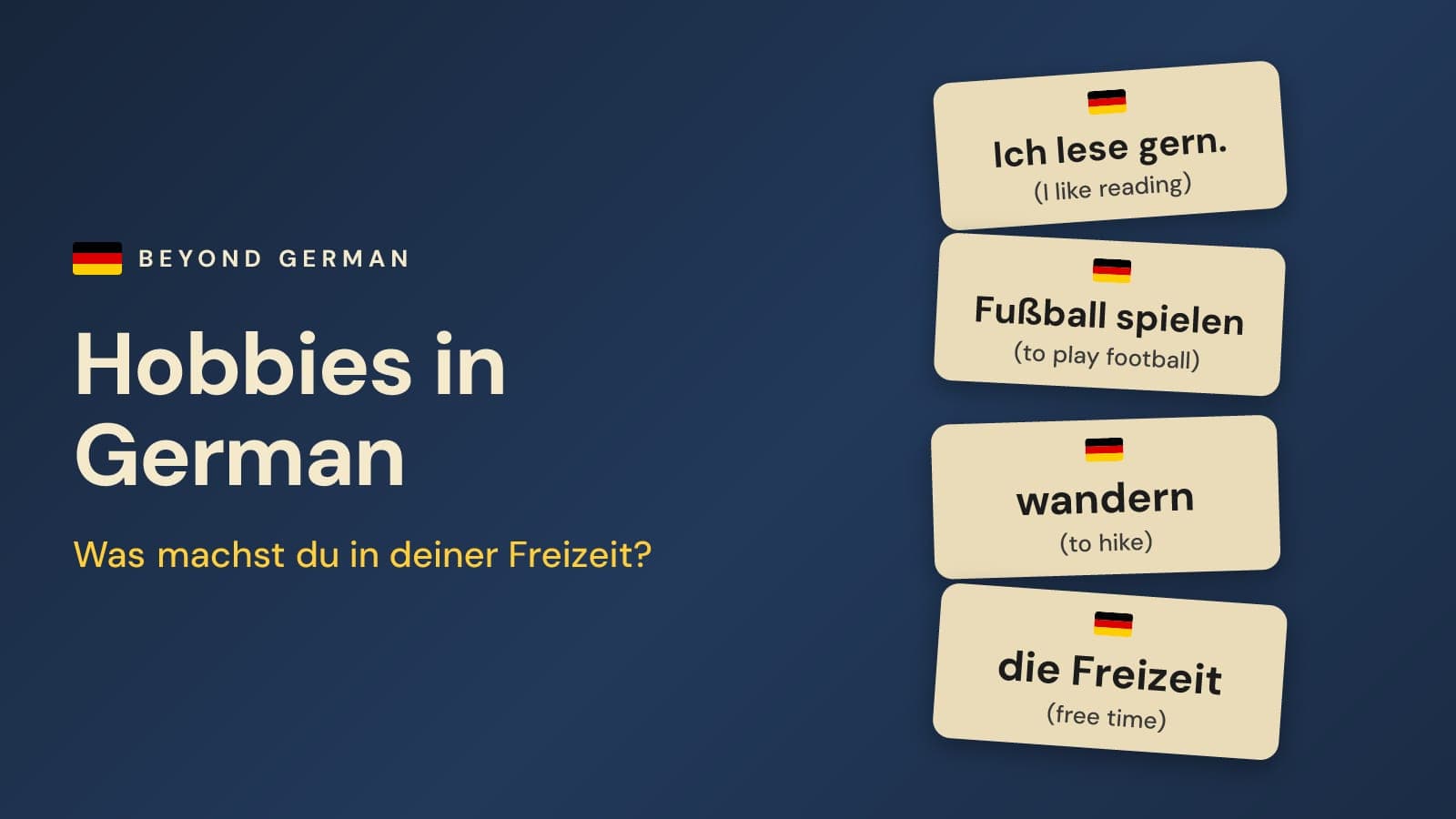
To ask about hobbies in German, say Was machst du in deiner Freizeit? — What do you do in your free time? To answer, use the verb plus gern: Ich lese gern. — I like reading. Ich spiele gern Fußball. — I like playing soccer.
Below: the key questions, gern, lieber and am liebsten, hobby vocabulary by category, spielen vs. machen vs. gehen, frequency words, German clubs and common mistakes.
How to Ask About Hobbies in German
Hobbies come up in almost every first conversation, so they're a standard part of introducing yourself in German. Use du with friends, Sie in formal situations:
| Informal (du) | Formal (Sie) | English |
|---|---|---|
| Was machst du in deiner Freizeit? | Was machen Sie in Ihrer Freizeit? | What do you do in your free time? |
| Was sind deine Hobbys? | Was sind Ihre Hobbys? | What are your hobbies? |
| Hast du Hobbys? | Haben Sie Hobbys? | Do you have any hobbies? |
| Was machst du gern? | Was machen Sie gern? | What do you like to do? |
| Was machst du am Wochenende? | Was machen Sie am Wochenende? | What do you do on weekends? / What are you doing this weekend? |
| Wofür interessierst du dich? | Wofür interessieren Sie sich? | What are you interested in? |
Germans often add so to sound casual: Was machst du so in deiner Freizeit? — So what do you get up to in your free time? And note the spelling: one Hobby, two Hobbys (not "Hobbies").
After you answer, return the question with Und du? — And you? To suggest doing something together, ask Hast du Lust, am Sonntag wandern zu gehen? — Do you feel like going hiking on Sunday?
How to Answer: Gern, Lieber, Am Liebsten
English says "I like reading". German takes the activity verb and adds gern (gladly): Ich lese gern is literally "I read gladly". The verb stays in second place, and gern usually comes right after it:
- Ich koche gern. — I like cooking.
- Ich spiele gern Tennis. — I like playing tennis.
- Ich gehe gern ins Kino. — I like going to the movies.
- Ich tanze nicht gern. — I don't like dancing.
For "don't like", put nicht before gern. No hobbies at all? Say Ich habe keine Hobbys. Our guide to nicht vs. kein explains why it's keine here. Gern and gerne are both correct.
To compare, step up to lieber (prefer) and am liebsten (like most of all):
| German | Meaning | Example |
|---|---|---|
| gern | like doing | Ich schwimme gern. — I like swimming. |
| lieber | prefer doing | Ich schwimme gern, aber ich jogge lieber. — I like swimming, but I prefer jogging. |
| am liebsten | like doing most of all | Am liebsten fahre ich Rad. — Most of all, I like cycling. |
When am liebsten opens the sentence, the verb still comes second, so the subject moves after it: Am liebsten fahre ich Rad, never Am liebsten ich fahre Rad. That's the verb-second rule from our guide to German word order.
Gern, Mögen or Gefallen?
Gern is for activities. For things and people, use mögen: Ich mag Hip-Hop. — I like hip-hop. For something you see or try, use gefallen: Der Film gefällt mir. — I like the movie. Mixing these up is one of the most common beginner mistakes, so read our full guide on how to say "I like" in German.
Mein Hobby ist… / Meine Hobbys sind…
You can also name your hobbies as nouns, or use these patterns:
- Mein Hobby ist Fotografieren. — My hobby is photography.
- Meine Hobbys sind Lesen, Wandern und Kochen. — My hobbies are reading, hiking and cooking.
- Kochen macht mir Spaß. — I enjoy cooking.
- Ich interessiere mich für Kunst. — I'm interested in art.
Any German verb can become a noun: capitalize it, and it's neuter (das Lesen, das Wandern). Macht mir Spaß (literally "makes me fun") is the everyday way to say you enjoy something.
Hobbies in German: Vocabulary by Category
Each hobby is listed as a verb phrase, ready to use in a sentence.
Sports
| German | English | Example |
|---|---|---|
| Fußball spielen | to play soccer (football) | Ich spiele jeden Samstag Fußball. — I play soccer every Saturday. |
| schwimmen | to swim | Im Sommer schwimme ich im See. — In summer I swim in the lake. |
| joggen | to jog | Ich jogge morgens im Park. — I jog in the park in the mornings. |
| Rad fahren | to cycle | Ich fahre jeden Tag Rad. — I cycle every day. |
| wandern | to hike | Wir wandern gern in den Bergen. — We like hiking in the mountains. |
| Yoga machen | to do yoga | Ich mache zweimal pro Woche Yoga. — I do yoga twice a week. |
| ins Fitnessstudio gehen | to go to the gym | Nach der Arbeit gehe ich ins Fitnessstudio. — After work I go to the gym. |
Wandern is a false friend: it means hiking, not wandering around.
Culture and Creative Hobbies
| German | English | Example |
|---|---|---|
| lesen | to read | Ich lese gern Krimis. — I like reading crime novels. |
| Musik hören | to listen to music | Ich höre viel Musik, vor allem Jazz. — I listen to a lot of music, especially jazz. |
| ins Kino gehen | to go to the movies | Gehen wir am Freitag ins Kino? — Shall we go to the movies on Friday? |
| ins Konzert gehen | to go to a concert | Ich gehe oft ins Konzert. — I often go to concerts. |
| ins Museum gehen | to go to a museum | Am Sonntag gehen wir ins Museum. — On Sunday we're going to a museum. |
| Gitarre spielen | to play the guitar | Ich spiele seit drei Jahren Gitarre. — I've been playing the guitar for three years. |
| Klavier spielen | to play the piano | Meine Tochter spielt Klavier. — My daughter plays the piano. |
| malen | to paint | Am Wochenende male ich gern. — I like painting on weekends. |
| fotografieren | to take photos | Im Urlaub fotografiere ich viel. — On vacation I take lots of photos. |
No article with instruments: English plays the guitar, German just plays Gitarre.
Social Life
| German | English | Example |
|---|---|---|
| Freunde treffen | to meet friends | Ich treffe heute Abend Freunde. — I'm meeting friends tonight. |
| ausgehen | to go out | Am Freitagabend gehe ich oft aus. — I often go out on Friday nights. |
| feiern | to party, to celebrate | Wir feiern am Samstag Lenas Geburtstag. — We're celebrating Lena's birthday on Saturday. |
| spazieren gehen | to go for a walk | Nach dem Essen gehen wir spazieren. — After the meal we go for a walk. |
| essen gehen | to eat out | Wir gehen gern essen. — We like eating out. |
You'll also hear Ich treffe mich mit Freunden. — I'm meeting up with friends. Both versions are correct.
At Home
| German | English | Example |
|---|---|---|
| kochen | to cook | Ich koche gern für Freunde. — I like cooking for friends. |
| backen | to bake | Sonntags backe ich oft Brot. — I often bake bread on Sundays. |
| gärtnern | to garden | Mein Vater gärtnert jeden Tag. — My dad gardens every day. |
| zocken / Videospiele spielen | to game / to play video games | Abends zocke ich online mit Freunden. — In the evenings I game online with friends. |
Zocken is casual and popular with younger people (it originally meant "to gamble"); Videospiele spielen is neutral. In everyday speech, gärtnern often becomes im Garten arbeiten: Meine Oma arbeitet gern im Garten. — My grandma likes working in the garden.
Spielen, Machen or Gehen?
German uses "play", "do" and "go" for hobbies too, but not always where English does. The logic is literal: you play games and instruments, do an activity, and go somewhere to do it.
| Verb | Used for | Examples |
|---|---|---|
| spielen | ball games, games, instruments | Fußball, Tennis, Schach, Karten, Gitarre, Klavier, Videospiele spielen |
| machen | general activities, many non-ball sports | Sport, Yoga, Karate, Musik, Fotos machen |
| gehen + infinitive | activities you go out to do | schwimmen, joggen, wandern, tanzen, spazieren gehen |
| gehen + ins / in die | places | ins Kino, ins Konzert, ins Museum, ins Theater, in die Oper gehen |
| fahren | anything with wheels or skis | Rad fahren, Ski fahren, Skateboard fahren |
With gehen + infinitive, the second verb goes to the end: Ich gehe am Samstag schwimmen. — I'm going swimming on Saturday. No zu, and no -ing form.
With places, in takes the accusative because you're going somewhere: in das Kino becomes ins Kino. Once you're there, it's dative: Ich bin im Kino. — I'm at the movies. Our guide to two-way prepositions explains the switch.
How Often? Frequency Words
| German | English | Example |
|---|---|---|
| immer | always | Beim Joggen höre ich immer Musik. — I always listen to music when I jog. |
| oft | often | Wir spielen oft Karten. — We often play cards. |
| manchmal | sometimes | Manchmal spiele ich Tennis. — Sometimes I play tennis. |
| selten | rarely | Ich gehe selten aus. — I rarely go out. |
| nie | never | Ich zocke nie unter der Woche. — I never play video games during the week. |
| jeden Tag | every day | Ich lese jeden Tag. — I read every day. |
| am Wochenende | on the weekend | Am Wochenende gehen wir wandern. — On the weekend we go hiking. |
| einmal pro Woche | once a week | Ich gehe einmal pro Woche schwimmen. — I go swimming once a week. |
| montags | on Mondays | Montags habe ich Training. — I have practice on Mondays. |
Frequency words usually come right after the verb: Ich gehe oft ins Kino. Put one first for emphasis, and the verb stays second, as in Manchmal spiele ich Tennis.
Jeden Tag is accusative, so the ending follows the gender: der Tag → jeden Tag, die Woche → jede Woche, das Jahr → jedes Jahr. For am Montag (on Monday) vs. montags (every Monday), see our guide to the days of the week in German.
Vereine: How Germans Do Hobbies
In Germany, hobbies often come with a membership. A club is der Verein (plural die Vereine), and there are more than 600,000 registered ones. The e.V. after a club's name stands for eingetragener Verein (registered association). Sports clubs alone count around 29 million memberships, and Germans joke about it themselves: Wenn sich drei Deutsche treffen, gründen sie einen Verein. — When three Germans meet, they start a club.
There's a club for almost everything, from soccer and choirs (der Chor) to allotment-garden clubs (der Kleingartenverein). Fees are usually modest, and joining one is one of the best ways to make friends and practice your German.
- Ich bin im Fußballverein. — I'm in a soccer club.
- Ich bin Mitglied in einem Chor. — I'm a member of a choir.
- Wann ist das Training? — When is practice?
- Wie hoch ist der Mitgliedsbeitrag? — How much is the membership fee?
For more everyday customs, see our guide to cultural habits in Germany.
Common Mistakes
| Wrong | Right | Why |
|---|---|---|
| Ich gern lese. | Ich lese gern. | The verb comes second; gern follows it. |
| Ich mag lesen. | Ich lese gern. | For activities, use the verb + gern. Mögen works best with nouns: Ich mag Bücher. |
| Ich spiele die Gitarre. | Ich spiele Gitarre. | No article with instruments. |
| Ich mache Fußball. | Ich spiele Fußball. | Ball games take spielen. |
| Ich gehe zu schwimmen. | Ich gehe schwimmen. | Gehen + infinitive, no zu. |
| Ich bin interessiert in Kunst. | Ich interessiere mich für Kunst. | German uses the reflexive verb sich interessieren für. |
| Meine Hobbies sind lesen und kochen. | Meine Hobbys sind Lesen und Kochen. | The plural is Hobbys, and hobbies used as nouns are capitalized. |
Sich interessieren für is one of many verbs with a fixed preposition. Our list of German verbs with prepositions has the most useful ones.
Practice
Fill in the gaps:
- Ich ___ gern Klavier. (spielen)
- Mein Bruder ___ gern Krimis. (lesen)
- Wir gehen am Freitag ___ Kino.
- ___ fahre ich Rad. (most of all)
- Ich mache ___ Woche Yoga. (every)
- Kochen ___ mir Spaß.
Answers: 1. spiele 2. liest 3. ins 4. Am liebsten 5. jede 6. macht
Watch the stem-changing verbs: du liest, er fährt Rad, sie trifft Freunde. Our guide to the German present tense lists them. Then write three sentences about your own free time with gern, lieber and am liebsten, explore the word Freizeit, and test yourself with an A1 German quiz.
FAQ
How do you say "hobbies" in German?
Das Hobby, plural die Hobbys. To ask someone about theirs: Was sind deine Hobbys? — What are your hobbies?
How do you ask "What do you like to do?" in German?
Informally, Was machst du gern? Formally, Was machen Sie gern? To ask about free time in general: Was machst du in deiner Freizeit?
How do you say "I like to…" in German?
Use the verb plus gern: Ich tanze gern. — I like dancing. Use lieber for "prefer" and am liebsten for "like most of all".
What does Freizeit mean?
Die Freizeit means free time or leisure time: In meiner Freizeit lese ich viel. — In my free time I read a lot.
Level Up Your German
Join 1,000+ learners getting weekly tips, grammar shortcuts, and cultural insights.
Share this article
Continue Reading
Directions in German: Links, Rechts, Geradeaus & How to Ask
How to ask for directions in German (Wie komme ich zum Bahnhof?), understand links, rechts and geradeaus, plus city vocabulary, two dialogues and common mistakes.
German Supermarket Vocabulary: Pfand, Kasse & Shopping Phrases
Shop like a local in Germany: types of shops, checkout phrases, how Pfand works, bags, quantities and Sunday closing, with the German you'll hear at the Kasse.
Rooms in German: House & Furniture Vocabulary With Plurals
Rooms, furniture and appliances in German with articles and plurals, plus how to describe your home, which floor the Erdgeschoss is, and why Germans air their rooms.