
German Verbs with Prepositions: 40 Must-Know Combinations
 Beyond German Team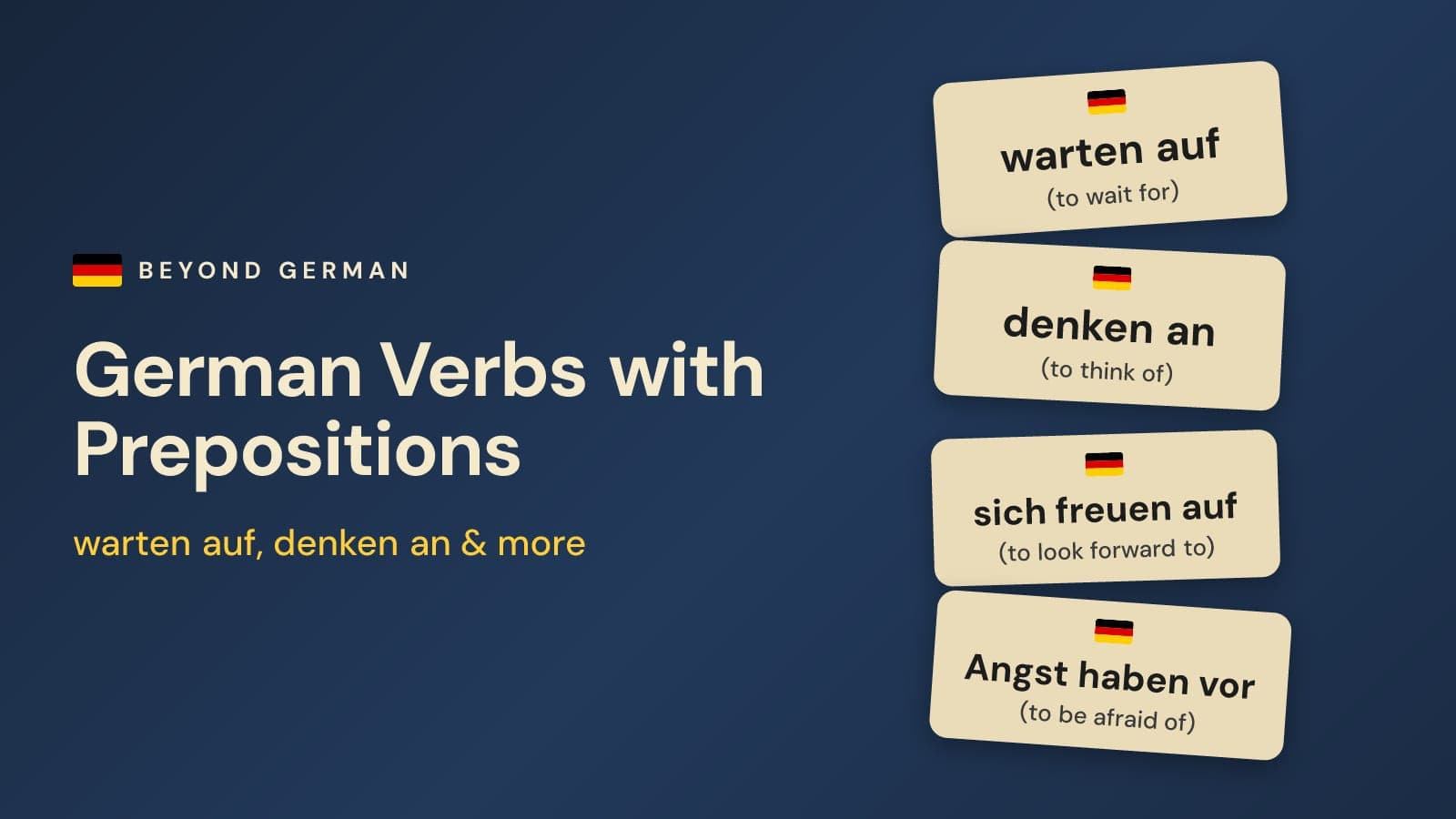
Many German verbs come with a fixed preposition: warten auf (to wait for), denken an (to think of), sich freuen auf (to look forward to). You can't swap in a different preposition, and each one also fixes the case, accusative or dative. So the smart way to learn these verbs is as one chunk: verb + preposition + case.
German textbooks call them Verben mit Präpositionen. Below you'll find the 40 most useful ones in a single table, example sentences, the difference between sich freuen auf and sich freuen über, how to ask questions with worauf and woran, and the mistakes almost every learner makes.
Why the Preposition Is Fixed
In these combinations, the preposition loses its everyday meaning. Auf normally means "on", but in warten auf it simply links the verb to the thing you're waiting for. That's why logic won't help you here.
English works the same way. You depend on something, you're interested in something, you look forward to something. Nobody chose those prepositions; they're just fixed. The trouble is that German often picks different ones:
- Ich warte auf den Bus. — I'm waiting for the bus. (not für)
- Ich interessiere mich für Musik. — I'm interested in music. (not in)
- Das hängt vom Wetter ab. — That depends on the weather. (not auf)
The case is fixed too, and it ignores the location-or-movement logic of two-way prepositions. Nothing moves in Ich warte auf den Bus, yet it's accusative. So always learn the verb together with an article that shows the case: auf den Bus warten, Angst vor dem Hund haben.
Accusative or Dative? Let the Preposition Help
You don't have to memorize the case for every verb separately. The preposition gives you a strong hint:
- mit, nach, von, zu, bei, aus → always dative. These are dative prepositions, and no verb can change that.
- für, um → always accusative.
- auf, über → with verbs, almost always accusative.
- vor → with verbs, dative.
- an, in → learn each verb: denken an takes the accusative, but teilnehmen an takes the dative.
Need a refresher on the cases themselves? See our guides to the accusative case and the dative case.
The List: 40 German Verbs with Prepositions
The table is sorted by preposition so you can spot the patterns. Akk = accusative, Dat = dative.
| Verb + preposition | Case | English |
|---|---|---|
| denken an | Akk | to think of / about |
| sich erinnern an | Akk | to remember |
| sich gewöhnen an | Akk | to get used to |
| glauben an | Akk | to believe in |
| arbeiten an | Dat | to work on |
| teilnehmen an | Dat | to take part in |
| antworten auf | Akk | to reply to (a question, an email) |
| aufpassen auf | Akk | to look after, keep an eye on |
| sich freuen auf | Akk | to look forward to |
| sich konzentrieren auf | Akk | to concentrate on |
| Lust haben auf | Akk | to feel like, be in the mood for |
| sich vorbereiten auf | Akk | to prepare for |
| warten auf | Akk | to wait for |
| sich bewerben bei | Dat | to apply to (a company) |
| sich entschuldigen bei | Dat | to apologize to (someone) |
| helfen bei | Dat | to help with |
| sich entschuldigen für | Akk | to apologize for |
| sich interessieren für | Akk | to be interested in |
| sich verlieben in | Akk | to fall in love with |
| aufhören mit | Dat | to stop (doing something) |
| sich beschäftigen mit | Dat | to deal with, spend time on |
| sprechen mit | Dat | to talk to / with |
| sich treffen mit | Dat | to meet (up) with |
| fragen nach | Dat | to ask about / for (information) |
| suchen nach | Dat | to look for, search for |
| sich ärgern über | Akk | to be annoyed about |
| sich freuen über | Akk | to be happy about |
| nachdenken über | Akk | to think about, reflect on |
| sprechen über | Akk | to talk about |
| bitten um | Akk | to ask for (a favor, help) |
| sich bewerben um | Akk | to apply for (a job) |
| es geht um | Akk | it's about |
| sich kümmern um | Akk | to take care of |
| abhängen von | Dat | to depend on |
| erzählen von | Dat | to tell about |
| halten von | Dat | to think of (your opinion) |
| träumen von | Dat | to dream of / about |
| Angst haben vor | Dat | to be afraid of |
| einladen zu | Dat | to invite to |
| gratulieren zu | Dat | to congratulate on |
Two things to watch for in the list:
- sich marks a reflexive verb, so you need the right pronoun as well: Wir interessieren uns für Kunst. — We're interested in art.
- Verbs like teilnehmen, aufhören and nachdenken are separable verbs, so the prefix moves to the end: Ich höre mit dem Rauchen auf. — I'm quitting smoking.
Example Sentences for the Most Common Ones
- Wir warten seit zwanzig Minuten auf die Pizza. — We've been waiting for the pizza for twenty minutes.
- Ich denke oft an meine Familie. — I often think of my family.
- Erinnerst du dich an unseren ersten Urlaub? — Do you remember our first vacation?
- Ich gewöhne mich langsam an das deutsche Wetter. — I'm slowly getting used to the German weather.
- Interessierst du dich für Geschichte? — Are you interested in history?
- Mein Sohn hat Angst vor Hunden. — My son is afraid of dogs.
- Ich nehme an einem Deutschkurs teil. — I'm taking part in a German course.
- Ich muss mit meinem Chef über mein Gehalt sprechen. — I need to talk to my boss about my salary.
- Ein Tourist hat mich nach dem Weg gefragt. — A tourist asked me for directions.
- Kannst du mir bei den Hausaufgaben helfen? — Can you help me with my homework?
- Ich träume von einem Haus am Meer. — I dream of a house by the sea.
- Darf ich Sie um einen Gefallen bitten? — May I ask you a favor?
- Wer kümmert sich um den Hund, wenn wir im Urlaub sind? — Who's taking care of the dog while we're on vacation?
- Der Preis hängt von der Größe ab. — The price depends on the size.
- Ich beschäftige mich gerade viel mit deutscher Grammatik. — I'm spending a lot of time on German grammar right now.
- Ich möchte mich bei Ihnen für die Verspätung entschuldigen. — I'd like to apologize to you for the delay.
- Ich habe mich bei drei Firmen um ein Praktikum beworben. — I've applied to three companies for an internship.
- Was hältst du von meiner Idee? — What do you think of my idea?
Sich freuen auf vs Sich freuen über
This pair trips up almost everyone. Both take the accusative; the difference is time.
| Phrase | Use it for | Example | English |
|---|---|---|---|
| sich freuen auf | something in the future | Ich freue mich auf die Ferien. | I'm looking forward to the holidays. |
| sich freuen über | something that has happened, or that you have now | Ich freue mich über dein Geschenk. | I'm happy about your present. |
| sich freuen für | someone else's good news | Ich freue mich für dich! | I'm happy for you! |
A quick test: the birthday party next week is auf; the presents you got at the party are über. You'll find more examples on the word page for sich freuen.
Asking Questions and Referring Back: Worauf, Darauf, Auf Wen
When the preposition points to a thing or an idea, standard German doesn't say auf was or auf es. Instead, it fuses the preposition with wo- for questions and da- for answers. If the preposition starts with a vowel, add an -r-: wo + auf = worauf, da + an = daran.
For people, keep the preposition and use wen (accusative) or wem (dative) in questions, and a normal pronoun in answers.
| Verb | Thing: question | Thing: answer | Person: question |
|---|---|---|---|
| warten auf (wait for) | Worauf wartest du? | Ich warte darauf. | Auf wen wartest du? |
| denken an (think of) | Woran denkst du? | Ich denke daran. | An wen denkst du? |
| sich interessieren für (be interested in) | Wofür interessierst du dich? | Ich interessiere mich dafür. | Für wen interessierst du dich? |
| sprechen über (talk about) | Worüber sprecht ihr? | Wir sprechen darüber. | Über wen sprecht ihr? |
| träumen von (dream of) | Wovon träumst du? | Ich träume davon. | Von wem träumst du? |
Here's the difference in real conversations:
- Wartest du auf den Zug? Ja, ich warte darauf. — Are you waiting for the train? Yes, I'm waiting for it.
- Wartest du auf Anna? Ja, ich warte auf sie. — Are you waiting for Anna? Yes, I'm waiting for her.
- Mit wem sprichst du? Mit meiner Lehrerin. — Who are you talking to? My teacher.
Da-compounds can also point ahead to a whole clause, which is very common with these verbs: Ich freue mich darauf, dich zu sehen. — I'm looking forward to seeing you. (See the word page for darauf and its spoken form drauf.)
In casual speech you'll also hear auf was or für was. People will understand you, but the wo-forms are standard, especially in writing. For the basics of wer, wen and wem, see our guide to German question words.
Common Mistakes With Verbs and Prepositions
Mistake 1: Translating the English preposition
Wrong: Ich warte für den Bus. / Ich bin interessiert in Musik.
Right: Ich warte auf den Bus. / Ich interessiere mich für Musik.
English "for" and "in" don't carry over. Whenever you learn a new verb, look up its German preposition, too.
Mistake 2: Guessing the case
Wrong: Ich denke an dem Urlaub. / Ich nehme an den Kurs teil.
Right: Ich denke an den Urlaub. / Ich nehme an dem Kurs teil.
Both verbs use an, but denken an takes the accusative and teilnehmen an takes the dative. Learn the case with the verb.
Mistake 3: Forgetting sich
Wrong: Ich freue auf das Wochenende.
Right: Ich freue mich auf das Wochenende.
Mistake 4: Using "es" after a preposition
Wrong: Ich warte auf es.
Right: Ich warte darauf.
For things, use a da-compound. For people, use the preposition plus a pronoun: if you mean Anna, say Ich warte auf sie, not Ich warte darauf.
Mistake 5: Mixing up fragen and bitten
Wrong: Ich frage für Hilfe.
Right: Ich bitte um Hilfe.
Fragen nach asks for information (nach dem Weg fragen). Bitten um asks for something you want (um Hilfe bitten).
Practice: Verbs with Prepositions
1. Fill in the preposition and the article.
- Ich warte ___ ___ Zug. (der Zug)
- Wir freuen uns ___ ___ Urlaub nächste Woche. (der Urlaub)
- Hast du Angst ___ ___ Prüfung? (die Prüfung)
- Kannst du dich ___ ___ Katze kümmern? (die Katze)
- Morgen nehme ich ___ ___ Meeting teil. (das Meeting)
2. Complete the question or the short answer.
- Ich denke an die Prüfung. → Ich denke ___.
- Ich spreche mit Tom. → ___ ___ sprichst du?
- Sie träumt von einer Weltreise. → ___ träumt sie?
Answers:
- Ich warte auf den Zug. — I'm waiting for the train.
- Wir freuen uns auf den Urlaub nächste Woche. — We're looking forward to our vacation next week.
- Hast du Angst vor der Prüfung? — Are you afraid of the exam?
- Kannst du dich um die Katze kümmern? — Can you take care of the cat?
- Morgen nehme ich an dem (or am) Meeting teil. — Tomorrow I'm taking part in the meeting.
Part 2: daran (I'm thinking about it), Mit wem (Who are you talking to?), Wovon (What does she dream of?).
Keep going:
- Pick five verbs from the table and write one true sentence about your own life with each.
- Check your accusative and dative endings with the A2 German quiz.
- Find more example sentences on the word pages for warten, denken, helfen and sich interessieren.
Keep learning:
- German Two-Way Prepositions (Wechselpräpositionen) Explained
- Common German Mistakes English Speakers Make (+ False Friends)
FAQ
Do I really have to memorize the preposition for each verb?
Yes. There's no reliable rule for which preposition a verb takes. Learn each one as a chunk with an article (auf den Bus warten) and start with the 40 in this guide. They cover most everyday situations.
How do I know if it's accusative or dative?
Check the preposition first. Mit, nach, von, zu, bei and aus are always dative; für and um always accusative. With verbs, auf and über are almost always accusative and vor takes the dative. Verbs with an are the ones you really have to memorize.
What's the difference between sich freuen auf and sich freuen über?
Sich freuen auf is for something in the future: you're looking forward to it. Sich freuen über is for something that has already happened or that you have now. Both take the accusative.
Is "auf was" wrong?
It's common in casual speech, but standard German uses wo-compounds for things: Worauf wartest du? For people, use the preposition with wen or wem: Auf wen wartest du?
Level Up Your German
Join 1,000+ learners getting weekly tips, grammar shortcuts, and cultural insights.
Share this article
Continue Reading
Common German Mistakes English Speakers Make (+ False Friends)
Why 'Ich bin heiß' gets laughs and 'Ich will' doesn't mean 'I will': 15 common German mistakes English speakers make, plus the false friends to watch out for.
Days of the Week in German, Months and How to Say the Date
Learn the days of the week and months in German with articles, abbreviations and pronunciation, plus seasons, dates like am 3. Oktober, years and holidays.
Telling Time in German: What Time Is It? (Halb Acht Explained)
Learn how to tell time in German: ask Wie spät ist es?, use the 24-hour clock, master Viertel nach and Viertel vor, and see why halb acht means 7:30.