
German Accusative Prepositions: durch, für, gegen, ohne, um
 Beyond German Team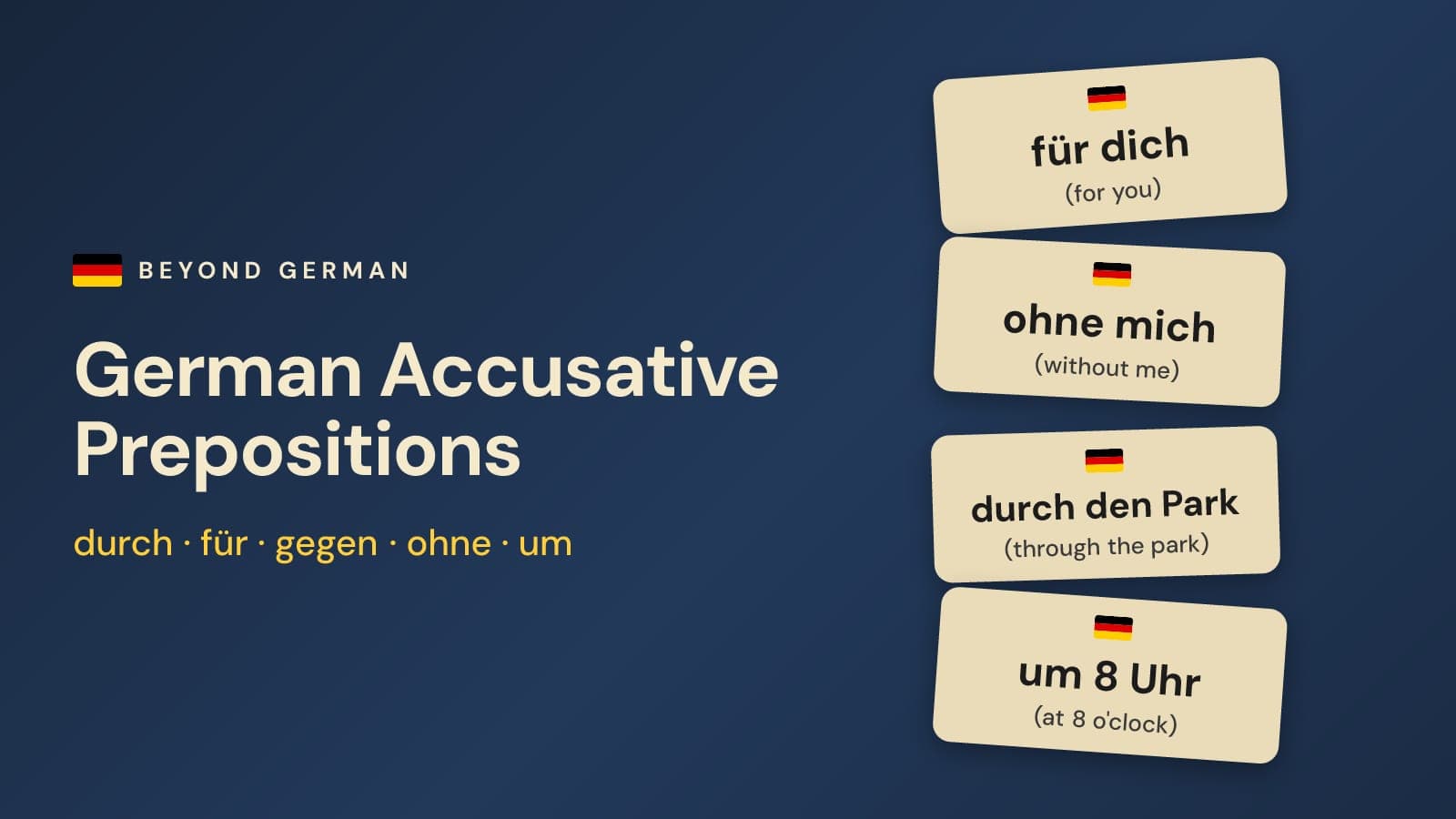
German has five prepositions that always take the accusative case: durch, für, gegen, ohne and um. Most lists add two more, bis and entlang. Whatever follows them goes into the accusative case: für den Chef (for the boss), durch die Stadt (through the city), ohne mich (without me).
The good news: the accusative is the easiest case to get right. Only masculine words and pronouns change, and unlike in or auf, these prepositions don't switch cases for movement. Below: each one with examples, a memory trick, the endings, and how this group fits in with the others.
The Accusative Prepositions at a Glance
| Preposition | Meaning(s) | Example | English |
|---|---|---|---|
| durch | through, across, by (means) | durch den Park | through the park |
| für | for | für meinen Bruder | for my brother |
| gegen | against, into; around (time) | gegen die Wand | against the wall |
| ohne | without | ohne mich | without me |
| um | around; at (clock times); about | um den See | around the lake |
| bis | until, by, as far as | bis nächsten Montag | until next Monday |
| entlang | along (after the noun) | den Fluss entlang | along the river |
A Memory Trick: DOGFU
Take the first letters of the five core prepositions and you get DOGFU: Durch, Ohne, Gegen, Für, Um. Picture a dog doing kung fu, and it'll stick. Then add the two extras, bis and entlang.
Accusative Articles and Endings
After these prepositions, only the masculine article changes. Feminine, neuter and plural look just like the dictionary form:
| Case | Masculine | Feminine | Neuter | Plural |
|---|---|---|---|---|
| Nominative | der / ein / mein | die / eine / meine | das / ein / mein | die / – / meine |
| Accusative | den / einen / meinen | die / eine / meine | das / ein / mein | die / – / meine |
| Example | für den Vater, für den Studenten | für die Mutter | für das Kind | für die Kinder |
Unlike the dative, the plural noun gets no extra -n: für die Kinder, but mit den Kindern. Since it all depends on gender, learn every noun with its article; our der, die, das rules help you guess it.
Weak Nouns Add -n
A small group of masculine nouns also adds -n or -en to the noun itself. Most are people or animals ending in -e, or nouns ending in -ent, -ant or -ist, plus a few like Herr and Nachbar:
- der Student → für den Studenten (for the student)
- der Nachbar → gegen den Nachbarn (against the neighbor)
- der Herr → für Herrn Weber (for Mr. Weber)
Ohne meinen Kollegen schaffe ich das nicht. — I can't do this without my colleague.
Accusative Pronouns
| Pronoun | Accusative | Example |
|---|---|---|
| ich (I) | mich | für mich |
| du (you) | dich | ohne dich |
| er (he) | ihn | gegen ihn |
| sie (she) | sie | für sie |
| es (it) | es | for things: dafür |
| wir (we) | uns | ohne uns |
| ihr (you all) | euch | für euch |
| sie (they) | sie | gegen sie |
| Sie (you, formal) | Sie | für Sie |
For things, German usually swaps the pronoun for da- + preposition: dafür, dagegen, dadurch, darum.
- Was hast du dafür bezahlt? — How much did you pay for it?
- Ich bin dagegen. — I'm against it.
Each Accusative Preposition Explained
durch — through, across, by
Durch means "through": a park, a door, a tunnel. With countries it often means "around": durch Italien reisen (to travel around Italy). It can also say how something happened: durch Zufall (by chance).
- Wir sind durch den Park gelaufen. — We walked through the park.
- Ich habe meinen Job durch einen Freund gefunden. — I found my job through a friend.
für — for
Für usually matches English "for": a person, a purpose, a price or a planned length of time.
- Die Blumen sind für meine Mutter. — The flowers are for my mother.
- Danke für deine Hilfe! — Thanks for your help!
- Ich bin für eine Woche in Hamburg. — I'm in Hamburg for a week.
Two traps: for something that's still going on, German uses seit, not für (see the mistakes below). And in was für ein…? (what kind of…?), für doesn't decide the case: Was für ein Hund ist das? — What kind of dog is that?
gegen — against, into, for (an illness)
Gegen means "against" (also in sports) and "into" when something crashes. At the pharmacy, it means "for" a problem; see German at the doctor and pharmacy for more.
- Ich habe nichts gegen deinen Plan. — I have nothing against your plan.
- Der Radfahrer ist gegen einen Baum gefahren. — The cyclist rode into a tree.
- Haben Sie etwas gegen Kopfschmerzen? — Do you have something for a headache?
ohne — without
Ohne often comes without any article: ohne Zucker, ohne Geld, ohne Probleme. With a verb, use ohne … zu + infinitive.
- Einen Kaffee ohne Zucker, bitte. — A coffee without sugar, please.
- Sie ist ohne ihren Mann gekommen. — She came without her husband.
- Er ist gegangen, ohne etwas zu sagen. — He left without saying anything.
um — around, about
Um means "around", often with herum at the end. In es geht um, it means "it's about". (Clock times and um … zu follow below.)
- Wir laufen jeden Sonntag um den See herum. — We walk around the lake every Sunday.
- Gleich um die Ecke ist eine Apotheke. — There's a pharmacy just around the corner.
bis — until, by, as far as
Bis usually comes without an article: bis Montag, bis morgen, bis Berlin. The accusative shows in phrases like bis nächsten Montag. With an article, bis teams up with a second preposition that decides the case: bis zum Bahnhof is dative because of zu.
- Kannst du das bis Freitag erledigen? — Can you get it done by Friday?
- Der Zug fährt nur bis Frankfurt. — The train only goes as far as Frankfurt.
- Bis nächsten Montag! — See you next Monday!
entlang — along
Entlang is the odd one out: it comes after the noun. You'll hear it a lot when you ask for directions with Wie komme ich zu…?
- Gehen Sie die Straße entlang bis zur Ampel. — Go along the street as far as the traffic lights.
- Wir fahren den Rhein entlang. — We're driving along the Rhine.
In everyday German you'll also hear an + dative + entlang: am Fluss entlang. If entlang comes before the noun, it takes the genitive, mostly in writing: entlang des Flusses.
Contractions: durchs, fürs, ums
Three accusative prepositions often merge with das:
| Short form | Long form | Example | English |
|---|---|---|---|
| durchs | durch das | Die Katze ist durchs Fenster gesprungen. | The cat jumped through the window. |
| fürs | für das | Danke fürs Zuhören! | Thanks for listening! |
| ums | um das | Es geht ums Geld. | It's about money. |
The short forms are normal in speech and everyday writing; the long form sounds more formal or points at one specific thing. Only das contracts: den and die never do.
Um and Gegen With Times
With clock times, um means "at" (exactly) and gegen means "around" (roughly):
| Phrase | Meaning | Example |
|---|---|---|
| um 8 Uhr | at 8 (exactly) | Der Kurs beginnt um 8 Uhr. — The class starts at 8. |
| gegen 8 Uhr | around 8 | Ich bin gegen 8 Uhr zu Hause. — I'll be home around 8. |
| gegen Abend | toward evening | Gegen Abend wird es kühler. — It gets cooler toward evening. |
| bis 18 Uhr | until 6 p.m. | Ich arbeite heute bis 18 Uhr. — I'm working until 6 p.m. today. |
In casual speech, you'll often hear so gegen acht or so um acht for "eight-ish". Remember that um is for clock times: days take am, and months take im. Our guide to German time prepositions explains the whole system.
Um … zu: "In Order To"
Um … zu + infinitive gives the purpose of an action. Here um isn't a preposition, so there's no case to worry about: um opens the clause, zu + infinitive goes to the end, and a comma separates it from the main clause.
- Ich lerne Deutsch, um in Deutschland zu arbeiten. — I'm learning German to work in Germany.
- Wir sind früh losgefahren, um den Stau zu vermeiden. — We left early to avoid the traffic.
- Ich gehe in die Stadt, um einzukaufen. — I'm going into town to do some shopping.
With separable verbs, zu goes in the middle: einzukaufen. Both parts need the same subject; if it changes, use damit: Ich spreche langsam, damit du mich verstehst. — I'm speaking slowly so that you understand me.
English speakers often try für here, but für needs a noun: Ich spare für ein Auto (I'm saving for a car).
Accusative vs Dative vs Two-Way Prepositions
| Group | Prepositions | Case |
|---|---|---|
| Accusative | durch, für, gegen, ohne, um, bis, entlang | always accusative |
| Dative | aus, außer, bei, gegenüber, mit, nach, seit, von, zu | always dative |
| Two-way | an, auf, hinter, in, neben, über, unter, vor, zwischen | accusative for movement to a place (Wohin?), dative for a location (Wo?) |
| Genitive | wegen, trotz, während, statt | genitive (often dative in speech) |
With the fixed groups, movement doesn't matter: durch den Park is always accusative, and mit dem Bus is always dative. Only the two-way group asks Wo? or Wohin? Compare:
- Ich laufe durch den Park. — I'm running through the park. (always accusative)
- Ich laufe in den Park. — I'm running into the park. (Wohin? → accusative)
- Ich laufe im Park. — I'm running in the park. (Wo? → dative)
The fixed dative group is covered in German dative prepositions, and the Wo?/Wohin? rule in German two-way prepositions.
Bonus: The Genitive Prepositions wegen, trotz, während, statt
Four common prepositions officially take the genitive case. In everyday speech, many Germans use the dative instead, especially with wegen (wegen dem Wetter). That's fine in conversation; in writing and exams, use the genitive.
| Preposition | Meaning | Example | English |
|---|---|---|---|
| wegen | because of | Wegen des Wetters bleiben wir zu Hause. | Because of the weather, we're staying home. |
| trotz | despite | Trotz des Regens sind wir spazieren gegangen. | Despite the rain, we went for a walk. |
| während | during | Während der Pause trinke ich einen Kaffee. | During the break, I have a coffee. |
| statt | instead of | Statt eines Autos habe ich mir ein Fahrrad gekauft. | Instead of a car, I bought a bike. |
Common Mistakes With Accusative Prepositions
| Wrong | Right | Why |
|---|---|---|
| Das ist für du. | Das ist für dich. | Pronouns after für take the accusative. |
| Geht nicht ohne mir! | Geht nicht ohne mich! | Ohne takes the accusative, even though mit takes the dative (mit mir). |
| Wir gehen durch der Park. | Wir gehen durch den Park. | Park is masculine: der → den. |
| ein Brief für Herr Weber | ein Brief für Herrn Weber | Herr is a weak noun and adds -n. |
| Wir gehen entlang die Straße. | Wir gehen die Straße entlang. | Entlang goes after the noun. |
| Ich lerne Deutsch für in Berlin zu arbeiten. | Ich lerne Deutsch, um in Berlin zu arbeiten. | A purpose with a verb needs um … zu. |
| Ich wohne hier für drei Jahre. | Ich wohne seit drei Jahren hier. | Still going on → seit + dative. |
Practice: Fill in the Accusative
Fill in the gaps. The words in brackets tell you what to use.
- Das Geschenk ist für ___ Bruder. (mein)
- Wir laufen durch ___ Wald. (der Wald)
- Ohne ___ macht es keinen Spaß. (du)
- Die Nachricht ist für ___ Müller. (Herr)
- Danke ___ Essen! (für + das)
- Ich weiß es noch nicht genau, aber ich komme ___ acht. (around)
Answers:
- Das Geschenk ist für meinen Bruder. — The present is for my brother.
- Wir laufen durch den Wald. — We're walking through the forest.
- Ohne dich macht es keinen Spaß. — It's no fun without you.
- Die Nachricht ist für Herrn Müller. — The message is for Mr. Müller.
- Danke fürs Essen! — Thanks for the meal!
- Ich weiß es noch nicht genau, aber ich komme gegen acht. — I don't know exactly yet, but I'll come around eight.
Want more practice?
- Test yourself on accusative vs. dative with the A2 German quiz.
- Drill articles and weak nouns like den Studenten in the noun case lab.
FAQ
What are the accusative prepositions in German?
The five core ones are durch, für, gegen, ohne and um (memory trick: DOGFU), plus bis and entlang. Any article, noun or pronoun after them goes into the accusative: für den Chef, ohne mich.
Is it "für mich" or "für mir"?
Always für mich. Für takes the accusative, and the accusative of ich is mich. Mir is dative, as in mit mir.
Is "bis" accusative or dative?
Accusative, though you rarely see it, because bis usually comes without an article (bis Montag). It shows in bis nächsten Montag. In bis zum Bahnhof, the dative comes from zu.
What's the difference between um and gegen with times?
Um acht Uhr means at eight exactly. Gegen acht Uhr means around eight, give or take a few minutes.
Level Up Your German
Join 1,000+ learners getting weekly tips, grammar shortcuts, and cultural insights.
Share this article
Continue Reading
Colors in German: Rot, Blau, Grün and How to Use Them
All the colors in German with pronunciation, light and dark shades, when colors take endings, how to ask Welche Farbe hat…?, and the color idioms Germans really use.
I Love You in German: Ich liebe dich vs. Ich hab dich lieb
Learn when to say Ich liebe dich and when to say Ich hab dich lieb, plus German pet names, romantic phrases, texting codes like HDL and Valentine's Day customs.
Great and Awesome in German: Super, Toll, Ausgezeichnet & More
Super, toll, klasse or ausgezeichnet? Learn the German words for great, awesome, excellent and cool, from neutral to slang, plus compliments for people, food and looks.