
German Two-Way Prepositions (Wechselpräpositionen) Explained
 Beyond German Team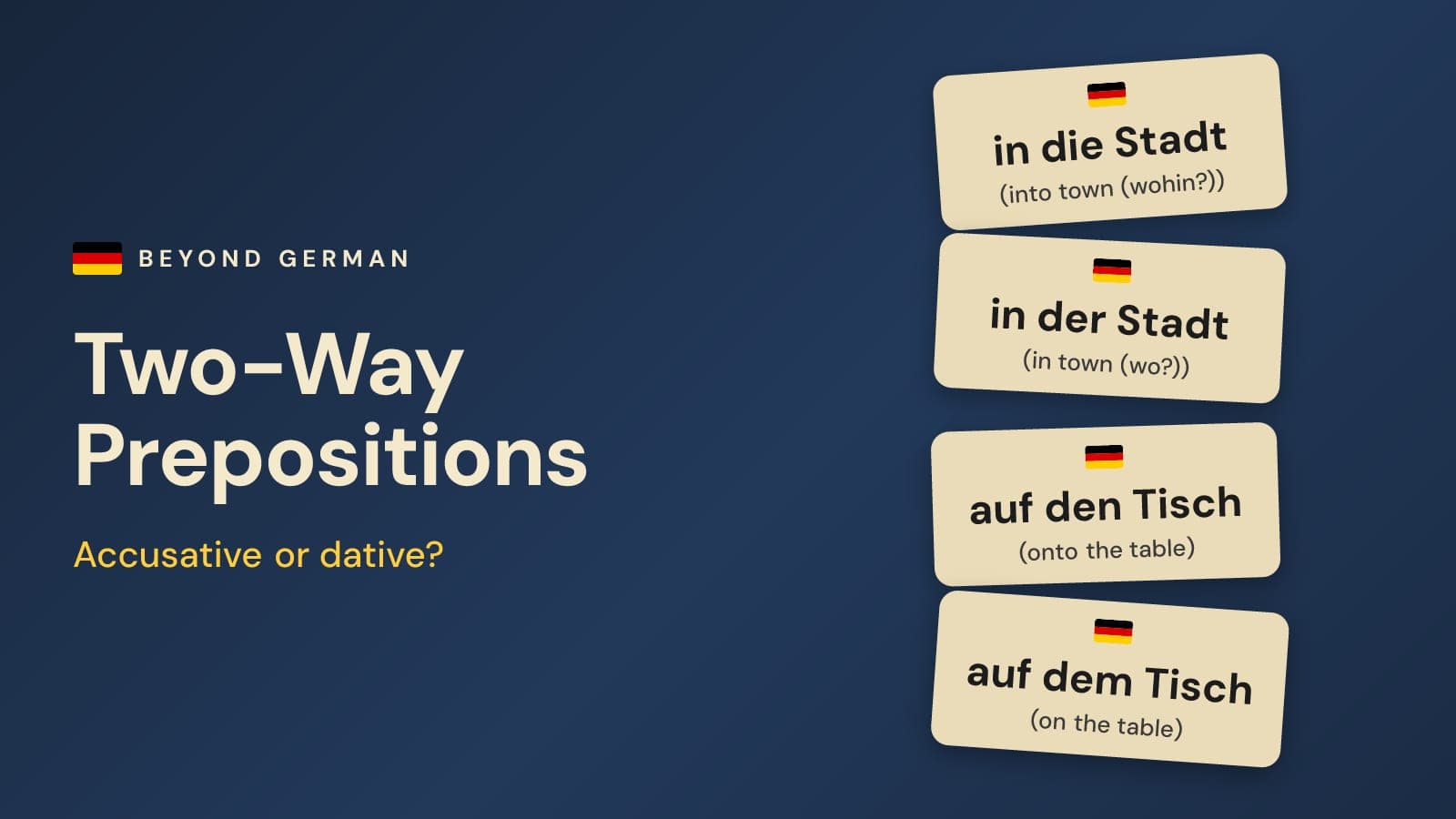
German has nine two-way prepositions (Wechselpräpositionen): an, auf, hinter, in, neben, über, unter, vor and zwischen. They take the dative for a location, answering Wo? (where?), and the accusative for movement to a new place, answering Wohin? (where to?). So you're in der Küche (in the kitchen), but you go in die Küche (into the kitchen).
If you've already learned the German dative prepositions (aus, bei, mit, nach, seit, von, zu), this is the next step. Those never change case. These nine switch, but always for the same reason, and once you know it, picking the case gets easy.
The 9 Two-Way Prepositions at a Glance
All nine describe a position in space. That's exactly why they care whether something stays put or moves somewhere new.
| Preposition | Meaning(s) | Wo? → dative | Wohin? → accusative |
|---|---|---|---|
| an | at, on (a wall or other vertical surface), by (water) | an der Wand | an die Wand |
| auf | on (top of), onto | auf dem Tisch | auf den Tisch |
| hinter | behind | hinter dem Haus | hinter das Haus |
| in | in, inside, into | in der Küche | in die Küche |
| neben | next to, beside | neben dem Bett | neben das Bett |
| über | over, above, across | über dem Sofa | über das Sofa |
| unter | under, below | unter dem Teppich | unter den Teppich |
| vor | in front of, before | vor der Tür | vor die Tür |
| zwischen | between | zwischen den Stühlen | zwischen die Stühle |
The preposition stays the same; only the article changes. That little article is what tells a German listener whether you mean "on the wall" or "onto the wall".
The Rule: Wo? → Dative, Wohin? → Accusative
Before you choose the case, ask which question your sentence answers:
- Wo? (where?) → something is at a place → dative
- Wohin? (where to?) → something is going to a place → accusative
Here's the rule in action, in pairs:
- Ich gehe in die Küche. — I'm going into the kitchen. (Wohin? → accusative)
- Ich bin in der Küche. — I'm in the kitchen. (Wo? → dative)
- Ich lege das Handy auf den Tisch. — I put the phone on the table. (Wohin?)
- Das Handy liegt auf dem Tisch. — The phone is on the table. (Wo?)
- Setz dich neben mich! — Sit down next to me! (Wohin?)
- Sie sitzt neben mir. — She's sitting next to me. (Wo?)
Even the question words follow this logic: Wo bist du? — Where are you? vs. Wohin gehst du? — Where are you going? (See our guide to German question words.)
Movement Inside a Place Stays Dative
The accusative needs movement to a destination, not just movement. If you're moving around but staying in the same place, the question is still Wo?, so it's dative:
- Die Kinder laufen in den Garten. — The kids run into the garden.
- Die Kinder laufen im Garten. — The kids are running around in the garden.
- Ich springe in den See. — I jump into the lake.
- Ich schwimme im See. — I'm swimming in the lake.
How the Articles Change
After a two-way preposition, the article takes its accusative or dative form. (Refresher: the accusative case and the dative case.)
| Case | Masculine | Feminine | Neuter | Plural |
|---|---|---|---|---|
| Nominative (dictionary form) | der / ein | die / eine | das / ein | die / keine |
| Accusative (Wohin?) | den / einen | die / eine | das / ein | die / keine |
| Dative (Wo?) | dem / einem | der / einer | dem / einem | den / keinen + noun -n |
Two shortcuts make this much easier:
- Accusative: only the masculine changes (der → den, ein → einen). Feminine, neuter and plural look just like the dictionary form.
- Dative: every article changes. Learn it as a chant: dem, der, dem, den. Plural nouns also add -n, unless they already end in -n or -s: die Bäume → unter den Bäumen.
Possessives like mein follow ein: in meinen Rucksack (into my backpack), in meinem Rucksack (in my backpack). Pronouns switch too:
| Pronoun | Wohin? → accusative | Wo? → dative |
|---|---|---|
| ich (I) | neben mich | neben mir |
| du (you) | neben dich | neben dir |
| er (he) | neben ihn | neben ihm |
| sie (she) | neben sie | neben ihr |
| wir (we) | neben uns | neben uns |
| ihr (you all) | neben euch | neben euch |
| sie / Sie (they / you, formal) | neben sie / Sie | neben ihnen / Ihnen |
All of this depends on knowing a noun's gender. If that's your weak spot, see our rules and tricks for der, die and das.
Verb Pairs: Stellen/Stehen, Legen/Liegen, Setzen/Sitzen, Hängen, Stecken
English uses "put" for almost everything. German picks the verb by the position the thing ends up in, and the verbs come in pairs: an action verb for putting something somewhere (accusative) and a position verb for where it is afterwards (dative).
| Action: Wohin? + accusative | Position: Wo? + dative | Used for |
|---|---|---|
| stellen (stellte, gestellt): to put upright | stehen (stand, gestanden): to stand, be upright | bottles, glasses, furniture |
| legen (legte, gelegt): to lay, put down flat | liegen (lag, gelegen): to lie, be lying | phones, keys, papers, people in bed |
| setzen (setzte, gesetzt): to seat; sich setzen = to sit down | sitzen (saß, gesessen): to sit, be sitting | people, animals |
| hängen (hängte, gehängt): to hang something up | hängen (hing, gehangen): to be hanging | pictures, coats |
| stecken (steckte, gesteckt): to put into, insert | stecken (steckte, gesteckt): to be (stuck) in | keys in locks, things in pockets |
- Ich stelle die Flasche in den Kühlschrank. — I put the bottle in the fridge.
- Die Flasche steht im Kühlschrank. — The bottle is in the fridge.
- Ich lege mich ins Bett. — I get into bed.
- Ich liege im Bett. — I'm lying in bed.
- Ich setze mich aufs Sofa. — I sit down on the sofa.
- Ich sitze auf dem Sofa. — I'm sitting on the sofa.
Notice the pattern. The action verbs are regular and always have an object: you put something (or yourself, mich) somewhere. The position verbs have no object, and most are irregular. No object? Then it's the position verb + dative.
Hängen is the tricky one, because both meanings look the same in the present tense: Ich hänge die Jacke an den Haken (action) vs. Die Jacke hängt am Haken (position). The difference shows up in the past: the action is weak, or regular (Ich habe das Bild an die Wand gehängt), the position strong, or irregular (Das Bild hing an der Wand). Stecken keeps the same forms for both meanings, even in the past, so watch the case: Er steckt den Schlüssel ins Schloss (action) vs. Der Schlüssel steckt im Schloss (position).
German really does care: a book steht on a shelf but liegt on a table. More examples on the word pages for stellen and liegen.
Contractions: ins, im, ans, am, aufs
Three two-way prepositions merge with das or dem; a few others do it less often, like übers (über das). These short forms are the normal choice in everyday German, and they give away the case:
| Short form | Long form | Example | English |
|---|---|---|---|
| ins | in das (accusative) | Wir gehen heute Abend ins Kino. | We're going to the movies tonight. |
| im | in dem (dative) | Ich warte im Auto. | I'll wait in the car. |
| ans | an das (accusative) | Wir fahren ans Meer. | We're going to the seaside. |
| am | an dem (dative) | Wir wohnen direkt am Meer. | We live right by the sea. |
| aufs | auf das (accusative) | Die Katze springt aufs Bett. | The cat jumps onto the bed. |
Memory trick: an -s comes from das, so it's accusative (you're going there). An -m comes from dem, so it's dative (you're there). Ins Kino is where you're going; im Kino is where you are.
Die, der and den never contract: in die Stadt, an der Tür, in den Park.
Exception 1: Time Expressions Take the Dative
When an, in and vor talk about time instead of place, nothing moves anywhere, so there's no choice to make: they always take the dative.
- am Montag (an dem Montag) — on Monday
- im Sommer (in dem Sommer) — in the summer
- in einer Stunde — in an hour
- vor einer Woche — a week ago
One sentence can use both: Im Sommer fahren wir an die Ostsee. — In the summer, we're going to the Baltic Sea. Im Sommer is time (dative); an die Ostsee is a destination (accusative).
The one exception you'll hear often: über for a stretch of time takes the accusative. Wir fahren übers Wochenende weg. — We're going away for the weekend.
More on um, seit and bis in our guide to German time prepositions, and on am vs. im in days of the week and months in German.
Exception 2: Fixed Verb + Preposition Combinations
Many verbs come with a fixed preposition that has lost its spatial meaning. The case is fixed too, so Wo? and Wohin? won't help you. Nothing moves in Ich warte auf den Bus, yet it's accusative.
| Verb + preposition | Case | Example | English |
|---|---|---|---|
| warten auf | accusative | Ich warte auf den Bus. | I'm waiting for the bus. |
| sich freuen auf | accusative | Ich freue mich auf das Wochenende. | I'm looking forward to the weekend. |
| denken an | accusative | Ich denke oft an dich. | I often think of you. |
| sprechen über | accusative | Wir sprechen über den Film. | We're talking about the film. |
| Angst haben vor | dative | Ich habe Angst vor dem Zahnarzt. | I'm afraid of the dentist. |
| teilnehmen an | dative | Ich nehme an einem Kurs teil. | I'm taking part in a course. |
A rule of thumb: with verbs, auf and über almost always take the accusative, and vor takes the dative. Verbs with an and in vary, so learn each one as a chunk with its article: auf den Bus warten, Angst vor dem Hund haben. Our list of German verbs with prepositions has 40 of them, with their cases.
Common Mistakes With Two-Way Prepositions
| Wrong | Right | Why |
|---|---|---|
| Ich gehe in der Küche. | Ich gehe in die Küche. | Going into the kitchen is a change of place (Wohin?). With the dative, you're walking around inside it. |
| Ich liege das Buch auf den Tisch. | Ich lege das Buch auf den Tisch. | Putting something down is legen. Liegen never has an object. |
| Ich sitze mich aufs Sofa. | Ich setze mich aufs Sofa. | Sitting down is the action, sich setzen. Sitzen is the result. |
| Ich warte auf dem Bus. | Ich warte auf den Bus. | Warten auf always takes the accusative. With the dative, you'd be waiting on the roof of the bus. |
| Vor eine Woche war ich krank. | Vor einer Woche war ich krank. | Time expressions with vor take the dative. |
| Ich gehe zu den Arzt. | Ich gehe zum Arzt. | Zu is a dative preposition. It never switches, even with movement. |
| Wo gehst du? | Wohin gehst du? / Wo gehst du hin? | A destination needs wohin. |
Practice: Accusative or Dative?
Fill in the article or contraction. Ask Wo? or Wohin? first, and watch out for the two exceptions.
- Ich hänge die Jacke an ___ Haken. (der Haken)
- Die Jacke hängt ___ Haken. (an + der Haken)
- Wir fahren am Wochenende ___ Meer. (an + das Meer)
- Die Kinder spielen ___ Garten. (in + der Garten)
- Ich warte seit zehn Minuten auf ___ Bus. (der Bus)
- Vor ___ Jahr bin ich nach Berlin gezogen. (ein Jahr)
Answers:
- Ich hänge die Jacke an den Haken. — I hang my jacket on the hook. (Wohin?)
- Die Jacke hängt am Haken. — The jacket is hanging on the hook. (Wo?)
- Wir fahren am Wochenende ans Meer. — We're going to the seaside this weekend. (Wohin?)
- Die Kinder spielen im Garten. — The kids are playing in the garden. (Wo? They stay there.)
- Ich warte seit zehn Minuten auf den Bus. — I've been waiting for the bus for ten minutes. (fixed: warten auf + accusative)
- Vor einem Jahr bin ich nach Berlin gezogen. — I moved to Berlin a year ago. (time → dative)
Want more practice?
- Test yourself on accusative vs. dative with the A2 German quiz.
- Drill articles and dative plurals in the noun case lab.
- See all three groups (accusative, dative and two-way) side by side in our German prepositions guide.
FAQ
What are the two-way prepositions in German?
The nine Wechselpräpositionen are an, auf, hinter, in, neben, über, unter, vor and zwischen. They take the accusative for movement to a place (Wohin?) and the dative for a location (Wo?).
Do an, auf and in take the accusative or the dative?
Both. Accusative when something moves to a new place (in die Stadt, auf den Tisch, an die Wand), dative for a location (in der Stadt, auf dem Tisch, an der Wand). For time, an and in are always dative: am Montag, im Mai.
What's the difference between two-way and dative prepositions?
Dative prepositions like aus, bei, mit, nach, von and zu always take the dative, even with movement: Ich gehe zum Arzt. Two-way prepositions switch. Our guide to dative prepositions covers the fixed nine.
Level Up Your German
Join 1,000+ learners getting weekly tips, grammar shortcuts, and cultural insights.
Share this article
Continue Reading
Common German Mistakes English Speakers Make (+ False Friends)
Why 'Ich bin heiß' gets laughs and 'Ich will' doesn't mean 'I will': 15 common German mistakes English speakers make, plus the false friends to watch out for.

Days of the Week in German, Months and How to Say the Date
Learn the days of the week and months in German with articles, abbreviations and pronunciation, plus seasons, dates like am 3. Oktober, years and holidays.
Telling Time in German: What Time Is It? (Halb Acht Explained)
Learn how to tell time in German: ask Wie spät ist es?, use the 24-hour clock, master Viertel nach and Viertel vor, and see why halb acht means 7:30.