
Countries in German: Nationalities, Languages & Where You're From
 Beyond German Team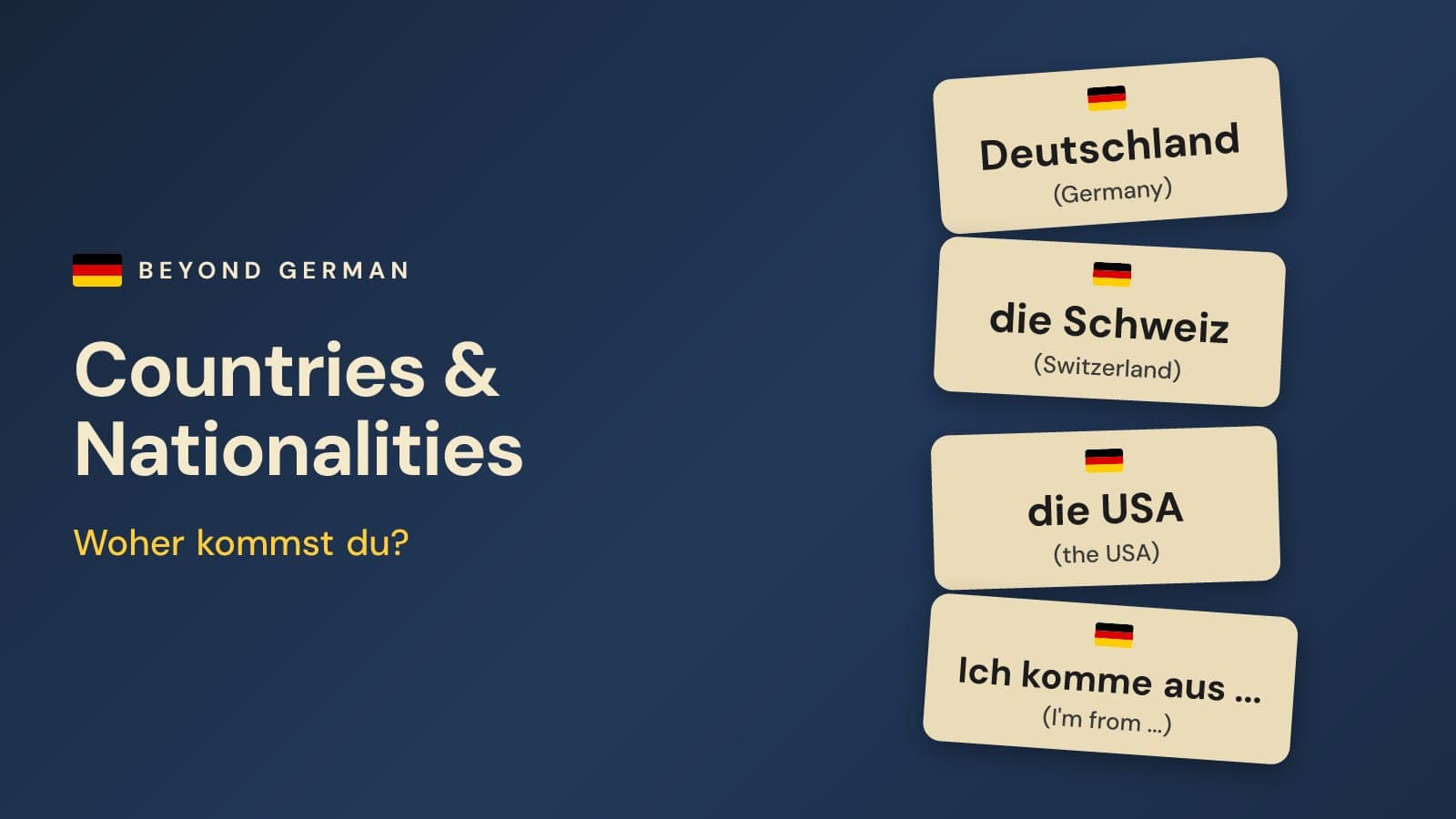
Most countries in German have no article: Ich komme aus Deutschland (I'm from Germany), Ich wohne in Spanien (I live in Spain), Ich fahre nach Italien (I'm going to Italy). A few always keep one, like die Schweiz, die Türkei and die USA, and then the article changes: aus der Schweiz, in der Schweiz, in die Schweiz. To ask "Where are you from?", say Woher kommst du? or, formally, Woher kommen Sie?
Below: how to answer, which countries take an article, when to use aus, in and nach, a table of 34 countries with their nationalities and languages, and the mistakes English speakers make most.
"Where Are You From?" in German
These are the questions you'll hear and the answers you'll need:
- Woher kommst du? / Woher kommen Sie? — Where are you from? (informal / formal)
- Wo kommst du her? — Where are you from? (casual)
- Ich komme aus Irland. — I'm from Ireland.
- Ich bin Irin. — I'm Irish. (a woman speaking)
- Ich bin in Dublin geboren, aber ich wohne jetzt in Köln. — I was born in Dublin, but I live in Cologne now.
- Welche Sprachen sprichst du? — What languages do you speak?
Answering with your country or your nationality works equally well. The formal question has its own phrase page, Woher kommen Sie?, and so does the answer, Ich komme aus… For a whole first conversation, see how to introduce yourself in German.
Countries With and Without an Article
Most country names are neuter, and neuter countries drop the article: Deutschland ist schön. — Germany is beautiful. The article only shows up with an adjective: das sonnige Spanien (sunny Spain).
A small group always keeps its article, a bit like "the" in "the Netherlands" or "the USA". They're feminine, masculine or plural, so learn the article as part of the name:
- Feminine (die): die Schweiz, die Türkei, die Ukraine, die Slowakei. Countries ending in -ei are feminine, just like die Bäckerei (see our der, die, das rules).
- Masculine (der): der Iran, der Irak, der Libanon, der Jemen. In the news, you'll also see Iran and Irak without the article.
- Plural (die): die USA, die Vereinigten Staaten (the United States), die Niederlande.
Aus, In and Nach: From, In and To
You need three prepositions, and each one answers a different question. If the country has an article, the article changes too:
| Question | No article | Feminine | Plural |
|---|---|---|---|
| Woher? (where from?) | aus Spanien | aus der Schweiz | aus den USA |
| Wo? (where?) | in Spanien | in der Schweiz | in den USA |
| Wohin? (where to?) | nach Spanien | in die Schweiz | in die USA |
Masculine countries follow the same logic: aus dem Iran, im Iran, in den Iran.
Aus + Dative: Where You're From
Aus always takes the dative, so die becomes der, der becomes dem, and plural die becomes den, with an extra -n where possible: aus den Niederlanden. Our guide to German dative prepositions explains the pattern.
- Meine Kollegin kommt aus der Ukraine. — My colleague is from Ukraine.
- Er kommt aus dem Iran. — He's from Iran.
- Wir kommen aus den USA. — We're from the US.
In + Dative: Where You Live
For where you live or where something is, use in + dative: in Kanada, in der Schweiz, in den USA, and im Iran (in dem → im). The phrase page Ich wohne in… has more examples.
- Meine Schwester lebt in der Türkei. — My sister lives in Turkey.
- Warst du schon mal in Österreich? — Have you ever been to Austria?
For places you've been, German says in where English says "to". (Warst is the simple past of sein.)
Nach or In: Where You're Going
For countries without an article, and for all cities, use nach. For direction, nach only works with names that have no article, so with die Schweiz or die USA you switch to in + accusative. In is a two-way preposition: dative for where you are, accusative for where you're going. More in our guide to German two-way prepositions.
- Wir fliegen im Sommer nach Spanien. — We're flying to Spain in the summer.
- Ich fahre am Wochenende in die Schweiz. — I'm going to Switzerland this weekend.
- Sie ist letztes Jahr in die USA gezogen. — She moved to the US last year.
Countries, Nationalities and Languages in German
Here are 34 countries with the word for a man and a woman from there, plus the main language. Countries that need an article are listed with it.
| Country | Man (der) | Woman (die) | Language |
|---|---|---|---|
| Deutschland | Deutscher (der Deutsche) | Deutsche (die Deutsche) | Deutsch |
| Österreich | Österreicher | Österreicherin | Deutsch |
| die Schweiz | Schweizer | Schweizerin | Deutsch, Französisch, Italienisch, Rätoromanisch |
| Großbritannien | Brite | Britin | Englisch |
| England | Engländer | Engländerin | Englisch |
| Schottland | Schotte | Schottin | Englisch |
| Irland | Ire | Irin | Englisch, Irisch |
| die USA / Amerika | Amerikaner | Amerikanerin | Englisch |
| Kanada | Kanadier | Kanadierin | Englisch, Französisch |
| Australien | Australier | Australierin | Englisch |
| Frankreich | Franzose | Französin | Französisch |
| Spanien | Spanier | Spanierin | Spanisch |
| Italien | Italiener | Italienerin | Italienisch |
| Portugal | Portugiese | Portugiesin | Portugiesisch |
| Griechenland | Grieche | Griechin | Griechisch |
| die Niederlande | Niederländer | Niederländerin | Niederländisch |
| Belgien | Belgier | Belgierin | Niederländisch, Französisch, Deutsch |
| Polen | Pole | Polin | Polnisch |
| Tschechien | Tscheche | Tschechin | Tschechisch |
| Schweden | Schwede | Schwedin | Schwedisch |
| Dänemark | Däne | Dänin | Dänisch |
| Russland | Russe | Russin | Russisch |
| die Ukraine | Ukrainer | Ukrainerin | Ukrainisch |
| die Türkei | Türke | Türkin | Türkisch |
| China | Chinese | Chinesin | Chinesisch |
| Japan | Japaner | Japanerin | Japanisch |
| Südkorea | Südkoreaner | Südkoreanerin | Koreanisch |
| Vietnam | Vietnamese | Vietnamesin | Vietnamesisch |
| Indien | Inder | Inderin | Hindi, Englisch |
| der Iran | Iraner | Iranerin | Persisch |
| Syrien | Syrer | Syrerin | Arabisch |
| Ägypten | Ägypter | Ägypterin | Arabisch |
| Brasilien | Brasilianer | Brasilianerin | Portugiesisch |
| Mexiko | Mexikaner | Mexikanerin | Spanisch |
Two pairs cause confusion:
- Brite or Engländer? Brite/Britin covers anyone from the UK; Engländer/Engländerin means someone from England. Many Germans say Engländer for all British people, but a Schotte won't thank you for it.
- Amerika or die USA? In everyday German, Amerika usually means the USA, and its people are Amerikaner. Formal texts prefer die USA and sometimes US-Amerikaner.
Ich bin Deutscher: Saying Your Nationality
To say your nationality, use the noun without an article, just like with jobs: Ich bin Kanadier. — I'm Canadian. The article only comes back with an adjective: Er ist ein typischer Engländer. — He's a typical Englishman.
Most Add -er and -erin
The biggest group adds -er for a man and -erin for a woman: der Österreicher, die Österreicherin. The plural looks like the masculine (die Japaner), or ends in -innen for a group of women (die Japanerinnen).
Some End in -e: der Franzose, der Pole
A second group ends in -e for a man and -in for a woman: der Brite, die Britin; der Russe, die Russin; der Türke, die Türkin. Watch der Franzose → die Französin, which adds an umlaut. The masculine forms take an -n everywhere except the nominative singular: die Franzosen (plural), einen Franzosen (accusative). Ich habe einen Franzosen kennengelernt. — I met a Frenchman.
Deutscher or Deutsche?
Deutsche is an adjective used as a noun, so its ending changes just like an adjective's:
| After der/die | After ein/kein | No article | |
|---|---|---|---|
| Man | der Deutsche | ein Deutscher | Er ist Deutscher. |
| Woman | die Deutsche | eine Deutsche | Sie ist Deutsche. |
| Plural | die Deutschen | keine Deutschen | Wir sind Deutsche. |
So a man says Ich bin Deutscher, and a woman says Ich bin Deutsche. If these endings look random, see German adjective endings explained.
Languages and Adjectives: Deutsch or deutsch?
Languages are nouns, so they're capitalized: Deutsch, Englisch, Französisch. Adjectives of nationality are lowercase: deutsch, englisch, französisch.
- Ich spreche Deutsch und ein bisschen Spanisch. — I speak German and a little Spanish.
- Wie sagt man das auf Deutsch? — How do you say that in German?
- Ich liebe die französische Küche. — I love French food.
- Er hat einen deutschen Pass. — He has a German passport.
Most adjectives look like the language: spanisch, türkisch, japanisch. Where the language has a different name, the adjective comes from the country: amerikanisch, kanadisch, österreichisch, brasilianisch. One exception: Schweizer is capitalized and never changes: Schweizer Käse, Schweizer Uhren.
On official forms, the Staatsangehörigkeit (citizenship) field usually takes the lowercase adjective: Staatsangehörigkeit: britisch. You'll fill this in for your Anmeldung at the Bürgeramt.
Common Mistakes
| Wrong | Right | Why |
|---|---|---|
| Ich komme von England. | Ich komme aus England. | Where you're from takes aus. |
| Ich wohne in Schweiz. | Ich wohne in der Schweiz. | Die Schweiz always keeps its article. |
| Ich fahre nach der Schweiz. | Ich fahre in die Schweiz. | With an article, "to" is in + accusative. |
| Wir fliegen nach USA. | Wir fliegen in die USA. | Die USA is plural and keeps its article. |
| Ich bin ein Amerikaner. | Ich bin Amerikaner. | No article before a nationality. |
| Sie ist Franzose. | Sie ist Französin. | A woman uses the feminine form. |
| Ich bin Deutsch. | Ich bin Deutscher. / Ich bin Deutsche. | Deutsch is the language. |
| Ich lerne deutsch. | Ich lerne Deutsch. | Languages are nouns, so capitalize them. |
| Ich mag Italienisches Essen. | Ich mag italienisches Essen. | Adjectives are lowercase. |
Practice
1. Aus, In or Nach?
Fill in the preposition, plus the article if the country needs one.
- Mein Kollege kommt ___ Türkei.
- Wir fliegen im Juli ___ USA.
- Lisa wohnt seit zwei Jahren ___ Schweiz.
- Nächste Woche fahre ich ___ Österreich.
- Meine Großeltern kommen ___ Iran.
- Amsterdam liegt ___ Niederlanden.
Answers:
- Mein Kollege kommt aus der Türkei. — My colleague is from Turkey.
- Wir fliegen im Juli in die USA. — We're flying to the US in July.
- Lisa wohnt seit zwei Jahren in der Schweiz. — Lisa has lived in Switzerland for two years.
- Nächste Woche fahre ich nach Österreich. — I'm going to Austria next week.
- Meine Großeltern kommen aus dem Iran. — My grandparents are from Iran.
- Amsterdam liegt in den Niederlanden. — Amsterdam is in the Netherlands.
2. What's the Nationality?
- Marco kommt aus Italien. Er ist ___.
- Sophie kommt aus Frankreich. Sie ist ___.
- Jonas kommt aus Deutschland. Er ist ___.
- Emily kommt aus England. Sie ist ___.
Answers: 1. Italiener 2. Französin 3. Deutscher 4. Engländerin (or Britin)
Then test yourself with the A1 German quiz, and drill dative articles like der and dem in the noun case lab.
FAQ
How do you say "Where are you from?" in German?
Woher kommst du? (informal) or Woher kommen Sie? (formal). Answer with Ich komme aus… plus your country or city.
Which countries have an article in German?
Only a few: feminine ones like die Schweiz, die Türkei and die Ukraine, masculine ones like der Iran and der Irak, and plurals like die USA and die Niederlande. Deutschland and most other countries have none.
Is it "nach" or "in" for countries?
For going somewhere, use nach with countries without an article (nach Kanada) and in + accusative with the others (in die Schweiz). For where you are, it's in + dative: in Kanada, in der Schweiz. (Island countries are the exception and take auf: auf Kuba.)
How do you say "I'm German" in German?
A man says Ich bin Deutscher, a woman Ich bin Deutsche, with no article. Ich bin Deutsch is wrong: Deutsch is the language.
Was "Ich bin ein Berliner" a mistake?
No. Kennedy wasn't from Berlin, so ein made sense: "I am one of you". The story that he called himself a jelly doughnut is a myth, and in Berlin that pastry is called a Pfannkuchen anyway.
Level Up Your German
Join 1,000+ learners getting weekly tips, grammar shortcuts, and cultural insights.
Share this article
Continue Reading
Hobbies in German: Was machst du gern? Freizeit Vocabulary
How to talk about hobbies in German: ask Was machst du in deiner Freizeit?, answer with gern, lieber and am liebsten, and learn Freizeit vocabulary by category.
Directions in German: Links, Rechts, Geradeaus & How to Ask
How to ask for directions in German (Wie komme ich zum Bahnhof?), understand links, rechts and geradeaus, plus city vocabulary, two dialogues and common mistakes.
German Supermarket Vocabulary: Pfand, Kasse & Shopping Phrases
Shop like a local in Germany: types of shops, checkout phrases, how Pfand works, bags, quantities and Sunday closing, with the German you'll hear at the Kasse.