
German Simple Past (Präteritum): War, Hatte, Ging + 30 Verbs
 Beyond German Team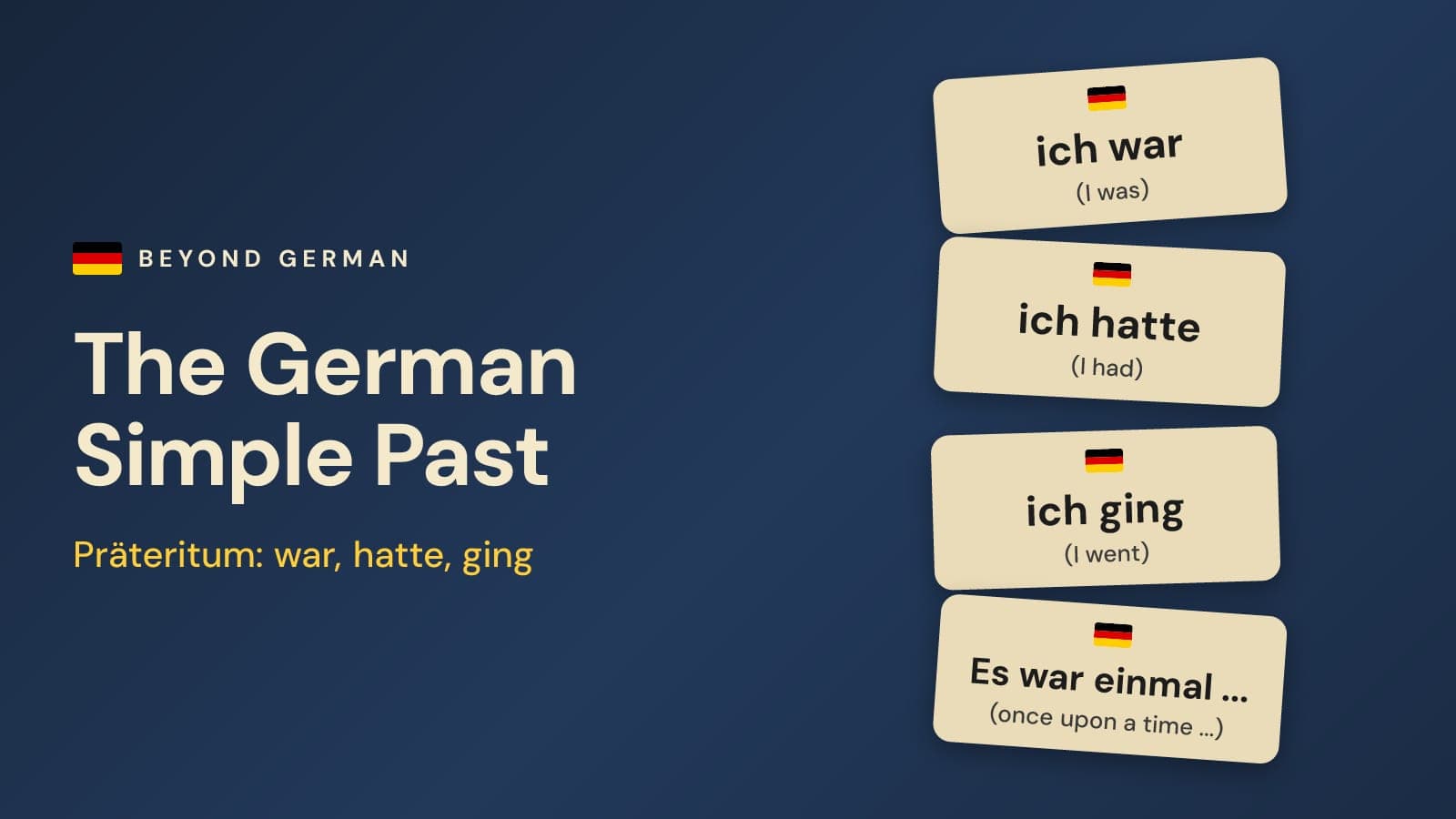
The German simple past (Präteritum) is the one-word past tense: ich war (I was), ich hatte (I had), ich ging (I went). Germans use it mainly in writing, like stories and the news. In conversation, they prefer the perfect tense (ich bin gegangen), except for sein, haben and the modal verbs, which usually stay in the Präteritum even in speech: Ich war müde. Ich hatte keine Zeit. Ich musste arbeiten.
Below: when to use which tense, how to form it, the 30 forms you'll meet most and a short story to read. For the spoken past, see our guide to the German perfect tense with haben or sein.
Präteritum vs. Perfekt: When Do Germans Use Which?
Most of the time, both tenses mean the same thing: ich ging and ich bin gegangen both translate as "I went". The difference is style, not meaning. The Präteritum sounds written; the Perfekt sounds spoken.
| Situation | Usual tense | Example |
|---|---|---|
| Novels, fairy tales, news, reports | Präteritum | Es war einmal ein König. (Once upon a time, there was a king.) |
| Telling a friend about your weekend | Perfekt | Ich habe einen Film gesehen. (I saw a film.) |
| sein and haben, even in speech | Präteritum | Ich war krank. (I was sick.) |
| Modal verbs, even in speech | Präteritum | Ich musste arbeiten. (I had to work.) |
In real conversation, the two tenses mix all the time: Gestern war ich bei meiner Oma, und wir haben Kuchen gegessen. — Yesterday I was at my grandma's, and we ate cake.
A few other everyday verbs are common in the Präteritum when people speak, too: es gab (there was/were), ich dachte (I thought), ich wusste (I knew) and ich fand (I found, or "I thought" for an opinion).
North vs. South
In northern Germany, people use the Präteritum more often in everyday speech. The farther south you go, the rarer it gets: in Bavaria, Austria and Switzerland, many people use the Perfekt even for sein and say Ich bin krank gewesen instead of Ich war krank (I was sick). Both are correct, but ich war sounds natural everywhere.
Rule of thumb: when you speak, use the Perfekt with haben or sein, except for sein, haben and the modal verbs. When you write a story or a report, use the Präteritum.
Sein, Haben and Modal Verbs: The Präteritum You'll Actually Say
Learn these first, because you'll use them every day. Sein and haben are irregular, and werden (to become) is worth learning alongside them:
| Person | sein (to be) | haben (to have) | werden (to become) |
|---|---|---|---|
| ich | war | hatte | wurde |
| du | warst | hattest | wurdest |
| er / sie / es | war | hatte | wurde |
| wir | waren | hatten | wurden |
| ihr | wart | hattet | wurdet |
| sie / Sie | waren | hatten | wurden |
Notice that ich and er/sie/es share one form. That's true for every verb in the Präteritum.
- Wo warst du gestern Abend? — Where were you last night?
- Wir hatten Glück mit dem Wetter. — We were lucky with the weather.
Modal Verbs: Drop the Umlaut
Modal verbs take regular -te endings, and the umlaut disappears:
| Infinitive | Präteritum (ich, er/sie/es) | English |
|---|---|---|
| können | konnte | could, was able to |
| müssen | musste | had to |
| dürfen | durfte | was allowed to |
| wollen | wollte | wanted to |
| sollen | sollte | was supposed to |
| mögen | mochte | liked |
- Ich konnte nicht schlafen. — I couldn't sleep.
- Als Kind durfte ich keine Cola trinken. — As a child, I wasn't allowed to drink cola.
Watch the umlaut, because it changes the meaning: konnte (was able to) vs. könnte (would be able to), hatte (had) vs. hätte (would have), mochte (liked) vs. möchte (would like). The umlaut forms belong to the Konjunktiv II. For the basics, see German modal verbs explained.
Regular Verbs: Add -te
Regular (weak) verbs build the Präteritum from the stem + -te + a personal ending: machen → mach- → machte.
| Person | Ending | machen (to do, to make) | arbeiten (to work) |
|---|---|---|---|
| ich | -te | machte | arbeitete |
| du | -test | machtest | arbeitetest |
| er / sie / es | -te | machte | arbeitete |
| wir | -ten | machten | arbeiteten |
| ihr | -tet | machtet | arbeitetet |
| sie / Sie | -ten | machten | arbeiteten |
- Stems ending in -t or -d add an extra -e- so you can pronounce them: warten → wartete, reden → redete. So do a few others, like öffnen → öffnete and regnen → regnete.
- Borrowed verbs ending in -ieren are always regular: studieren → studierte, telefonieren → telefonierte. (Verlieren isn't borrowed, and it's irregular: verlor.)
- Separable prefixes go to the end, as in the present tense: einkaufen → Ich kaufte ein. In a subordinate clause, they join back up: …, als ich einkaufte. See our guide to separable verbs.
- Wir wohnten zwei Jahre in Wien. — We lived in Vienna for two years.
- Es regnete den ganzen Tag. — It rained all day.
Irregular Verbs: Change the Vowel
Irregular (strong) verbs don't use -te. Instead, the stem vowel changes, and the ich and er/sie/es forms have no ending at all (werden → wurde is the one common exception):
gehen: ich ging, du gingst, er/sie/es ging, wir gingen, ihr gingt, sie/Sie gingen
No rule predicts the new vowel, but many verbs fall into groups:
| Vowel change | Examples |
|---|---|
| ei → ie | bleiben → blieb, schreiben → schrieb |
| ie → o | fliegen → flog, verlieren → verlor |
| i → a | trinken → trank, finden → fand, sitzen → saß |
| e → a | sprechen → sprach, geben → gab, sehen → sah, essen → aß |
| a → u | fahren → fuhr, tragen → trug |
| a, au, u → ie | schlafen → schlief, laufen → lief, rufen → rief |
| Learn by heart | gehen → ging, stehen → stand, kommen → kam, liegen → lag |
Tip: verbs with a prefix usually copy their base verb. Stehen → stand, so verstehen → verstand and aufstehen → stand auf. Kommen → kam, so bekommen → bekam.
- Wir fuhren mit dem Zug nach München. — We took the train to Munich.
- Sie trank einen Kaffee und las die Zeitung. — She drank a coffee and read the paper.
Mixed Verbs: Dachte, Brachte, Wusste, Kannte
A handful of verbs mix both systems: they change the vowel like irregular verbs but add -te like regular ones: denken → dachte (thought), bringen → brachte (brought), wissen → wusste (knew a fact), kennen → kannte (knew a person or place), nennen → nannte (named) and rennen → rannte (ran).
- Ich dachte, das war ein Witz. — I thought that was a joke.
- Wir kannten niemanden in der Stadt. — We didn't know anyone in the city.
- Sie wusste die Antwort nicht. — She didn't know the answer.
Wusste and kannte both mean "knew", but they aren't interchangeable: see wissen vs. kennen.
The 30 Most Common Irregular Präteritum Forms
These are the past forms you'll meet most often. The Präteritum column shows the ich and er/sie/es form. Strictly speaking, wollte and sollte are regular, but like all modal verbs, they're must-knows.
| Infinitive | Präteritum | Perfekt | English |
|---|---|---|---|
| sein | war | ist gewesen | to be |
| haben | hatte | hat gehabt | to have |
| werden | wurde | ist geworden | to become |
| gehen | ging | ist gegangen | to go |
| kommen | kam | ist gekommen | to come |
| sehen | sah | hat gesehen | to see |
| geben | gab | hat gegeben | to give |
| nehmen | nahm | hat genommen | to take |
| finden | fand | hat gefunden | to find |
| wissen | wusste | hat gewusst | to know (a fact) |
| denken | dachte | hat gedacht | to think |
| können | konnte | hat gekonnt | can, to be able to |
| müssen | musste | hat gemusst | must, to have to |
| wollen | wollte | hat gewollt | to want |
| sollen | sollte | hat gesollt | to be supposed to |
| dürfen | durfte | hat gedurft | to be allowed to |
| mögen | mochte | hat gemocht | to like |
| bleiben | blieb | ist geblieben | to stay |
| schreiben | schrieb | hat geschrieben | to write |
| lesen | las | hat gelesen | to read |
| sprechen | sprach | hat gesprochen | to speak |
| essen | aß | hat gegessen | to eat |
| trinken | trank | hat getrunken | to drink |
| fahren | fuhr | ist gefahren | to go, to drive |
| laufen | lief | ist gelaufen | to run, to walk |
| stehen | stand | hat gestanden* | to stand |
| sitzen | saß | hat gesessen* | to sit |
| liegen | lag | hat gelegen* | to lie (be lying) |
| treffen | traf | hat getroffen | to meet |
| rufen | rief | hat gerufen | to call |
*In southern Germany, Austria and Switzerland: ist gestanden, ist gesessen, ist gelegen. With a second verb, modal verbs use the infinitive in the Perfekt (Ich habe arbeiten müssen), so most people simply say Ich musste arbeiten.
For more verbs with example sentences, see the 100 most common German verbs.
Reading Practice: A Short Story in the Präteritum
Here's a short story told the way a German book would tell it, with the Präteritum verbs in bold.
Als ich letzten Freitag nach Hause kam, regnete es, und ich war sehr müde. Ich suchte meinen Schlüssel, aber ich fand ihn nicht.
When I got home last Friday, it was raining, and I was very tired. I looked for my key, but I couldn't find it.
Zuerst rief ich meine Mitbewohnerin Lena an, aber sie ging nicht ans Telefon. Dann dachte ich an unseren Nachbarn: Er hatte einen Ersatzschlüssel! Ich klingelte bei ihm, aber niemand öffnete die Tür. Ich wusste nicht, was ich machen sollte.
First, I called my roommate Lena, but she didn't answer the phone. Then I thought of our neighbor: he had a spare key! I rang his doorbell, but nobody opened the door. I didn't know what to do.
Also ging ich ins Café an der Ecke, trank einen Tee und schrieb Lena eine Nachricht. Eine Stunde später kam sie herein und lachte: „Dein Schlüssel lag heute Morgen auf dem Küchentisch. Ich wollte dich anrufen, aber mein Akku war leer!“
So I went to the café on the corner, drank a tea and texted Lena. An hour later, she came in and laughed: "Your key was on the kitchen table this morning. I wanted to call you, but my battery was dead!"
What to notice:
- Regular verbs add -te: regnete, suchte, klingelte, öffnete, lachte.
- Irregular verbs change the vowel: kam, fand, rief an, ging, trank, schrieb, lag. Mixed verbs do both: dachte, wusste.
- Als ich nach Hause kam: "when" for one event in the past is als, with the verb at the end. Our guide to wenn vs. als vs. ob explains why it isn't wenn.
Common Mistakes With the Präteritum
| Wrong | Right | Why |
|---|---|---|
| Ich gehte nach Hause. | Ich ging nach Hause. | Gehen is irregular: a vowel change, no -te. |
| Er kamt zu spät. | Er kam zu spät. | With irregular verbs, ich and er/sie/es forms take no ending (regular verbs add -te). |
| Ich könnte gestern nicht kommen. | Ich konnte gestern nicht kommen. | Modal verbs drop the umlaut in the past. Könnte means "would be able to". |
| Als Kind möchte ich Pilotin werden. | Als Kind wollte ich Pilotin werden. | Möchte has no past form. Use wollte. |
| Wenn ich ein Kind war, … | Als ich ein Kind war, … | One event or period in the past takes als. |
| Gestern aß ich Pizza und sah einen Film. (to a friend) | Gestern habe ich Pizza gegessen und einen Film gesehen. | Not wrong, but it sounds like a novel. Speak in the Perfekt. |
Practice: Put the Verbs in the Präteritum
Fill in the Präteritum form of the verb in brackets.
- Gestern ___ ich keine Zeit. (haben)
- Wir ___ eine Stunde auf den Bus. (warten)
- Er ___ nicht, wo der Bahnhof war. (wissen)
- Leider ___ ich nicht kommen. (können)
- Ich ___ heute um sechs Uhr ___. (aufstehen)
- Rotkäppchen ___ durch den Wald und ___ Blumen. (gehen, pflücken)
Answers:
- Gestern hatte ich keine Zeit. — I didn't have time yesterday.
- Wir warteten eine Stunde auf den Bus. — We waited an hour for the bus.
- Er wusste nicht, wo der Bahnhof war. — He didn't know where the station was.
- Leider konnte ich nicht kommen. — Unfortunately, I couldn't come.
- Ich stand heute um sechs Uhr auf. — I got up at six today.
- Rotkäppchen ging durch den Wald und pflückte Blumen. — Little Red Riding Hood walked through the forest and picked flowers.
Want more practice?
- Drill the forms in the German verb conjugation lab.
- Test yourself with the B1 German quiz.
- Review the rules in our German simple past (Präteritum) grammar guide.
FAQ
What is the Präteritum in German?
It's the simple past tense, a single verb form like ich ging (I went) or sie hatte (she had). It's the standard past tense in written German.
What's the difference between Präteritum and Perfekt?
Mostly style, not meaning: ich sah and ich habe gesehen both mean "I saw". Use the Präteritum in writing and for sein, haben and modal verbs, and the Perfekt for most other verbs when you speak.
Is "war" Präteritum or Perfekt?
War is the Präteritum of sein: ich war (I was). The Perfekt is ich bin gewesen, but in conversation most Germans say ich war.
How do I know if a verb is regular or irregular?
You usually can't tell from the infinitive, so learn three forms together: machen – machte – gemacht (regular), gehen – ging – gegangen (irregular). Start with the 30 verbs in the table above.
Level Up Your German
Join 1,000+ learners getting weekly tips, grammar shortcuts, and cultural insights.
Share this article
Continue Reading
Hobbies in German: Was machst du gern? Freizeit Vocabulary
How to talk about hobbies in German: ask Was machst du in deiner Freizeit?, answer with gern, lieber and am liebsten, and learn Freizeit vocabulary by category.
Directions in German: Links, Rechts, Geradeaus & How to Ask
How to ask for directions in German (Wie komme ich zum Bahnhof?), understand links, rechts and geradeaus, plus city vocabulary, two dialogues and common mistakes.
Rooms in German: House & Furniture Vocabulary With Plurals
Rooms, furniture and appliances in German with articles and plurals, plus how to describe your home, which floor the Erdgeschoss is, and why Germans air their rooms.