
Wenn vs Als vs Ob vs Wann: How to Say When and If in German
 Beyond German Team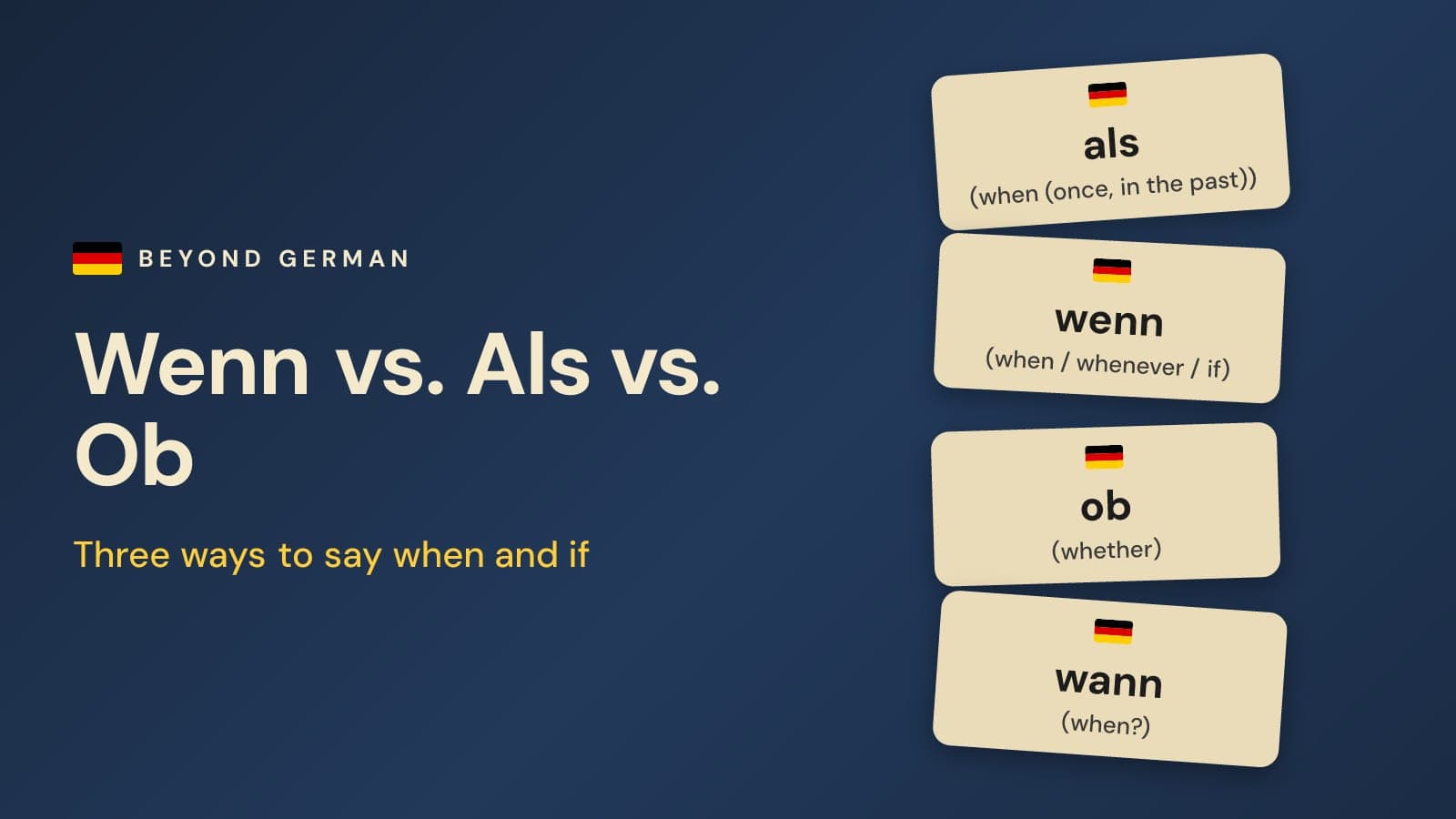
German splits English "when" and "if" into four words. Use als for a single event or period in the past, wenn for repeated events ("whenever"), for the present and future, and for "if", ob for "whether", and wann to ask "when?".
The good news: the word order works just like weil. If you've read our guide to weil vs denn vs deshalb, you already know the key rule: the verb goes to the end. This post covers the other half, choosing the right word, with a decision table, plenty of examples, wenn vs. falls, unreal "if" sentences and the mistakes English speakers make most.
Quick Decision Table
| English | Situation | German | Example |
|---|---|---|---|
| when | One event or one period in the past | als | Als ich ein Kind war, … |
| when / whenever | Repeated events in the past | wenn | Immer wenn wir Oma besuchten, … |
| when | Present or future | wenn | Wenn ich nach Hause komme, … |
| if | A condition | wenn (or falls) | Wenn es regnet, … |
| if / whether | A hidden yes/no question | ob | Ich weiß nicht, ob … |
| when? | A question about time (direct or indirect) | wann | Wann kommst du? / Ich weiß nicht, wann … |
Still unsure? Ask these four questions in order:
- Could you say "at what time" instead of "when"? → wann
- Does "if" introduce a hidden yes/no question, so you could say "whether"? → ob
- Is it one event or one period in the past? → als
- Everything else → wenn
Als: One Event or Period in the Past
Als means "when" for something that happened once in the past. That can be a single moment or one whole period, like your childhood or the year you lived abroad. What matters is that it happened one time, not how long it lasted.
- Als ich ein Kind war, wohnten wir in Hamburg. — When I was a child, we lived in Hamburg.
- Als wir in Berlin ankamen, regnete es. — When we arrived in Berlin, it was raining.
- Ich war sehr nervös, als ich meine erste Deutschprüfung hatte. — I was very nervous when I had my first German exam.
- Als ich in Wien gewohnt habe, habe ich jeden Tag Deutsch gesprochen. — When I lived in Vienna, I spoke German every day.
The last example trips up many learners: things can repeat during the period (jeden Tag), but living in Vienna was still one period, so it's als.
In writing, als-clauses usually use the simple past (war, hatte, kam). In conversation you'll also hear the perfect tense, as in the last example.
Tip: als also means "than" (größer als ich, taller than me) and "as" (als Kind, as a child), which gives you a handy shortcut:
Als Kind habe ich in Hamburg gewohnt. — As a child, I lived in Hamburg.
Wenn: Whenever, When (Now or Later) and If
Wenn covers everything else. It has three jobs.
1. Repeated Events in the Past ("Whenever")
If something happened again and again, use wenn, often with immer or jedes Mal (every time):
- Wenn wir unsere Oma besuchten, backte sie einen Kuchen. — Whenever we visited our grandma, she baked a cake.
- Jedes Mal, wenn ich ihn anrief, war er nicht zu Hause. — Every time I called him, he wasn't home.
Compare: Als ich meine Oma letzten Sonntag besuchte, … — When I visited my grandma last Sunday, … That happened once, so it's als.
2. Present and Future ("When")
For the present and future, wenn is the only option, even for a one-time event. Als is strictly for the past.
- Wenn ich nach Hause komme, rufe ich dich an. — When I get home, I'll call you.
- Wenn du fertig bist, können wir gehen. — When you're ready, we can go.
3. Conditions ("If")
- Wenn es morgen regnet, bleiben wir zu Hause. — If it rains tomorrow, we'll stay home.
- Wenn du Hilfe brauchst, sag mir Bescheid. — If you need help, let me know.
Because wenn means both "when" and "if", context decides. Wenn er kommt can mean "when he comes" or "if he comes". That's rarely a problem, and when it is, use falls (see below).
Ob: "Whether" (Yes/No Questions)
Ob turns a yes/no question into part of a longer sentence. If the hidden question could be answered with ja or nein, use ob, even when English says "if":
- Kommt er mit? → Ich weiß nicht, ob er mitkommt. — Is he coming along? → I don't know if he's coming along.
- Weißt du, ob der Supermarkt sonntags offen ist? — Do you know if the supermarket is open on Sundays?
- Sie hat gefragt, ob wir Zeit haben. — She asked if we had time.
This is also how you report yes/no questions: Er fragt: „Hast du Zeit?“ becomes Er fragt, ob ich Zeit habe. In news and formal writing you'll often see the subjunctive instead (Er fragte, ob sie Zeit habe); our guide to indirect speech in German explains how that works.
With wohl, ob can even stand alone and mean "I wonder if": Ob er wohl kommt? — I wonder if he'll come.
Wann: The Question Word "When?"
Wann asks about time. In a direct question, the verb comes second, as with all German question words:
- Wann beginnt der Deutschkurs? — When does the German course start?
- Wann hast du Geburtstag? — When is your birthday?
Inside a longer sentence (an indirect question), wann sends the verb to the end, just like wenn, als and ob:
- Weißt du, wann der Deutschkurs beginnt? — Do you know when the German course starts?
- Ich weiß nicht, wann er nach Hause kommt. — I don't know when he's coming home.
The quick test: if you could say "at what time", it's wann. This pair shows the difference:
- Sag mir, wann du Zeit hast. — Tell me when you're free. (Tell me the day or time.)
- Sag mir Bescheid, wenn du Zeit hast. — Let me know when you're free. (Get in touch once you are.)
Answers to wann often use a time preposition: um acht, am Montag, im Juli. Our guide to German time prepositions explains which one to use.
Word Order: The Verb Goes to the End
Wenn, als and ob start a subordinate clause, and so does wann in an indirect question. In all of them, the conjugated verb moves to the very end:
| Main clause | Inside a wenn / als / ob / wann clause |
|---|---|
| Ich habe Zeit. | …, wenn ich Zeit habe. |
| Ich war klein. | …, als ich klein war. |
| Er kommt mit. | …, ob er mitkommt. |
| Der Film fängt an. | …, wann der Film anfängt. |
| Ich kann kommen. | …, ob ich kommen kann. |
| Sie ist angekommen. | …, als sie angekommen ist. |
Separable verbs join back together at the end (mitkommt, anfängt), and a modal or helper verb comes after the infinitive or participle (kommen kann, angekommen ist).
When the clause comes first, it counts as position 1, so the main clause starts with its verb. That gives you the typical verb, comma, verb pattern:
- Wenn ich Zeit habe, komme ich vorbei. — If I have time, I'll drop by.
- Als ich ankam, war niemand da. — When I arrived, nobody was there.
Either way, a comma always separates the two clauses.
Wenn vs. Falls
Falls means "if" or "in case". Unlike wenn, it's only for conditions, never for time, so it makes clear that something may or may not happen:
- Falls du Hilfe brauchst, ruf mich an. — In case you need help, call me.
- Nimm einen Regenschirm mit, falls es regnet. — Take an umbrella in case it rains.
Compare Wenn er kommt, … (when or if he comes) with Falls er kommt, … (if he comes, which isn't certain). The word order is the same, with the verb at the end. For clearly unreal situations ("if I were you"), stick with wenn.
Wenn + Konjunktiv II: Unreal Conditions
For situations that aren't real or are very unlikely ("if I had…", "if I were…"), combine wenn with the Konjunktiv II: wäre, hätte, könnte or würde + infinitive.
- Wenn ich mehr Zeit hätte, würde ich öfter reisen. — If I had more time, I'd travel more often.
- Wenn ich du wäre, würde ich das Angebot annehmen. — If I were you, I'd take the offer.
- Wenn ich das gewusst hätte, wäre ich früher gekommen. — If I'd known that, I would have come earlier.
- Wenn ich nur mehr Zeit hätte! — If only I had more time!
Compare the real and the unreal version:
- Wenn ich Zeit habe, komme ich. — If I have time, I'll come. (It's possible.)
- Wenn ich Zeit hätte, würde ich kommen. — If I had time, I'd come. (But I don't.)
Bonus: Als ob ("As If")
Put als and ob together and you get "as if", usually with the Konjunktiv II and the verb at the end:
Er tut so, als ob er nichts wüsste. — He's acting as if he didn't know anything.
Common Mistakes With Wenn, Als, Ob and Wann
| Wrong | Right | Why |
|---|---|---|
| Wenn ich ein Kind war, … | Als ich ein Kind war, … | Childhood is one period in the past, so it's als. |
| Als ich morgen ankomme, … | Wenn ich morgen ankomme, … | Als is only for the past. |
| Ich weiß nicht, wenn er kommt. | Ich weiß nicht, ob er kommt. / … wann er kommt. | A hidden yes/no question takes ob; a hidden time question takes wann. |
| Wenn beginnt der Film? | Wann beginnt der Film? | Questions about time use wann. |
| Als ich war klein, … | Als ich klein war, … | The verb goes to the end of the clause. |
| Wenn ich Zeit habe, ich komme. | Wenn ich Zeit habe, komme ich. | After the clause, the main clause starts with the verb. |
The third one is the classic English-speaker mistake: English uses "if" for both conditions and yes/no questions; German doesn't.
Practice: Wenn, Als, Ob or Wann?
Fill in each gap with wenn, als, ob or wann:
- ___ ich zehn Jahre alt war, bekam ich mein erstes Fahrrad.
- Weißt du, ___ Anna einen Bruder hat?
- ___ fährt der nächste Bus?
- ___ ich morgens aufstehe, trinke ich zuerst einen Kaffee.
- Früher hat mein Opa immer Geschichten erzählt, ___ wir ihn besucht haben.
- Kannst du mir sagen, ___ der Kurs anfängt? Um neun oder um zehn?
- ___ ich du wäre, würde ich mehr schlafen.
- ___ wir letzten Sommer in Italien waren, war es sehr heiß.
Answers:
- Als ich zehn Jahre alt war, bekam ich mein erstes Fahrrad. — When I was ten, I got my first bike. (one period in the past)
- Weißt du, ob Anna einen Bruder hat? — Do you know if Anna has a brother? (yes/no)
- Wann fährt der nächste Bus? — When does the next bus leave? (question)
- Wenn ich morgens aufstehe, trinke ich zuerst einen Kaffee. — When I get up in the morning, I have a coffee first. (repeated, present)
- Früher hat mein Opa immer Geschichten erzählt, wenn wir ihn besucht haben. — My grandpa always used to tell stories when we visited him. (repeated, past)
- Kannst du mir sagen, wann der Kurs anfängt? — Can you tell me when the course starts? (at what time)
- Wenn ich du wäre, würde ich mehr schlafen. — If I were you, I'd sleep more. (unreal condition)
- Als wir letzten Sommer in Italien waren, war es sehr heiß. — When we were in Italy last summer, it was very hot. (one period in the past)
Want more practice?
- Review every verb-at-the-end conjunction in our guide to German subordinate clauses.
- Test yourself in the B1 German quiz.
- Practice giving reasons with the same word order in weil vs denn vs deshalb.
FAQ
What's the difference between wenn and als?
Als is for one event or one period in the past: Als ich jung war, … Wenn is for everything else: repeated past events, the present and future, and conditions.
What's the difference between wann and wenn?
Wann asks about time, in direct questions (Wann kommst du?) and indirect ones (Ich weiß nicht, wann …). Wenn means "when" or "if" and connects two ideas. If you could say "at what time", use wann.
Can ob mean "if"?
Yes, when English "if" means "whether": Ich weiß nicht, ob er kommt. For conditions ("if it rains…"), use wenn or falls.
Is als only used for the past?
As a word for "when", yes. Als has other jobs too: comparisons (größer als), roles (als Kind) and als ob (as if).
Does the verb always go to the end after wenn, als and ob?
Yes, they always start a subordinate clause. Wann sends the verb to the end only in indirect questions; in a direct question (Wann kommst du?), the verb comes second.
Level Up Your German
Join 1,000+ learners getting weekly tips, grammar shortcuts, and cultural insights.
Share this article
Continue Reading
Colors in German: Rot, Blau, Grün and How to Use Them
All the colors in German with pronunciation, light and dark shades, when colors take endings, how to ask Welche Farbe hat…?, and the color idioms Germans really use.
I Love You in German: Ich liebe dich vs. Ich hab dich lieb
Learn when to say Ich liebe dich and when to say Ich hab dich lieb, plus German pet names, romantic phrases, texting codes like HDL and Valentine's Day customs.
Great and Awesome in German: Super, Toll, Ausgezeichnet & More
Super, toll, klasse or ausgezeichnet? Learn the German words for great, awesome, excellent and cool, from neutral to slang, plus compliments for people, food and looks.