
Obwohl vs Trotzdem vs Dennoch: Although in German (+ Word Order)
 Beyond German Team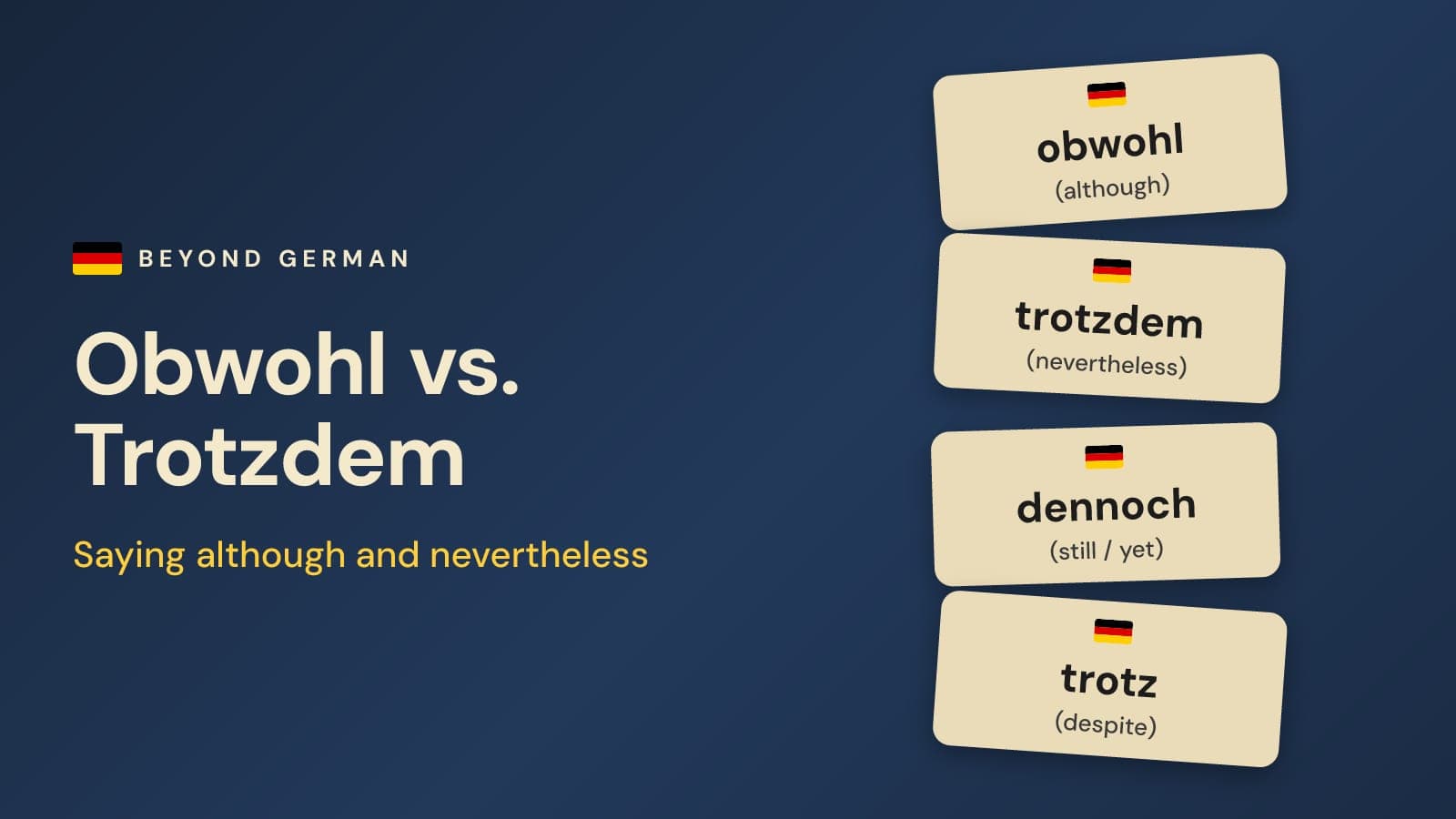
Obwohl means "although" or "even though". It introduces the obstacle, and the verb goes to the end: Ich gehe zur Arbeit, obwohl ich krank bin. — I'm going to work even though I'm sick. Trotzdem means "nevertheless" or "anyway". It introduces the surprising result, and the verb comes right after it: Ich bin krank. Trotzdem gehe ich zur Arbeit. — I'm sick. I'm going to work anyway.
If you've read our guide to weil vs denn vs deshalb, you already know both patterns: obwohl works exactly like weil, and trotzdem works exactly like deshalb. Below, you'll also learn dennoch, allerdings, trotz (despite) and three ways to say "but".
Quick Overview: What's the Difference?
| Word | Meaning | Word order | Works like |
|---|---|---|---|
| obwohl | although, even though | Verb goes to the END | weil |
| trotzdem | nevertheless, still, anyway | Verb comes right after it | deshalb |
| dennoch | nevertheless (more formal) | Verb comes right after it | deshalb |
| allerdings | however, though | Verb comes right after it | deshalb |
| trotz | despite, in spite of | Followed by a noun (genitive) | wegen |
| aber | but | Normal word order | denn |
The key insight: obwohl introduces the obstacle, the reason that should have stopped something. Trotzdem and dennoch introduce the result that happens anyway. It's the same split as weil (reason) and deshalb (result), only with a surprise:
| Expected: I stay home | Surprise: I go to work anyway |
|---|---|
| Ich bleibe zu Hause, weil ich krank bin. | Ich gehe zur Arbeit, obwohl ich krank bin. |
| Ich bin krank. Deshalb bleibe ich zu Hause. | Ich bin krank. Trotzdem gehe ich zur Arbeit. |
| Wegen meiner Erkältung bleibe ich zu Hause. | Trotz meiner Erkältung gehe ich zur Arbeit. |
Same word order, opposite outcome. New to the left column? Start with our guide to weil, denn and deshalb, which uses the same example.
Memory trick: Obwohl introduces the obstacle. Trotzdem is built from trotz dem, "despite that", so it always points back to something you've just said.
1. Obwohl (Although): The Verb Goes to the End
Obwohl is a subordinating conjunction, like weil, dass and wenn. It starts a subordinate clause, so the conjugated verb moves to the very end of that clause:
[Main clause], obwohl + [subject] + [middle] + [VERB]- Ich gehe zur Arbeit, obwohl ich krank bin. — I'm going to work even though I'm sick.
- Wir haben den Zug verpasst, obwohl wir früh losgefahren sind. — We missed the train even though we left early.
The verb lands at the end every time (bin, sind). In the perfect tense, the helper verb comes last (losgefahren sind), and so does a modal verb (obwohl ich früh aufstehen muss).
Starting With Obwohl
You can also put the obwohl clause first. Then the main clause starts with its verb, which gives you the typical "verb, comma, verb" pattern:
- Obwohl ich krank bin, gehe ich zur Arbeit. — Although I'm sick, I'm going to work.
- Obwohl es regnet, gehen wir spazieren. — Although it's raining, we're going for a walk.
Either way, a comma separates the two clauses. In formal texts, you may also meet obgleich and obschon, which work the same way.
2. Trotzdem and Dennoch (Nevertheless): The Verb Comes Next
Trotzdem is an adverb, not a conjunction. Like deshalb, it often takes position 1, and then the verb follows immediately in position 2, before the subject:
[Obstacle]. Trotzdem + [VERB] + [subject] + [rest]- Ich bin krank. Trotzdem gehe ich zur Arbeit. — I'm sick. I'm going to work anyway.
- Das Wetter war schlecht. Trotzdem hatten wir viel Spaß. — The weather was bad. We still had a lot of fun.
Trotzdem in the Middle of the Sentence
Trotzdem doesn't have to come first. It can also sit after the verb (and after short pronouns like es), often together with aber:
- Es ist teuer, aber ich kaufe es trotzdem. — It's expensive, but I'm buying it anyway.
Also worth learning right now: Trotzdem danke! — Thanks anyway!
Dennoch: The Formal Twin
Dennoch means the same as trotzdem and follows the same word order. It just sounds a little more formal, so you'll meet it more in writing, on the news and in presentations:
- Die Kosten sind gestiegen. Dennoch bleibt der Preis gleich. — Costs have gone up. Nevertheless, the price stays the same.
- Sie war müde, dennoch arbeitete sie weiter. — She was tired, yet she kept working.
As the second example shows, a comma can replace the full stop, and the verb still comes next. In conversation, trotzdem is far more common; in an email or essay, dennoch sounds more polished.
3. Allerdings (However, Though): Adding a Catch
Allerdings follows the same word order as trotzdem, but it doesn't mean "anyway". It adds a limitation: a catch or a drawback to what you've just said. In English, "though" at the end of the sentence often captures it best.
- Die Wohnung ist schön. Allerdings ist sie ziemlich teuer. — The apartment is nice. It's pretty expensive, though.
- Ich komme gern mit. Allerdings muss ich um zehn zu Hause sein. — I'd love to come. I have to be home at ten, though.
- Das Essen war gut. Der Service war allerdings langsam. — The food was good. The service was slow, though.
Compare: Ich bin krank. Trotzdem gehe ich zur Arbeit. says the obstacle didn't stop you. Ich gehe zur Arbeit. Allerdings bin ich etwas erkältet. (I'm going to work. I've got a bit of a cold, though.) adds a catch to your plan.
On its own, Allerdings! is an emphatic "yes": „War das Konzert gut?“ – „Allerdings!“ — "Was the concert good?" "It sure was!"
4. Trotz (Despite): Followed by a Noun
Trotz means "despite" or "in spite of". It's a preposition, so it's followed by a noun, not by a subject and verb. In standard German, it takes the genitive case:
| Noun | Standard (genitive) | Everyday (dative) | English |
|---|---|---|---|
| der Regen | trotz des Regens | trotz dem Regen | despite the rain |
| das Wetter | trotz des schlechten Wetters | trotz dem schlechten Wetter | despite the bad weather |
| die Erkältung | trotz meiner Erkältung | trotz meiner Erkältung | despite my cold |
| die Probleme (plural) | trotz der Probleme | trotz den Problemen | despite the problems |
In everyday speech, especially in southern Germany, Austria and Switzerland, you'll often hear the dative. In writing and exams, use the genitive. Feminine nouns look the same either way, and the fixed phrase trotz allem (despite everything) always uses the dative.
A trotz phrase at the start of a sentence fills position 1, so the verb comes next, with no comma: Trotz des Regens gehen wir spazieren. — Despite the rain, we're going for a walk.
Quick test: "despite" + noun → trotz. "Although" + subject and verb → obwohl. Trotz des Regens and obwohl es regnet say the same thing.
5. Aber, Doch, Sondern (But): Normal Word Order
These three are coordinating conjunctions, like denn. They sit between two main clauses in "position 0", so the clause after them keeps normal word order.
- aber (but) is the everyday all-rounder: Ich bin krank, aber ich gehe zur Arbeit. — I'm sick, but I'm going to work.
- doch (but, yet) means the same and is more common in writing and storytelling: Er wollte anrufen, doch er hatte keine Zeit. — He wanted to call, but he didn't have time.
- sondern (but rather) only follows a negation (nicht, kein) and replaces the wrong thing with the right one: Ich trinke keinen Kaffee, sondern Tee. — I don't drink coffee, I drink tea.
Here's the difference between aber and sondern in one pair:
- Das Restaurant ist nicht billig, aber sehr gut. — The restaurant isn't cheap, but it's very good. (Both parts are true.)
- Das Restaurant ist nicht in Berlin, sondern in Potsdam. — The restaurant isn't in Berlin, it's in Potsdam. (The second part corrects the first.)
Side-by-Side: One Idea, Seven Ways
English: I'm going to work even though I'm sick. Here's that idea in every structure from this guide:
| Structure | German sentence | Word order |
|---|---|---|
| obwohl (second) | Ich gehe zur Arbeit, obwohl ich krank bin. | Verb at the END |
| obwohl (first) | Obwohl ich krank bin, gehe ich zur Arbeit. | Verb, comma, verb |
| trotzdem | Ich bin krank. Trotzdem gehe ich zur Arbeit. | Verb in position 2 |
| trotzdem (middle) | Ich bin krank, aber ich gehe trotzdem zur Arbeit. | trotzdem after the verb |
| dennoch | Ich bin krank. Dennoch gehe ich zur Arbeit. | Verb in position 2 (more formal) |
| trotz | Trotz meiner Erkältung gehe ich zur Arbeit. | Noun, then the verb |
| aber | Ich bin krank, aber ich gehe zur Arbeit. | Normal word order |
All seven are correct. Allerdings is missing on purpose: it adds a catch rather than a surprising result, so it doesn't fit this sentence.
Word Order: Why the Verb Comes Right After the Obwohl Clause
In a German statement, the conjugated verb is always the second element. That's the verb-second rule from German word order basics. Position 1 can hold a single word, a phrase or a whole clause:
| Position 0 | Position 1 | Verb | Rest |
|---|---|---|---|
| Trotzdem | gehe | ich zur Arbeit. | |
| Trotz meiner Erkältung | gehe | ich zur Arbeit. | |
| Obwohl ich krank bin, | gehe | ich zur Arbeit. | |
| Aber | ich | gehe | trotzdem zur Arbeit. |
| Ich | gehe | zur Arbeit, obwohl ich krank bin. |
That's why the main clause after an obwohl clause starts with the verb: the whole clause counts as position 1, and the verb has to come next. Aber sits in position 0, so it doesn't count. For the order of everything after the verb (time, reason, manner, place), see our guide to German word order and TeKaMoLo.
Common Mistakes With Obwohl and Trotzdem
| Wrong | Right | Why |
|---|---|---|
| …, obwohl ich bin krank. | …, obwohl ich krank bin. | Obwohl sends the verb to the end. |
| Trotzdem ich gehe zur Arbeit. | Trotzdem gehe ich zur Arbeit. | Trotzdem fills position 1, so the verb comes next. |
| Obwohl es regnet, wir gehen spazieren. | Obwohl es regnet, gehen wir spazieren. | After the obwohl clause, the main clause starts with the verb. |
| Obwohl es regnet, trotzdem gehen wir spazieren. | Obwohl es regnet, gehen wir trotzdem spazieren. | Only one thing fits in position 1. |
| Trotzdem es regnet, gehen wir spazieren. | Obwohl es regnet, gehen wir spazieren. | You may hear it in casual speech, but in standard German, trotzdem isn't a conjunction. |
| Trotz des Regens, gehen wir spazieren. | Trotz des Regens gehen wir spazieren. | No comma after a trotz phrase: it isn't a clause. |
| Ich trinke keinen Kaffee, aber Tee. | Ich trinke keinen Kaffee, sondern Tee. | To correct a negation, use sondern. |
Practice: Obwohl, Trotzdem, Trotz or Sondern?
Join each pair of sentences with the word in brackets. Watch the verb!
- Es regnet. Wir gehen spazieren. (obwohl, at the start)
- Er hat wenig Geld. Er kauft ein neues Handy. (trotzdem)
- Sie spricht sehr gut Deutsch. Sie hat nie einen Kurs gemacht. (obwohl)
- Das Konzert findet statt. Es regnet. (trotz + der Regen)
- Die Wohnung ist schön. Sie ist sehr teuer. (allerdings)
- Das Treffen ist nicht am Montag. Es ist am Dienstag. (sondern)
Answers:
- Obwohl es regnet, gehen wir spazieren. — Although it's raining, we're going for a walk.
- Er hat wenig Geld. Trotzdem kauft er ein neues Handy. — He doesn't have much money. He's buying a new phone anyway.
- Sie spricht sehr gut Deutsch, obwohl sie nie einen Kurs gemacht hat. — She speaks German very well, although she's never taken a course.
- Trotz des Regens findet das Konzert statt. — Despite the rain, the concert is going ahead.
- Die Wohnung ist schön. Allerdings ist sie sehr teuer. — The apartment is nice. It's very expensive, though.
- Das Treffen ist nicht am Montag, sondern am Dienstag. — The meeting isn't on Monday, it's on Tuesday.
Want more? Test yourself in the B1 German quiz, practice more verb-at-the-end conjunctions with wenn vs als vs ob, or review them all in our guide to German subordinate clauses.
FAQ
What's the difference between obwohl and trotzdem?
Both express a contrast. Obwohl introduces the obstacle and sends the verb to the end (…, obwohl ich krank bin). Trotzdem introduces what happens anyway, and the verb comes right after it (Trotzdem gehe ich zur Arbeit).
Is dennoch the same as trotzdem?
Yes. They mean the same thing and follow the same word order, but dennoch sounds a little more formal.
Can obwohl take normal word order?
Only in casual speech, as an afterthought meaning "actually": Ich rufe dich heute Abend an. Obwohl, wir sehen uns ja morgen. (I'll call you tonight. Actually, we're seeing each other tomorrow anyway.) In writing, always put the verb at the end.
Can I use obwohl and trotzdem in the same sentence?
Yes, especially in speech: Obwohl es regnet, gehen wir trotzdem spazieren. Trotzdem must follow the verb, because the obwohl clause already fills position 1. In careful writing, one of the two is enough.
Level Up Your German
Join 1,000+ learners getting weekly tips, grammar shortcuts, and cultural insights.
Share this article
Continue Reading
German Word Order: Verb-Second Rule, Verb at the End & TeKaMoLo
German word order in 7 rules: verb second, verb first in yes/no questions, verb last after weil and dass, the verb bracket, TeKaMoLo, object order and where nicht goes.
How to Be Polite in German: Würde, Könnte, Hätte gern & More
Sound polite in German with Konjunktiv II: Ich hätte gern, Könnten Sie, Würden Sie and Dürfte ich, plus softening words, Sie vs. du, polite refusals and dialogues.
Animals in German: Names, Plurals, Sounds and Idioms
The most common animals in German, from der Hund and die Katze to der Igel, with articles, plurals, male and female forms, animal sounds and the idioms Germans love.