
German Word Order: Verb-Second Rule, Verb at the End & TeKaMoLo
 Beyond German Team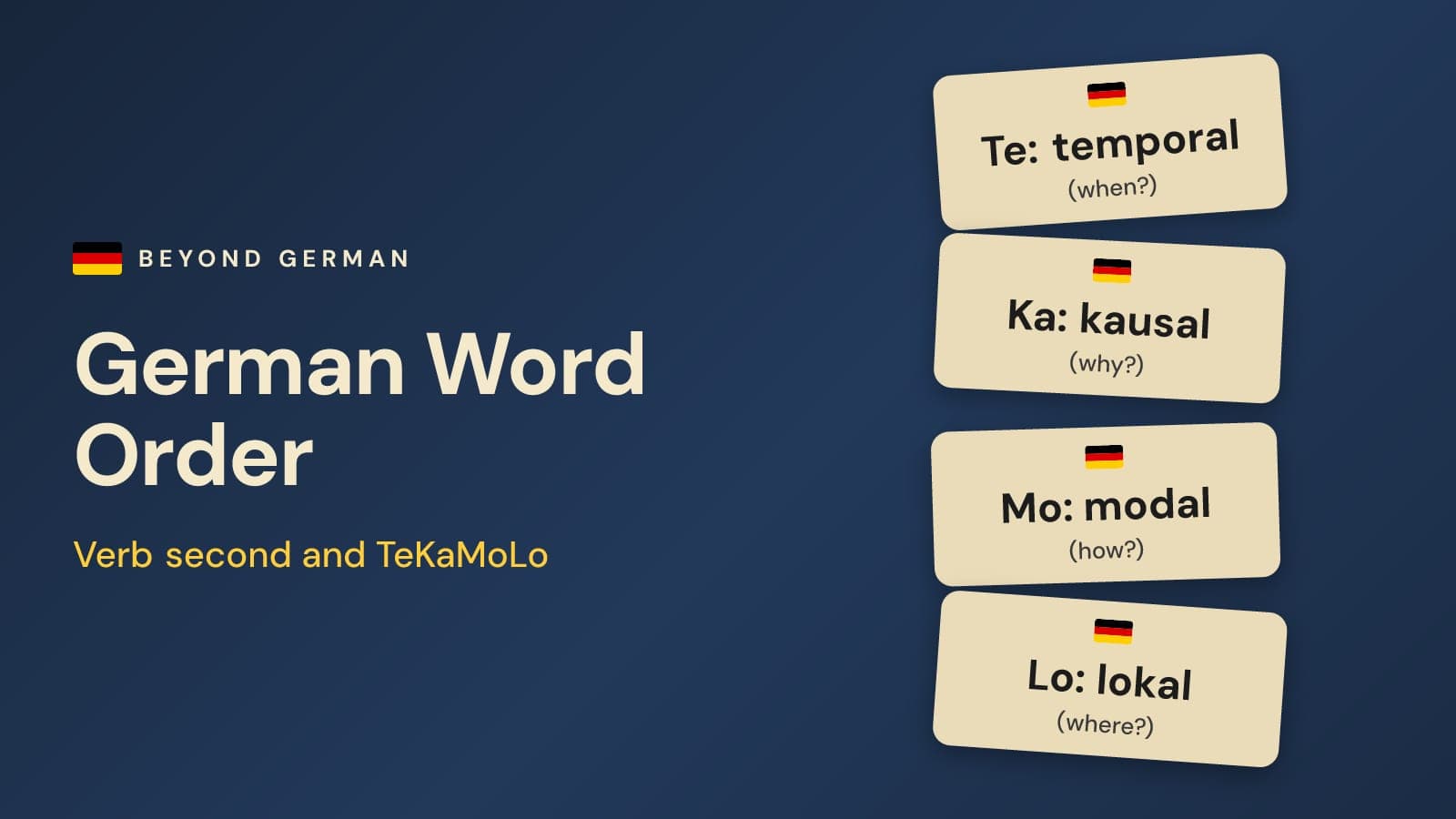
German word order follows a handful of fixed rules. In a statement, the conjugated verb is always the second element. In a yes/no question it comes first, and after words like weil, dass, wenn and obwohl it moves to the end. Extra details usually follow the order TeKaMoLo: when, why, how, where.
Below, each rule gets its own section with examples. For a one-page summary, keep our German word order basics reference open while you practice.
Rule 1: The Verb-Second Rule (V2)
In a German statement, the conjugated verb (the one that changes for ich, du, er…) always comes second: the second element, not the second word. Position 1, called the Vorfeld ("front field"), holds exactly one element of any length.
The subject often goes first, as in English. But anything can take position 1 to set the scene or add emphasis; the verb stays put and the subject moves behind it:
- Ich gehe heute ins Kino. — I'm going to the movies today.
- Heute gehe ich ins Kino. — Today I'm going to the movies.
- Mit meinem Bruder spiele ich am Samstag Tennis. — I'm playing tennis with my brother on Saturday.
- Den Film habe ich schon gesehen. — I've already seen that movie.
Mit meinem Bruder is three words but one element, so the verb comes right after it.
Words That Don't Count: und, aber, oder, denn, sondern
These five connectors (remember them as ADUSO) sit in "position 0", so the sentence after them starts fresh. Adverbs like deshalb and dann, by contrast, count as position 1:
- Ich bin müde, aber ich gehe noch einkaufen. — I'm tired, but I'm still going shopping.
- Ich bin müde, deshalb gehe ich ins Bett. — I'm tired, so I'm going to bed.
- Und dann gehen wir nach Hause. — And then we go home.
Rule 2: Questions Start With the Verb or a Question Word
German doesn't need "do" to ask a question. It just moves the verb.
W-questions follow the V2 rule: the question word (wer, was, wann, wo, warum, wie…) takes position 1, and the verb comes next:
- Wann gehst du ins Kino? — When are you going to the movies?
- Mit wem spielst du Tennis? — Who are you playing tennis with?
Yes/no questions put the verb in position 1, followed by the subject. A second verb part still goes to the end:
- Hast du den Film schon gesehen? — Have you seen the movie yet?
Commands start with the verb, too: Ruf mich morgen an! — Call me tomorrow! Every question word is in our guide to German question words.
Rule 3: The Verb Bracket (Satzklammer)
Many German verbs come in two parts. The conjugated part stays in position 2 and the other part goes to the very end, forming a bracket (Satzklammer) around the middle field (Mittelfeld):
| Verb type | Example | English |
|---|---|---|
| Modal verb + infinitive | Ich muss heute lange arbeiten. | I have to work late today. |
| Perfekt: haben/sein + participle | Ich habe gestern einen Film gesehen. | I saw a movie yesterday. |
| Separable verb | Ich rufe dich morgen an. | I'll call you tomorrow. |
Why? The last word often carries the key information, so Germans listen right to the end. Mach bitte die Tür auf. — Please open the door. Mach bitte die Tür zu. — Please close the door. Only the last syllable tells you which.
Each verb type has its own guide: German modal verbs explained, haben or sein in the perfect tense and German separable verbs.
Rule 4: The Verb Goes Last in Subordinate Clauses
Conjunctions like weil (because), dass (that), wenn (if, when) and obwohl (although) start a subordinate clause, and they send the conjugated verb to the very end:
- Ich bleibe zu Hause, weil ich krank bin. — I'm staying home because I'm sick.
- Ich glaube, dass der Zug Verspätung hat. — I think the train is delayed.
- Ruf mich an, wenn du in Berlin bist. — Call me when you're in Berlin.
- Er geht joggen, obwohl es regnet. — He's going jogging even though it's raining.
Watch for three details:
- Two verbs? The conjugated one goes last: …, weil ich morgen früh arbeiten muss. — … because I have to work tomorrow morning.
- Separable verbs join back up: …, wenn der Zug ankommt. — … when the train arrives.
- Subordinate clause first? It counts as position 1, so the main clause starts with its verb: Weil ich krank bin, bleibe ich zu Hause. — Because I'm sick, I'm staying home.
Two look-alikes break the pattern. Denn (because) is an ADUSO word, so word order stays normal. Trotzdem (still, anyway) is an adverb, so when it comes first, the verb follows right after it:
- Ich bleibe zu Hause, denn ich bin krank. — I'm staying home, as I'm sick.
- Es regnet, trotzdem geht er joggen. — It's raining, but he's going jogging anyway.
Full comparisons: weil vs. denn vs. deshalb and obwohl vs. trotzdem. More verb-final conjunctions (als, ob, bevor, damit) are in our guide to German subordinate clauses.
Rule 5: TeKaMoLo (Time, Reason, Manner, Place)
When you add details about when, why, how and where, they go into the middle field in this default order:
| Part | Stands for | Answers | Examples |
|---|---|---|---|
| Te | temporal (time) | Wann? Wie lange? Wie oft? | morgen, am Montag, jeden Tag |
| Ka | kausal (reason) | Warum? | wegen des Regens, aus Neugier |
| Mo | modal (manner) | Wie? Womit? | mit dem Zug, zu Fuß, allein |
| Lo | lokal (place) | Wo? Wohin? Woher? | in Berlin, nach Hause, zur Arbeit |
All four in one sentence:
- Ich fahre morgen wegen des Bahnstreiks mit dem Fahrrad zur Arbeit. — I'm cycling to work tomorrow because of the train strike.
Te: morgen. Ka: wegen des Bahnstreiks. Mo: mit dem Fahrrad. Lo: zur Arbeit. English does almost the opposite (place first, time last), so Ich fahre zur Arbeit morgen is a classic learner mistake. You may also see the rule as TMP: time, manner, place.
When TeKaMoLo Is Flexible
TeKaMoLo is a default, not a law:
- Any one element can go to position 1. The rest keep their order: Wegen des Bahnstreiks fahre ich morgen mit dem Fahrrad zur Arbeit. — Because of the train strike, I'm cycling to work tomorrow.
- You rarely need all four. Two or three is normal, in the same relative order: Ich gehe heute zu Fuß zur Arbeit. — I'm walking to work today.
- Destinations stay last. A "where to" like nach Hause or ins Kino is closely tied to the verb, so it almost always ends the middle field.
- Pronouns ignore TeKaMoLo. Short words like mich, ihn and es come right at the start of the middle field: Ich habe ihn gestern im Park gesehen. — I saw him in the park yesterday.
Rule 6: Object Order (Dative and Accusative)
Verbs like geben, zeigen and erklären often take two objects: a person (dative) and a thing (accusative). Their order depends on whether they're nouns or pronouns:
| Objects | Order | Example |
|---|---|---|
| Two nouns | Dative before accusative | Ich gebe meinem Bruder das Buch. (I'm giving my brother the book.) |
| Pronoun + noun | Pronoun first | Ich gebe ihm das Buch. (I'm giving him the book.) Ich gebe es meinem Bruder. (I'm giving it to my brother.) |
| Two pronouns | Accusative before dative | Ich gebe es ihm. (I'm giving it to him.) |
The logic: short, known words come first. With two nouns, think "person before thing". Two pronouns flip, and pairs like es mir or ihn dir soon feel like one chunk:
- Kannst du es mir erklären? — Can you explain it to me?
- Ich schicke dir den Link. → Ich schicke ihn dir. — I'll send you the link. → I'll send it to you.
If the cases still feel fuzzy, start with our German dative case guide.
Rule 7: Where Does nicht Go?
To negate a whole sentence, nicht goes toward the end. It comes after the conjugated verb, objects and time words like heute, but before the second verb part, adjectives and places:
- Ich arbeite heute nicht. — I'm not working today.
- Ich kenne den Mann nicht. — I don't know the man.
- Er hat mich nicht angerufen. — He didn't call me.
- Das Hotel ist nicht teuer. — The hotel isn't expensive.
- Wir fahren morgen nicht nach Berlin. — We're not going to Berlin tomorrow.
To negate just one part, put nicht right in front of it, often with sondern (but rather): Ich fahre nicht heute, sondern morgen. — I'm not going today, but tomorrow. For nouns with ein or no article, use kein: Ich habe keine Zeit. — I don't have time.
German Sentence Structure: One Sentence, Step by Step
Here's every rule working together, one change at a time (verbs in bold):
| German | English | What changed |
|---|---|---|
| Ich fahre nach Hamburg. | I'm going to Hamburg. | Verb in position 2. |
| Ich fahre morgen nach Hamburg. | I'm going to Hamburg tomorrow. | Time before place. |
| Ich fahre morgen mit dem Zug nach Hamburg. | I'm taking the train to Hamburg tomorrow. | Manner goes in between. |
| Ich fahre morgen wegen der Konferenz mit dem Zug nach Hamburg. | I'm taking the train to Hamburg tomorrow for the conference. | Reason added: full TeKaMoLo. |
| Morgen fahre ich wegen der Konferenz mit dem Zug nach Hamburg. | Tomorrow I'm taking the train to Hamburg for the conference. | Time in position 1, subject after the verb. |
| Morgen muss ich wegen der Konferenz mit dem Zug nach Hamburg fahren. | Tomorrow I have to take the train to Hamburg for the conference. | Modal verb: infinitive at the end. |
| Gestern bin ich wegen der Konferenz mit dem Zug nach Hamburg gefahren. | Yesterday I took the train to Hamburg for the conference. | Perfekt: participle at the end. |
| Ich bin müde, weil ich gestern mit dem Zug nach Hamburg gefahren bin. | I'm tired because I took the train to Hamburg yesterday. | Subordinate clause: verb last. |
| Ich fahre morgen nicht nach Hamburg. | I'm not going to Hamburg tomorrow. | Nicht after the time, before the place. |
Look at rows four to seven: the middle (wegen der Konferenz mit dem Zug nach Hamburg) never changes. Only position 1 and the verbs move.
Common Mistakes
| Wrong | Right | Why |
|---|---|---|
| Heute ich gehe ins Kino. | Heute gehe ich ins Kino. | The verb comes second, so the subject moves behind it. |
| Ich fahre nach Berlin morgen. | Ich fahre morgen nach Berlin. | Time before place, unlike English. |
| Ich kann sprechen Deutsch. | Ich kann Deutsch sprechen. | The infinitive goes to the end. |
| Ich rufe an dich morgen. | Ich rufe dich morgen an. | The separable prefix goes to the end. |
| …, weil ich habe keine Zeit. | …, weil ich keine Zeit habe. | Weil sends the verb to the end. |
| Wenn ich Zeit habe, ich komme mit. | Wenn ich Zeit habe, komme ich mit. | The wenn clause fills position 1, so the verb comes next. |
| Ich nicht verstehe das. | Ich verstehe das nicht. | Nicht goes after the verb and the object. |
In casual speech, you'll hear the verb in second place after weil, but in writing and exams it goes last. More slip-ups: common German mistakes English speakers make.
Practice: Put It in Order
Rewrite each sentence, then check your answers.
- Ich fahre nach München. (Add mit dem Bus and am Freitag.)
- Er ruft mich an. (Put it in the Perfekt.)
- Ich komme nicht. Ich habe keine Zeit. (Join them with weil.)
- Ich gebe meiner Schwester den Schlüssel. (Replace both objects with pronouns.)
- Ich verstehe die Frage. (Negate it with nicht.)
Answers:
- Ich fahre am Freitag mit dem Bus nach München. — I'm taking the bus to Munich on Friday.
- Er hat mich angerufen. — He called me.
- Ich komme nicht, weil ich keine Zeit habe. — I'm not coming because I don't have time.
- Ich gebe ihn ihr. — I'm giving it to her.
- Ich verstehe die Frage nicht. — I don't understand the question.
Keep practicing:
- Review all the rules on one page in German word order basics.
- Build ready-made sentences with 20 German sentence patterns for beginners.
- Test yourself with the A1 German quiz.
FAQ
What is the verb-second rule in German?
In a German statement, the conjugated verb is always the second element. If something other than the subject comes first, the subject moves behind the verb: Heute gehe ich, never Heute ich gehe.
What does TeKaMoLo stand for?
Temporal, kausal, modal, lokal: when, why, how and where. It's the default order for extra details in the middle of a sentence: Ich fahre morgen wegen der Arbeit mit dem Auto nach München.
Is German word order SOV or SVO?
Linguists call German SOV with verb-second in main clauses. Simple statements look like English (Ich kaufe ein Auto), but with a second verb or a subordinate clause, the verb goes last: Ich will ein Auto kaufen; …, dass ich ein Auto kaufe.
Level Up Your German
Join 1,000+ learners getting weekly tips, grammar shortcuts, and cultural insights.
Share this article
Continue Reading
How to Be Polite in German: Würde, Könnte, Hätte gern & More
Sound polite in German with Konjunktiv II: Ich hätte gern, Könnten Sie, Würden Sie and Dürfte ich, plus softening words, Sie vs. du, polite refusals and dialogues.
Obwohl vs Trotzdem vs Dennoch: Although in German (+ Word Order)
Obwohl means although and sends the verb to the end, while trotzdem and dennoch mean nevertheless and take the verb right after them. Allerdings, trotz and sondern are covered too.
Animals in German: Names, Plurals, Sounds and Idioms
The most common animals in German, from der Hund and die Katze to der Igel, with articles, plurals, male and female forms, animal sounds and the idioms Germans love.