
Common German Mistakes English Speakers Make (+ False Friends)
 Beyond German Team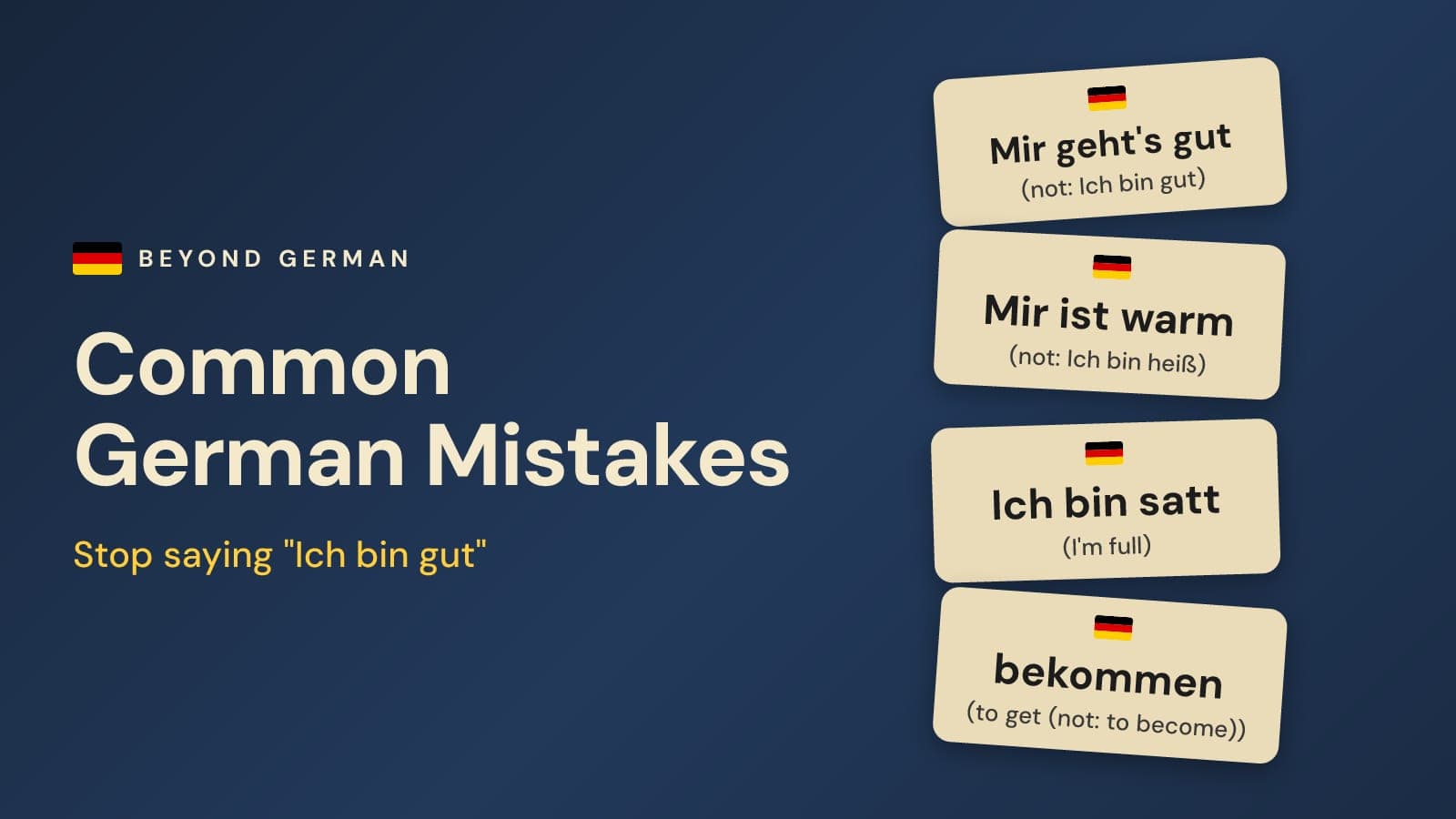
Most German mistakes English speakers make come from translating word for word. "I'm hot" becomes Ich bin heiß (which means something very different), "I will" becomes Ich will (which means "I want"), and "gift" becomes Gift (which means poison). Each fix is small once you see why the English pattern doesn't carry over.
Here are 15 classic mistakes, each with the wrong version, the right one, the reason and an example, plus a table of the false friends that cause the most confusion. Three of them come with a short video from our YouTube channel.
"Ich bin…" Mistakes: When "I Am" Doesn't Translate
English uses "I am" for almost everything: feelings, temperature, age, job. German often doesn't, or uses it differently, and that's behind the first eight mistakes.
1. "Ich bin gut" → "Mir geht es gut"
Wrong: Ich bin gut. (as an answer to Wie geht's?)
Right: Mir geht es gut.
Why: German doesn't use sein (to be) for how you're doing. It uses es geht + dative, literally "it goes well for me". Ich bin gut sounds like you're good at something, or telling people you're a good person.
- Danke, mir geht's gut. Und dir? — I'm good, thanks. And you?
More ways to answer are in our guide to how are you in German and on the phrase page for Mir geht es gut. Or watch our short: Stop Saying "Ich bin gut" in German.
2. "Ich bin heiß" → "Mir ist heiß" or "Mir ist warm"
Wrong: Ich bin heiß.
Right: Mir ist heiß. / Mir ist warm.
Why: For how your body feels, German uses the dative: mir ist, literally "to me it is". Ich bin heiß describes you, and to a German ear it means "I'm hot" as in sexy, or as in turned on. Not what you want to announce on a crowded train in July.
- Mir ist so warm. Kannst du das Fenster aufmachen? — I'm so hot. Can you open the window?
For the weather, say Heute ist es heiß. — It's hot today. Watch our short: Stop Saying "Ich bin heiß" in German.
3. "Ich bin kalt" → "Mir ist kalt"
Wrong: Ich bin kalt.
Right: Mir ist kalt. (or Ich friere.)
Why: Same pattern. Ich bin kalt describes your personality: cold, distant, unfeeling.
- Mir ist kalt. Hast du eine Decke? — I'm cold. Do you have a blanket?
4. "Ich bin langweilig" → "Mir ist langweilig"
Wrong: Ich bin langweilig.
Right: Mir ist langweilig.
Why: Ich bin langweilig means "I'm boring", not "I'm bored". Boredom is something you feel, so it takes mir ist.
- Mir ist langweilig. Wollen wir einen Film schauen? — I'm bored. Shall we watch a movie?
The rule behind mistakes 2 to 4: ich bin + adjective says what you're like; mir ist + adjective says how you feel.
| Ich bin… (what you're like) | Mir ist… (how you feel) |
|---|---|
| Ich bin kalt. — I'm a cold person. | Mir ist kalt. — I'm cold. |
| Ich bin heiß. — I'm hot (sexy). | Mir ist heiß. — I'm (feeling) hot. |
| Ich bin langweilig. — I'm boring. | Mir ist langweilig. — I'm bored. |
| Ich bin schlecht. — I'm bad (at it). | Mir ist schlecht. — I feel sick. |
5. "Ich bin fertig": Done or Exhausted?
Ambiguous: Ich bin fertig.
Clearer: Ich bin mit der Arbeit fertig. (done with work) / Ich bin total fertig. (exhausted)
Why: Fertig means finished or ready, so Ich bin fertig isn't wrong. But it's also how Germans say they're completely worn out. Sigh it after a long day, and nobody will think you've finished anything. Add what you're done with (mit + dative), and the meaning is clear.
- Ich bin gleich mit den Hausaufgaben fertig. — I'll be done with my homework in a minute.
- Nach der Nachtschicht war ich fix und fertig. — After the night shift, I was completely wiped out.
To say you're ready to go, use Ich bin so weit. Watch our short: Stop Saying "Ich bin fertig" in German! Say THIS Instead.
6. "Ich bin voll" → "Ich bin satt"
Wrong (after a meal): Ich bin voll.
Right: Ich bin satt.
Why: In casual German, voll means drunk. Tell your host Ich bin voll after dinner, and it can sound like you've had too much wine, not too much food. Satt is the word for "full from eating".
- Danke, das war lecker, aber ich bin satt. — Thanks, that was delicious, but I'm full.
7. "Ich habe 20 Jahre" → "Ich bin 20 Jahre alt"
Wrong: Ich habe 20 Jahre.
Right: Ich bin 20 Jahre alt. (or just Ich bin 20.)
Why: This one sneaks in from Spanish or French (tengo 20 años, j'ai 20 ans). German works like English here: you are your age.
- Wie alt bist du? – Ich bin 28. — How old are you? – I'm 28.
8. "Ich bin ein Lehrer" → "Ich bin Lehrer"
Wrong: Ich bin ein Lehrer.
Right: Ich bin Lehrer. / Ich bin Lehrerin.
Why: With jobs and nationalities, German drops the article after sein and werden. The article comes back when you add an adjective: Er ist ein guter Lehrer (he's a good teacher). Women use the -in form: Lehrerin, Ärztin, Amerikanerin.
- Ich bin Kanadier und arbeite als Koch. — I'm Canadian and work as a chef.
Age and job come up in every first conversation, so see our guide on how to introduce yourself in German for the full set of phrases.
Word Order Mistakes
9. "Heute ich gehe" → "Heute gehe ich"
Wrong: Heute ich gehe ins Kino.
Right: Heute gehe ich ins Kino.
Why: In a German main clause, the conjugated verb is always the second element. Start with anything other than the subject (a time, a place) and the subject moves behind the verb. English says "Today I go"; German can't.
- Am Wochenende besuche ich meine Eltern. — This weekend I'm visiting my parents.
Am Wochenende counts as one element, even though it's two words. More in our guide to German word order basics.
10. "…weil ich bin müde" → "…weil ich müde bin"
Wrong: Ich bleibe zu Hause, weil ich bin müde.
Right: Ich bleibe zu Hause, weil ich müde bin. — I'm staying home because I'm tired.
Why: After weil, dass, wenn and other subordinating conjunctions, the conjugated verb goes to the end. You'll hear Germans break this rule with weil in casual speech, but in writing and exams, the verb goes last. See weil vs. denn vs. deshalb.
Vocabulary Mistakes and False Friends
11. "Ich will" Means "I Want", Not "I Will"
Wrong: Ich will dich morgen anrufen. (meaning "I'll call you tomorrow")
Right: Ich rufe dich morgen an. / Ich werde dich morgen anrufen.
Why: Will comes from wollen, to want. The future uses werden, though Germans usually just use the present tense plus a time word. And when ordering, Ich will… sounds blunt, like a child demanding a toy. Say Ich möchte… or Ich hätte gern… instead.
- Ich will heute nicht kochen. — I don't want to cook today.
All the modal verbs are covered in German modal verbs explained.
12. "Ich mag einen Kaffee" → "Ich möchte einen Kaffee"
Wrong: Ich mag einen Kaffee, bitte.
Right: Ich möchte einen Kaffee, bitte.
Why: Ich mag means "I like" (in general). Ich möchte means "I would like" (right now). One is a preference, the other is an order. See the phrase page for Ich möchte.
- Ich mag Kaffee, aber heute möchte ich einen Tee. — I like coffee, but today I'd like a tea.
13. "Wenn kommst du?" → "Wann kommst du?"
Wrong: Wenn kommst du?
Right: Wann kommst du? — When are you coming?
Why: English "when" has three German translations: wann for questions, als for a single event or period in the past, and wenn for the rest (if, whenever, and the present or future). Wenn looks like "when", so it gets overused.
- Als ich zehn war, sind wir nach Hamburg gezogen. — When I was ten, we moved to Hamburg.
The full breakdown is in wenn vs. als vs. ob.
14. False Friends: Gift, Chef, Handy and More
False friends (falsche Freunde) look like English words but mean something else. These cause the most confusion:
| German | Actually means | For the English word, say… |
|---|---|---|
| bekommen | to get, to receive | to become = werden |
| also | so, therefore | also = auch |
| das Gift | poison | gift = das Geschenk |
| das Handy | mobile phone, cell phone | handy = praktisch |
| der Chef / die Chefin | boss | chef = der Koch / die Köchin |
| eventuell | possibly, maybe | eventually = irgendwann, schließlich |
| aktuell | current, up to date | actual(ly) = tatsächlich, eigentlich |
| sensibel | sensitive | sensible = vernünftig |
| das Rezept | recipe; (doctor's) prescription | receipt = die Quittung, der Kassenbon |
| die Hose | trousers, pants | hose = der Schlauch |
| der Rat | advice | rat = die Ratte |
| bald | soon | bald = kahl |
| fast | almost | fast = schnell |
| eine Billion | a trillion | a billion = eine Milliarde (see German numbers) |
A few in action:
- Ich will Lehrer werden. — I want to become a teacher. (Lehrer bekommen would mean "to get teachers".)
- Es regnet, also bleiben wir zu Hause. — It's raining, so we're staying home.
- Mein Chef ist heute nicht da. — My boss isn't in today.
- Der Arzt hat mir ein Rezept gegeben. — The doctor gave me a prescription.
- Ich brauche eine neue Hose. — I need new trousers. (One pair is singular in German.)
Formal vs. Informal: Du or Sie?
15. Saying "du" to Strangers
Wrong (to a stranger): Entschuldigung, kannst du mir helfen?
Right: Entschuldigung, können Sie mir helfen? — Excuse me, can you help me?
Why: English has one "you"; German has two. Du is for friends, family, children and people your age in casual settings. Sie is for adults you don't know, shop staff, officials and most work contacts. Saying du to a stranger can come across as rude or overly familiar. Sie is always capitalized and takes the same verb form as "they": Sie sind, Sie haben.
Start with Sie and let the other person offer du. Usually the older or more senior person does, often with Wollen wir uns duzen? — Shall we say "du" to each other? Among students, young people and in many startups, du is normal from the start.
The same split shows up in small talk (Wie geht es dir? vs. Wie geht es Ihnen?) and in greetings, where Guten Tag is the safe formal choice. See our guide to German greetings.
Practice: Fix the Mistake
Each sentence has one typical mistake. Fix it, then check your answers.
- Ich bin kalt. Kannst du das Fenster zumachen?
- Morgen ich fahre nach Berlin.
- Ich habe 25 Jahre.
- Sie ist eine Ärztin.
- Danke, ich bin voll! (after dinner)
- Wenn beginnt der Film?
- Mein Gift für dich ist im Auto.
Answers:
- Mir ist kalt. Kannst du das Fenster zumachen? — I'm cold. Can you close the window?
- Morgen fahre ich nach Berlin. — Tomorrow I'm going to Berlin.
- Ich bin 25 Jahre alt. — I'm 25.
- Sie ist Ärztin. — She's a doctor.
- Danke, ich bin satt! — Thanks, I'm full!
- Wann beginnt der Film? — When does the movie start?
- Mein Geschenk für dich ist im Auto. — My gift for you is in the car.
Keep going:
- Check your basics with the A1 German quiz.
- Learn the phrases you'll need first in our essential German phrases for beginners.
FAQ
What is the most common mistake English speakers make in German?
Translating "I am" word for word. For certain feelings and sensations, German uses the dative: Mir ist kalt (I'm cold), Mir ist langweilig (I'm bored), Mir geht es gut (I'm fine). With these, Ich bin + adjective describes what you're like.
What are German false friends?
Words that look or sound like English but mean something different. The classics: Gift (poison), Chef (boss), bekommen (to get), Handy (cell phone), also (so) and bald (soon).
Is it rude to say du in German?
To adults you don't know, it can be. Use Sie with strangers, in shops and with officials, and switch when the other person offers du. With friends, family, children and fellow students, du is normal.
Will Germans understand me if I make these mistakes?
Almost always. Most of them get a smile, not a misunderstanding. The ones that can genuinely mislead are Ich bin heiß, Ich bin voll and Ich will for "I will", so fix those first.
Level Up Your German
Join 1,000+ learners getting weekly tips, grammar shortcuts, and cultural insights.
Share this article
Continue Reading
Days of the Week in German, Months and How to Say the Date
Learn the days of the week and months in German with articles, abbreviations and pronunciation, plus seasons, dates like am 3. Oktober, years and holidays.
Telling Time in German: What Time Is It? (Halb Acht Explained)
Learn how to tell time in German: ask Wie spät ist es?, use the 24-hour clock, master Viertel nach and Viertel vor, and see why halb acht means 7:30.
German Two-Way Prepositions (Wechselpräpositionen) Explained
The nine German two-way prepositions (an, auf, hinter, in, neben, über, unter, vor, zwischen): when they take the accusative or dative, with verb pairs and examples.