
How to Introduce Yourself in German: Ich heiße & Sample Intros
 Beyond German Team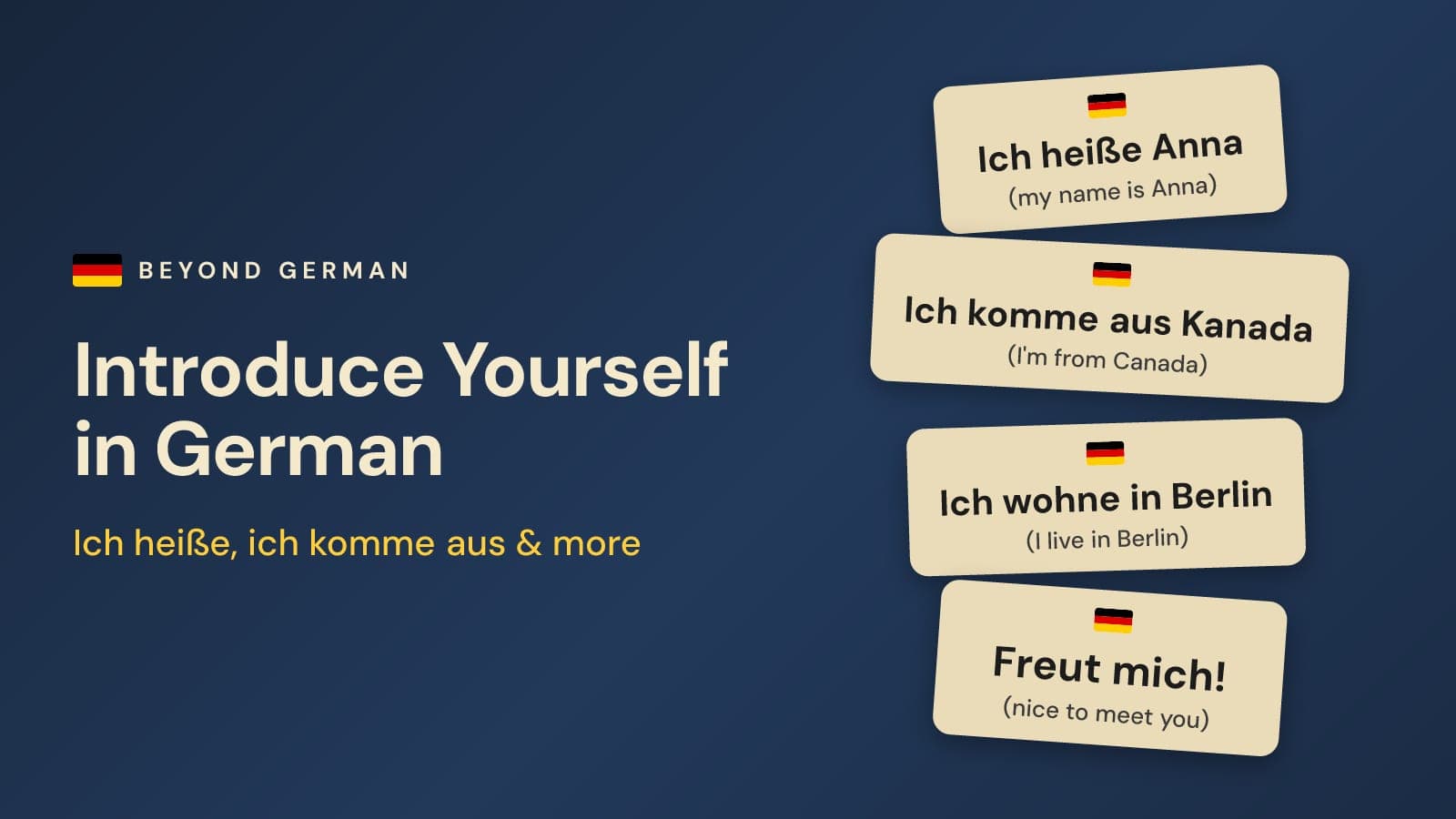
To introduce yourself in German, start with Hallo, ich heiße… (Hello, my name is…), then say where you're from and where you live: Ich komme aus Kanada und wohne in Berlin. — I'm from Canada, and I live in Berlin. When the other person tells you their name, answer with Freut mich! — Nice to meet you!
Below you'll find every sentence you need for a first conversation, when to use du and when to use Sie, the mistakes to avoid, and two sample introductions (A1 and A2/B1) you can adapt.
The Core Sentences for Introducing Yourself
These nine patterns cover almost every self-introduction. Swap in your own details, and you're ready.
| Pattern | Example | English |
|---|---|---|
| Ich heiße… / Mein Name ist… / Ich bin… | Ich heiße Anna. | My name is Anna. |
| Ich komme aus… | Ich komme aus England. | I'm from England. |
| Ich wohne in… | Ich wohne in Hamburg. | I live in Hamburg. |
| Ich bin … Jahre alt. | Ich bin 29 Jahre alt. | I'm 29 years old. |
| Ich arbeite als… | Ich arbeite als Krankenpfleger. | I work as a nurse. (no article!) |
| Ich studiere… | Ich studiere Informatik. | I study computer science. |
| Ich spreche… | Ich spreche Englisch und ein bisschen Deutsch. | I speak English and a little German. |
| Meine Hobbys sind… / Ich … gern. | Meine Hobbys sind Lesen und Schwimmen. Ich koche gern. | My hobbies are reading and swimming. I like cooking. |
| Ich lerne Deutsch, weil… | Ich lerne Deutsch, weil ich in Wien arbeite. | I'm learning German because I work in Vienna. |
Saying Your Name: Ich heiße, Mein Name ist, Ich bin
Ich heiße comes from the verb heißen (to be called), so it literally means "I am called". It's the most common way to give your name, and it works in every situation.
- Ich heiße Sophie. — My name is Sophie.
- Ich heiße Alexander, aber alle nennen mich Alex. — My name is Alexander, but everyone calls me Alex.
Mein Name ist… sounds a little more formal. You'll hear it on the phone, at work and with full names. Ich bin… is the casual option, common among young people:
- Guten Tag, mein Name ist Daniel Wright. — Hello, my name is Daniel Wright.
- Hi, ich bin Tom. — Hi, I'm Tom.
The ß in heißen is a sharp "s" sound, so heiße sounds roughly like "HY-suh". In Switzerland, where ß isn't used, it's spelled ich heisse. The forms you'll need most are ich heiße, du heißt, er/sie heißt and Sie heißen (formal "you").
Where You're From and Where You Live
Use Ich komme aus… for your country or hometown and Ich wohne in… for where you live now:
- Ich komme aus Manchester, aber ich wohne in Köln. — I'm from Manchester, but I live in Cologne.
- Ich wohne seit drei Jahren in Deutschland. — I've been living in Germany for three years.
Note the present tense with seit (for/since): English says "I've been living", but German simply says ich wohne.
To give your nationality, leave out the article: Ich bin Amerikaner. — I'm American. A woman says Amerikanerin, just as Brite (a British man) becomes Britin.
Countries with an article: aus der Türkei, aus den USA
Most countries have no article, so you simply say aus Deutschland, aus Spanien or aus Kanada. A few always use one, and because aus takes the dative, the article changes:
| Country | I'm from… | I live in… |
|---|---|---|
| die Schweiz | aus der Schweiz | in der Schweiz |
| die Türkei | aus der Türkei | in der Türkei |
| die Ukraine | aus der Ukraine | in der Ukraine |
| der Iran | aus dem Iran | im Iran |
| die USA (plural) | aus den USA | in den USA |
| die Niederlande (plural) | aus den Niederlanden | in den Niederlanden |
Feminine die becomes der, masculine der becomes dem, and plural die becomes den. Our guide to German dative prepositions explains why.
Age, Family and Job
Your age: Ich bin … Jahre alt
German uses sein (to be) for age, just like English: Ich bin 25 Jahre alt. — I'm 25 years old. Or simply: Ich bin 25. If you speak Spanish, French or Italian, watch out: Ich habe 25 Jahre doesn't work in German. For the numbers themselves (25 is fünfundzwanzig), see German numbers 1–100.
Your family
- Ich bin verheiratet und habe zwei Kinder. — I'm married and have two children.
- Ich habe einen Bruder und eine Schwester. — I have a brother and a sister.
For more words, see our guide to family members in German.
Your job: no article
In English you say "I'm a teacher", but in German the article disappears:
- Ich bin Lehrer. / Ich bin Lehrerin. — I'm a teacher. (man / woman)
- Ich arbeite als Ingenieurin bei einer Autofirma. — I work as an engineer at a car company.
- Ich suche gerade eine Stelle. — I'm looking for a job at the moment.
Most job titles add -in for women (Verkäufer → Verkäuferin), and some add an umlaut too: Arzt → Ärztin, Koch → Köchin. The phrase page Ich arbeite als… has more examples.
Studieren vs. lernen: studieren means studying at a university: Ich studiere Medizin. — I'm studying medicine. For a language course, use lernen: Ich lerne Deutsch. — I'm learning German. Ich studiere Deutsch means German is your university subject.
Languages, Hobbies and Why You're Learning German
- Ich spreche Englisch, Spanisch und ein bisschen Deutsch. — I speak English, Spanish and a little German.
- Meine Muttersprache ist Englisch. — My native language is English.
- Meine Hobbys sind Lesen, Reisen und Fotografieren. — My hobbies are reading, traveling and photography.
- Am Wochenende gehe ich gern wandern. — On weekends I like to go hiking.
To say you like doing something, add gern after the verb: Ich koche gern (I like cooking). And note the spelling: the German plural is Hobbys, not "Hobbies".
People will almost always ask why you're learning German. After weil (because), the verb goes to the end:
- Ich lerne Deutsch, weil mein Partner aus Österreich kommt. — I'm learning German because my partner is from Austria.
- Ich lerne Deutsch, weil ich nächstes Jahr in Berlin studieren möchte. — I'm learning German because I want to study in Berlin next year.
Our guide to weil, denn and deshalb explains this word order step by step.
Formal vs. Informal: du or Sie?
Good news: your own sentences don't change. Ich heiße Anna works with your boss and with a classmate. What changes is the greeting and the way you ask questions.
- Use Sie with adults you don't know, in shops and offices, with officials and in most professional situations.
- Use du with friends, family, children and classmates, and usually with other young people. Many workplaces, especially startups, use du too.
- Not sure? Start with Sie and let the other person suggest du: Wollen wir uns duzen? — Shall we use du?
Greetings follow the same split: Guten Tag is formal, Hallo or Hi informal. Our guide to German greetings covers the rest. Compare:
- Guten Tag, darf ich mich vorstellen? Mein Name ist Laura Bennett. — Hello, may I introduce myself? My name is Laura Bennett.
- Hi, ich bin Laura. Ich bin neu hier. — Hi, I'm Laura. I'm new here.
Asking Other People About Themselves
| English | Informal (du) | Formal (Sie) |
|---|---|---|
| What's your name? | Wie heißt du? | Wie heißen Sie? |
| Where are you from? | Woher kommst du? | Woher kommen Sie? |
| Where do you live? | Wo wohnst du? | Wo wohnen Sie? |
| What do you do for work? | Was machst du beruflich? | Was machen Sie beruflich? |
| How old are you? | Wie alt bist du? | Wie alt sind Sie? |
| What languages do you speak? | Welche Sprachen sprichst du? | Welche Sprachen sprechen Sie? |
| And you? | Und du? | Und Sie? |
Don't mix up woher (where from) and wo (where). In speech, woher is often split in two: Wo kommst du her? — Where are you from? And Und du? is the easiest way to keep a conversation going: answer the question, then bounce it back.
Freut mich! Saying "Nice to Meet You"
- Freut mich! — Nice to meet you!
- Freut mich auch! or Mich auch! — Nice to meet you too!
- Schön, dich kennenzulernen! / Schön, Sie kennenzulernen! — Nice to meet you! (informal / formal)
- Angenehm. — Pleased to meet you. (formal and a little old-fashioned)
Freut mich is short for Es freut mich, dich/Sie kennenzulernen (It's a pleasure to meet you). In formal and business settings, Germans usually shake hands when they meet. The next time you meet, you'll probably hear Wie geht's?, so learn how to say "How are you?" in German and how to answer.
Sample Self-Introductions
A1: a simple introduction
Hallo! Ich heiße Emma. Ich komme aus Kanada und wohne jetzt in Berlin. Ich bin 28 Jahre alt. Ich arbeite als Grafikdesignerin. Ich spreche Englisch, Französisch und ein bisschen Deutsch. Meine Hobbys sind Yoga und Kochen.
Hi! My name is Emma. I'm from Canada, and I live in Berlin now. I'm 28 years old. I work as a graphic designer. I speak English, French and a little German. My hobbies are yoga and cooking.
A2/B1: a richer version
Hallo zusammen! Mein Name ist Daniel Wright. Ich komme ursprünglich aus den USA, aus Chicago, aber ich wohne seit zwei Jahren in Frankfurt. Ich bin 34, verheiratet und habe eine kleine Tochter. Ich bin Softwareentwickler und arbeite bei einer Bank. Vorher habe ich drei Jahre in New York gearbeitet. Ich lerne Deutsch, weil ich mich hier wirklich zu Hause fühlen möchte. In meiner Freizeit wandere ich gern, und am Wochenende spiele ich Gitarre in einer Band. Ich freue mich auf den Kurs!
Hi, everyone! My name is Daniel Wright. I'm originally from the US, from Chicago, but I've been living in Frankfurt for two years. I'm 34, married, and I have a little daughter. I'm a software developer, and I work at a bank. Before that, I worked in New York for three years. I'm learning German because I want to really feel at home here. In my free time I like hiking, and on weekends I play guitar in a band. I'm looking forward to the course!
What makes it A2/B1: seit + present tense, a sentence in the past (habe … gearbeitet), a weil clause with the verb at the end, and inversion after In meiner Freizeit.
Common Mistakes
1. Putting an article before your job
Wrong: Ich bin ein Lehrer. Right: Ich bin Lehrer.
The article only comes back with an adjective: Ich bin ein guter Lehrer. — I'm a good teacher.
2. Using haben for your age
Wrong: Ich habe 25 Jahre. Right: Ich bin 25 Jahre alt.
3. Using von for your country
Wrong: Ich komme von Spanien. Right: Ich komme aus Spanien.
Aus is for where you're from. Von is for a place you're coming from right now: Ich komme gerade vom Arzt. — I'm just coming from the doctor's.
4. Forgetting the article with die Schweiz or die USA
Wrong: Ich komme aus Schweiz. Right: Ich komme aus der Schweiz.
5. Translating "I've been living here for…"
Wrong: Ich habe hier für zwei Jahre gewohnt. Right: Ich wohne seit zwei Jahren hier.
If it's still true, use seit + present tense.
For more traps like these, see common German mistakes English speakers make.
Practice
Fix the mistake in each sentence, then check your answers.
- Ich bin eine Ärztin.
- Ich habe 30 Jahre.
- Ich komme von England.
- Ich komme aus USA.
- Wie heißen du?
Answers:
- Ich bin Ärztin.
- Ich bin 30 Jahre alt.
- Ich komme aus England.
- Ich komme aus den USA.
- Wie heißt du?
Now write your own introduction with this template, and say it out loud until it flows:
Hallo! Ich heiße ___. Ich komme aus ___ und wohne in ___. Ich bin ___ Jahre alt. Ich arbeite als ___. Ich spreche ___. Ich ___ gern. Ich lerne Deutsch, weil ___.
Then test yourself with the A1 German quizzes, and pick up more building blocks from our 20 German sentence patterns for beginners.
FAQ
How do you introduce yourself in German?
Say Hallo, ich heiße… (Hello, my name is…), then add Ich komme aus… (I'm from…) and Ich wohne in… (I live in…). When the other person gives their name, say Freut mich! (Nice to meet you!).
What does "ich heiße" mean?
It means "my name is", literally "I am called". It comes from the verb heißen. Don't confuse it with the adjective heiß (hot).
Is it "Ich heiße" or "Mein Name ist"?
Both are correct. Ich heiße is the everyday choice; Mein Name ist sounds a little more formal and is common on the phone and at work.
How do you say "nice to meet you" in German?
Freut mich! is the most common way. You can also say Schön, dich kennenzulernen (informal) or Schön, Sie kennenzulernen (formal). To reply, say Freut mich auch!
Level Up Your German
Join 1,000+ learners getting weekly tips, grammar shortcuts, and cultural insights.
Share this article
Continue Reading
Common German Mistakes English Speakers Make (+ False Friends)
Why 'Ich bin heiß' gets laughs and 'Ich will' doesn't mean 'I will': 15 common German mistakes English speakers make, plus the false friends to watch out for.
Days of the Week in German, Months and How to Say the Date
Learn the days of the week and months in German with articles, abbreviations and pronunciation, plus seasons, dates like am 3. Oktober, years and holidays.
Telling Time in German: What Time Is It? (Halb Acht Explained)
Learn how to tell time in German: ask Wie spät ist es?, use the 24-hour clock, master Viertel nach and Viertel vor, and see why halb acht means 7:30.