Grandma in German: Oma, Opa, Großmutter and Grandparents
 Beyond German Team
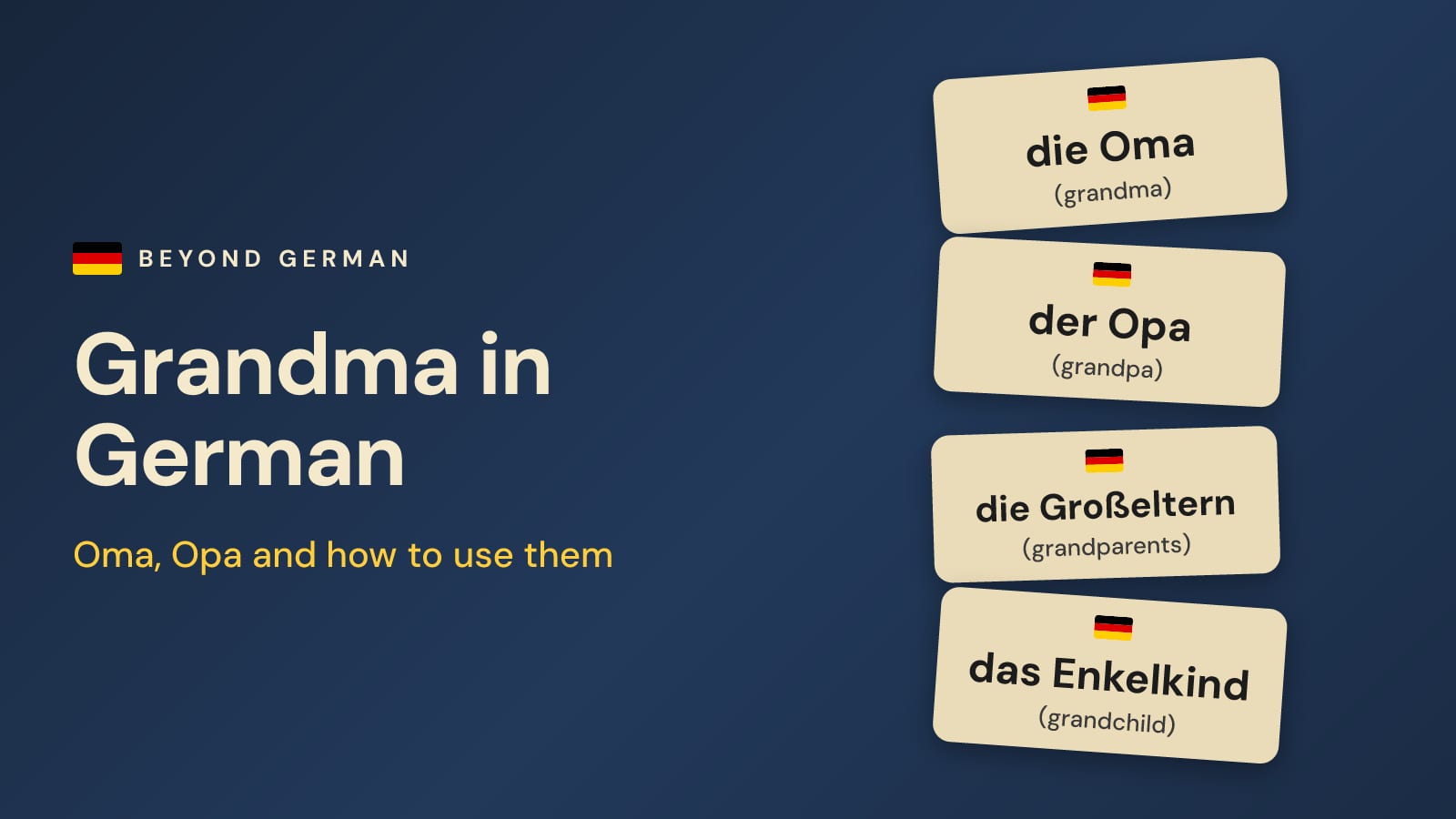
Grandma in German is die Oma (OH-mah), and grandpa is der Opa (OH-pah). These are the warm, everyday words that German speakers of every age use for their grandparents. The more formal words are die Großmutter (grandmother) and der Großvater (grandfather), and grandparents are die Großeltern.
Below: a quick table, where Oma comes from, Oma vs Omi vs Großmutter, the grammar that trips learners up, great-grandparents and grandchildren, cards to Grandma and a few expressions. Then mistakes, practice and quick answers.
Grandma in German: The Quick Answer
These are the words for grandparents, great-grandparents and grandchildren:
| German | English | When to use it |
|---|---|---|
| die Oma | grandma | Everyday |
| die Omi | granny, nana | Extra affectionate, often from small children |
| die Großmutter | grandmother | Formal, written, official |
| der Opa | grandpa | Everyday |
| der Opi | grandpa (affectionate) | Extra affectionate, often from small children |
| der Großvater | grandfather | Formal, written, official |
| die Großeltern | grandparents | Plural only; everyday and formal |
| die Urgroßmutter / die Uroma | great-grandmother | Formal / everyday |
| der Urgroßvater / der Uropa | great-grandfather | Formal / everyday |
| der Enkel / die Enkelin | grandson (or grandchild) / granddaughter | Everyday and formal |
| das Enkelkind | grandchild | Any grandchild, boy or girl |
If you only learn two words, learn Oma and Opa.
What Does Oma Mean?
Oma simply means grandma, and adults use it as much as children do: Meine Oma ist 90 und topfit. (My grandma is 90 and in great shape.)
How to Pronounce Oma, Opa and Großmutter
Say OH-mah and OH-pah, stressing the first syllable. The o is a long, pure "oh", and the final a is an open "ah", not the soft "uh" at the end of English "sofa".
The formal words start with groß (big, grand): Großmutter (GROHS-moo-ter), Großvater (GROHS-fah-ter) and Großeltern (GROHS-el-tern). The ß is a sharp "s", and the v in Vater sounds like "f"; our guide to German pronunciation covers both.
Where Oma Comes From
Oma began as a child's word: dictionaries describe it as children's language for Großmama, and Opa for Großpapa. Like Mama and Papa, the short forms are easy for small children to say, and they stuck.
Oma and Opa are used all over Germany and Austria and understood wherever German is spoken. Swiss German also has its own words, such as Grosi (grandma), and Swiss spelling writes Grossmutter, since Switzerland doesn't use ß.
Dutch uses the same two words, oma and opa. So if your family has German (or Dutch) roots and you've always called your grandmother Oma, you've been speaking correct German all along.
Oma vs Omi vs Großmutter vs Großmama
| Word | How it feels | Typical use |
|---|---|---|
| Oma | warm, normal | The default |
| Omi | cuddly, sweet | Small children; some families use it as her name |
| Großmutter | neutral, a bit formal | Writing, forms, polite questions |
| Großmama | old-fashioned | Older books; rare today |
Talking to her: use Oma or Omi like a name. Oma, kommst du am Sonntag? (Grandma, are you coming on Sunday?) Omi, liest du mir was vor? (Granny, will you read me something?)
Talking about her: meine Oma works in almost any conversation; meine Großmutter sounds a little more serious.
Forms and writing: official documents, family trees and essays use Großmutter: Meine Großmutter ist in Köln geboren. (My grandmother was born in Cologne.) It's also the polite choice when you ask about someone else's: Wie geht es Ihrer Großmutter? (How is your grandmother?)
In the Grimm fairy tale Rotkäppchen (Little Red Riding Hood), the wolf in disguise hears the famous line: Ei, Großmutter, was hast du für große Ohren! (Oh, Grandmother, what big ears you have!)
Grandpa in German: Opa, Opi and Großvater
The grandpa words work exactly like the grandma words:
- der Opa (OH-pah): the everyday word. Mein Opa kocht jeden Sonntag für die ganze Familie. (My grandpa cooks for the whole family every Sunday.)
- der Opi (OH-pee): extra affectionate, mostly from small children. Opi, spielst du mit mir? (Grandpa, will you play with me?)
- der Großvater (GROHS-fah-ter): formal and written. Mein Großvater war Lehrer. (My grandfather was a teacher.)
- der Großpapa: old-fashioned, like Großmama.
Don't let the -a ending fool you: Opa is masculine, der Opa, just like der Papa.
Together they're Oma und Opa in family talk, or die Großeltern (grandparents). Großeltern is a plural-only word, so the verb is plural too: Meine Großeltern sind seit 60 Jahren verheiratet. (My grandparents have been married for 60 years.)
Grammar Tips: Articles, Plurals and Cases
Articles and Plurals
| Singular | Plural | English |
|---|---|---|
| die Oma | die Omas | grandma |
| die Großmutter | die Großmütter | grandmother |
| der Opa | die Opas | grandpa |
| der Großvater | die Großväter | grandfather |
| (no singular) | die Großeltern | grandparents |
The formal plurals take an umlaut, just like die Mutter, die Mütter and der Vater, die Väter. The short forms simply add -s. More patterns in our guide to German plural rules.
Oma Without an Article
Inside the family, Oma and Opa work like first names, so you often drop the article:
- Oma kommt morgen. (Grandma is coming tomorrow.)
- Wir fahren zu Oma. (We're going to Grandma's.)
- Das Rezept ist von Opa. (The recipe is from Grandpa.)
- Am Wochenende sind wir bei Oma und Opa. (This weekend we're at Grandma and Grandpa's.)
Learn the last one as a chunk: bei means "at someone's place". Zu, von and bei all take the dative; see our guide to German dative prepositions.
You'll also hear the article in casual speech, especially in southern Germany and Austria: Die Oma kommt morgen. Wir fahren zur Oma. Both versions are correct and mean the same.
Omas Apfelkuchen: The Possessive -s
To say "Grandma's" or "Grandpa's", add -s with no apostrophe:
- Omas Apfelkuchen (Grandma's apple cake)
- Opas Garten (Grandpa's garden)
This works when Oma is used like a name. With meine or mein, written German uses the genitive case, and everyday speech often uses von instead:
- das Haus meiner Großmutter (my grandmother's house)
- der Garten meines Opas (my grandpa's garden)
- der Garten von meinem Opa (my grandpa's garden, spoken)
Meine Oma, mein Opa: Possessives and Cases
"My" changes its ending with the case. These are the forms you'll use all the time:
| Case | grandma | grandpa | grandparents |
|---|---|---|---|
| Nominative | meine Oma | mein Opa | meine Großeltern |
| Accusative | meine Oma | meinen Opa | meine Großeltern |
| Dative | meiner Oma | meinem Opa | meinen Großeltern |
- Ich besuche meinen Opa. (I'm visiting my grandpa.) Accusative: he's the direct object.
- Das Geschenk ist für meinen Opa. (The present is for my grandpa.) Für is one of the accusative prepositions.
- Ich telefoniere oft mit meiner Oma. (I often talk to my grandma on the phone.) Mit takes the dative.
- Ich schreibe meiner Oma eine Karte. (I'm writing my grandma a card.) Dative: she receives something.
- Ich wohne bei meinen Großeltern. (I live with my grandparents.) Dative plural: Großeltern already ends in -n, so nothing more is added.
Which Grandma? Mother's Side and Father's Side
German has two handy words for the family side:
- meine Oma mütterlicherseits (my grandma on my mother's side)
- mein Opa väterlicherseits (my grandpa on my father's side)
Or describe the relationship directly: die Mutter meiner Mutter (my mother's mother), der Vater meines Vaters (my father's father). More casually: die Mutter von meinem Vater (my father's mother).
In daily life, many families simply tell two grandmas apart by first name (Oma Inge, Oma Hanne) or by where they live (die Oma aus Hamburg).
Great-Grandparents: The Ur- Words
For each extra generation, add Ur- (OOR):
| German | English |
|---|---|
| die Urgroßmutter, die Uroma | great-grandmother |
| der Urgroßvater, der Uropa | great-grandfather |
| die Urgroßeltern | great-grandparents |
| die Ururgroßmutter, die Ururoma | great-great-grandmother |
| der Urenkel, die Urenkelin | great-grandson, great-granddaughter |
Uroma (OOR-oh-mah) and Uropa are the everyday words; Urgroßmutter is what you'd write in a family tree. Meine Uroma ist 98 und erzählt die besten Geschichten. (My great-grandma is 98 and tells the best stories.)
Grandchildren: Enkel, Enkelin, Enkelkind
- der Enkel (ENG-kel), plural die Enkel: grandson. It also means grandchild in general, and the plural covers a mixed group: Sie hat fünf Enkel. (She has five grandchildren.)
- die Enkelin (ENG-keh-lin), plural die Enkelinnen: granddaughter. Ich bin ihre Enkelin. (I'm her granddaughter.)
- das Enkelkind, plural die Enkelkinder: grandchild, boy or girl. Meine Großeltern haben sieben Enkelkinder. (My grandparents have seven grandchildren.)
Step-Grandparents
A step-grandma is die Stiefoma (formally die Stiefgroßmutter), and a step-grandpa is der Stiefopa. In practice, many families just say Oma and Opa. For aunts, cousins, in-laws and the rest of the family tree, see our guide to family members in German.
Writing to Grandma: Cards and Messages
Start a card or message with Liebe for her and Lieber for him:
- Liebe Oma, (Dear Grandma,)
- Lieber Opa, (Dear Grandpa,)
- Liebe Oma, lieber Opa, (Dear Grandma and Grandpa,)
After the comma, continue on a new line with a small letter, unless the first word is a noun or a name. To sign off:
- Hab dich lieb! (Love you!) The warm family "I love you"; our guide to I love you in German explains how it differs from Ich liebe dich.
- Ganz liebe Grüße (Lots of love)
- Ich vermisse dich! (I miss you!)
- deine Lea or dein Ben (your Lea, your Ben): deine if you're female, dein if you're male.
A birthday card to Grandma could look like this:
Liebe Oma, (Dear Grandma,)
alles Gute zum Geburtstag! (Happy birthday!)
Ich wünsche dir Gesundheit und ganz viel Freude. (I wish you good health and lots of happiness.)
Ich freue mich schon auf Sonntag. (I'm already looking forward to Sunday.)
Hab dich lieb! (Love you!)
deine Lea (Lea)
For more wishes, see our guide to happy birthday in German.
Talking About Your Grandparents
Family often comes up when you introduce yourself in German. These sentences cover most conversations:
- Meine Oma wohnt in Hamburg. (My grandma lives in Hamburg.)
- Ich besuche meine Großeltern jedes Wochenende. (I visit my grandparents every weekend.)
- Mein Opa ist 85 Jahre alt. (My grandpa is 85 years old.)
- Wie heißt deine Oma? (What's your grandma's name?) Sie heißt Inge. (Her name is Inge.)
- Hast du noch Großeltern? (Do you still have any grandparents?)
- Meine Oma geht jeden Morgen schwimmen. (My grandma goes swimming every morning.)
- Mein Großvater ist leider schon gestorben. (Sadly, my grandfather has passed away.)
A typical exchange with a friend:
Friend: Was machst du am Wochenende? (What are you doing this weekend?)
You: Ich fahre zu meinen Großeltern nach Hamburg. (I'm going to see my grandparents in Hamburg.)
Friend: Schön! Wie alt ist deine Oma jetzt? (Nice! How old is your grandma now?)
You: Sie wird am Samstag 80. (She turns 80 on Saturday.)
Expressions With Oma
Das kannst du deiner Oma erzählen!
Literally "You can tell that to your grandma!", this means "I don't believe a word of it" or "tell that to someone else". You'll also hear it with Großmutter. It's casual, so keep it for friends:
- Du warst um zehn im Bett? Das kannst du deiner Oma erzählen! (You were in bed by ten? Tell that to someone else!)
Nach Omas Art: Grandma-Style Cooking
On menus and food packaging, nach Omas Art (grandma-style) and nach Omas Rezept (from Grandma's recipe) promise traditional, homemade-style food:
- Kartoffelsalat nach Omas Art (grandma-style potato salad)
- Apfelkuchen nach Omas Rezept (apple cake from Grandma's recipe)
Related: wie zu Omas Zeiten (like in Grandma's day), meaning the traditional way.
Don't Call Strangers Oma or Opa
Oma and Opa are family words. Addressing an older person you don't know as "Oma" or "Opa" sounds rude. Use Sie and a neutral opener instead: Entschuldigung, kann ich Ihnen helfen? (Excuse me, can I help you?) To describe someone, say die ältere Dame (the older lady) or der ältere Herr (the older gentleman).
Common Mistakes
Adding an Apostrophe
Avoid: Oma's Apfelkuchen Better: Omas Apfelkuchen
You'll see the apostrophe on some shop signs, but standard German adds a plain -s, with no apostrophe.
Writing Liebe Opa
Wrong: Liebe Opa, Right: Lieber Opa,
Liebe is for a woman, lieber for a man.
Forgetting the Case Ending
Wrong: Ich fahre mit meine Oma. Right: Ich fahre mit meiner Oma.
Wrong: Ich besuche mein Opa. Right: Ich besuche meinen Opa.
Mit takes the dative, and a masculine direct object takes meinen.
Treating Großeltern as Singular
Wrong: Meine Großeltern wohnt in Bremen. Right: Meine Großeltern wohnen in Bremen.
Getting the Article or Plural Wrong
Wrong: die Opa Right: der Opa
Wrong: die Großmutters Right: die Großmütter
Calling a Granddaughter Enkel
Wrong: Ich bin ihr Enkel. (said by a girl) Right: Ich bin ihre Enkelin.
Practice
Try these, then check the answers below:
- Translate: My grandpa lives in Berlin.
- Fill the gap: Ich telefoniere jeden Sonntag mit ___ Oma. (mein)
- Fill the gap: Die Blumen sind für ___ Opa. (mein)
- Give the plurals: die Großmutter, der Opa.
- Write the first line of a birthday card to your grandpa.
- How do you say "Grandma's apple cake" in German?
Answers: 1. Mein Opa wohnt in Berlin. 2. meiner 3. meinen 4. die Großmütter, die Opas 5. Lieber Opa, 6. Omas Apfelkuchen
Keep going: see more examples on the Oma and Opa word pages, then test yourself with the A1 German quiz.
FAQ
What does Oma mean in German?
Oma means grandma. It's the warm, everyday word for die Großmutter (grandmother), used by children and adults. It started as a child's word, like Mama.
What is grandpa in German?
Grandpa is der Opa (OH-pah). The formal word for grandfather is der Großvater (GROHS-fah-ter), and small children often say Opi.
Is it Oma or Omi?
Both are correct. Oma is the standard everyday word. Omi is a cuddlier version, common with small children, and some families use it as her name.
How do you say grandmother formally in German?
Say die Großmutter (GROHS-moo-ter), plural die Großmütter. Use it in writing, on forms and when you ask politely about someone else's grandmother.
What do German kids call their grandparents?
Mostly Oma and Opa, or Omi and Opi when they're small. Many families add a first name to tell two grandmas apart, such as Oma Inge. In Switzerland, you'll also hear dialect words like Grosi.
How do you say grandparents in German?
Say die Großeltern (GROHS-el-tern). It's plural only, so the verb is plural too: Meine Großeltern wohnen in Wien. (My grandparents live in Vienna.) In family talk, people often just say Oma und Opa.
New from Beyond German
Learn every A1 word, with audio
The A1 Word Kit: 787 words sorted by real life in Germany, two example sentences each, and flashcards that remember for you.
See the kit · launch price €29Level Up Your German
Join 1,000+ learners getting weekly tips, grammar shortcuts, and cultural insights.
Share this article
Continue Reading
Goethe B1 Word List (Wortliste): What's on It and How to Learn It
The official Goethe B1 Wortliste explained in English: what's on it, how to read the entries, how big it really is, and a free extract of 39 B1 words by situation.
German for Nurses: Which Level You Need and How to Get There
Which German level nurses need for Germany: A2 for a recognition visa, B1 for Triple Win, B2 for the licence. Plus a study plan and 35 hospital words and phrases.
Goethe A1 Exam: Start Deutsch 1 Format, Syllabus and Tips
Everything about the Goethe A1 exam (Start Deutsch 1): the four parts with examples, scoring, the A1 syllabus, fees and a realistic plan to prepare.