
I Love You in German: Ich liebe dich vs. Ich hab dich lieb
 Beyond German Team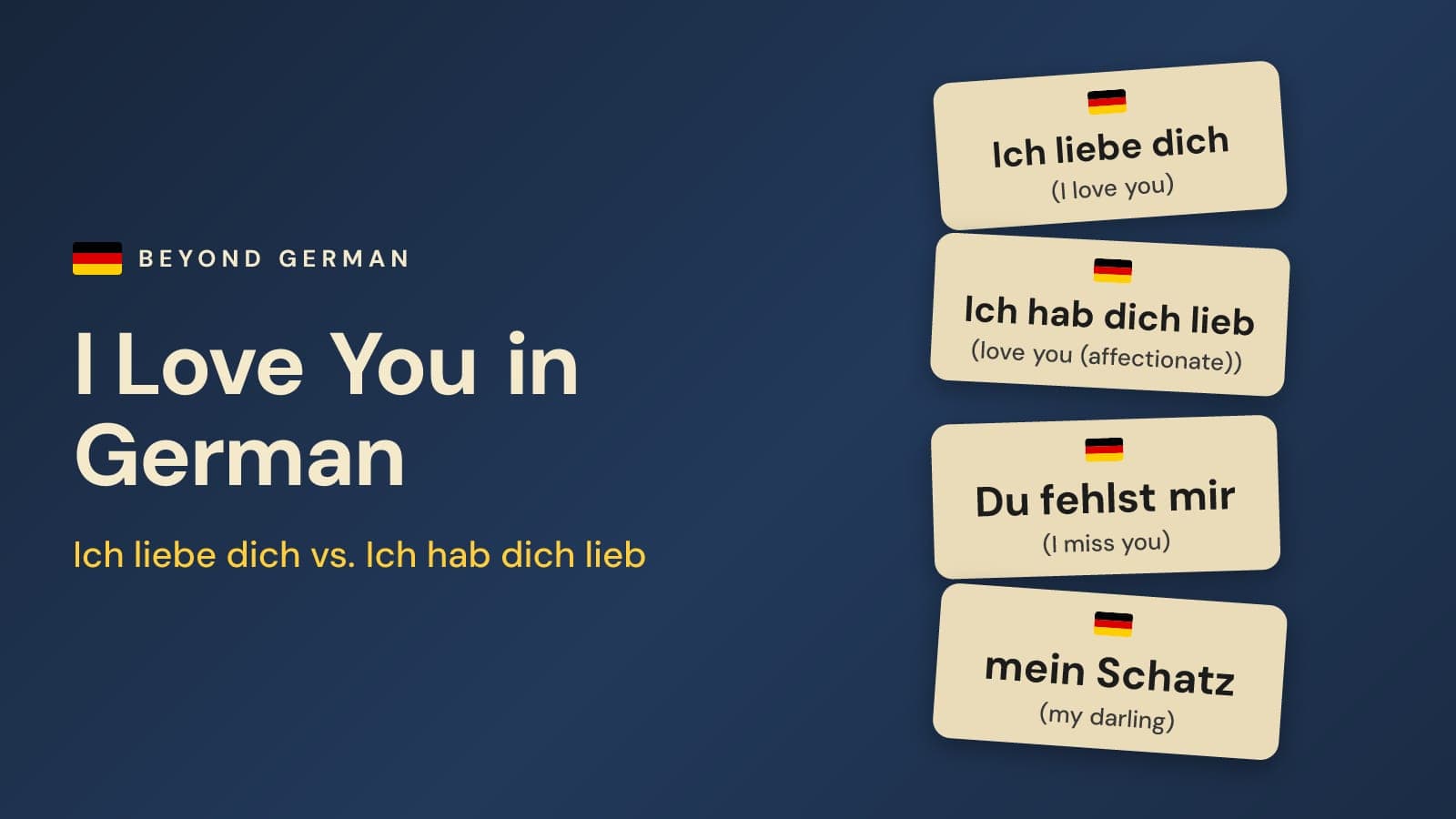
"I love you" in German is Ich liebe dich (ikh LEE-buh dikh). But Germans save it for romantic love and use it more sparingly than English speakers use "I love you". For family, friends and everyday affection, the go-to phrase is Ich hab dich lieb, which falls somewhere between "love you" and "I'm really fond of you".
Below you'll learn when to use which, how to say "I like you", pet names like Schatz, romantic phrases (including the tricky Du fehlst mir), texting codes like HDL, the boyfriend-or-friend trap and how Germans do Valentine's Day.
Ich liebe dich vs. Ich hab dich lieb
Both phrases translate as "I love you", but you use them with different people:
| German | English | Say it to | How it feels |
|---|---|---|---|
| Ich liebe dich. | I love you. | Your partner | Deep, romantic, weighty |
| Ich liebe dich über alles. | I love you more than anything. | Your partner | A big declaration |
| Ich hab dich lieb. | Love you. / I'm very fond of you. | Family, friends, your partner | Warm and affectionate |
| Ich hab dich sehr lieb. | I love you very much. | Family, friends, your partner | Extra warm |
| Ich hab dich ganz doll lieb. | I love you so, so much. | Children, family | Sweet; typical with kids |
Ich liebe dich: For Romantic Love
Ich liebe dich comes from lieben (to love), and it carries real weight. Germans tend to say it less casually than English speakers: you won't hear it between friends, and many couples wait a good while before saying it for the first time. Once it's said, it means a lot.
- Ich liebe dich. — I love you.
- Ich liebe dich auch. — I love you too.
- Ich liebe dich so sehr. — I love you so much.
Pronunciation tip: the ch in ich and dich is a soft hiss, like the h in "huge" said with more air. It's never a hard "k": dick is a different German word, meaning "fat".
Talking about people, you can say Ich liebe meine Kinder. — I love my children. And you can love things, too: Ich liebe Pizza! — I love pizza! But said directly to someone, Ich liebe dich usually means romantic love. Some parents say it to their children, but Ich hab dich lieb is the traditional family phrase.
Ich hab dich lieb: For Family, Friends and Partners
Lieb means "dear, sweet, kind", so Ich hab dich lieb is literally "I have you dear". Hab is the spoken short form of habe, and both versions are correct. It's what parents say to their kids, grandchildren to their grandparents and best friends to each other. Couples use it too, as an everyday "love you".
- Ich hab dich lieb, Mama! — Love you, Mom!
- Wir haben dich alle sehr lieb. — We all love you very much.
- Ich hab dich ganz doll lieb! — I love you so, so much! (doll is colloquial for "very")
For everyone you might say it to, from Oma to Schwiegermutter, see family members in German.
From "I Like You" to "I'm in Love With You"
German has a whole ladder of phrases between friendship and love. From mild to strong:
| German | English | Nuance |
|---|---|---|
| Ich mag dich. | I like you. | Friendly, or a careful first hint |
| Ich finde dich süß. | I think you're cute. | Flirty |
| Ich steh auf dich. | I'm into you. | Slang; you fancy someone |
| Ich bin verrückt nach dir. | I'm crazy about you. | Playful and passionate |
| Ich bin in dich verliebt. | I'm in love with you. | Romantic: the butterflies stage |
| Ich liebe dich. | I love you. | Deep, lasting love |
Ich mag dich comes from mögen (to like) and is often just friendly. Add echt gern and it starts to sound like more: Ich mag dich echt gern. — I really like you.
The difference between verliebt sein and lieben matters to Germans. Verliebt is the exciting, falling-in-love feeling; lieben is deeper and usually comes later. That's why the classic first confession is Ich habe mich in dich verliebt. — I've fallen in love with you.
Watch the prepositions: verliebt in and stehen auf take the accusative (in dich, auf dich), while verrückt nach takes the dative (nach dir). Stehen auf works for things, too: Ich steh total auf Jazz. — I'm really into jazz.
German Terms of Endearment: Schatz, Liebling, Mausi and More
Germans have plenty of pet names for their partners, and many of them are animals:
| Pet name | Literally | Good to know |
|---|---|---|
| Schatz, Schatzi | treasure | The classic, for partners and kids; Schatzi is extra cute |
| Liebling | darling, favorite | Classic, a little old-fashioned |
| Maus, Mausi | mouse, little mouse | Playful; mostly for women and children |
| Hase, Häschen, Hasi | hare, bunny | Playful; for anyone |
| Süße / Süßer | sweet one | Flirty; Süße to a woman, Süßer to a man |
| Spatz | sparrow | Sweet; very common with children |
| Bärchen | little bear | Cuddly; for anyone |
| mein Herz | my heart | Tender and romantic |
Many of these are playful, and a few are cheesy, so couples tend to keep Mausi and Häschen private. Schatz is safe anywhere, and friends use it as a warm "dear", too: Danke, Schatz! — Thanks, dear! After a favor, you'll hear Du bist ein Schatz! — You're a gem!
Mein Schatz or Meine Schatz?
A pet name keeps its own grammatical gender, whoever you say it to. Der Schatz is masculine, so it's always mein Schatz, even for a woman. Die Maus is feminine, so it's meine Maus, and words ending in -chen are neuter: mein Häschen. Only Süße and Süßer change with the person, because they're adjectives turned into nouns: meine Süße, mein Süßer.
Romantic German Phrases
- Du fehlst mir. — I miss you.
- Ich vermisse dich. — I miss you.
- Ich denke an dich. — I'm thinking of you.
- Ich freue mich auf dich. — I can't wait to see you.
- Träum was Schönes! — Sweet dreams!
- Du machst mich glücklich. — You make me happy.
- Du bist mein Ein und Alles. — You're my everything. (literally "my one and all")
- Du bist die Liebe meines Lebens. — You're the love of my life.
- Willst du mich heiraten? — Will you marry me?
Du fehlst mir vs. Ich vermisse dich
Both mean "I miss you", but they're built in opposite ways. Vermissen works like English: you're the subject, and the person you miss is the object (accusative). Fehlen flips it around: the person you miss is the subject, and you go in the dative case. Du fehlst mir literally means "You are missing to me".
| With vermissen | With fehlen | English |
|---|---|---|
| Ich vermisse dich. | Du fehlst mir. | I miss you. |
| Ich vermisse ihn. | Er fehlt mir. | I miss him. |
| Sie vermisst dich. | Du fehlst ihr. | She misses you. |
| Wir vermissen euch. | Ihr fehlt uns. | We miss you (all). |
Germans use both every day. Many feel Du fehlst mir is a touch more tender, because it says something is missing from their life without you.
Ich denke an dich and Willst du mich heiraten?
Denken an (to think of) takes the accusative: Ich denke die ganze Zeit an dich. — I think about you all the time. And for the big question, heiraten (to marry) takes a direct object, just like English "marry": Willst du mich heiraten? The happy answer: Ja, ich will! — Yes, I will!
Signing Off: Kuss, HDL and HDGDL
In texts and cards, Germans sign off with a kiss or a code:
| Sign-off | Meaning | Use it with |
|---|---|---|
| Kuss / Küsschen | kiss / little kiss | Partners, also close friends and family |
| Bussi | kiss | The same, in southern Germany and Austria |
| HDL | Hab dich lieb (love you) | Friends, family, partners |
| HDGDL | Hab dich ganz doll lieb (love you so much) | The same, extra affectionate |
| Fühl dich gedrückt! | Consider yourself hugged! | Friends and family |
| LG | Liebe Grüße (warm wishes) | People you know well; not romantic |
Don't read too much into LG: despite the Liebe, it's an ordinary friendly sign-off for friends, family and close colleagues. For the full range, see how to say goodbye in German.
Freund or Freundin? Boyfriend, Girlfriend and Dating Words
Here's a classic trap: der Freund means both "friend" and "boyfriend", and die Freundin means both "friend" and "girlfriend". With mein or meine, it often sounds like your partner, so small words make the difference:
| German | English |
|---|---|
| mein Freund / meine Freundin | my boyfriend / my girlfriend (often) |
| mein fester Freund / meine feste Freundin | my (steady) boyfriend / girlfriend |
| ein Freund von mir / eine Freundin von mir | a friend of mine |
| ein guter Freund / eine gute Freundin | a good friend |
| mein Kumpel | my buddy (never romantic) |
| mein Partner / meine Partnerin | my partner |
| mein Mann / meine Frau | my husband / my wife |
A few phrases for dating:
- Hast du einen Freund? — Do you have a boyfriend?
- Bist du vergeben? — Are you taken?
- Ich bin Single. — I'm single.
- Hast du Lust, mit mir etwas trinken zu gehen? — Would you like to go for a drink with me?
- Wir sind seit drei Jahren zusammen. — We've been together for three years.
- Wir haben uns verlobt! — We got engaged!
- Sie hat mit ihm Schluss gemacht. — She broke up with him.
Notice the present tense in Wir sind seit drei Jahren zusammen: with seit, German uses the present for something that's still going on.
Valentine's Day in Germany (Valentinstag)
Germany celebrates der Valentinstag on February 14, but it's a smaller affair than in the US or the UK. It's mainly a day for couples: men traditionally bring flowers, often red roses, and couples go out for dinner or give each other chocolates. Kids don't swap cards at school, and you wouldn't send a valentine to friends or colleagues.
The custom only caught on after World War II, when American soldiers stationed in West Germany brought it with them, and plenty of Germans still grumble that florists invented it. If you do celebrate, these lines fit a card:
- Alles Liebe zum Valentinstag! — Happy Valentine's Day! (literally "All love for Valentine's Day")
- Für dich. — For you.
- Ich bin so froh, dass es dich gibt. — I'm so glad you're in my life. (literally "...that you exist")
Romance isn't limited to February, either. At fairs like the Oktoberfest and at Christmas markets, couples buy Lebkuchenherzen: big gingerbread hearts on a ribbon, iced with messages like Ich liebe dich or Mein Schatz.
Common Mistakes
1. Saying "Ich liebe dich" to friends
Wrong: Ich liebe dich! (to your best friend)
Right: Ich hab dich lieb!
Said to a friend, Ich liebe dich sounds like a romantic confession.
2. "Verliebt mit" instead of "verliebt in"
Wrong: Ich bin verliebt mit dir.
Right: Ich bin in dich verliebt.
English says "in love with"; German says in, followed by the accusative.
3. Mixing up fehlen and vermissen
Wrong: Ich fehle dich. / Ich vermisse dir.
Right: Du fehlst mir. / Ich vermisse dich.
Careful: Ich fehle dir is correct German, but it means "You miss me".
4. Matching the pet name to the person
Wrong: Meine Schatz, ich vermisse dich.
Right: Mein Schatz, ich vermisse dich.
Der Schatz is masculine, whoever you're talking to.
5. Introducing a friend as "mein Freund"
Ambiguous: Das ist mein Freund Tom.
Clear: Das ist Tom, ein Freund von mir.
Flirting has its own traps: Ich bin heiß doesn't mean you're feeling warm. See more common German mistakes English speakers make.
Practice
Try these, then check the answers below.
- Tell your best friend you love her (as a friend).
- Say "I miss you" in two ways.
- Rewrite with fehlen: Ich vermisse meine Familie.
- Fill the gap: Ich habe mich ___ dich verliebt.
- Fix the two mistakes: Meine Schatz, ich denke an dir.
- Make it clear that Lisa is just a friend: Das ist Lisa, …
Answers: 1. Ich hab dich lieb! 2. Ich vermisse dich. / Du fehlst mir. 3. Meine Familie fehlt mir. 4. in 5. Mein Schatz, ich denke an dich. 6. Das ist Lisa, eine Freundin von mir.
Next, test yourself with the A1 German quiz, and when you want to pay someone a compliment, learn how to say great and awesome in German.
FAQ
What does "Ich hab dich lieb" mean?
It means "I love you" in a warm, everyday way; literally, "I have you dear". Germans say it to family, friends and partners. Ich liebe dich is the stronger, romantic version.
How do you reply to "Ich liebe dich"?
Say Ich liebe dich auch (I love you too) or, more casually, Ich dich auch (Me too).
How do you say "my love" in German?
The most common is mein Schatz (literally "my treasure"), followed by Liebling (darling). Meine Liebe or mein Lieber (my dear) can be warm, but also teasing or stern, depending on your tone.
How do you say "I miss you" in German?
Ich vermisse dich or Du fehlst mir. Both are common. In Du fehlst mir, the person who is missed is the subject.
Level Up Your German
Join 1,000+ learners getting weekly tips, grammar shortcuts, and cultural insights.
Share this article
Continue Reading
Colors in German: Rot, Blau, Grün and How to Use Them
All the colors in German with pronunciation, light and dark shades, when colors take endings, how to ask Welche Farbe hat…?, and the color idioms Germans really use.
Merry Christmas in German: Frohe Weihnachten & Traditions
Learn how to say Merry Christmas and Happy New Year in German, plus the traditions from Advent and Nikolaus to Heiligabend and Silvester, with food and market words.
Happy Birthday in German: Alles Gute zum Geburtstag & Wishes
Learn how to say happy birthday in German, from Alles Gute zum Geburtstag to formal card wishes, plus belated wishes, the birthday song and why Germans never congratulate early.