Good Morning in German: Guten Morgen to Gute Nacht
 Beyond German Team
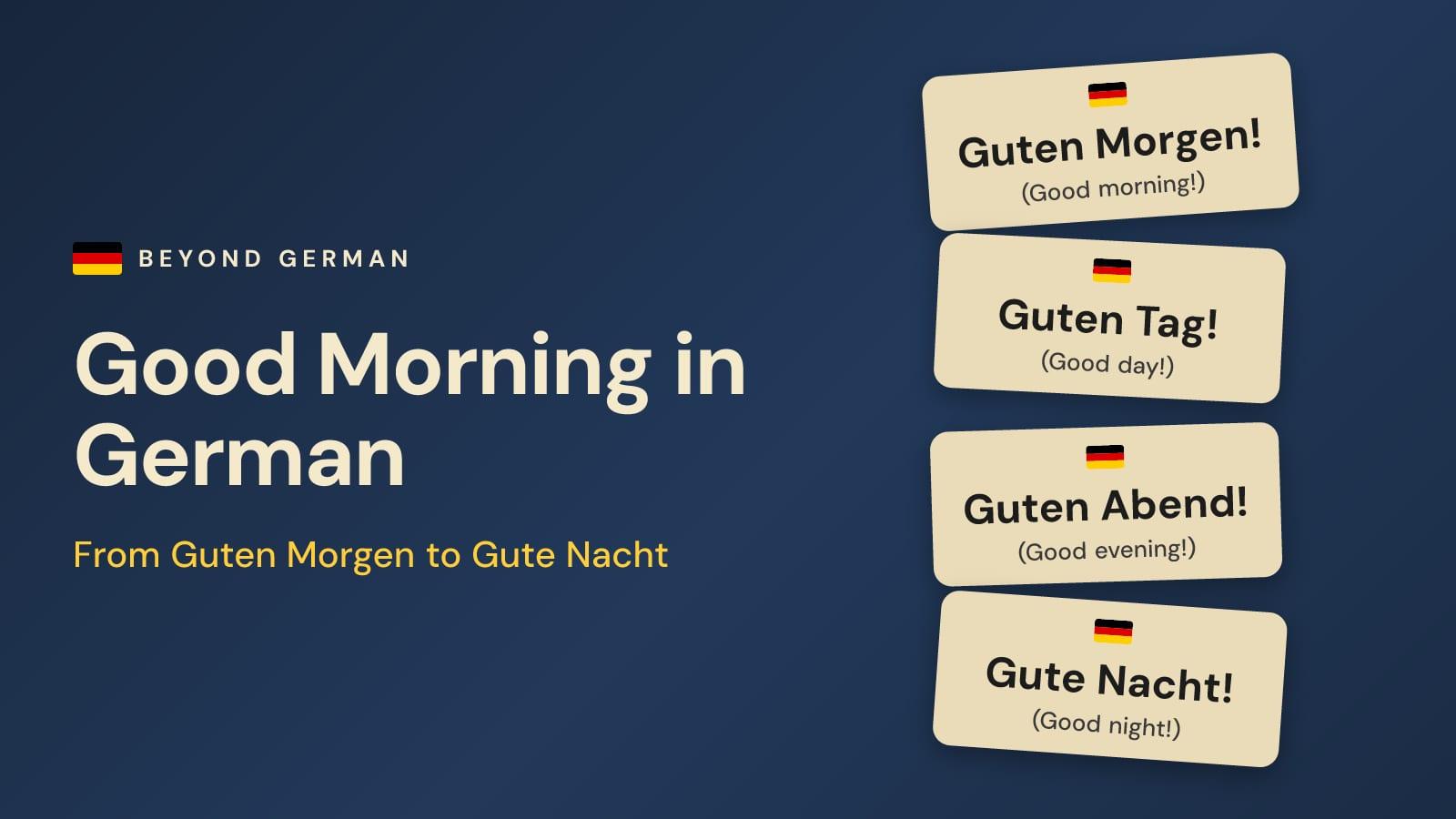
Good morning in German is Guten Morgen (GOO-ten MOR-gen). It's polite, friendly and right for almost anyone until about 10 or 11 a.m. Friends and colleagues often shorten it to Morgen!, and in northern Germany you'll hear Moin.
The words are easy; the timing is where learners slip. Below: a table for every time of day, the grammar behind Guten, warmer variations, good night wishes, replies, real situations, mistakes, practice and quick answers to common questions.
From Good Morning to Good Night: The Quick Answer
Every phrase in this table is a hello, except Gute Nacht:
| German | English | When to say it |
|---|---|---|
| Guten Morgen! | Good morning! | From waking up until about 10 or 11 a.m. |
| Morgen! | Morning! | The same time, but casual |
| Moin! | Hi! Hello! | Northern Germany, at any time of day |
| Guten Tag! | Hello! Good day! | Late morning to early evening |
| Mahlzeit! | Hi! (at lunchtime) | Around lunch, in many workplaces |
| Guten Abend! | Good evening! | From about 6 p.m. |
| Gute Nacht! | Good night! | Only when someone goes to bed or you part late at night |
The times are a guide, not a law: they shift a little with the person, the region and the workplace.
Guten Morgen: Pronunciation and Meaning
How to Pronounce Guten Morgen
Say GOO-ten MOR-gen, stressing the first syllable of each word. The u is long, like the "oo" in "food", and the endings are light, so in fast speech it sounds closer to "GOO-tn MOR-gn". The r is the soft German r from the back of the throat. Our guide to the German alphabet and pronunciation covers it in detail.
Why It's Guten, Not Gute
Word for word, Guten Morgen means "good morning": gut is good and der Morgen is the morning. The ending comes from a longer wish that Germans have shortened:
- Ich wünsche dir einen guten Morgen. (I wish you a good morning.) With Sie: Ich wünsche Ihnen einen guten Morgen.
The morning is the thing being wished, so it's in the accusative case. Morgen is masculine, and a masculine noun in the accusative gives the adjective the ending -en. The same logic explains all four time-of-day greetings:
| Greeting | Noun | Ending |
|---|---|---|
| Guten Morgen | der Morgen (masculine) | -en |
| Guten Tag | der Tag (masculine) | -en |
| Guten Abend | der Abend (masculine) | -en |
| Gute Nacht | die Nacht (feminine) | -e |
That's why Gute Nacht has no n: die Nacht is feminine. It's also why you say Schönen Tag noch! (Have a nice day!) but Schönes Wochenende! (Have a nice weekend!): das Wochenende is neuter.
Morgen! The Casual Short Form
Among colleagues, neighbors and friends, many people drop the Guten and just say Morgen! It's friendly, not rude, and a perfectly good answer to Guten Morgen. In the same way, Guten Tag often becomes Tag!
Moin: The Northern Greeting
In northern Germany, especially Hamburg, Bremen, Schleswig-Holstein and Lower Saxony, the everyday greeting is Moin (MOYN). It sounds like a short Morgen, but there it works all day: at 7 a.m., at lunch and at 8 p.m. Some people double it to Moin moin.
Moin is casual, yet in the north people use it with almost everyone, from neighbors to the person at the checkout. For a job interview, stick to Guten Morgen or Guten Tag.
Until When Do You Say Guten Morgen?
There's no official cut-off. Most people switch to Guten Tag around 10 or 11 a.m., and some keep saying Guten Morgen until noon. A handy rule of thumb: once people start thinking about lunch, the morning is over. If you're unsure, Guten Tag or Hallo always works.
One exception: if someone has only just got up, you can say it at any hour, usually with a grin. Na, auch schon wach? Guten Morgen! (Oh, finally awake? Good morning!)
Guten Tag: Late Morning to Early Evening
Guten Tag (GOO-ten TAHK) is the polite all-purpose hello for the middle of the day: in shops, in offices and with anyone you call Sie. With friends, Hallo sounds more natural. When you leave, switch to Schönen Tag noch! (Have a nice day!) or Auf Wiedersehen! (Goodbye!)
Mahlzeit: The Lunchtime Greeting at Work
Around lunchtime, in many offices, canteens and factories, colleagues greet each other with Mahlzeit! (MAHL-tsite), literally "mealtime". The answer is simply Mahlzeit! It belongs to the workplace, so you'll rarely hear it in a shop. Some find it old-fashioned, but it's very much alive.
What About Good Afternoon?
Guten Nachmittag (good afternoon) is correct German, but it's uncommon as a greeting. In the afternoon, Germans say Guten Tag or Hallo. You'll hear the word in goodbyes instead: Schönen Nachmittag noch! (Have a nice afternoon!)
Guten Abend: From About 6 p.m.
Guten Abend (GOO-ten AH-bent) takes over from about 6 p.m., or 18 Uhr, since Germans often use the 24-hour clock (see telling time in German). Use it when you arrive at a restaurant or a party:
- Guten Abend! Haben Sie einen Tisch für zwei? (Good evening! Do you have a table for two?)
When you leave, it turns into a wish: Schönen Abend noch! (Have a nice evening!) Our guide on how to say goodbye in German has many more ways to wrap up.
Gute Nacht: Only at the End of the Night
Gute Nacht (GOO-tuh NAKHT, with the ch of Scottish "loch") is a goodbye, not a hello. Say it when someone goes to bed, or when you part late at night: leaving a party after midnight, ending a late phone call. Early in the evening, Schönen Abend noch! or Tschüss! fits better.
A colloquial bonus: Na dann, gute Nacht! said with a sigh means "Well, that's hopeless."
Warmer Ways to Say Good Morning
Guten Morgen is always right. These versions add warmth or fit a group:
- Schönen guten Morgen! (A very good morning!) Cheerful and polite, common in shops and on the phone.
- Einen wunderschönen guten Morgen! (A wonderful good morning!) Big and bright, typical of radio hosts, and often a little playful.
- Guten Morgen, mein Schatz! (Good morning, darling!) For a partner or a child. Schatz literally means "treasure".
- Gut geschlafen? or Hast du gut geschlafen? (Did you sleep well?) For family, friends and guests. With Sie: Haben Sie gut geschlafen?
- Ausgeschlafen? (Well rested?) From ausschlafen, to sleep until you've had enough. Friendly, sometimes teasing.
- Guten Morgen zusammen! or Morgen allerseits! (Good morning, everyone!) To a group.
Regional Morning Greetings
In Bavaria and Austria, Grüß Gott is the polite hello at any time of day, morning included, and friends say Servus. In the north, it's Moin. Guten Morgen is still understood and used everywhere. Our guide to German greetings covers all the regional ones.
How to Say Good Night in German
Gute Nacht is the core, and Germans like to add a sleep wish:
| German | English | Use it with |
|---|---|---|
| Gute Nacht! | Good night! | Anyone |
| Schlaf gut! | Sleep well! | One person you call du |
| Schlaft gut! | Sleep well! | Several people you call du |
| Schlafen Sie gut! | Sleep well! | Anyone you call Sie |
| Schlaf schön! | Sleep tight! | Family and friends |
| Träum was Schönes! | Sweet dreams! | Partners, children, close friends |
| Süße Träume! | Sweet dreams! | Partners and children |
| Gute Nacht und schlaf gut! | Good night and sleep well! | The classic bedtime pair |
A few details make these sound right:
- Schlaf is the du command of schlafen (to sleep). Even though you say du schläfst, the command has no umlaut: Schlaf gut!, not Schläf gut!
- Träum was Schönes! literally means "Dream something nice!" Was is short for etwas, and Schönes is capitalized because it's an adjective used as a noun.
- Dream wishes are for people you're close to. With Sie, keep it simple: Gute Nacht, schlafen Sie gut! (Good night, sleep well!)
A typical bedtime exchange between roommates:
Lena: Ich gehe ins Bett. Gute Nacht! (I'm going to bed. Good night!)
Max: Gute Nacht! Schlaf gut und träum was Schönes! (Good night! Sleep well and sweet dreams!)
Lena: Danke, du auch! (Thanks, you too!)
How to Reply to Guten Morgen and Gute Nacht
Greetings go back the same way they came. Wishes get a thank-you and a "you too":
| They say | You reply |
|---|---|
| Guten Morgen! | Guten Morgen! or Morgen! |
| Hast du gut geschlafen? | Ja, danke. Und du? |
| Gute Nacht! | Gute Nacht! or Danke, dir auch! |
| Schlaf gut! | Danke, du auch! |
| Schlafen Sie gut! | Danke, Sie auch! or Danke, gleichfalls! |
| Schönen Tag noch! | Danke, gleichfalls! or Danke, Ihnen auch! |
Why dir auch in one row and du auch in the next? Gute Nacht is a wish (Ich wünsche dir eine gute Nacht), so you answer Dir auch! (I wish you one too). Schlaf gut! is a command, so you answer Du auch! (you sleep well too). In everyday speech people mix them up, and nobody minds. Danke, gleichfalls! (Thanks, likewise!) works for all of these wishes, with du and Sie. Our guide to likewise and you too in German has the full set.
And if someone asks how you slept:
- Ja, danke, super! (Yes, thanks, great!)
- Wie ein Stein. (Like a log. Literally "like a stone".)
- Geht so. Ich bin noch müde. (So-so. I'm still tired.)
For more answers like these, see how are you in German.
Guten Morgen in Real Life
At Work
Greeting colleagues when you arrive is normal in German workplaces. Say Guten Morgen! or Morgen! to the people you pass, and Morgen zusammen! (Morning, everyone!) in a shared office or the team chat. With a manager or a client, add the name: Guten Morgen, Frau Weber! Once a day is enough; after that, a smile or a nod will do.
With Neighbors
In German apartment buildings, people usually greet neighbors in the stairwell, even ones they barely know. A friendly Guten Morgen! or Morgen! is all it takes. Walking past in silence can come across as unfriendly.
At the Bakery and in Small Shops
In bakeries, small shops, pharmacies and even a doctor's waiting room, people greet when they come in and say goodbye when they leave. A typical morning at the bakery:
Assistant: Guten Morgen! Was darf's sein? (Good morning! What can I get you?)
You: Morgen! Zwei Brötchen und eine Brezel, bitte. (Morning! Two rolls and a pretzel, please.)
You, after paying: Danke! Schönen Tag noch! (Thanks! Have a nice day!)
Assistant: Danke, gleichfalls! (Thanks, you too!)
In Messages
Good-morning messages are common among family, partners and friends, often with a little sun or coffee emoji:
- Guten Morgen! Gut geschlafen? (Good morning! Did you sleep well?)
- Morgen, Schatz! Ich wünsche dir einen schönen Tag. (Morning, darling! Have a lovely day.)
In work emails, Guten Tag or Hallo is safer: the reader may open your message after lunch.
On the Phone
Many Germans answer the phone with just their surname, so open with a greeting and your name: Guten Morgen, hier ist Sam Taylor. (Good morning, this is Sam Taylor.) Businesses often answer with their name and a greeting: Hotel Lindenhof, guten Morgen!
Common Mistakes
Getting the Ending Wrong
Wrong: Gute Morgen! Right: Guten Morgen!
Wrong: Guten Nacht! Right: Gute Nacht!
Morgen, Tag and Abend are masculine, so they take -en. Nacht is feminine, so it takes -e.
Saying Gute Nacht as a Hello
Wrong: Gute Nacht! (as you arrive at a party at 9 p.m.) Right: Guten Abend!
In the evening, a hello is Guten Abend or Hallo. Gute Nacht only closes a conversation.
Saying Guten Morgen in the Afternoon
Wrong: Guten Morgen! (at 3 p.m.) Right: Guten Tag! or Hallo!
The only exception is the friendly joke for someone who has just rolled out of bed.
Mixing Up Morgen, morgen and morgens
Wrong: Bis Morgen! Right: Bis morgen! (See you tomorrow!)
Capital letters matter here:
- der Morgen (the morning) is a noun, so it's capitalized: Guten Morgen!, heute Morgen (this morning).
- morgen (tomorrow) is an adverb, so it's lowercase: Bis morgen!
- morgens (in the mornings) describes a habit: Ich trinke morgens Kaffee. (I drink coffee in the mornings.)
And the classic trap: "tomorrow morning" is morgen früh, literally "tomorrow early", not the clumsy morgen Morgen. Ich rufe dich morgen früh an. (I'll call you tomorrow morning.)
Practice
Try these, then check the answers below:
- It's 8 a.m. and you walk into a bakery. What do you say?
- Fill the gaps: Gut___ Abend! and Gut___ Nacht!
- It's 7:30 p.m. and you arrive at a friend's dinner. Do you say Gute Nacht or Guten Abend?
- Your roommate says Schlaf gut! How do you answer?
- Ask a hotel guest (Sie) if they slept well.
- Say in German: "See you tomorrow morning!"
Answers: 1. Guten Morgen! (or Morgen!) 2. Guten Abend, Gute Nacht 3. Guten Abend! 4. Danke, du auch! (or Gleichfalls!) 5. Haben Sie gut geschlafen? 6. Bis morgen früh!
Keep going: see more examples on the phrase pages for Guten Morgen and Gute Nacht, then test yourself with the A1 German quiz.
FAQ
How do you say good morning in German?
Say Guten Morgen (GOO-ten MOR-gen). It's polite and works with anyone. Friends often shorten it to Morgen!, and in northern Germany people say Moin.
What does Guten Morgen mean?
It means "good morning", word for word. It's short for Ich wünsche dir einen guten Morgen (I wish you a good morning), which is why guten ends in -en.
Until what time do you say Guten Morgen?
There's no fixed rule. Most people say it until about 10 or 11 a.m., some until noon. After that, say Guten Tag or Hallo, which is also how Germans say good afternoon.
How do you say good night in German?
Gute Nacht (GOO-tuh NAKHT), often with Schlaf gut! (Sleep well!) or, formally, Schlafen Sie gut! Use it only when someone goes to bed or you part late at night. As an evening hello, say Guten Abend.
How do you reply to Guten Morgen?
Say it back: Guten Morgen! or simply Morgen! No thank-you is needed.
Is "Moin" good morning?
Not quite. It sounds like Morgen, but in northern Germany Moin is a hello for any time of day, even in the evening. Answer it with Moin!
New from Beyond German
Learn every A1 word, with audio
The A1 Word Kit: 787 words sorted by real life in Germany, two example sentences each, and flashcards that remember for you.
See the kit · launch price €29Level Up Your German
Join 1,000+ learners getting weekly tips, grammar shortcuts, and cultural insights.
Share this article
Continue Reading
Goethe B1 Word List (Wortliste): What's on It and How to Learn It
The official Goethe B1 Wortliste explained in English: what's on it, how to read the entries, how big it really is, and a free extract of 39 B1 words by situation.
German for Nurses: Which Level You Need and How to Get There
Which German level nurses need for Germany: A2 for a recognition visa, B1 for Triple Win, B2 for the licence. Plus a study plan and 35 hospital words and phrases.
Goethe A1 Exam: Start Deutsch 1 Format, Syllabus and Tips
Everything about the Goethe A1 exam (Start Deutsch 1): the four parts with examples, scoring, the A1 syllabus, fees and a realistic plan to prepare.