
Telling Time in German: What Time Is It? (Halb Acht Explained)
 Beyond German Team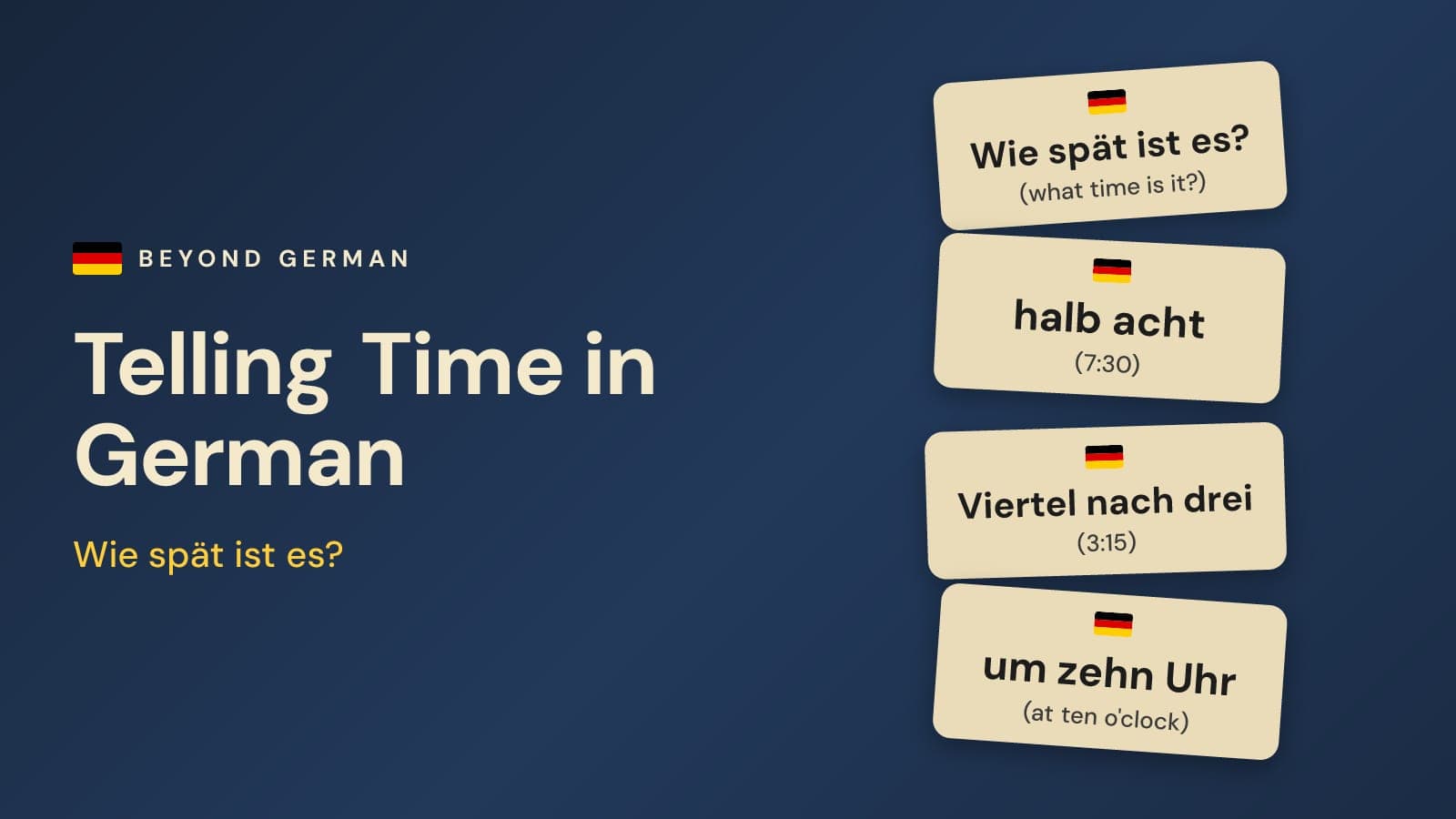
To ask the time in German, say Wie spät ist es? or Wie viel Uhr ist es? Both mean "What time is it?", and you answer with Es ist + the time: Es ist drei Uhr. (It's three o'clock.) The rule that trips up every learner: halb acht means 7:30, not 8:30, because German counts the half hour toward the next hour.
This guide covers both clocks Germans use, quarter hours, tricky times like fünf vor halb acht, regional variants and parts of the day. To use times in real sentences, pair it with our complete guide to German time prepositions (am, um, im, in, vor, nach).
How to Ask "What Time Is It?" in German
The two standard questions are completely interchangeable:
- Wie spät ist es? — What time is it? (literally "How late is it?")
- Wie viel Uhr ist es? — What time is it? (literally "How much o'clock is it?")
With a stranger, add a polite opener (note how the verb moves to the end):
- Entschuldigung, wissen Sie, wie spät es ist? — Excuse me, do you know what time it is?
- Weißt du, wie spät es ist? — Do you know what time it is? (informal)
To ask at what time something happens, use Um wie viel Uhr …? or simply Wann …? (when): Um wie viel Uhr beginnt der Film? — What time does the movie start?
Full Hours: Es ist drei Uhr
For full hours, say Es ist + number + Uhr. You'll need the numbers up to 59, so if they're shaky, review German numbers 1–100 first.
- Es ist drei Uhr. — It's three o'clock.
- Es ist ein Uhr. — It's one o'clock. (Or simply: Es ist eins.)
- Es ist zwölf Uhr mittags. — It's noon.
- Es ist Mitternacht. — It's midnight.
Three details to get right:
- It's ein Uhr, not "eins Uhr". Without Uhr, it's eins.
- Uhr has no plural in times: drei Uhr, never "drei Uhren" (Uhren are clocks or watches).
- Uhr is not Stunde. Uhr is a point on the clock; Stunde is an hour that passes. Der Film beginnt um zwei Uhr und dauert zwei Stunden. — The movie starts at two o'clock and lasts two hours.
The 24-Hour Clock (Official Time)
Timetables, opening hours, TV listings, appointments and invitations all use the 24-hour clock. The pattern is hour + Uhr + minutes:
- 14:30 — vierzehn Uhr dreißig
- 9:05 — neun Uhr fünf
- 18:45 — achtzehn Uhr fünfundvierzig
- 0:20 — null Uhr zwanzig
It's written 14:30 Uhr or 14.30 Uhr, but when spoken, the minutes always come after the word Uhr. Many Germans use this format when making plans, too, because it can't be misunderstood: Wir treffen uns um achtzehn Uhr. — We're meeting at 6 p.m.
When you ask Wann fährt der Zug? (When does the train leave?), the answer will sound like this: Um sechzehn Uhr zweiundvierzig. — At 4:42 p.m.
The 12-Hour Clock (Everyday Time)
In conversation, most Germans use the 12-hour clock. There's no a.m. or p.m.: context, or a word like morgens or abends, makes it clear. Minutes are counted nach (after) the hour or vor (before) the next one:
- Es ist fünf nach drei. — It's five past three. (3:05)
- Es ist zwanzig nach drei. — It's twenty past three. (3:20)
- Es ist zehn vor vier. — It's ten to four. (3:50)
Quarter Hours: Viertel nach, Viertel vor
A Viertel is a quarter, and it works just like English "quarter past" and "quarter to":
- Es ist Viertel nach drei. — It's quarter past three. (3:15)
- Es ist Viertel vor vier. — It's quarter to four. (3:45)
Why halb acht Means 7:30 (Not 8:30)
Halb means "half", but German looks forward to the next hour. Halb acht means "halfway to eight", so it's 7:30.
- Es ist halb acht. — It's 7:30.
- Wir essen um halb eins. — We eat at 12:30.
The logic: think of the time between seven and eight as "the eighth hour". At 7:30, the eighth hour is half over, so it's halb acht. A quick decoding trick: when you hear halb, take the hour you hear and go back 30 minutes.
UK readers, take extra care: British "half eight" means 8:30, the exact opposite of German halb acht.
Fünf vor halb and fünf nach halb
Around the half hour, Germans use halb as a landmark and count from it:
- Es ist fünf vor halb acht. — It's 7:25. (five minutes before half to eight)
- Es ist fünf nach halb acht. — It's 7:35. (five minutes after half to eight)
For 7:20 and 7:40, it depends on the region: you'll hear zwanzig nach sieben or zehn vor halb acht, and zwanzig vor acht or zehn nach halb acht. Both are correct. Still confused by 7:25? Our short video Why German Time Makes No Sense (7:25 Explained) breaks it down step by step.
Regional: viertel acht and drei viertel acht
In eastern Germany, parts of the south (such as Franconia and Swabia) and eastern Austria, many people apply the halb logic to quarter hours too:
- viertel acht = 7:15 (a quarter of the way to eight)
- halb acht = 7:30 (halfway to eight)
- drei viertel acht = 7:45 (three quarters of the way to eight)
The official spelling is two words, though you'll often see dreiviertel acht. In other regions, including northwestern Germany and Switzerland, people say Viertel nach sieben and Viertel vor acht instead, and viertel acht can cause confusion. Learn to recognize both systems, but use Viertel nach and Viertel vor yourself: they're understood everywhere.
German Time Chart: 7:00 to 8:00
Here's the whole system in one table, with the evening version in the official column.
| Time | Everyday (12-hour) | Official (24-hour) |
|---|---|---|
| 7:00 | sieben (Uhr) | 19:00 — neunzehn Uhr |
| 7:05 | fünf nach sieben | 19:05 — neunzehn Uhr fünf |
| 7:10 | zehn nach sieben | 19:10 — neunzehn Uhr zehn |
| 7:15 | Viertel nach sieben (regional: viertel acht) | 19:15 — neunzehn Uhr fünfzehn |
| 7:20 | zwanzig nach sieben or zehn vor halb acht | 19:20 — neunzehn Uhr zwanzig |
| 7:25 | fünf vor halb acht | 19:25 — neunzehn Uhr fünfundzwanzig |
| 7:30 | halb acht | 19:30 — neunzehn Uhr dreißig |
| 7:35 | fünf nach halb acht | 19:35 — neunzehn Uhr fünfunddreißig |
| 7:40 | zwanzig vor acht or zehn nach halb acht | 19:40 — neunzehn Uhr vierzig |
| 7:45 | Viertel vor acht (regional: drei viertel acht) | 19:45 — neunzehn Uhr fünfundvierzig |
| 7:50 | zehn vor acht | 19:50 — neunzehn Uhr fünfzig |
| 7:55 | fünf vor acht | 19:55 — neunzehn Uhr fünfundfünfzig |
| 8:00 | acht (Uhr) | 20:00 — zwanzig Uhr |
The morning versions work the same way: 7:05 a.m. is officially sieben Uhr fünf.
Prepositions for Time: um, gegen, ab, von … bis
To say when something happens, you need a preposition. These are the ones that go with clock times:
| Preposition | Meaning | Example |
|---|---|---|
| um | at (exact time) | Der Kurs beginnt um neun Uhr. — The class starts at nine. |
| gegen | around, about | Ich komme gegen acht. — I'll come around eight. |
| ab | from … on | Frühstück gibt es ab sieben Uhr. — Breakfast is served from seven. |
| von … bis | from … to | Ich arbeite von neun bis fünf. — I work from nine to five. |
| bis | until | Die Bäckerei hat bis 18 Uhr geöffnet. — The bakery is open until 6 p.m. |
| vor / nach | before / after | Ruf mich nach 20 Uhr an. — Call me after 8 p.m. |
Three handy extras: kurz nach acht (just after eight), gleich acht (almost eight) and Punkt acht (eight sharp).
Remember that um is only for clock times. Days take am, months take im, and "two hours ago" is vor zwei Stunden. Our complete guide to German time prepositions explains each one with examples.
Parts of the Day: morgens, mittags, abends
German divides the day more finely than English. Each part has a noun for one specific day (am Abend) and an adverb ending in -s for habits (abends).
| Part of the day | Roughly | On one day | Regularly |
|---|---|---|---|
| der Morgen (morning) | until about 10 a.m. | am Morgen | morgens |
| der Vormittag (late morning) | about 9 a.m. to noon | am Vormittag | vormittags |
| der Mittag (midday) | about noon to 2 p.m. | am Mittag | mittags |
| der Nachmittag (afternoon) | about 2 to 6 p.m. | am Nachmittag | nachmittags |
| der Abend (evening) | about 6 to 10 p.m. | am Abend | abends |
| die Nacht (night) | about 10 p.m. to 5 a.m. | in der Nacht | nachts |
Notice that Nacht is the odd one out: it's in der Nacht, never "am Nacht". These words also make the 12-hour clock clear: um acht Uhr morgens (8 a.m.), um drei Uhr nachmittags (3 p.m.), um acht Uhr abends (8 p.m.), um zwei Uhr nachts (2 a.m.).
Heute Abend vs. abends
Heute Abend means "this evening" or "tonight": one specific evening. Abends means "in the evening" as a habit.
- Heute Abend gehe ich ins Kino. — I'm going to the movies tonight.
- Abends gehe ich oft ins Kino. — I often go to the movies in the evening.
The same pattern works with gestern (yesterday) and morgen (tomorrow): heute Morgen (this morning), gestern Abend (last night), morgen Nachmittag (tomorrow afternoon). The part of the day is capitalized because it's a noun. For "tomorrow morning", Germans say morgen früh, which avoids the clumsy morgen Morgen.
Days follow the same logic: am Montag (on Monday) vs. montags (on Mondays). Our guide to days of the week and months in German covers it in detail.
Useful Sentences About Time
- Wie spät ist es? – Kurz nach drei. — What time is it? – Just after three.
- Ich stehe jeden Tag um halb sieben auf. — I get up at 6:30 every day.
- Ich habe um Viertel nach zehn einen Termin. — I have an appointment at quarter past ten.
- Der Zug fährt um 16:42 Uhr ab. — The train leaves at 4:42 p.m.
- Die Apotheke hat samstags bis 13 Uhr geöffnet. — The pharmacy is open until 1 p.m. on Saturdays.
- Wie lange dauert das? – Ungefähr eine Stunde. — How long does it take? – About an hour.
- Meine Uhr geht fünf Minuten vor. — My watch is five minutes fast.
Germans take being pünktlich (on time) seriously, and showing up late without a message comes across as rude. It's one of the key cultural habits in Germany. If it happens anyway, apologize with Tut mir leid, dass ich zu spät bin (Sorry I'm late).
Common Mistakes When Telling Time in German
1. Reading halb acht as 8:30
Wrong: halb acht = 8:30. Right: halb acht = 7:30.
Halb always points to the next hour. Get it wrong and you'll arrive an hour late.
2. Using an or bei for "at"
Wrong: Der Kurs beginnt an neun Uhr. Right: Der Kurs beginnt um neun Uhr.
Clock times always take um.
3. Adding um after es ist
Wrong: Es ist um drei Uhr. Right: Es ist drei Uhr.
To say what time it is, you don't need a preposition. Um is for when something happens.
4. Using Uhr for a length of time
Wrong: Ich habe zwei Uhr gewartet. Right: Ich habe zwei Stunden gewartet.
Uhr is a time on the clock; Stunde is an hour that passes.
5. Mixing the two clocks
Wrong: halb fünfzehn. Right: vierzehn Uhr dreißig, or halb drei.
Halb, Viertel, nach and vor belong to the 12-hour clock only.
Practice
Say these times the way you would in conversation, then check the answers.
- 6:15
- 9:30
- 11:45
- 4:25
- 12:30
- 18:40 (as on a timetable)
Answers:
- Viertel nach sechs
- halb zehn
- Viertel vor zwölf
- fünf vor halb fünf
- halb eins
- achtzehn Uhr vierzig
Then keep going: test yourself with the A1 German quizzes, and review separable verbs, because aufstehen, abfahren and anrufen turn up in almost every sentence about schedules.
FAQ
What does "halb acht" mean?
It means 7:30. German halb counts toward the next hour, so halb acht is half an hour before eight. Likewise, halb zehn is 9:30 and halb eins is 12:30.
How do you say "What time is it?" in German?
Say Wie spät ist es? or Wie viel Uhr ist es? The answer starts with Es ist …, for example Es ist Viertel nach zwei. (It's quarter past two.)
Do Germans use the 24-hour clock?
Yes, for anything written or official: timetables, opening hours, appointments and invitations. In conversation, most people use the 12-hour clock with Viertel, halb and words like abends.
How do you say a.m. and p.m. in German?
German has no a.m. or p.m. Add a part of the day instead (um sieben Uhr morgens, um sieben Uhr abends) or use the 24-hour clock: um 19 Uhr.
What does "viertel acht" mean?
It's a regional way of saying 7:15, used mainly in eastern Germany, parts of southern Germany and eastern Austria. Drei viertel acht is 7:45. If you're not sure, say Viertel nach sieben and Viertel vor acht: they're understood everywhere.
Level Up Your German
Join 1,000+ learners getting weekly tips, grammar shortcuts, and cultural insights.
Share this article
Continue Reading
Common German Mistakes English Speakers Make (+ False Friends)
Why 'Ich bin heiß' gets laughs and 'Ich will' doesn't mean 'I will': 15 common German mistakes English speakers make, plus the false friends to watch out for.
Days of the Week in German, Months and How to Say the Date
Learn the days of the week and months in German with articles, abbreviations and pronunciation, plus seasons, dates like am 3. Oktober, years and holidays.
German Two-Way Prepositions (Wechselpräpositionen) Explained
The nine German two-way prepositions (an, auf, hinter, in, neben, über, unter, vor, zwischen): when they take the accusative or dative, with verb pairs and examples.