
German Public Transport Vocabulary: Trains, Tickets & Phrases
 Beyond German Team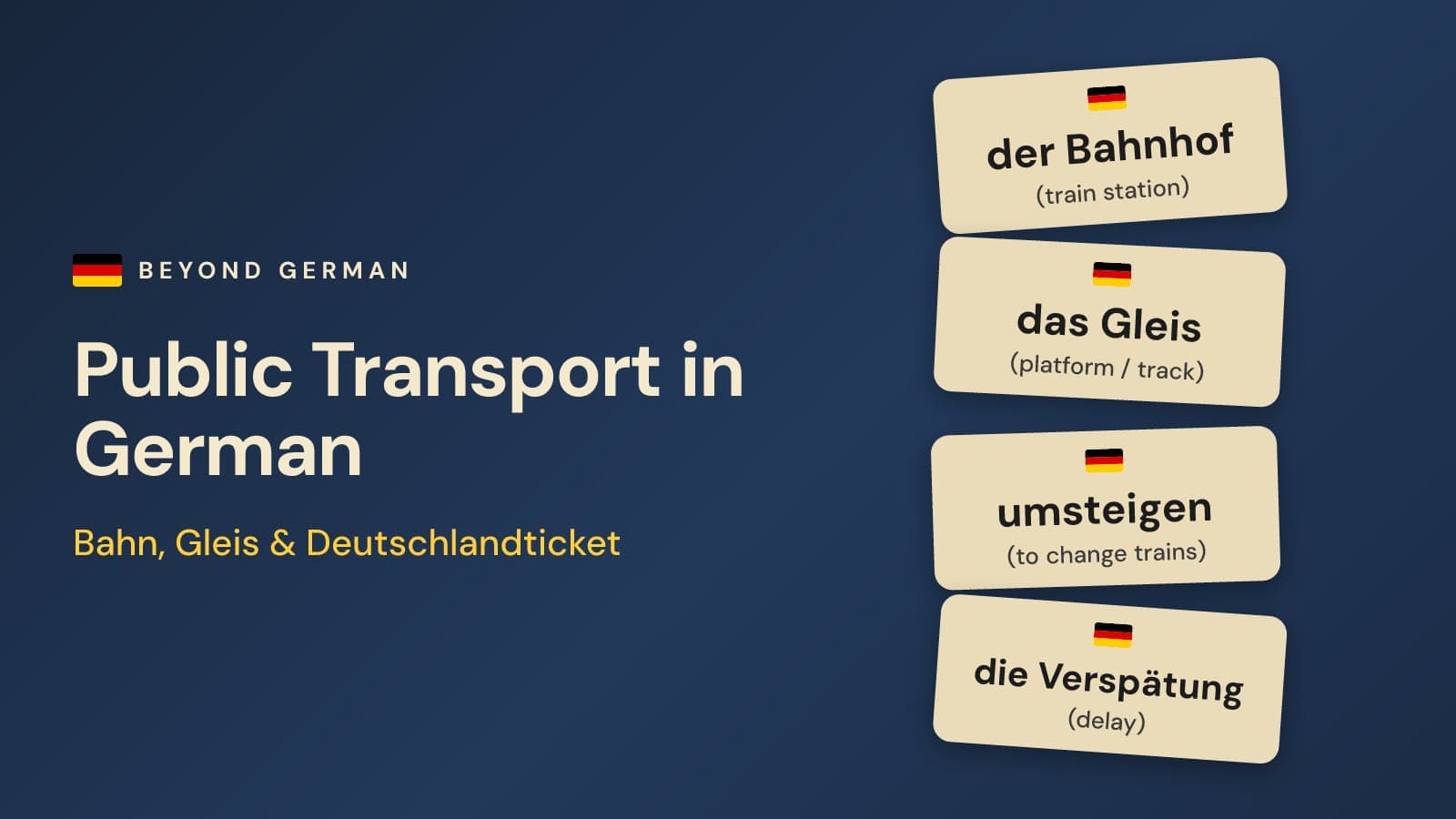
The German words you'll use most on buses and trains are der Bahnhof (station), das Gleis (track, as in Gleis 7), die Fahrkarte (ticket), umsteigen (to change trains) and die Verspätung (delay). If you ride often, look at the Deutschlandticket: a monthly subscription for local and regional buses and trains nationwide, but not for ICE, IC or EC long-distance trains.
Below: vocabulary with articles, how the Deutschlandticket works, phrases for buying tickets and asking your way, the announcements you'll hear, and etiquette.
At the Station: Bahnhof, Gleis, Bahnsteig
| German | English |
|---|---|
| der Bahnhof (pl. die Bahnhöfe) | (train) station |
| der Hauptbahnhof (Hbf) | main station, as in Köln Hbf |
| das Gleis (pl. die Gleise) | track: the number on departure boards |
| der Bahnsteig (pl. die Bahnsteige) | platform, where you wait |
| die Abfahrt / die Ankunft | departure / arrival |
| der Fahrplan | timetable |
| die Haltestelle (pl. die Haltestellen) | stop (bus, tram): look for the green H on a yellow sign |
Why ask for the Gleis, not the Bahnsteig? A platform often has a track on each side, so the track number tells you exactly where your train leaves: Von welchem Gleis fährt der Zug? — Which platform does the train leave from?
Departure boards use the 24-hour clock: Abfahrt 17:42 is siebzehn Uhr zweiundvierzig. Our guide to telling time in German covers official and everyday time.
Types of Public Transport in German
| German | What it is |
|---|---|
| die S-Bahn | commuter rail between a city and its suburbs (green S sign) |
| die U-Bahn | subway, underground, in larger cities (blue U sign) |
| die Straßenbahn (or die Tram) | tram, streetcar |
| der Bus (pl. die Busse) | bus |
| der Regionalzug: RE / RB | regional train: the Regional-Express (RE) skips small stations; the Regionalbahn (RB) stops at all of them |
| der ICE / der IC / der EC | long-distance trains: Intercity-Express (high-speed), Intercity, Eurocity |
Buses, trams, U-Bahn, S-Bahn and regional trains make up der Nahverkehr (local and regional transport); ICE, IC and EC are der Fernverkehr (long-distance). That split decides where the Deutschlandticket is valid. Public transport as a whole is die öffentlichen Verkehrsmittel, casually die Öffis. And die Bahn can mean any train, but it's also the everyday name for Deutsche Bahn (DB), the national rail company.
To say how you travel, use mit + dative: Ich fahre mit dem Bus. — I'm going by bus. Wir fahren mit der S-Bahn. — We're taking the S-Bahn. Our guide to German dative prepositions explains why.
Tickets, Connections and Delays
| German | English | Example |
|---|---|---|
| die Fahrkarte / das Ticket | ticket | Ich brauche eine Fahrkarte. — I need a ticket. |
| umsteigen | to change (trains, buses) | Wir steigen in Köln um. — We change in Cologne. |
| einsteigen / aussteigen | to get on / to get off | Wo muss ich aussteigen? — Where do I get off? |
| die Verspätung | delay | Der Zug hat Verspätung. — The train is late. |
| der Zugausfall | cancellation | Der Zug fällt aus. — The train is cancelled. |
| der Anschluss | connection | Ich habe meinen Anschluss verpasst. — I missed my connection. |
| entwerten | to validate (a ticket) | Du musst die Fahrkarte noch entwerten. — You still need to validate the ticket. |
| die Kontrolle | ticket inspection | Die Fahrkarten, bitte! — Tickets, please! |
| schwarzfahren | to ride without a ticket | Er ist schwarzgefahren. — He rode without a ticket. |
On local transport, a ticket is officially der Fahrschein. You'll also see die Einzelfahrt (single trip), die Tageskarte (day ticket) and ermäßigt (reduced fare).
Verspätung: on Deutsche Bahn, if you reach your destination 60 minutes late or more, you can usually claim part of your fare back. Look for Fahrgastrechte (passenger rights) in the app.
Entwerten: some paper tickets, especially ones bought in advance, must be stamped in a small machine (der Entwerter) before you ride, or they aren't valid. App tickets and the Deutschlandticket don't need this.
Kontrolle: most German stations have no ticket barriers. You just get on, and inspectors check at random, often in plain clothes. Riding without a valid ticket, schwarzfahren, means a fine. Schwarz means "illegal" here, one of the idioms in our guide to colors in German.
The Deutschlandticket Explained
The Deutschlandticket (often D-Ticket) is a monthly subscription (das Abo) for public transport across Germany:
- Valid on local and regional transport nationwide: buses, trams, U-Bahn, S-Bahn and regional trains (RE, RB), in second class.
- Not valid on long-distance trains: ICE, IC and EC.
- Personal: only you can use it.
- Digital: it lives in an app or on a chip card.
- Monthly: it renews automatically, and you can cancel (kündigen) month by month.
- Often discounted: many employers offer it as a Jobticket, and many universities include it in the semester ticket.
You can buy it from Deutsche Bahn or a local transport company, usually in their app.
Phrases you'll need:
- Gilt das Deutschlandticket im ICE? — Is the Deutschlandticket valid on the ICE?
- Nein, nur im Nahverkehr. — No, only on local and regional transport.
- Ich habe ein Deutschlandticket. — I have a Deutschlandticket.
- Ich möchte mein Abo kündigen. — I'd like to cancel my subscription.
Planning a longer trip? Journey planners usually let you search for local and regional trains only. It takes longer, but your ticket covers the whole route.
How to Buy a Train Ticket in Germany
You can buy tickets in an app, at a machine or at a counter. For long-distance trains, booking early online is usually cheapest.
In the App
Deutsche Bahn's DB Navigator app sells train tickets for all of Germany, and most cities also have their own transport app. Key words:
- die Verbindung — connection, route
- die Umstiege — changes
- der Sparpreis — saver fare, valid only on the trains you booked (die Zugbindung)
- der Flexpreis — flexible fare, not tied to one train
- die Sitzplatzreservierung — seat reservation, optional and extra
At the Ticket Machine
The Fahrkartenautomat usually has an English option, but the German screens are good practice: das Ziel (destination), Erwachsene / Kinder (adults / children), bestätigen (confirm), abbrechen (cancel) and bar oder mit Karte (cash or card).
At the Counter
At big stations, look for Deutsche Bahn's Reisezentrum (travel center). A typical exchange:
| German | English |
|---|---|
| Sie: Guten Tag. Eine Fahrkarte nach Hamburg, bitte. | Hello. A ticket to Hamburg, please. |
| Mitarbeiter: Für wann? | For when? |
| Sie: Für morgen früh, gegen acht Uhr. | For tomorrow morning, around eight. |
| Mitarbeiter: Einfach oder hin und zurück? | One-way or round trip? |
| Sie: Einfach, bitte. Muss ich umsteigen? | One-way, please. Do I have to change trains? |
| Mitarbeiter: Nein, der ICE um 8:04 Uhr fährt direkt. Möchten Sie einen Sitzplatz reservieren? | No, the 8:04 ICE is direct. Would you like to reserve a seat? |
| Sie: Ja, gern. Kann ich mit Karte zahlen? | Yes, please. Can I pay by card? |
| Mitarbeiter: Natürlich. | Of course. |
Also useful: Gibt es eine günstigere Verbindung? — Is there a cheaper connection?
Asking for Directions on Public Transport
- Welche Linie fährt zum Hauptbahnhof? — Which line goes to the main station?
- Fährt dieser Bus zum Flughafen? — Does this bus go to the airport?
- Ist das der Zug nach Bonn? — Is this the train to Bonn?
- Wann fährt der nächste Zug nach Bonn? — When does the next train to Bonn leave?
- Wo muss ich umsteigen? — Where do I have to change?
- Wie viele Stationen sind es bis zum Rathaus? — How many stops is it to the town hall?
- Wie komme ich zum Stadion? — How do I get to the stadium?
Answers you might hear:
- Nehmen Sie die U2 Richtung Hauptbahnhof. — Take the U2 toward the main station.
- Steigen Sie am Rathaus in die S1 um. — Change to the S1 at the town hall.
- Das sind drei Stationen. — That's three stops.
Lines are signed by their last stop, so check the Richtung (direction) on the front before you get on. For directions on foot, see our essential German phrases for beginners.
Understanding Announcements
Announcements (die Durchsagen) are fast, but they follow fixed patterns:
| Announcement | Meaning |
|---|---|
| Der Zug hat ca. 10 Minuten Verspätung. | The train is about 10 minutes late. (ca. = circa) |
| Gleiswechsel: Der Zug fährt heute von Gleis 4 ab. | Platform change: today the train leaves from platform 4. |
| Bitte zurückbleiben! | Please stand back! The doors are closing. (In Berlin: Zurückbleiben, bitte!) |
| Vorsicht bei der Einfahrt! | Caution, train arriving! |
| Nächster Halt: Hauptbahnhof. | Next stop: main station. |
| Ausstieg in Fahrtrichtung links. | Exit on the left in the direction of travel. |
| Der Zug fällt heute aus. | The train is cancelled today. |
| Grund dafür ist eine Signalstörung. | This is due to a signal failure. |
| Ersatzverkehr mit Bussen | replacement buses instead of trains (also Schienenersatzverkehr, SEV) |
| Dieser Zug endet hier. Bitte alle aussteigen. | This train terminates here. Everyone off, please. |
Didn't catch it? Ask: Entschuldigung, was wurde gerade durchgesagt? — Excuse me, what was just announced? Or check directly: Hat der Zug Verspätung? — Is the train delayed?
Etiquette on German Buses and Trains
- Let people off first, and wait beside the doors, not in front of them.
- Stand on the right, walk on the left on escalators.
- Keep your voice down. Loud calls and music annoy people, and ICE trains have quiet zones (der Ruhebereich).
- Ask before you sit down: Ist hier noch frei? — Is this seat free? You might hear Nein, hier sitzt schon jemand (someone's sitting here).
- Offer your seat to older people, pregnant women and anyone who needs it: Möchten Sie sich setzen? — Would you like to sit down?
- Check for reservations on long-distance trains: a small display at each seat shows if it's reserved, and for which stretch.
- Bikes usually need their own ticket (die Fahrradkarte); the Deutschlandticket doesn't cover them.
Common Mistakes
| Wrong | Right | Why |
|---|---|---|
| Ich gehe mit dem Zug nach Berlin. | Ich fahre mit dem Zug nach Berlin. | Gehen means to walk. Travel by vehicle is fahren. |
| Ich fahre mit den Bus. | Ich fahre mit dem Bus. | Mit always takes the dative. |
| Ich steige im Zug ein. | Ich steige in den Zug ein. | Getting in is movement, so accusative. Once aboard, you're im Zug (dative). |
| Der Zug ist spät. | Der Zug hat Verspätung. | German trains have a delay. |
| Ich habe den Zug vermisst. | Ich habe den Zug verpasst. | Vermissen is missing a person; verpassen is missing a train or a chance. |
| Ich habe umgestiegen. | Ich bin umgestiegen. | Like fahren, umsteigen takes sein in the perfect tense. |
| Von welcher Plattform? | Von welchem Gleis? | For trains, Germans ask about the track. |
The in den Zug / im Zug switch is the classic two-way preposition rule: movement takes the accusative, location the dative. And one costly non-grammar mistake: boarding an ICE with only a Deutschlandticket, which counts as riding without a valid ticket.
Practice
Fill in the gaps:
- Ich fahre mit ___ U-Bahn. (die U-Bahn)
- Wir steigen in ___ Bus ein. (der Bus)
- Ich sitze schon ___ Zug. (in + dem)
- Der Zug hat 20 Minuten ___. (delay)
- Ich habe meinen Anschluss ___. (missed)
Answers: 1. der 2. den 3. im 4. Verspätung 5. verpasst
Most transport verbs are separable: Ich steige in Mannheim um. — I'm changing trains in Mannheim. Our guide to German separable verbs explains the pattern, and an A1 German quiz will test the basics.
FAQ
Is the Deutschlandticket valid on ICE trains?
No. It covers local and regional transport nationwide (buses, trams, U-Bahn, S-Bahn and regional trains) in second class, but not ICE, IC or EC long-distance trains.
How do I buy a train ticket in Germany?
In the DB Navigator app, at a ticket machine or at a DB Reisezentrum. At the counter, say: Eine Fahrkarte nach München, bitte. — A ticket to Munich, please.
What's the difference between Gleis and Bahnsteig?
Der Bahnsteig is the platform you stand on; das Gleis is the track. Boards and announcements give the Gleis number.
What does schwarzfahren mean?
Riding public transport without a valid ticket. There are usually no barriers, but inspectors check at random, and you pay a fine if you're caught.
What's the difference between S-Bahn and U-Bahn?
The S-Bahn is commuter rail linking a city with its suburbs; the U-Bahn is the subway in larger cities. The Deutschlandticket covers both.
Level Up Your German
Join 1,000+ learners getting weekly tips, grammar shortcuts, and cultural insights.
Share this article
Continue Reading
Formal Email in German: Greetings, Phrases & 3 Sample Emails
How to write a formal email in German: Sehr geehrte vs. Sehr geehrter, the comma rule, useful phrases, Mit freundlichen Grüßen and three sample emails with translations.
German Job Interview Questions & Answers (Vorstellungsgespräch)
The 10 most common German job interview questions with model answers and translations, plus key vocabulary, phrases to buy time, questions to ask and Sie vs. du.
German Apartment Vocabulary: WG, Kaltmiete & Viewing Phrases
Find an apartment in Germany in German: WG, Kaltmiete and Warmmiete explained, a listing decoded, an inquiry template, viewing phrases and moving-in words.