
Directions in German: Links, Rechts, Geradeaus & How to Ask
 Beyond German Team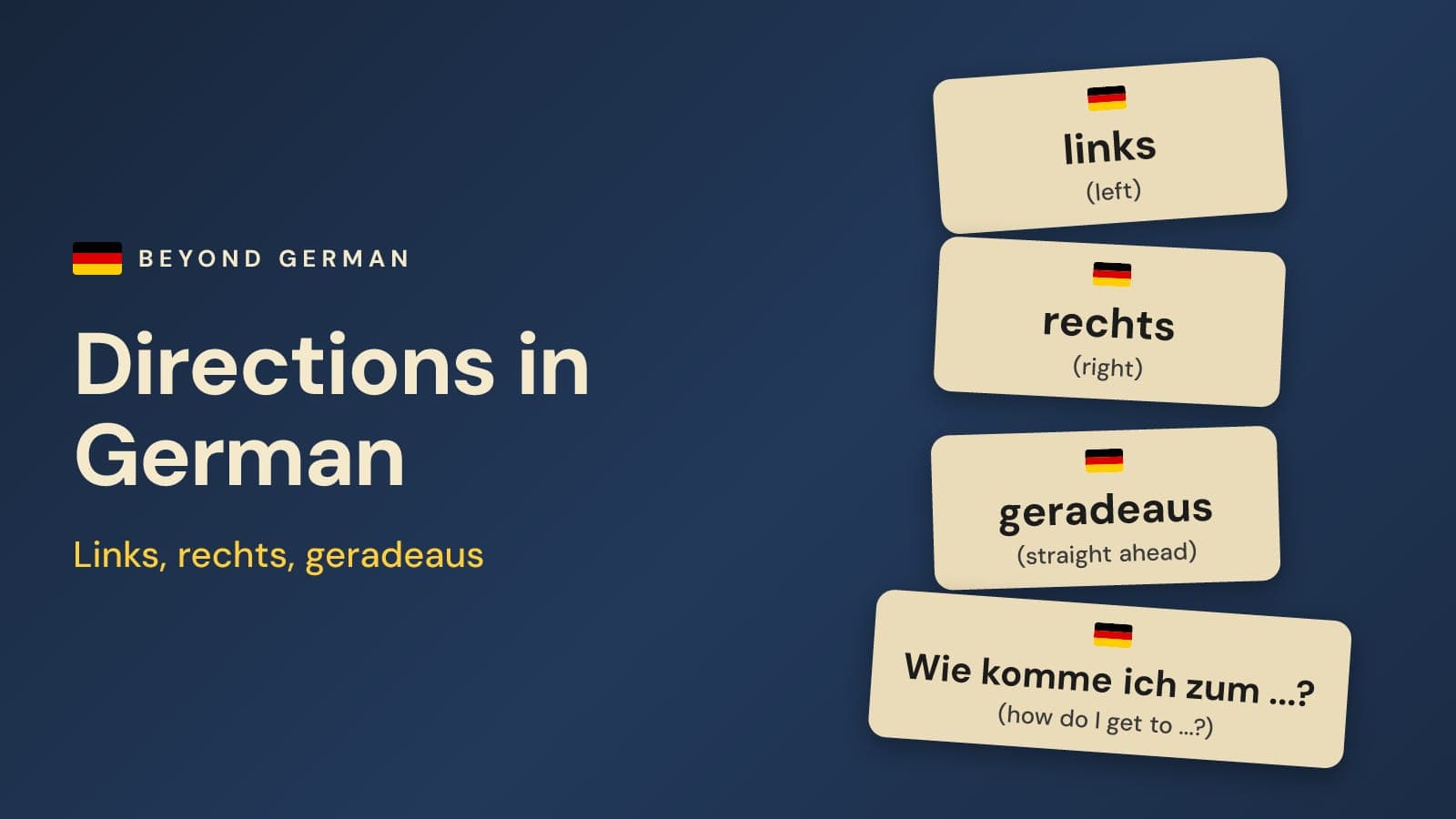
To ask for directions in German, say Entschuldigung, wie komme ich zum Bahnhof? — Excuse me, how do I get to the train station? Most answers use three words: links (left), rechts (right) and geradeaus (straight ahead).
Below: polite questions, the phrases you'll hear in the answer, direction commands, distances, city vocabulary, two dialogues and common mistakes.
How to Ask for Directions in German
Start with Entschuldigung (excuse me) to get someone's attention, or the slightly more formal Entschuldigen Sie. Use Sie with strangers. Then ask one of these:
| German | English |
|---|---|
| Wie komme ich zum Bahnhof? | How do I get to the train station? |
| Wo ist die Post? | Where is the post office? |
| Wo ist hier die nächste Apotheke? | Where's the nearest pharmacy around here? |
| Gibt es hier in der Nähe einen Supermarkt? | Is there a supermarket near here? |
| Ich suche den Bahnhof. | I'm looking for the train station. |
| Können Sie mir sagen, wo das Rathaus ist? | Can you tell me where the town hall is? |
| Ist das weit von hier? | Is that far from here? |
After es gibt and suchen, nouns take the accusative, so masculine articles change: ein Supermarkt becomes einen Supermarkt, and der Bahnhof becomes den Bahnhof. And in Können Sie mir sagen, wo…, the verb moves to the end: wo das Rathaus ist.
Zum or Zur? Zu + Dative
The preposition zu (to) always takes the dative case, and it merges with the article:
| Noun | Zu + dative | Question |
|---|---|---|
| der Bahnhof | zu dem → zum | Wie komme ich zum Bahnhof? |
| das Rathaus | zu dem → zum | Wie komme ich zum Rathaus? |
| die Post | zu der → zur | Wie komme ich zur Post? |
| die Toiletten (plural) | zu den (no contraction) | Wie komme ich zu den Toiletten? |
So der and das words take zum, and feminine die words take zur. For cities and countries, use nach: Wie komme ich nach Köln? — How do I get to Cologne? For an area you go into, use in: Wie komme ich in die Innenstadt? — How do I get downtown? Our guide to German dative prepositions covers zu and nach in depth.
Understanding the Answer: Links, Rechts, Geradeaus
Directions use a small set of words, so answers are more predictable than they sound. A memory trick: links is left, rechts is right.
| German | English | Example |
|---|---|---|
| links / rechts | left / right | Die Post ist links. — The post office is on the left. |
| geradeaus | straight ahead | Gehen Sie immer geradeaus. — Keep going straight ahead. |
| an der Ampel | at the traffic lights | An der Ampel gehen Sie links. — At the lights, go left. |
| an der Kreuzung | at the intersection | Die Haltestelle ist an der Kreuzung. — The stop is at the intersection. |
| um die Ecke | around the corner | Die Bank ist gleich um die Ecke. — The bank is just around the corner. |
| gegenüber (+ dative) | opposite, across from | Die Apotheke ist gegenüber dem Bahnhof. — The pharmacy is opposite the station. |
| neben (+ dative) | next to | Das Café ist neben der Kirche. — The café is next to the church. |
| die zweite Straße links | the second street on the left | Nehmen Sie die zweite Straße links. — Take the second street on the left. |
| über die Brücke | across the bridge | Gehen Sie über die Brücke. — Go across the bridge. |
| bis zur / bis zum | as far as, up to | Gehen Sie geradeaus bis zur Kreuzung. — Go straight ahead as far as the intersection. |
| auf der linken / rechten Seite | on the left / right side | Das Museum ist auf der rechten Seite. — The museum is on the right-hand side. |
| Sie können es nicht verfehlen. | You can't miss it. | The friendly last line of many directions |
An der Ampel covers both "at the light" and "at the lights": one set of traffic lights is eine Ampel. And wait for green: crossing on red is frowned upon in Germany, especially in front of children.
Gegenüber takes the dative: gegenüber dem Bahnhof, gegenüber der Post. In everyday speech you'll also hear gegenüber vom Bahnhof. On its own, it means "across the street": Die Bäckerei ist gleich gegenüber. — The bakery is right across the street.
Neben, vor (in front of) and hinter (behind) take the dative when they say where something is: neben der Bank, vor dem Rathaus, hinter der Kirche. But über die Brücke is accusative, because it describes movement across. Our guide to two-way prepositions explains the logic.
When You Don't Understand
If the answer is too fast:
- Wie bitte? — Sorry? / Pardon?
- Können Sie bitte langsamer sprechen? — Can you speak more slowly, please?
- Können Sie mir den Weg zeigen? — Can you show me the way?
- Können Sie mir das auf der Karte zeigen? — Can you show me on the map?
The best trick is to repeat the route back: Also: geradeaus bis zur Ampel und dann links? — So: straight ahead to the lights and then left? People will happily confirm or correct you.
Direction Commands: Gehen Sie…, Biegen Sie … ab
Directions are usually given as commands. The formal Sie imperative is easy: put the verb first and add Sie. It sounds direct, but it isn't rude.
| Verb | Formal (Sie) | Informal (du) | English |
|---|---|---|---|
| gehen | Gehen Sie geradeaus. | Geh geradeaus. | Go straight ahead. |
| nehmen | Nehmen Sie die erste Straße rechts. | Nimm die erste Straße rechts. | Take the first street on the right. |
| abbiegen | Biegen Sie links ab. | Bieg links ab. | Turn left. |
| fahren | Fahren Sie bis zur Ampel. | Fahr bis zur Ampel. | Drive to the traffic lights. |
Abbiegen (to turn) is a separable verb, so ab jumps to the end: Biegen Sie an der Kreuzung rechts ab. — Turn right at the intersection. Without ab, biegen means "to bend". Our guide to separable verbs shows the pattern.
The du form drops the pronoun and the -st ending: du gehst → Geh!, du nimmst → Nimm! Verbs with an a → ä change lose the umlaut: du fährst → Fahr!
Many people skip the command form and use the present tense, which sounds softer: Sie gehen hier geradeaus und nehmen dann die zweite Straße links. — You go straight ahead here and then take the second street on the left.
Is It Far? Distances and Walking Times
Before you set off, check: Kann man zu Fuß gehen? — Can you walk there? Typical answers:
- Ja, das ist ganz nah. — Yes, it's really close.
- Das sind nur fünf Minuten zu Fuß. — It's only five minutes on foot.
- Ungefähr 500 Meter. — About 500 meters.
- Das ist zu weit zum Laufen. Nehmen Sie lieber den Bus. — It's too far to walk. You'd better take the bus.
Zu Fuß (on foot) always uses zu. For vehicles, use mit + dative: mit dem Bus, mit dem Fahrrad, mit der U-Bahn. And don't be thrown by laufen: in everyday German it often just means "to walk", as in Das können Sie laufen. — You can walk it.
Distances are metric (der Meter, der Kilometer), and the plural looks the same: 500 Meter, zwei Kilometer. If the answer involves a bus or tram, our guide to German public transport vocabulary has the phrases for lines, stops and tickets.
City Vocabulary With Articles
The article decides between zum and zur, and between neben dem and neben der.
| German | Plural | English | To get there |
|---|---|---|---|
| der Bahnhof | die Bahnhöfe | train station | zum Bahnhof |
| die Haltestelle | die Haltestellen | bus or tram stop | zur Haltestelle |
| die Post | — | post office | zur Post |
| die Apotheke | die Apotheken | pharmacy | zur Apotheke |
| die Bank | die Banken | bank | zur Bank |
| das Rathaus | die Rathäuser | town hall | zum Rathaus |
| die Kirche | die Kirchen | church | zur Kirche |
| der Platz | die Plätze | square | zum Platz |
| die Ampel | die Ampeln | traffic light(s) | bis zur Ampel |
| die Kreuzung | die Kreuzungen | intersection, crossroads | bis zur Kreuzung |
A few things worth knowing on the street:
- Die Bank has two plurals: die Banken (banks) and die Bänke (benches).
- Die Apotheke is marked with a big red A.
- Also useful: die Straße (street), die Ecke (corner), die Brücke (bridge), die Innenstadt (town center), der Hauptbahnhof (main station) and die Fußgängerzone (pedestrian zone).
Two Sample Dialogues
Dialogue 1: Asking a Stranger (Sie)
You're in town and need the train station.
| German | English |
|---|---|
| Sie: Entschuldigung, wie komme ich zum Bahnhof? | Excuse me, how do I get to the train station? |
| Passantin: Zum Bahnhof? Gehen Sie hier geradeaus bis zur Ampel. | To the station? Go straight ahead here as far as the traffic lights. |
| Sie: Bis zur Ampel. Und dann? | As far as the lights. And then? |
| Passantin: An der Ampel biegen Sie links ab. Dann nehmen Sie die zweite Straße rechts. | At the lights, turn left. Then take the second street on the right. |
| Sie: Also: an der Ampel links, dann die zweite Straße rechts? | So: left at the lights, then the second street on the right? |
| Passantin: Genau. Dann gehen Sie über die Brücke, und der Bahnhof ist direkt vor Ihnen. Sie können es nicht verfehlen. | Exactly. Then you go across the bridge, and the station is right in front of you. You can't miss it. |
| Sie: Ist das weit von hier? | Is that far from here? |
| Passantin: Nein, zu Fuß sind das ungefähr zehn Minuten. | No, it's about ten minutes on foot. |
| Sie: Vielen Dank! | Thank you very much! |
| Passantin: Gern geschehen. | You're welcome. |
Dialogue 2: A Friend on the Phone (du)
Tom has just arrived by tram and calls Lena to find her apartment.
| German | English |
|---|---|
| Tom: Hallo Lena! Ich bin jetzt an der Haltestelle Goetheplatz. Wie komme ich zu dir? | Hi Lena! I'm at the Goetheplatz stop now. How do I get to your place? |
| Lena: Das ist ganz nah! Siehst du die Apotheke? | It's really close! Can you see the pharmacy? |
| Tom: Ja, auf der anderen Straßenseite. | Yes, on the other side of the street. |
| Lena: Genau. Geh über die Straße und dann geradeaus, an der Apotheke vorbei. | Exactly. Cross the street and then go straight on, past the pharmacy. |
| Tom: Okay. Und dann? | Okay. And then? |
| Lena: Bieg an der Bäckerei rechts ab. Das ist die Bergstraße. Ich wohne in Nummer 12, gegenüber der Kirche. | Turn right at the bakery. That's Bergstraße. I live at number 12, opposite the church. |
| Tom: Gegenüber der Kirche, alles klar. Ist das weit? | Opposite the church, got it. Is it far? |
| Lena: Nein, höchstens fünf Minuten zu Fuß. Bis gleich! | No, five minutes on foot at most. See you in a bit! |
Notice the du commands (Geh, Bieg … ab) and zu dir: zu + a person means "to someone's place".
Common Mistakes
| Wrong | Right | Why |
|---|---|---|
| Wie komme ich zu der Bahnhof? | Wie komme ich zum Bahnhof? | Zu takes the dative: der Bahnhof → dem → zum. |
| Wie komme ich zum Post? | Wie komme ich zur Post? | Post is feminine, so zu der → zur. |
| Wie komme ich zu Berlin? | Wie komme ich nach Berlin? | Cities and countries take nach. |
| Gibt es hier ein Supermarkt? | Gibt es hier einen Supermarkt? | Es gibt takes the accusative. |
| Biegen Sie links. | Biegen Sie links ab. | Abbiegen is separable, and you can't drop the ab. |
| Ist das rechts? (meaning "Is that correct?") | Ist das richtig? | Rechts is the direction; richtig is "right" as in correct. |
| Ich bin verloren. | Ich habe mich verlaufen. | Ich bin verloren sounds like "I'm doomed". If you're driving, it's Ich habe mich verfahren. |
Practice
Fill in the gaps:
- Wie komme ich ___ Apotheke? (zu + die)
- Wie komme ich ___ Rathaus? (zu + das)
- Gibt es hier in der Nähe ___ Supermarkt? (a)
- Biegen Sie an der Kreuzung links ___.
- Die Bank ist gegenüber ___ Kirche. (die Kirche)
- ___ geradeaus! (gehen, du form)
Answers: 1. zur 2. zum 3. einen 4. ab 5. der 6. Geh
Then say it out loud: describe the way from your home to the nearest bakery in three sentences. Review the German dative case behind zum, zur and gegenüber, test yourself with an A1 German quiz, and pick up more survival phrases in our essential German phrases for beginners.
FAQ
How do you ask for directions in German?
Say Entschuldigung, wie komme ich zum Bahnhof? — Excuse me, how do I get to the train station? Or simply Wo ist der Bahnhof? Use zum for der and das nouns, and zur for feminine die nouns.
What do links, rechts and geradeaus mean?
Links means left, rechts means right and geradeaus means straight ahead. Immer geradeaus means "keep going straight".
How do you say "turn left" in German?
Formally, Biegen Sie links ab. Informally, Bieg links ab. You'll also hear the simpler Gehen Sie links. — Go left.
How do you say "I'm lost" in German?
Ich habe mich verlaufen. — I'm lost (on foot). If you're driving, it's Ich habe mich verfahren.
Level Up Your German
Join 1,000+ learners getting weekly tips, grammar shortcuts, and cultural insights.
Share this article
Continue Reading
Hobbies in German: Was machst du gern? Freizeit Vocabulary
How to talk about hobbies in German: ask Was machst du in deiner Freizeit?, answer with gern, lieber and am liebsten, and learn Freizeit vocabulary by category.

German Supermarket Vocabulary: Pfand, Kasse & Shopping Phrases
Shop like a local in Germany: types of shops, checkout phrases, how Pfand works, bags, quantities and Sunday closing, with the German you'll hear at the Kasse.
Rooms in German: House & Furniture Vocabulary With Plurals
Rooms, furniture and appliances in German with articles and plurals, plus how to describe your home, which floor the Erdgeschoss is, and why Germans air their rooms.