
German Dative Prepositions: aus, bei, mit, nach, seit, von, zu
 Beyond German Team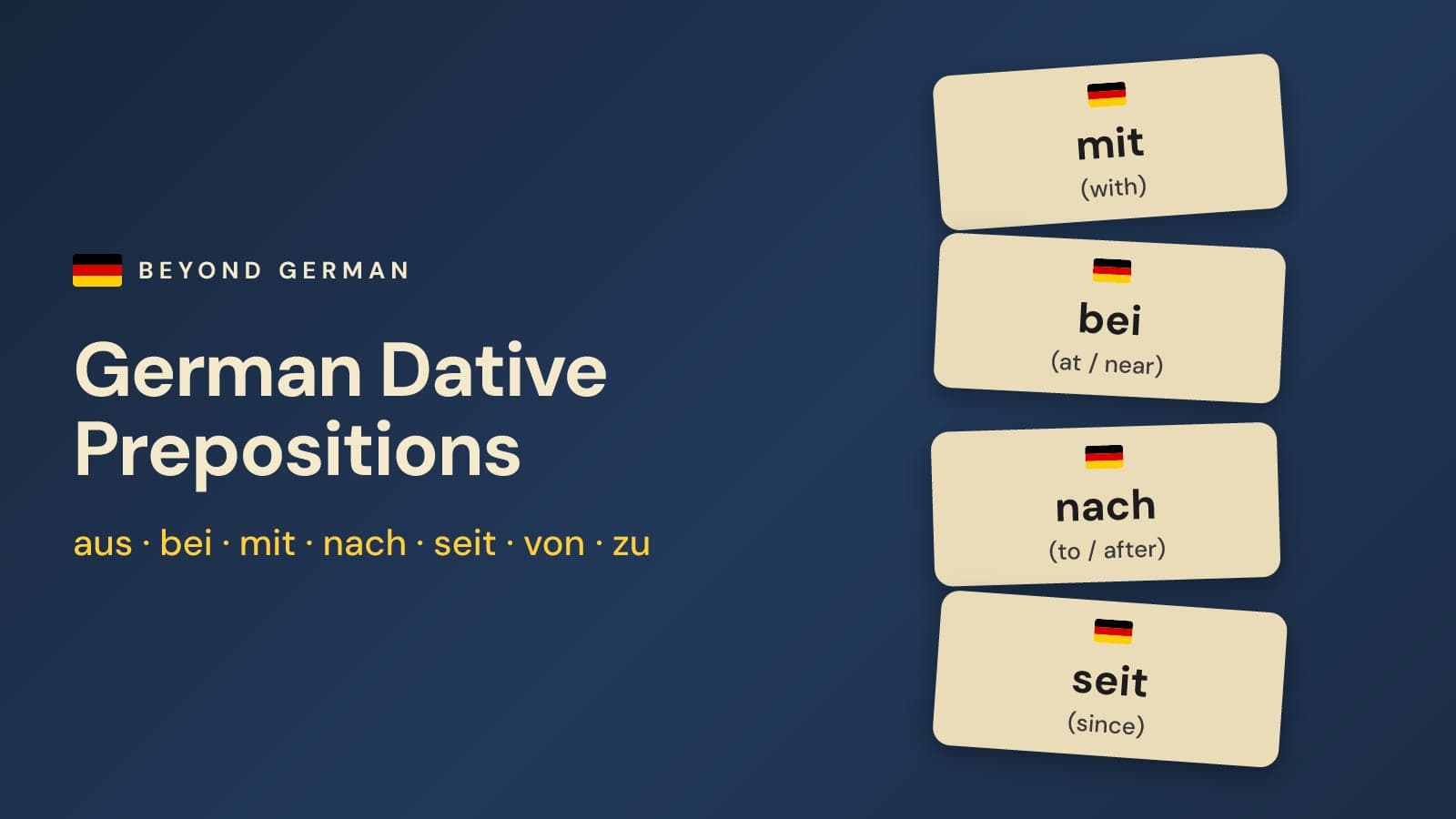
German has nine prepositions that always take the dative case: aus, außer, bei, gegenüber, mit, nach, seit, von and zu. Any article, noun or pronoun that belongs to them goes into the dative case: mit dem Bus, bei meiner Mutter, zu dir.
That's the good news: unlike in or auf, these nine never switch cases. Learn the list once, and you'll never have to wonder "dative or accusative?" after them again.
Below: meanings and examples for each one, a memory trick, the dative endings, the contractions zum, zur, beim and vom, and the most common mistakes.
The 9 German Dative Prepositions at a Glance
| Preposition | Meaning(s) | Example | English |
|---|---|---|---|
| aus | from, out of, made of | aus dem Haus | out of the house |
| außer | except, apart from | außer mir | except me |
| bei | at (someone's place or company), near, while | bei meinen Eltern | at my parents' place |
| gegenüber | opposite, across from, towards | gegenüber der Kirche | opposite the church |
| mit | with, by (transport) | mit dem Zug | by train |
| nach | to (cities, countries), after, according to | nach der Arbeit | after work |
| seit | since, for (still going on) | seit einem Jahr | for a year |
| von | from, of, by | von meiner Oma | from my grandma |
| zu | to (people, places, events) | zu meiner Schwester | to my sister's |
A Memory Trick for the Dative Prepositions
Say the seven most common ones as one long word until it sticks: aus-bei-mit-nach-seit-von-zu. Many learners sing it to the tune of the Blue Danube waltz, and once it's in your head as a melody, it stays there. Then tack on the two longer ones at the end: außer and gegenüber.
Dative Articles and Endings
After a dative preposition, the article changes. Here's the whole pattern:
| Case | Masculine | Feminine | Neuter | Plural |
|---|---|---|---|---|
| Nominative | der / ein | die / eine | das / ein | die / keine |
| Dative | dem / einem | der / einer | dem / einem | den / keinen + noun -n |
| Example | mit dem Vater | mit der Mutter | mit dem Kind | mit den Kindern |
Learn the definite articles as a little chant: dem, der, dem, den. Possessives like mein and dein take the same endings as ein and kein: meinem, meiner, meinem, meinen.
The Dative Plural -n
In the dative plural, the noun itself also gets an -n, unless the plural already ends in -n or -s:
- die Freunde → mit den Freunden (with the friends)
- die Kinder → mit den Kindern (with the children)
- die Frauen → mit den Frauen (already ends in -n)
- die Autos → mit den Autos (-s plural, no extra -n)
Dative Pronouns
Pronouns switch to their dative forms too: mir, dir, ihm, ihr, ihm, uns, euch, ihnen, Ihnen (me, you, him, her, it, us, you all, them, you formal).
- Kommst du mit mir? — Are you coming with me?
- Ich habe ein Paket von ihm bekommen. — I got a package from him.
Each Dative Preposition Explained
aus — from, out of, made of
Aus tells you where someone comes from (a country or a city) or what something comes out of. It also describes materials: aus Holz (made of wood).
- Ich komme aus der Schweiz. — I'm from Switzerland.
- Er nimmt das Handy aus der Tasche. — He takes his phone out of his bag.
außer — except, apart from
Außer means "except" or "apart from". You'll also see it on broken machines: außer Betrieb (out of order).
- Außer meinem Bruder kommen alle. — Everyone's coming except my brother.
- Außer dir kenne ich hier niemanden. — Apart from you, I don't know anyone here.
bei — at, near, while
Bei means "at someone's place": at a person's home, at a company, at the doctor's. It can also mean "near", and with an activity it means "while": beim Kochen (while cooking).
- Sie arbeitet bei einer Bank. — She works at a bank.
- Beim Kochen höre ich gern Musik. — I like listening to music while I cook.
gegenüber — opposite, across from
Gegenüber means "opposite" or "across from", and also "towards" a person: freundlich gegenüber Kunden (friendly towards customers). With pronouns, it usually comes after the pronoun: mir gegenüber.
- Die Apotheke ist gegenüber dem Bahnhof. — The pharmacy is opposite the train station.
- Er sitzt mir gegenüber. — He's sitting across from me.
mit — with, by
Mit means "with", and it's also how you say how you travel. English says "by bus", German says "with the bus": mit dem Bus, mit dem Auto, mit der Bahn.
- Ich fahre mit dem Bus zur Arbeit. — I take the bus to work.
- Sie telefoniert mit ihrer Mutter. — She's on the phone with her mother.
nach — to, after, according to
Nach has three jobs: "to" with cities, countries and directions (nach Berlin, nach links), "after" with times and events, and "according to" in phrases like meiner Meinung nach (in my opinion), where it comes after the noun.
- Wir fliegen im Sommer nach Spanien. — We're flying to Spain in the summer.
- Nach dem Frühstück gehe ich joggen. — After breakfast, I go jogging.
seit — since, for
Seit means "since" or "for" when something started in the past and is still going on (more on its tense below).
- Ich lerne seit drei Monaten Deutsch. — I've been learning German for three months.
- Seit dem Sommer wohnt sie in Hamburg. — She has lived in Hamburg since the summer.
von — from, of, by
Von means "from" (a person or a starting point), "of" (in everyday speech it often replaces the genitive), and "by" for authors and artists: ein Buch von Kafka.
- Ich habe eine Nachricht von meinem Chef bekommen. — I got a message from my boss.
- Das ist das Auto von meiner Schwester. — That's my sister's car.
zu — to
Zu means "to" when you go to a person, a building, a shop or an event. It also appears in fixed phrases like zu Hause (at home) and zum Frühstück (for breakfast).
- Wie komme ich zum Bahnhof? — How do I get to the train station?
- Am Wochenende fahre ich zu meinen Eltern. — This weekend I'm going to my parents' place.
Contractions: zum, zur, beim, vom
Three dative prepositions merge with the article. In everyday German, these short forms are the normal choice; zu dem Arzt sounds stiff when you simply mean "to the doctor".
| Short form | Long form | Example | English |
|---|---|---|---|
| zum | zu dem (masculine, neuter) | Kommst du mit zum Konzert? | Are you coming to the concert? |
| zur | zu der (feminine) | Sie fährt zur Arbeit. | She drives to work. |
| beim | bei dem (masculine, neuter) | Ich bin beim Bäcker. | I'm at the bakery. |
| vom | von dem (masculine, neuter) | Er holt mich vom Bahnhof ab. | He's picking me up from the station. |
- Everything else stays long: mit dem, aus dem, nach dem, bei der, von der, zu den.
- Verbs used as nouns always contract: beim Kochen (while cooking), zum Lernen (for learning).
- Use the long form to point at one specific thing, often before a relative clause: Ich gehe zu dem Arzt, den du empfohlen hast. — I'm going to the doctor you recommended.
Nach vs Zu: How to Say "Going To"
Both can mean "to", which is why learners mix them up. The choice depends on where you're going:
| Going to… | Use | Example | English |
|---|---|---|---|
| a city, or a country without an article | nach | Ich fahre nach Berlin. | I'm going to Berlin. |
| a country with an article | in + accusative | Wir fliegen in die USA. | We're flying to the US. |
| a direction | nach | Gehen Sie nach links. | Go left. |
| home | nach Hause | Ich gehe jetzt nach Hause. | I'm going home now. |
| a person | zu | Ich gehe zu meiner Oma. | I'm going to my grandma's. |
| a doctor, building, shop or event | zu (zum/zur) | Ich muss zum Arzt. | I have to go to the doctor. |
Nach Hause vs Zu Hause
Nach Hause is movement: you're on your way home. Zu Hause (also written zuhause) is location: you're already there. If the question is Wohin? (where to?), say nach Hause. If it's Wo? (where?), say zu Hause.
- Ich gehe nach Hause. — I'm going home.
- Ich bin zu Hause. — I'm at home.
Seit + Present Tense
English uses the present perfect for something that started in the past and is still true: "I have lived here for three years." German uses the simple present tense with seit. Notice the dative plural, too: drei Jahre becomes seit drei Jahren.
- Ich wohne seit drei Jahren hier. — I've lived here for three years. (still true)
- Ich habe drei Jahre in Köln gewohnt. — I lived in Cologne for three years. (over now)
- Ich bin vor drei Jahren nach Berlin gezogen. — I moved to Berlin three years ago.
- Seit wann lernst du Deutsch? — How long have you been learning German?
One thing to know: for something that hasn't happened since a certain point, German often uses the perfect: Ich habe ihn seit Wochen nicht gesehen. — I haven't seen him for weeks. For vor, am, um and friends, see our guide to German time prepositions.
Don't Confuse Them With Two-Way Prepositions
Nine other prepositions take the dative only sometimes: an, auf, hinter, in, neben, über, unter, vor, zwischen. These two-way prepositions take the dative for a location (Wo?) and the accusative for movement towards a place (Wohin?).
- Ich bin in der Küche. — I'm in the kitchen. (location → dative)
- Ich gehe in die Küche. — I'm going into the kitchen. (movement → accusative)
The nine prepositions in this guide ignore that rule completely: zum Arzt is movement, yet it's still dative. The whole Wo?/Wohin? system is explained in our German prepositions guide.
Common Mistakes With Dative Prepositions
The number one mistake: using the article you learned first (the nominative) after a dative preposition. In the plural, many learners fix the article but forget the -n on the noun:
- Wrong: mit die Freunde
- Still wrong: mit den Freunde
- Right: mit den Freunden
Ich gehe mit den Freunden von Lisa ins Kino. — I'm going to the movies with Lisa's friends.
Here are the other classics:
| Wrong | Right | Why |
|---|---|---|
| Ich komme von Deutschland. | Ich komme aus Deutschland. | Where you're from = aus. Von is a starting point: Ich komme gerade von der Arbeit. |
| Ich gehe zu Hause. | Ich gehe nach Hause. | Going home is movement = nach Hause. |
| Ich fahre nach meiner Oma. | Ich fahre zu meiner Oma. | People take zu. Nach meiner Oma means "after my grandma". |
| Ich fahre mit der Bus. | Ich fahre mit dem Bus. | Bus is masculine: der → dem. |
| Ich habe hier für drei Jahre gewohnt. | Ich wohne seit drei Jahren hier. | Still true = seit + present tense. |
Practice: Fill in the Dative
Fill in the gaps. The words in brackets tell you what to use.
- Ich fahre mit ___ Zug nach Hamburg. (der Zug)
- Wir sprechen mit ___ Kinder___. (die Kinder)
- Nach ___ Kurs gehen wir essen. (der Kurs)
- Ich muss heute noch ___ Post. (zu + die Post)
- Seit ___ Woche habe ich eine neue Wohnung. (eine Woche)
- Es ist spät. Ich gehe jetzt ___ Hause.
Answers:
- Ich fahre mit dem Zug nach Hamburg. — I'm taking the train to Hamburg.
- Wir sprechen mit den Kindern. — We're talking to the children.
- Nach dem Kurs gehen wir essen. — After the class, we're going out to eat.
- Ich muss heute noch zur Post. — I still have to go to the post office today.
- Seit einer Woche habe ich eine neue Wohnung. — I've had a new apartment for a week.
- Es ist spät. Ich gehe jetzt nach Hause. — It's late. I'm going home now.
Want more practice?
- Drill dative plurals like den Kindern in the noun case declension lab.
- Test yourself on accusative vs dative with the A2 German quiz.
- If the four cases still feel fuzzy, start with the German cases overview.
- Next step: many verbs come with a fixed dative preposition, like helfen bei and träumen von. See German verbs with prepositions.
Keep learning:
FAQ
What are the German dative prepositions?
The nine prepositions that always take the dative are aus, außer, bei, gegenüber, mit, nach, seit, von and zu. Any article, noun or pronoun that belongs to them goes into the dative: mit dem Auto, zu mir.
Is "bis" a dative preposition?
No. Bis takes the accusative (bis nächsten Montag), and it's often combined with a second preposition that decides the case: bis zum Bahnhof is dative because of zu.
What's the difference between nach and zu?
Use nach for cities, countries without an article, directions and nach Hause. Use zu for people, buildings, shops and events: nach Wien, but zum Supermarkt.
Are there more dative prepositions?
Yes, a few more exist, such as ab (from), entgegen (contrary to) and gemäß (according to). Learn the core nine first; they're the ones you'll use every day at A1 to B1.
Level Up Your German
Join 1,000+ learners getting weekly tips, grammar shortcuts, and cultural insights.
Share this article
Continue Reading
Common German Mistakes English Speakers Make (+ False Friends)
Why 'Ich bin heiß' gets laughs and 'Ich will' doesn't mean 'I will': 15 common German mistakes English speakers make, plus the false friends to watch out for.

Days of the Week in German, Months and How to Say the Date
Learn the days of the week and months in German with articles, abbreviations and pronunciation, plus seasons, dates like am 3. Oktober, years and holidays.
Telling Time in German: What Time Is It? (Halb Acht Explained)
Learn how to tell time in German: ask Wie spät ist es?, use the 24-hour clock, master Viertel nach and Viertel vor, and see why halb acht means 7:30.