
How to Say I Like in German: Gern vs Mögen vs Gefallen
 Beyond German Team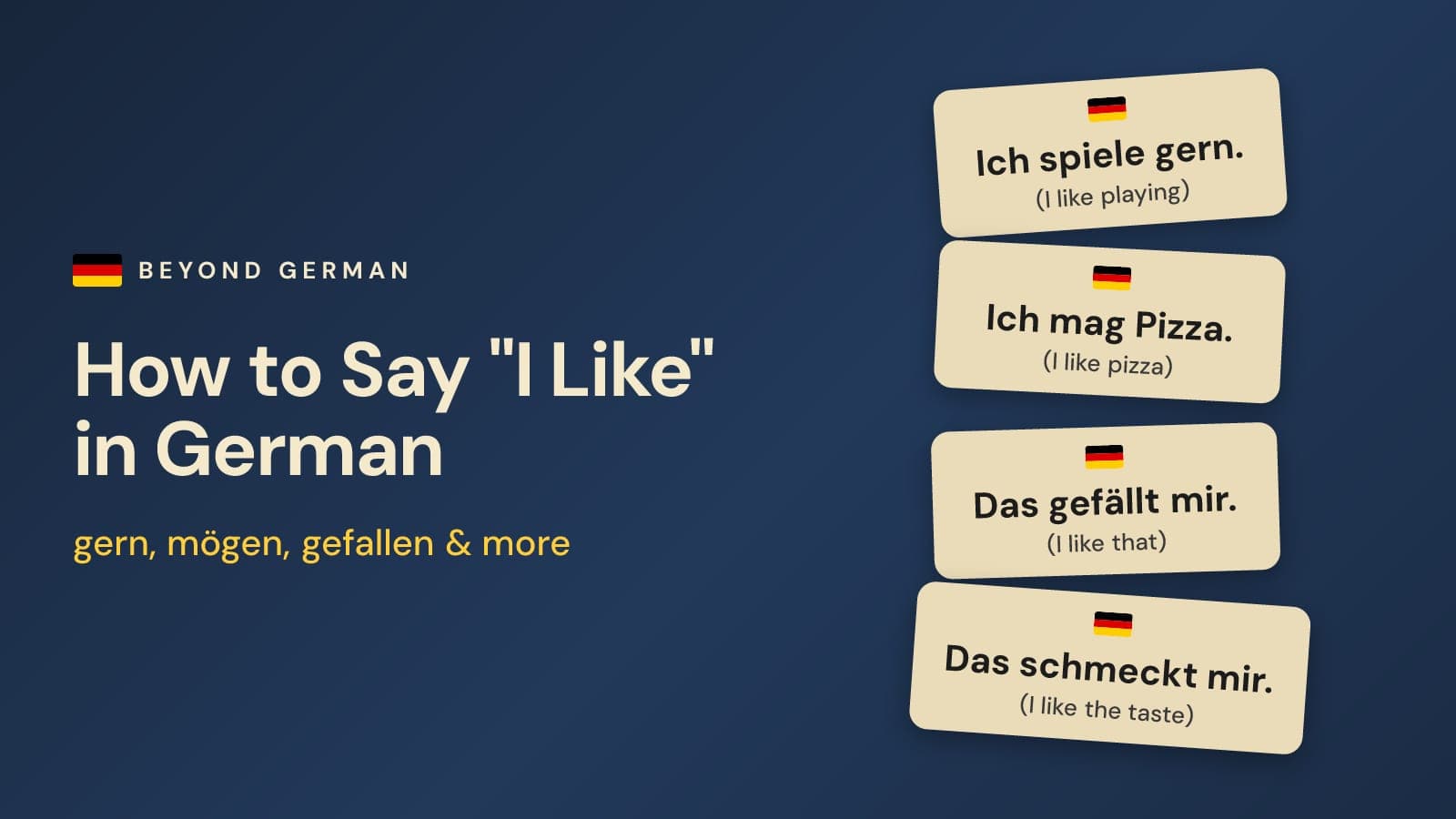
How you say "I like" in German depends on what you like. For activities, add gern to the verb: Ich spiele gern Fußball. — I like playing soccer. For things and people, use mögen: Ich mag Pizza. — I like pizza. And for something you see, hear or experience, Germans often flip the sentence with gefallen: Der Film gefällt mir. — I like the film.
Then there's möchte for "I'd like" (right now), schmecken for food and lieben for "love". Here's when to use each, plus lieber, am liebsten and the mistakes English speakers make most.
Quick Overview: Gern, Mögen, Gefallen and More
Here's one food, liked seven different ways:
| German | Use it for | Example | English |
|---|---|---|---|
| gern + verb | Activities you enjoy | Ich esse gern Pizza. | I like eating pizza. |
| lieber / am liebsten | Preferences and favorites | Am liebsten esse ich Pizza. | I like eating pizza best. |
| mögen + noun | Things, people and food in general | Ich mag Pizza. | I like pizza. |
| möchte | A polite wish right now | Ich möchte eine Pizza, bitte. | I'd like a pizza, please. |
| gefallen + dative | Things you see, hear or experience | Die Pizzeria gefällt mir. | I like the pizzeria. |
| schmecken + dative | Food and drink you're tasting | Die Pizza schmeckt mir. | I like the pizza. (its taste) |
| lieben | Strong liking; romantic love | Ich liebe Pizza! | I love pizza! |
The key insight: gern goes with doing, mögen with things. Gefallen and schmecken turn the sentence around, so the thing you like becomes the subject. And möchte isn't about liking at all: it's about wanting something now.
Gern + Verb: Things You Like Doing
Gern (or gerne, which means exactly the same) is an adverb meaning "gladly". Add it to a verb, and you're saying you like doing that. It usually comes right after the verb and its subject:
- Ich lese gern. — I like reading.
- Sie hört gern Musik. — She likes listening to music.
- Spielst du gern Tennis? — Do you like playing tennis?
- Am Wochenende schlafe ich gern lange. — On weekends, I like to sleep in.
For "don't like", put nicht before gern: Ich koche nicht gern. — I don't like cooking. In the Perfekt, gern stays in the middle: Als Kind habe ich gern gezeichnet. — As a kid, I liked drawing. This is the pattern for talking about hobbies; for the vocabulary, see hobbies and free time in German.
On its own, Gern! means "With pleasure!" or "You're welcome!": „Kommst du mit?“ – „Ja, gern!“ — "Are you coming?" "Yes, I'd love to!"
Lieber and am liebsten: Prefer and Like Most
Gern has an irregular comparison, just like gut, besser, am besten:
| Form | Meaning | Example | English |
|---|---|---|---|
| gern | like (doing) | Ich trinke gern Tee. | I like drinking tea. |
| lieber | prefer, would rather | Ich trinke lieber Kaffee. | I prefer coffee. |
| am liebsten | like most of all | Am liebsten trinke ich Kakao. | Most of all, I like hot chocolate. |
- Ich bleibe heute lieber zu Hause. — I'd rather stay home today.
- Magst du lieber Hunde oder Katzen? — Do you prefer dogs or cats?
- Was machst du am liebsten? — What do you like doing most?
Your favorite thing is Lieblings- + noun, and the noun keeps its article (das Essen → das Lieblingsessen): Mein Lieblingsessen ist Pizza. — My favorite food is pizza.
Mögen + Noun: Things and People You Like
Mögen is for liking things, people, animals and food in general. What you like is the direct object, in the accusative:
- Magst du Katzen? — Do you like cats?
- Wir mögen unsere Nachbarn sehr. — We like our neighbors a lot.
- Er mag keinen Fisch. — He doesn't like fish.
- Ich mag dich. — I like you.
- Ich mag es, wenn es schneit. — I like it when it snows.
The past forms are mochte and hat gemocht: Als Kind mochte ich keinen Spinat. — As a kid, I didn't like spinach.
Why Not "Ich mag schwimmen"?
Technically, mögen is a modal verb and can take another verb. But Ich mag schwimmen sounds like a word-for-word translation of "I like swimming". For activities, Germans use gern: Ich schwimme gern. You'll mainly hear mögen + verb in the negative, meaning "don't feel like" (Ich mag heute nicht kochen. — I don't feel like cooking today), and in southern Germany and Austria, where Magst du mitkommen? means "Do you want to come along?"
Ich möchte vs. Ich mag: "I'd Like" vs. "I Like"
Ich mag is a general preference. Ich möchte is a wish for right now, the polite "I'd like":
- Ich mag Kaffee. — I like coffee. (in general)
- Ich möchte einen Kaffee, bitte. — I'd like a coffee, please. (now)
- Ich mag Pizza, aber heute möchte ich einen Salat. — I like pizza, but today I'd like a salad.
So Ich mag einen Kaffee sounds strange at a café counter, and Ich möchte Pizza doesn't mean "I like pizza": it means you want some now. Unlike mögen, möchte happily takes a second verb, which goes to the end: Ich möchte bezahlen. — I'd like to pay.
| Pronoun | mögen (like) | möchte (would like) |
|---|---|---|
| ich | mag | möchte |
| du | magst | möchtest |
| er / sie / es | mag | möchte |
| wir | mögen | möchten |
| ihr | mögt | möchtet |
| sie / Sie | mögen | möchten |
As with all modal verbs, the ich and er/sie/es forms are identical. Möchte started out as a form of mögen (its Konjunktiv II), but today it works as a verb of its own. It has no past tense, so for "wanted", use wollte: Ich wollte einen Kaffee. — I wanted a coffee. For more ways to ask nicely, like Ich hätte gern…, see how to be polite in German.
Gefallen + Dative: "The Film Pleases Me"
Gefallen means "to please", and it turns the English sentence around. The thing you like is the subject, and the person who likes it goes in the dative case:
| English | German | Literally |
|---|---|---|
| I like the film. | Der Film gefällt mir. | The film pleases me. |
| Do you like the apartment? | Gefällt dir die Wohnung? | Does the apartment please you? |
| She likes the shoes. | Die Schuhe gefallen ihr. | The shoes please her. |
| We liked Vienna. | Wien hat uns gefallen. | Vienna pleased us. |
Two things to watch. The verb agrees with the thing you like: gefällt for one thing, gefallen for several. And the person is always in the dative (mir, dir, ihm, ihr, uns, euch, ihnen, Ihnen), nouns included: Das Geschenk hat meiner Mutter gefallen. — My mother liked the present. In speech, the person often comes first: Mir gefällt das. — I like that.
Gefallen or Mögen?
With things, the two often overlap, but the focus differs. Gefallen is about the impression something makes, how it looks, sounds or feels, often when it's new to you. Mögen is a general, lasting liking:
- Wie gefällt es dir in Deutschland? — How do you like it in Germany? (You've just arrived.)
- Ich mag Deutschland. — I like Germany. (in general)
- Du gefällst mir. — I like you. (I like how you look or come across; often flirty.)
Schmecken + Dative: Liking Food and Drink
For food you're eating, use schmecken (to taste). It works just like gefallen: the food is the subject, and the person goes in the dative:
- Der Kuchen schmeckt mir. — I like the cake.
- Schmeckt dir die Suppe? — Do you like the soup?
- Die Tomaten schmecken mir nicht. — I don't like the tomatoes.
- Hat es Ihnen geschmeckt? — Did you enjoy your meal? (what servers ask)
Without a person, it's just about taste: Das schmeckt gut! — That tastes good! Schmecken is about the food in front of you, mögen about food in general: Ich mag Fisch, aber dieser Fisch schmeckt mir nicht. — I like fish, but I don't like this fish.
Don't use gefallen for taste: Die Pizza gefällt mir sounds like you like how it looks. For more food words and restaurant phrases, see our German food and drink vocabulary.
Lieben: When You Really Love It
For things you're passionate about, lieben works like English "love":
- Ich liebe Pizza! — I love pizza!
- Sie liebt ihren Job. — She loves her job.
- Ich liebe es, am Meer zu sein. — I love being by the sea.
With people, it's a different story. Ich liebe dich is a serious, romantic declaration that Germans don't say to friends; friends and family say Ich hab dich lieb. Our guide to I love you in German explains the whole scale, from Ich mag dich to Ich liebe dich.
More Ways to Say You Like Something
Germans also use these all the time:
| German | English | Good to know |
|---|---|---|
| Ich finde den Film toll. | I think the film is great. | finden + adjective gives your opinion |
| Ich stehe auf Jazz. | I'm into jazz. | Casual; also for people you fancy |
| Ich habe Lust auf Pizza. | I'm in the mood for pizza. | A craving right now |
| Hast du Lust, ins Kino zu gehen? | Do you feel like going to the movies? | A casual invitation |
The finden pattern works with any adjective, good or bad: Ich finde das Buch langweilig. — I think the book is boring.
Common Mistakes
| Wrong | Right | Why |
|---|---|---|
| Ich gefalle den Film. | Der Film gefällt mir. | The thing you like is the subject, and you go in the dative. |
| Die Schuhe gefällt mir. | Die Schuhe gefallen mir. | The verb agrees with the thing you like. |
| Ich mag schwimmen. | Ich schwimme gern. | For activities, use the verb + gern. |
| Ich gern spiele Fußball. | Ich spiele gern Fußball. | The verb comes second, and gern follows it. |
| Ich mag einen Kaffee, bitte. | Ich möchte einen Kaffee, bitte. | To order, use möchte (would like). |
| Ich möchte Pizza. (meaning "I like pizza") | Ich mag Pizza. | Möchte is a wish for now, not a general preference. |
| Die Suppe gefällt mir. (about the taste) | Die Suppe schmeckt mir. | For taste, use schmecken. |
The first one is the classic. Ich gefalle dir is correct German, by the way, but it means "You like me".
Practice: Gern, Mögen, Gefallen, Schmecken or Möchte?
Say it in German. Use du for "you".
- I like reading.
- Do you like dogs?
- I like your jacket. (Use gefallen.)
- Do you like the soup? (You're eating it.)
- I'd like a glass of water, please.
- I'd rather stay at home.
- What do you like doing most?
- Did you like the film? (Use the Perfekt.)
Answers:
- Ich lese gern.
- Magst du Hunde?
- Deine Jacke gefällt mir. (or Mir gefällt deine Jacke.)
- Schmeckt dir die Suppe?
- Ich möchte ein Glas Wasser, bitte.
- Ich bleibe lieber zu Hause.
- Was machst du am liebsten?
- Hat dir der Film gefallen?
Want more?
- Test yourself in the A1 German quiz.
- See how mögen and möchte fit in with können, müssen and the rest in our guide to German modal verbs.
- Tackle another set of verbs English speakers mix up: wissen vs. kennen vs. können.
FAQ
What's the difference between gern and mögen?
Gern goes with a verb, for activities you enjoy (Ich koche gern). Mögen goes with a noun, for things and people (Ich mag Pizza).
What's the difference between gefallen and mögen?
With gefallen, the thing you like is the subject and you're in the dative (Der Film gefällt mir), and it's often about first impressions. Mögen works like English "like" and describes a general preference (Ich mag Filme).
Is it "ich mag" or "ich möchte"?
Ich mag means "I like" (in general). Ich möchte means "I'd like" (now), so use it when you order or ask for something.
Is it gern or gerne?
Both are correct and mean exactly the same, so use whichever you prefer.
How do you say "I don't like" in German?
Negate whichever verb fits: Ich mag keinen Käse (I don't like cheese), Ich tanze nicht gern (I don't like dancing), Das gefällt mir nicht (I don't like that) or Das schmeckt mir nicht (I don't like the taste).
Level Up Your German
Join 1,000+ learners getting weekly tips, grammar shortcuts, and cultural insights.
Share this article
Continue Reading
Hobbies in German: Was machst du gern? Freizeit Vocabulary
How to talk about hobbies in German: ask Was machst du in deiner Freizeit?, answer with gern, lieber and am liebsten, and learn Freizeit vocabulary by category.
Directions in German: Links, Rechts, Geradeaus & How to Ask
How to ask for directions in German (Wie komme ich zum Bahnhof?), understand links, rechts and geradeaus, plus city vocabulary, two dialogues and common mistakes.
German Supermarket Vocabulary: Pfand, Kasse & Shopping Phrases
Shop like a local in Germany: types of shops, checkout phrases, how Pfand works, bags, quantities and Sunday closing, with the German you'll hear at the Kasse.