
German Food Vocabulary: Foods, Drinks and How to Order
 Beyond German Team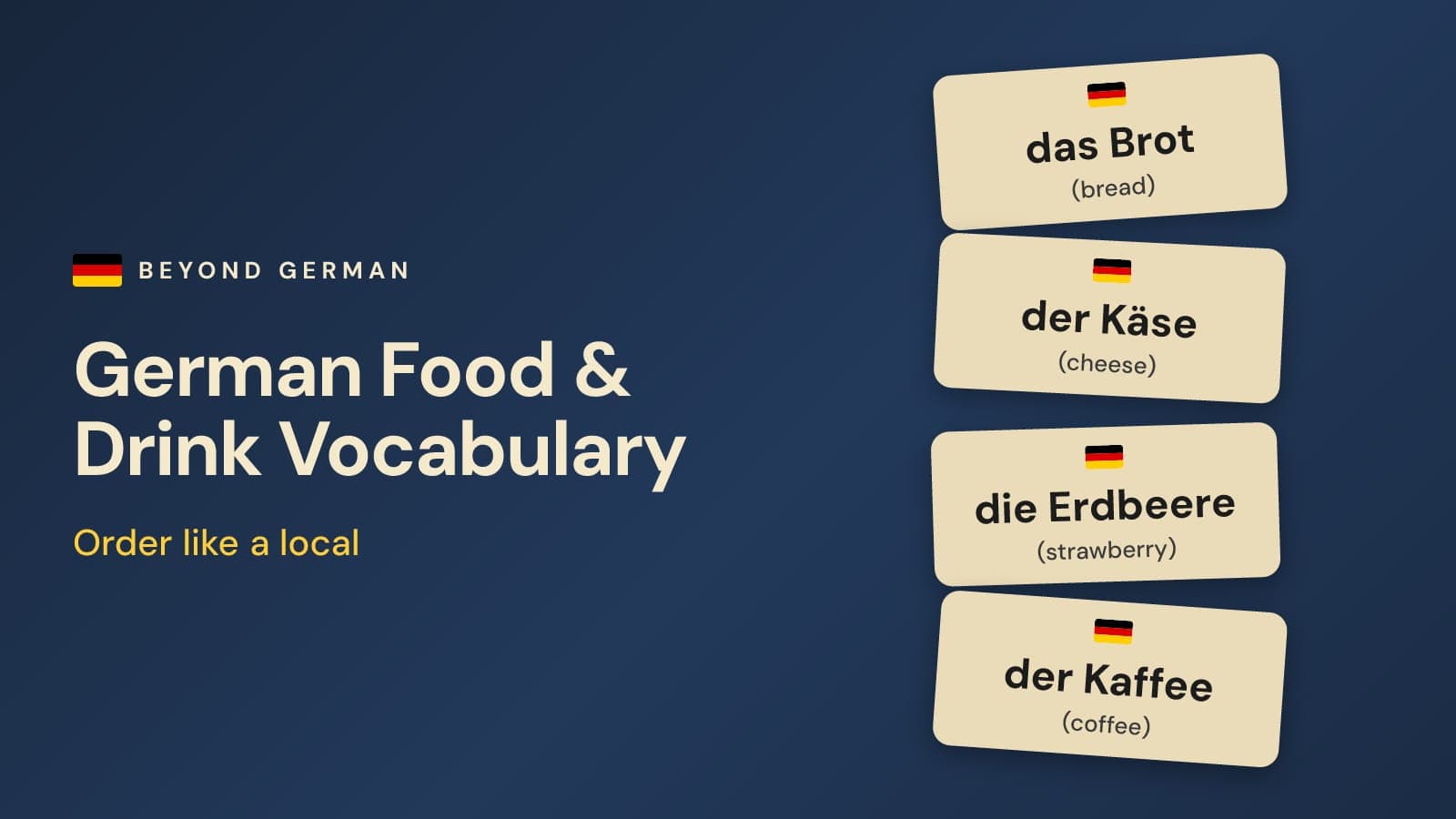
Food in German is das Essen, drinks are die Getränke, and the words you'll use most are das Brot (bread), der Käse (cheese), das Wasser (water) and der Kaffee (coffee). To order food in German, say Ich hätte gern… (I'd like…) or Ich nehme… (I'll have…) and add bitte. Below you'll find everyday foods, fruits and drinks with their articles and plurals, the German meals of the day, and the exact phrases for cafés and restaurants.
Learn every food word with its article, because the article changes how you order (einen Kaffee, eine Suppe, ein Wasser). If German genders still feel random, our guide to der, die and das explains the patterns.
Everyday Foods in German
You'll see these words on every menu and every breakfast table. A dash (—) means the word normally has no plural, like "rice" or "milk" in English.
| German | Plural | English |
|---|---|---|
| das Brot | die Brote | bread; loaf |
| das Brötchen | die Brötchen | bread roll |
| der Käse | die Käse | cheese |
| die Wurst | die Würste | sausage; cold cuts |
| das Fleisch | — | meat |
| das Hähnchen | die Hähnchen | chicken (as food) |
| der Fisch | die Fische | fish |
| das Ei | die Eier | egg |
| die Butter | — | butter |
| die Milch | — | milk |
| das Obst | — | fruit |
| das Gemüse | — | vegetables |
| die Kartoffel | die Kartoffeln | potato |
| die Nudel | die Nudeln | noodle; (plural) pasta |
| der Reis | — | rice |
| der Salat | die Salate | salad; lettuce |
| die Suppe | die Suppen | soup |
| der Kuchen | die Kuchen | cake |
| die Tomate | die Tomaten | tomato |
A few things that trip up learners:
- Brötchen are the crusty rolls Germans buy fresh at the bakery (die Bäckerei). In Bavaria and Austria they're called Semmeln, and in Berlin Schrippen.
- Wurst means hot sausages like Bratwurst, but also the sliced cold cuts you put on bread.
- Obst and Gemüse are singular in German, even where English uses a plural: Das Gemüse ist frisch. — The vegetables are fresh.
Try them in sentences:
- Ich esse gern Käse. — I like eating cheese.
- Ich esse kein Fleisch. — I don't eat meat.
- Ich bin Vegetarier. — I'm a vegetarian. (Women say Vegetarierin.)
Fruits and Berries in German
Das Obst means fruit in general. Individual fruits have their own articles, and most of them are feminine:
| German | Plural | English |
|---|---|---|
| der Apfel | die Äpfel | apple |
| die Birne | die Birnen | pear |
| die Banane | die Bananen | banana |
| die Orange | die Orangen | orange |
| die Zitrone | die Zitronen | lemon |
| die Kirsche | die Kirschen | cherry |
| die Traube | die Trauben | grape |
| die Erdbeere | die Erdbeeren | strawberry |
| die Himbeere | die Himbeeren | raspberry |
| die Heidelbeere / die Blaubeere | die Heidelbeeren / die Blaubeeren | blueberry |
| die Brombeere | die Brombeeren | blackberry |
Why Every Berry Is Feminine
Here's a rule that saves you a lot of guessing: a compound noun takes the gender of its last part. Die Beere (berry) is feminine, so every berry is too: die Erdbeere (literally "earth berry"), die Himbeere, die Brombeere. The same rule gives you der Apfelsaft (from der Saft) and die Apfelschorle (from die Schorle).
Heidelbeere and Blaubeere are the same fruit: Heidelbeere is the more standard word, but you'll hear both.
- Im Sommer esse ich gern Erdbeeren. — In summer, I like eating strawberries.
- Ein Kilo Äpfel, bitte. — A kilo of apples, please.
Can you tell your berries apart? Test yourself with our YouTube short Kennst du diese Beeren? German Vocabulary Challenge.
Drinks in German
Drinks are die Getränke (singular: das Getränk), and in a restaurant you'll find them on the Getränkekarte (drinks menu). These are the ones you'll order most:
| German | Plural | English |
|---|---|---|
| das Wasser | — | water |
| der Kaffee | die Kaffees | coffee |
| der Tee | die Tees | tea |
| der Saft | die Säfte | juice |
| die Apfelschorle | die Apfelschorlen | apple juice mixed with sparkling water |
| die Limonade | die Limonaden | fizzy soft drink, soda |
| das Bier | die Biere | beer |
| der Wein | die Weine | wine |
Still or Sparkling Water?
Ask for Wasser in a German restaurant and you'll usually get bottled mineral water, often sparkling. So say which one you want:
- Ein stilles Wasser, bitte. — A still water, please.
- Ein Wasser mit Kohlensäure, bitte. — A sparkling water, please.
- Einen Sprudel, bitte. — A sparkling water, please. (common in southwestern Germany)
The basic Ein Wasser, bitte works everywhere. Tap water is Leitungswasser. It isn't served automatically, so you have to ask for it, and not every restaurant gives it out for free.
Coffee, Juice, Beer and Wine
Kaffee is a German institution. Order eine Tasse Kaffee (a cup of coffee) or, in traditional cafés, ein Kännchen Kaffee (a small pot, about two cups). Apfelschorle is the classic German soft drink, and you'll find it on almost every menu.
For beer, keep it simple: Ein Bier, bitte. — A beer, please. For wine, choose Rotwein (red) or Weißwein (white): Ein Glas Weißwein, bitte. — A glass of white wine, please. Before the first sip, Germans say Prost! and look each other in the eye.
Two tips for ordering drinks:
- The noun usually stays singular after a number: Zwei Bier, bitte. — Two beers, please. Drei Kaffee, bitte. — Three coffees, please.
- German needs no "of" after amounts: ein Glas Wasser (a glass of water), eine Tasse Tee (a cup of tea), ein Stück Kuchen (a piece of cake).
Meals of the Day in German
| Meal | English | When and what |
|---|---|---|
| das Frühstück | breakfast | Brötchen with butter, jam, cheese or Wurst |
| das Mittagessen | lunch | around noon; traditionally the main hot meal |
| Kaffee und Kuchen | coffee and cake | mid-afternoon, especially on weekends |
| das Abendessen | dinner | early evening; hot or cold |
| das Abendbrot | supper | a cold meal of bread, cheese, Wurst and vegetables |
Culture note: Traditionally, lunch was the main hot meal in Germany, and the evening meal was Abendbrot, literally "evening bread": a simple cold spread of bread, cheese, Wurst and some vegetables. Today many people eat their hot meal in the evening, but Abendbrot is still a ritual in many homes. The word is used mostly in northern and eastern Germany; elsewhere people say Abendessen. Around noon, colleagues often greet each other with Mahlzeit! (literally "mealtime").
To talk about meals, use frühstücken (to have breakfast) and zu Mittag essen or zu Abend essen:
- Ich frühstücke um sieben Uhr. — I have breakfast at seven.
- Wir essen um zwölf zu Mittag. — We have lunch at twelve.
- Was gibt es zum Abendessen? — What's for dinner?
How to Order Food in German
Here's a whole restaurant visit, step by step.
Getting a Table and the Menu
- Ist hier noch frei? — Is this seat free? (Sharing tables is normal in busy cafés and beer gardens.)
- Einen Tisch für zwei, bitte. — A table for two, please.
- Die Speisekarte, bitte. — The menu, please.
- Was können Sie empfehlen? — What can you recommend?
Ordering: Ich hätte gern… and Ich nehme…
These two phrases cover almost every order. Ich hätte gern… (I'd like…) is polite and works everywhere; hätte is the "would have" form of haben. Ich nehme… (I'll have…) sounds natural once you've chosen from the menu.
- Ich hätte gern einen Kaffee und ein Stück Apfelkuchen. — I'd like a coffee and a piece of apple cake.
- Ich nehme die Tomatensuppe. — I'll have the tomato soup.
- Für mich das Schnitzel mit Pommes, bitte. — The schnitzel with fries for me, please.
- Kann ich einen Tee bekommen? — Can I get a tea? (Bekommen means "to get", not "to become".)
Notice einen Kaffee and einen Tee. What you order is the direct object, so masculine words change ein to einen: that's the accusative case at work. Feminine and neuter words stay the same: eine Suppe, ein Wasser.
What the Server Will Say
| German | English |
|---|---|
| Was darf es sein? | What can I get you? |
| Was möchten Sie trinken? | What would you like to drink? |
| Haben Sie schon gewählt? | Are you ready to order? |
| Sonst noch etwas? | Anything else? |
| Hat es geschmeckt? | Did you enjoy your meal? |
| Zusammen oder getrennt? | Together or separate bills? |
Paying and Tipping
In Germany, the server won't bring the bill until you ask for it. Staying a while after your meal is normal, not rude. When you're ready, catch the server's eye and say:
- Die Rechnung, bitte. — The bill, please.
- Zahlen, bitte! — I'd like to pay, please.
- Kann ich mit Karte zahlen? — Can I pay by card?
- Getrennt, bitte. — Separately, please.
Cash is still popular in small cafés and bakeries, so ask about cards first. The server usually tells you the total at the table: Das macht 18,50 Euro. — That's 18.50 euros. Germans write a comma where English uses a decimal point. If prices still go by too fast, practice your German numbers.
Tipping: Germans usually round up or add about 5–10%. Instead of leaving the tip on the table, you tell the server what you want to pay. If the bill is 18.50 euros, say Machen Sie zwanzig. — Make it twenty. If you hand over exactly what you want to pay, just say Stimmt so. — Keep the change.
A Short Café Dialogue
| Who | German | English |
|---|---|---|
| Server | Hallo! Was darf es sein? | Hi! What can I get you? |
| You | Ich hätte gern einen Cappuccino und ein Stück Käsekuchen. | I'd like a cappuccino and a piece of cheesecake. |
| Server | Gern. Sonst noch etwas? | Sure. Anything else? |
| You | Nein, danke. | No, thanks. |
| You | Die Rechnung, bitte. | The bill, please. |
| Server | Das macht 9,80 Euro. | That's 9.80 euros. |
| You | Zehn, bitte. Mit Karte. | Ten, please. By card. |
Essen vs. Fressen (and How to Use Schmecken)
Essen or Fressen?
The verb essen (to eat) is for people. Fressen is for animals: Der Hund frisst sein Futter. — The dog is eating its food. Say fressen about a person and you're saying they eat like an animal. Friends use it as a joke, but never say it to your host.
Both verbs change their vowel in the present tense (du isst, er frisst), while trinken (to drink) doesn't:
| Person | essen (to eat) | trinken (to drink) |
|---|---|---|
| ich | esse | trinke |
| du | isst | trinkst |
| er/sie/es | isst | trinkt |
| wir | essen | trinken |
| ihr | esst | trinkt |
| sie/Sie | essen | trinken |
Schmecken: How to Say Food Tastes Good
Schmecken means "to taste", and Germans use it all the time to say they like their food. The food is the subject, and the person who enjoys it goes in the dative (mir, dir, Ihnen):
- Das schmeckt gut! — That tastes good!
- Schmeckt dir der Kuchen? — Do you like the cake?
- Die Suppe schmeckt mir nicht. — I don't like the soup.
- Das ist lecker! — That's delicious!
When the server asks Hat es geschmeckt?, the classic answer is Ja, danke, sehr gut! — Yes, thanks, it was very good!
Common Mistakes
Saying "Ich bin voll" After a Big Meal
Ich bin voll is slang for "I'm drunk". When you've had enough to eat, say Ich bin satt. — I'm full.
"Being" Hungry Instead of "Having" Hunger
Germans have hunger and thirst: Ich habe Hunger. — I'm hungry. Ich habe Durst. — I'm thirsty. Ich bin Hunger is wrong, and Ich bin hungrig is correct but much less common in everyday speech.
Forgetting "einen" With Masculine Foods
Ich hätte gern ein Kaffee is a classic slip. Kaffee is masculine, so you need Ich hätte gern einen Kaffee. — I'd like a coffee.
Asking for Chips When You Want Fries
In German, Chips are potato chips (crisps) from a bag. Fries are Pommes: Eine Currywurst mit Pommes, bitte. — A currywurst with fries, please.
Practice
Cover the answers and try these before your next café visit:
- Add the article: ___ Brot, ___ Käse, ___ Erdbeere, ___ Apfelsaft.
- Order a coffee and a piece of cake politely.
- Ask for the bill and whether you can pay by card.
- Tell your host you're full (not drunk!).
Answers: 1. das Brot, der Käse, die Erdbeere, der Apfelsaft. 2. Ich hätte gern einen Kaffee und ein Stück Kuchen. 3. Die Rechnung, bitte. Kann ich mit Karte zahlen? 4. Ich bin satt.
Want more? Take an A1 German quiz, and open the word pages linked in the tables above.
FAQ
How do you say "food" in German?
The everyday word is das Essen, which means both "food" and "meal": Das Essen ist fertig! — The food is ready! Groceries are Lebensmittel.
What is the most polite way to order food in German?
Ich hätte gern… plus bitte is polite in any café or restaurant, and Ich möchte… works just as well. Avoid Ich will…, which sounds demanding.
Is tap water free in German restaurants?
Not automatically. Ask for Leitungswasser: many places bring it for free, but some charge for it. If you just say Wasser, you'll get bottled mineral water and pay for it.
How do you say "Enjoy your meal" in German?
Say Guten Appetit! before everyone starts eating. Among friends you'll also hear Lass es dir schmecken! — Enjoy your food!
Level Up Your German
Join 1,000+ learners getting weekly tips, grammar shortcuts, and cultural insights.
Share this article
Continue Reading
Common German Mistakes English Speakers Make (+ False Friends)
Why 'Ich bin heiß' gets laughs and 'Ich will' doesn't mean 'I will': 15 common German mistakes English speakers make, plus the false friends to watch out for.
Days of the Week in German, Months and How to Say the Date
Learn the days of the week and months in German with articles, abbreviations and pronunciation, plus seasons, dates like am 3. Oktober, years and holidays.
Telling Time in German: What Time Is It? (Halb Acht Explained)
Learn how to tell time in German: ask Wie spät ist es?, use the 24-hour clock, master Viertel nach and Viertel vor, and see why halb acht means 7:30.