
German Supermarket Vocabulary: Pfand, Kasse & Shopping Phrases
 Beyond German Team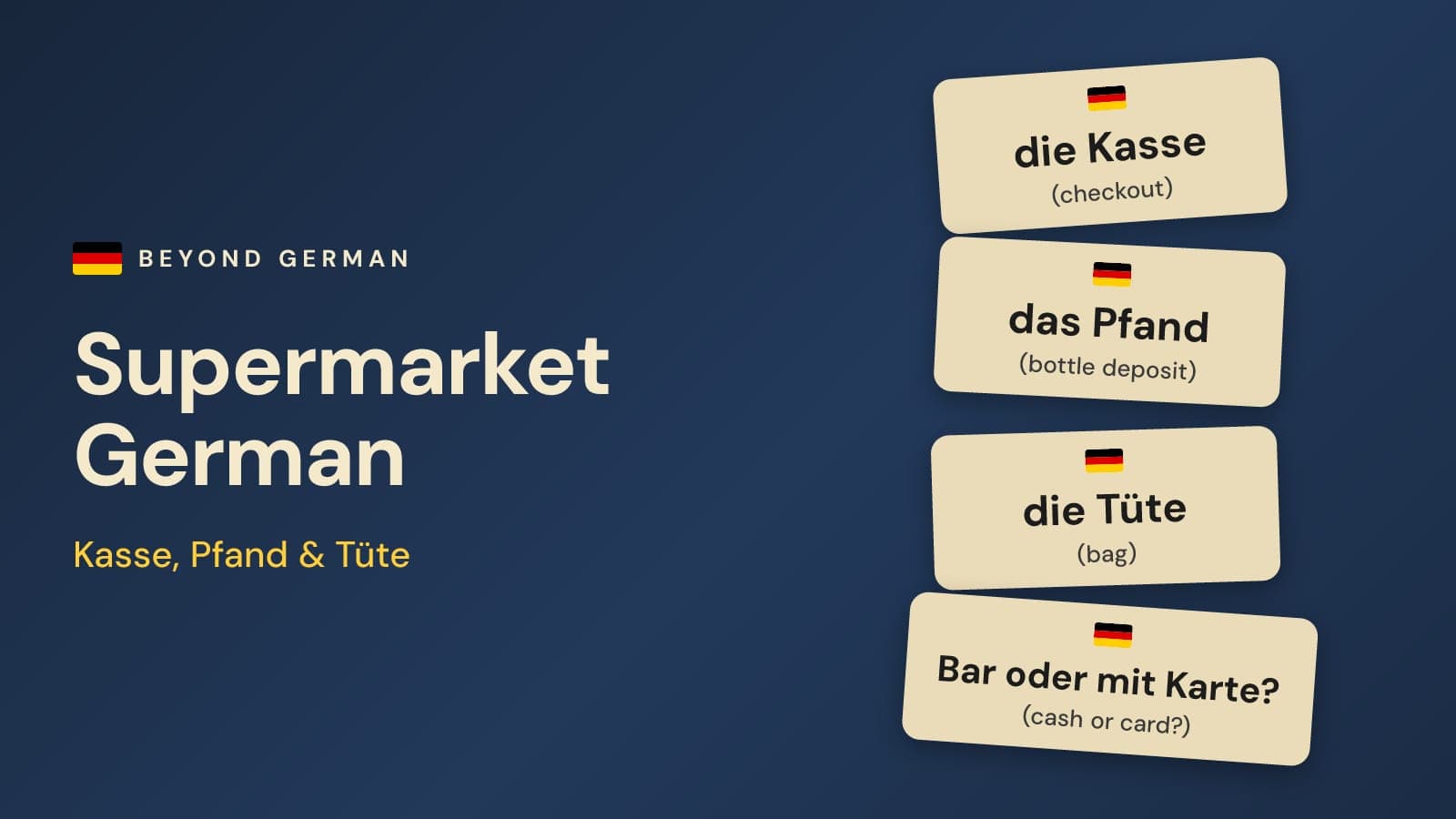
The German supermarket is der Supermarkt, the checkout is die Kasse, a shopping bag is die Tüte, and the deposit you pay on bottles and cans is das Pfand. At the checkout, expect two questions: Brauchen Sie eine Tüte? (Do you need a bag?) and Bar oder mit Karte? (Cash or card?). And plan ahead: in most of Germany, supermarkets are closed on Sundays.
Below you'll find the words for the main types of shops, how Pfand works, what the cashier will ask, how to order quantities like 200 Gramm, and the unwritten rules of a German checkout. For the food words themselves, see our guide to German food and drink vocabulary.
Types of Shops: Supermarkt, Discounter, Bäckerei
Everyday shopping is einkaufen: Ich gehe einkaufen. — I'm going shopping. Here's where you'll do it:
| German | English | Good to know |
|---|---|---|
| der Supermarkt (pl. die Supermärkte) | supermarket | Chains like Rewe and Edeka, with a wide range |
| der Discounter (pl. die Discounter) | discount supermarket | Aldi, Lidl, Netto, Penny: smaller range, lower prices |
| die Bäckerei (pl. die Bäckereien) | bakery | Fresh Brötchen every morning, often on Sundays too |
| die Metzgerei (pl. die Metzgereien) | butcher's shop | Also die Fleischerei or die Schlachterei, depending on the region |
| die Drogerie (pl. die Drogerien) | drugstore | dm, Rossmann: toiletries, cosmetics, cleaning products |
| der Wochenmarkt (pl. die Wochenmärkte) | farmers' market | Usually once or twice a week, often on a town square |
| der Kiosk (pl. die Kioske) / der Späti (pl. die Spätis) | kiosk, corner shop | Drinks, snacks, newspapers. Späti, from Spätkauf ("late shopping"), is mainly a Berlin word. |
A Drogerie isn't a pharmacy. It sells shampoo, toothpaste, diapers and cleaning products, but for most medicine, even basic painkillers, you need die Apotheke (pharmacy).
In the Supermarket: Einkaufswagen, Kasse, Angebot
| German | English | Good to know |
|---|---|---|
| der Einkaufswagen (pl. die Einkaufswagen) | shopping cart, trolley | Often needs a coin to unlock |
| der Korb (pl. die Körbe) | basket | Stacked near the entrance |
| die Kasse (pl. die Kassen) | checkout, till | an der Kasse = at the checkout; die SB-Kasse = self-checkout |
| der Kassenbon (pl. die Kassenbons) | receipt | Often just der Bon |
| die Quittung (pl. die Quittungen) | receipt | A bit more formal, e.g. for expenses |
| das Angebot (pl. die Angebote) | offer | im Angebot = on sale |
| das Sonderangebot (pl. die Sonderangebote) | special offer | Listed in the weekly flyer, der Prospekt |
The coin in the cart: many carts are chained together with a coin lock. Push a coin (usually 1 euro) or a plastic token, der Einkaufswagenchip, into the slot to release one, and you'll get it back when you return the cart. Keep one handy: Hast du einen Euro für den Wagen? — Do you have a euro for the cart?
Offers are everywhere: Die Erdbeeren sind diese Woche im Angebot. — Strawberries are on sale this week.
Asking Where Things Are: Wo finde ich…?
Can't find something? Catch an employee and ask:
- Entschuldigung, wo finde ich die Eier? — Excuse me, where can I find the eggs?
- Wo finde ich den Zucker? — Where can I find the sugar?
- Haben Sie Hafermilch? — Do you have oat milk?
Notice den Zucker: what you're looking for is the object of finden, so masculine der becomes den. That's the accusative case; die and das don't change.
The answer will often name a section of the store:
| German | English |
|---|---|
| die Obst- und Gemüseabteilung | fruit and vegetables |
| die Backwaren | bread and baked goods |
| das Kühlregal | chilled section (milk, cheese, yogurt) |
| die Tiefkühlabteilung | frozen food |
| die Getränke | drinks |
| die Fleischtheke / die Käsetheke | meat counter / cheese counter |
Or a direction: Da hinten links. — Back there on the left. Neben dem Brot. — Next to the bread. And if they're out: Das haben wir leider nicht. — Sorry, we don't have that.
How Pfand Works in Germany
When you buy most drinks in bottles or cans, you pay a deposit, das Pfand, on top of the price. The shelf label shows it, for example zzgl. 0,25 € Pfand (plus a 25-cent deposit), and you get the money back when you return the empty Flasche (bottle) or Dose (can). There are two kinds:
| Type | What it is | Deposit |
|---|---|---|
| Einweg (single-use) | Mostly plastic bottles and cans, marked with the Pfand logo. They're recycled after you return them. | 25 cents |
| Mehrweg (reusable) | Mostly glass bottles, plus some sturdy plastic ones. They're washed and refilled. | usually 8–15 cents |
Crates (der Kasten) have a deposit of their own. Wine bottles and jars usually have none: they go in the glass recycling container, der Altglascontainer.
How to Return Your Bottles
- Take your empties (das Leergut) to a supermarket and look for the sign Leergutannahme (bottle return).
- Feed them into the machine, der Pfandautomat, one at a time.
- Press the button and take your receipt, der Pfandbon.
- Hand the Pfandbon over at the checkout. The amount comes off your bill, or you get it in cash.
You can usually return single-use bottles and cans at any supermarket that sells them, not just where you bought them. Reusable bottles are best returned to a store that sells the same kind, or the machine may reject them.
- Wo ist der Pfandautomat? — Where's the bottle return machine?
- Der Automat ist voll. — The machine is full.
- Ich habe noch einen Pfandbon. — I have a deposit receipt, too.
One more custom: in cities, people often leave empty bottles next to public trash cans, not in them, so that those who collect bottles for the deposit don't have to dig through the trash. The slogan: Pfand gehört daneben (deposit belongs next to it).
Checkout Phrases: What the Cashier Will Ask
| The cashier says | English | You can answer |
|---|---|---|
| Brauchen Sie eine Tüte? | Do you need a bag? | Nein, danke. / Ja, eine, bitte. |
| Haben Sie eine Payback-Karte? | Do you have a Payback card? | Nein, danke. |
| Bar oder mit Karte? | Cash or card? | Mit Karte, bitte. / Bar, bitte. |
| Möchten Sie den Kassenbon? | Do you want the receipt? | Nein, danke. / Ja, gern. |
| Das macht 23,45 Euro. | That's 23.45 euros. | — |
Payback is a loyalty-points program used by several chains, and some cashiers ask Sammeln Sie Punkte? — Do you collect points? — instead. If you don't, Nein, danke is all you need.
Supermarkets take cards, but some bakeries and kiosks still prefer cash. If you're unsure, ask Kann ich mit Karte zahlen? (Can I pay by card?). Our guide to paying and tipping in Germany covers cards, cash and the EC card.
Checkout Culture: Scan Fast, Pack Later
German checkouts are fast, especially at discounters like Aldi and Lidl. The cashier scans at full speed, nobody bags your groceries for you, and the next customer's shopping is already rolling toward you. Here's how locals keep up:
- Put the divider, der Warentrenner, on the belt behind your items.
- Put everything straight back into your cart or basket as it's scanned. Don't hold up the line by packing at the till.
- Have your card or cash ready before the total comes up.
- Pay, then push your cart to the shelf near the exit and pack your bags there.
It can feel rushed, but it isn't rude: it's just efficient. If you need a second, a friendly Moment, bitte! — Just a moment, please! — is fine.
Bring Your Own Bag: die Tüte and the Jutebeutel
Bags usually cost money at German checkouts, and thin plastic carrier bags have been banned since 2022 (only the very thin ones for loose fruit and vegetables are still allowed). So most people bring their own:
- die Tüte (pl. die Tüten) — bag: die Plastiktüte (plastic bag), die Papiertüte (paper bag)
- der Jutebeutel (pl. die Jutebeutel) — cloth tote bag. Most are cotton rather than jute, and many Germans own a whole collection.
- Ich brauche keine Tüte, danke. — I don't need a bag, thanks.
- Ich habe einen Beutel dabei. — I've brought a bag.
- Was kostet eine Tüte? — How much is a bag?
Opening Hours: Closed on Sundays
In most of Germany, supermarkets and other shops are closed on Sundays and public holidays (die Feiertage). Sunday is a protected day of rest, one of the cultural habits in Germany newcomers notice first, so do your big shop on Saturday. The exceptions: shops in large train stations and airports, petrol stations, many bakeries on Sunday mornings, some kiosks and Spätis depending on local rules, and a few special shopping Sundays a year (verkaufsoffene Sonntage).
From Monday to Saturday, hours depend on the state and the store: in big cities, many supermarkets stay open until 10 p.m. or later, while in smaller towns, 8 p.m. is common. Signs use the 24-hour clock (see our guide to telling time in German):
- Öffnungszeiten: Mo–Sa 7–22 Uhr — Opening hours: Monday to Saturday, 7 a.m. to 10 p.m.
- Wann macht der Supermarkt zu? — When does the supermarket close?
- Haben Sie am Sonntag geöffnet? — Are you open on Sunday?
Quantities: ein Kilo, 200 Gramm, eine Packung
German doesn't use "of" with quantities: the food comes straight after the amount.
| German | English | Example |
|---|---|---|
| das Kilo | kilo | Ein Kilo Äpfel, bitte. — A kilo of apples, please. |
| das Pfund | half a kilo | Ein Pfund Tomaten, bitte. — Half a kilo of tomatoes, please. |
| das Gramm | gram | 200 Gramm Käse, bitte. — 200 grams of cheese, please. |
| der Liter | liter | Zwei Liter Milch. — Two liters of milk. |
| die Packung | pack, box | Eine Packung Nudeln. — A pack of pasta. |
| die Flasche | bottle | Zwei Flaschen Wasser. — Two bottles of water. |
| die Dose | can, tin | Eine Dose Tomaten. — A can of tomatoes. |
| das Stück | piece; each | Drei Stück, bitte. — Three, please. |
One rule to remember: masculine and neuter units stay singular after a number (zwei Kilo, 200 Gramm, drei Stück), while feminine ones take the plural (zwei Flaschen, drei Packungen).
At the counter, you'll hear Was darf's sein? — What can I get you? Answer with Ich hätte gern… or the very common Ich bekomme…:
- Ich hätte gern 200 Gramm Gouda. — I'd like 200 grams of Gouda.
- Ich bekomme sechs Brötchen. — I'll have six rolls.
- Darf's ein bisschen mehr sein? — Is a little more OK? (when the cut weighs a bit more than you asked for)
- Sonst noch etwas? — Anything else? Nein, danke, das war's. — No, thanks, that's all.
Prices are written with a comma, so 2,49 € is zwei Euro neunundvierzig, or just zwei neunundvierzig. To ask, use Was kostet das?, and if prices still go by too fast, practice with our guide to German numbers.
Common Mistakes
| Wrong | Right | Why |
|---|---|---|
| Ich gehe shoppen. (for groceries) | Ich gehe einkaufen. | Shoppen is shopping for fun, like clothes. |
| ein Kilo von Äpfeln | ein Kilo Äpfel | No "of" after a quantity. |
| zwei Kilos Tomaten | zwei Kilo Tomaten | Masculine and neuter units stay singular. |
| zwei Flasche Wasser | zwei Flaschen Wasser | Feminine units take the plural. |
| Wo finde ich der Zucker? | Wo finde ich den Zucker? | What you're looking for is in the accusative. |
| Ich gehe in die Drogerie. (for medicine) | Ich gehe in die Apotheke. | Most medicine, even painkillers, is sold only at the pharmacy. |
The costliest mistake isn't grammar, though: throwing Pfand bottles in the trash. At up to 25 cents each, that adds up fast.
Practice
What do you say? Cover the answers and try it out loud:
- The cashier asks Brauchen Sie eine Tüte? You brought your own bag.
- You can't find the eggs.
- At the cheese counter, you'd like 200 grams of Gouda.
- The cashier asks Bar oder mit Karte? You want to pay by card.
- You want three bottles of water.
- You have a Pfandbon to hand in.
Answers: 1. Nein, danke, ich habe einen Beutel dabei. 2. Entschuldigung, wo finde ich die Eier? 3. Ich hätte gern 200 Gramm Gouda. 4. Mit Karte, bitte. 5. Drei Flaschen Wasser, bitte. 6. Ich habe noch einen Pfandbon.
Then test yourself with an A1 German quiz.
FAQ
What is Pfand in Germany?
A deposit on drink bottles and cans, refunded when you return the empties at a supermarket's Pfandautomat: 25 cents for single-use bottles and cans (Einweg), usually 8–15 cents for reusable bottles (Mehrweg).
Are supermarkets open on Sundays in Germany?
In most of Germany, no. Shops are closed on Sundays and public holidays, except in large train stations, airports and petrol stations. Many bakeries open on Sunday mornings.
How do you say "shopping" in German?
Einkaufen is everyday shopping, including groceries: Ich gehe einkaufen. Shoppen is shopping for fun, like clothes. The groceries you carry home are die Einkäufe.
Do German supermarkets give out free bags?
Usually not. Bags cost money at the checkout, so most people bring their own, like a Jutebeutel or a backpack.
What does "im Angebot" mean?
On sale, or on special offer: Die Butter ist im Angebot. — Butter is on sale. The weekly flyer (der Prospekt) lists the week's Angebote.
Level Up Your German
Join 1,000+ learners getting weekly tips, grammar shortcuts, and cultural insights.
Share this article
Continue Reading
Hobbies in German: Was machst du gern? Freizeit Vocabulary
How to talk about hobbies in German: ask Was machst du in deiner Freizeit?, answer with gern, lieber and am liebsten, and learn Freizeit vocabulary by category.
Directions in German: Links, Rechts, Geradeaus & How to Ask
How to ask for directions in German (Wie komme ich zum Bahnhof?), understand links, rechts and geradeaus, plus city vocabulary, two dialogues and common mistakes.
Rooms in German: House & Furniture Vocabulary With Plurals
Rooms, furniture and appliances in German with articles and plurals, plus how to describe your home, which floor the Erdgeschoss is, and why Germans air their rooms.