
How to Tip in Germany: Paying the Bill, Stimmt so & More
 Beyond German Team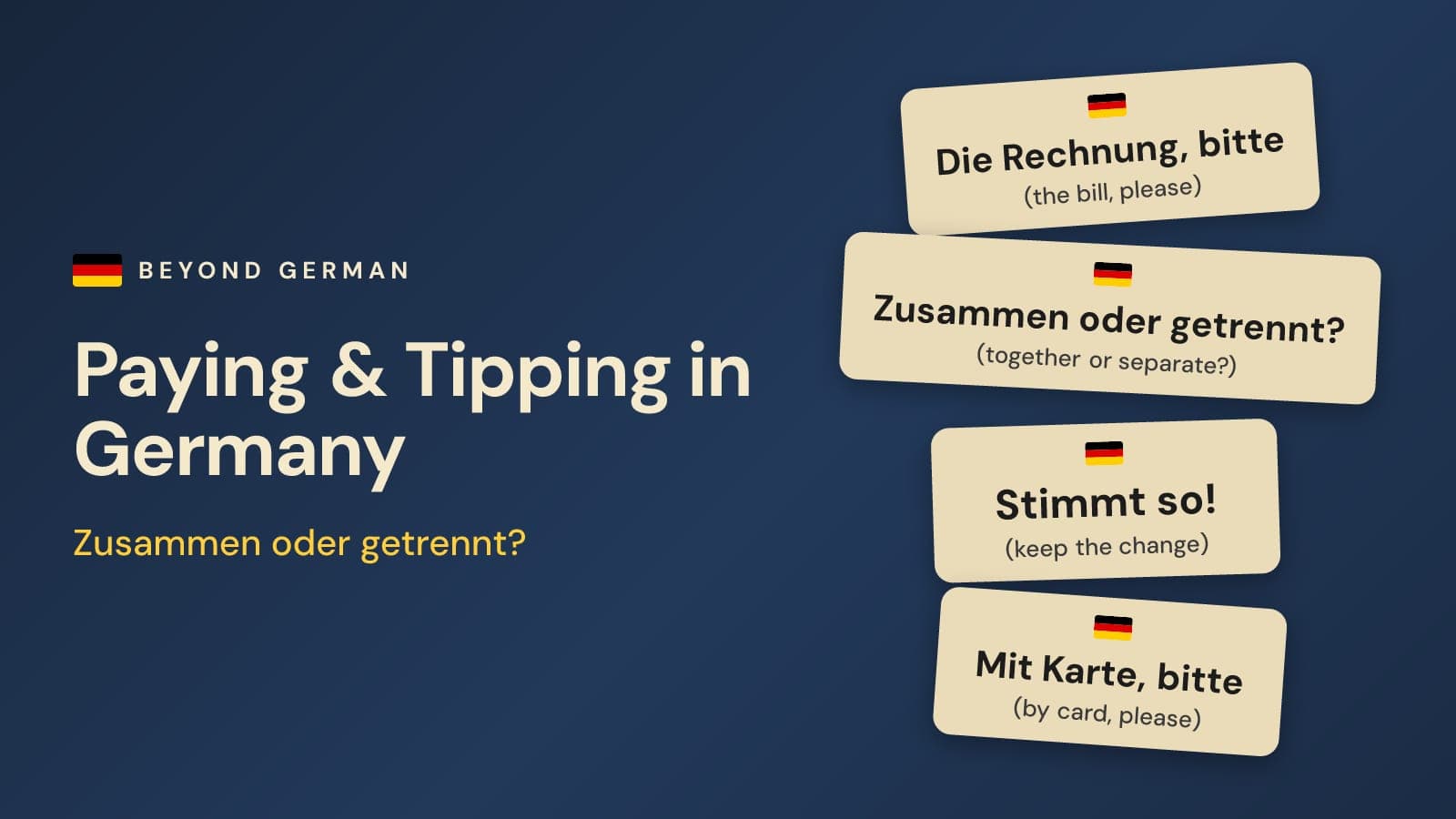
To pay in a German restaurant, catch your server's eye and say Die Rechnung, bitte (The bill, please). The server will ask Zusammen oder getrennt? (Together or separate?) and tell you the total. To tip, round up or add about 5–10% and say the new total out loud, for example Machen Sie 25 (Make it 25), or hand over the money and say Stimmt so (Keep the change).
Below are the exact phrases for each step, plus how to tip by card and what to give taxi drivers, hairdressers and hotel staff.
How to Ask for the Bill in German
In Germany, the server won't bring the bill until you ask for it (the culture notes below explain why). When you're ready to go, make eye contact or raise your hand slightly, and say one of these:
- Die Rechnung, bitte. — The bill, please.
- Zahlen, bitte! — I'd like to pay, please. (literally "Pay, please!")
- Wir möchten bitte zahlen. — We'd like to pay, please.
- Ich möchte bitte zahlen. — I'd like to pay, please.
All four are polite. Zahlen, bitte! is short and works well across a busy room. Wir möchten bitte zahlen is the softest, perfect for a nicer restaurant.
If the server is busy, a friendly Entschuldigung! (Excuse me!) gets their attention. Never snap your fingers or call out Kellner! (Waiter!): both come across as rude.
Zusammen oder getrennt? (Together or Separate?)
Once you ask for the bill, the server will almost always ask Zusammen oder getrennt? It means "Together or separate?": should one person pay for the whole table, or should everyone pay for their own food and drinks?
- Zusammen, bitte. — Together, please. (One person pays for everything.)
- Getrennt, bitte. — Separately, please. (Everyone pays for what they had.)
- Ich zahle für uns beide. — I'm paying for both of us.
- Das geht auf mich. — This one's on me.
If you say getrennt, the server goes around the table and asks each person Was hatten Sie? (What did you have?). You list your items, for example Ich hatte die Lasagne und eine Cola. — I had the lasagna and a Coke. The server adds them up on the spot and tells you your total. If the menu words are still new to you, our German food and drink vocabulary guide covers them.
To treat someone, say Ich lade dich ein. — It's my treat. (To someone you call Sie: Ich lade Sie ein.) In German, inviting someone (einladen) usually means you pay. And on your birthday, you're often the one who treats your friends (see our guide to German birthday traditions).
How Tipping Works in Germany
The German word for tip is das Trinkgeld, literally "drink money". In a sit-down restaurant, a normal tip is about 5–10%. For small bills, like a coffee or a beer, people simply round up to the next euro or two.
Why so much less than in the US? Menu prices in Germany already include service and tax, and servers earn at least the legal minimum wage. The tip is a thank-you for good service, not the server's salary.
Say the Total, Not the Tip
Here's the part that confuses visitors: you don't leave the tip on the table. You tell the server how much you want to pay in total, tip included, and they give you change from that amount.
Say your bill is 22,80 € and you hand over a 50-euro note. You want to pay 25, so you say Machen Sie 25. — Make it 25. The server keeps 25 and gives you 25 back. You can also just say the number: Fünfundzwanzig, bitte. — Twenty-five, please.
| Bill | You say | Tip |
|---|---|---|
| 4,60 € | Fünf, bitte. | 0,40 € |
| 18,50 € | Machen Sie 20. | 1,50 € |
| 37,20 € | Machen Sie 40. | 2,80 € |
| 68,90 € | Machen Sie 75. | 6,10 € |
Germans write prices with a comma, so 18,50 € is 18 euros and 50 cents. You'll hear it as achtzehn Euro fünfzig or just achtzehn fünfzig. If prices still go by too fast, brush up on your German numbers before your next meal out.
Stimmt so: Keep the Change
Stimmt so literally means "It's right like that." You say it when the money you hand over is exactly what you want to pay, tip included, so you don't want any change. Your bill is 9,20 € and you give the server a 10-euro note? Stimmt so. — Keep the change.
You'll also hear Passt so (especially in southern Germany and Austria) and Der Rest ist für Sie. — The rest is for you. All three mean the same thing.
Paying by Card or Cash
It's worth asking before you order: Kann ich mit Karte zahlen? — Can I pay by card? Card payment is now normal in Germany, but some small restaurants, bars, bakeries and kiosks still take only cash. Look out for signs like these:
- Nur Barzahlung — Cash only
- Kartenzahlung ab 10 € — Card payment only from 10 euros
- Keine Kartenzahlung — No card payments
Cash is das Bargeld, and paying in cash is bar zahlen: Ich zahle bar. — I'll pay cash. If you run out, ask Wo ist der nächste Geldautomat? — Where's the nearest ATM?
EC Card, Girocard and Credit Cards
Many Germans pay with a girocard, the German bank debit card. Most people still call it by its old name, EC-Karte. Some places accept girocard but not credit cards, so if your card is from abroad, ask Nehmen Sie Kreditkarten? — Do you take credit cards?
Tipping by Card
Want to tip on your card? Say the total before the server types the amount into the card machine: Mit Karte, bitte. Machen Sie 40. — By card, please. Make it 40. The server usually brings the machine to your table and says Einfach hinhalten. — Just tap your card.
In some cafés, the card machine suggests a tip on the screen. At a counter, tipping is optional, so you can pick an amount or skip it.
Tipping in Other Situations
Outside restaurants, tips are smaller and more relaxed. These are typical amounts, not rules, and Germans themselves vary a lot:
| Situation | Typical tip | What to do |
|---|---|---|
| Café or bar with table service | Round up to the next euro or two | Say the total, or Stimmt so |
| Counter service, bakery, coffee to go | Optional | Use the tip jar if you like |
| Taxi | Round up, or about 5–10% | Machen Sie 20, bitte. |
| Hairdresser | A few euros, or about 5–10% | Hand it to your stylist: Das ist für Sie. |
| Food delivery | 1–3 euros | Stimmt so at the door, or tip in the app |
| Hotel housekeeping | 1–2 euros per night | Leave it in the room with a short note |
| Hotel porter | 1–2 euros per bag | Hand it over with a Danke |
| Toilet attendant | 50 cents | Put it on the plate by the entrance |
You don't need to tip in supermarkets or at self-service counters. And if the service was bad, it's fine to tip less or not at all.
Useful Phrases for Paying and Tipping
| German | English |
|---|---|
| Die Rechnung, bitte. | The bill, please. |
| Zahlen, bitte! | I'd like to pay, please. |
| Wir möchten bitte zahlen. | We'd like to pay, please. |
| Zusammen, bitte. / Getrennt, bitte. | Together, please. / Separately, please. |
| Das geht auf mich. | This one's on me. |
| Kann ich mit Karte zahlen? | Can I pay by card? |
| Nehmen Sie Kreditkarten? | Do you take credit cards? |
| Ich zahle bar. | I'll pay cash. |
| Machen Sie 25. | Make it 25. |
| Stimmt so. | Keep the change. |
| Kann ich eine Quittung bekommen? | Can I get a receipt? |
And these are the lines you'll hear from the server:
- Mit Karte oder bar? — Card or cash?
- Das macht 31,40 Euro. — That comes to 31.40 euros.
- Haben Sie es kleiner? — Do you have anything smaller?
- Brauchen Sie eine Quittung? — Do you need a receipt?
Sample Dialogue: Paying at a Restaurant
You and your friend Lena are finishing dinner. You pay separately: you tip by card, and Lena pays cash.
| Who | German | English |
|---|---|---|
| Server | Hat's geschmeckt? | Did you enjoy your meal? |
| You | Ja, sehr gut, danke! Wir möchten bitte zahlen. | Yes, very good, thanks! We'd like to pay, please. |
| Server | Gern. Zusammen oder getrennt? | Sure. Together or separate? |
| You | Getrennt, bitte. | Separately, please. |
| Server | Was hatten Sie? | What did you have? |
| You | Die Lasagne und eine Apfelschorle. | The lasagna and an apple spritzer. |
| Server | Das macht 16,80 Euro. | That's 16.80 euros. |
| You | Machen Sie 18. Kann ich mit Karte zahlen? | Make it 18. Can I pay by card? |
| Server | Natürlich. Einfach hinhalten. … Und bei Ihnen? | Of course. Just tap your card. … And for you? |
| Lena | Die Pizza und ein Bier. | The pizza and a beer. |
| Server | Das sind 14,20 Euro. | That's 14.20 euros. |
| Lena | Stimmt so. | Keep the change. (hands over 15 euros) |
| Server | Vielen Dank! Schönen Abend noch! | Thank you! Have a nice evening! |
Nobody named the tip itself: you said your total (18), and Lena handed over exactly what she wanted to pay (15).
Culture Notes: Why Germans Pay This Way
The Bill Only Comes When You Ask
In many countries, the bill arrives with your last plate. In Germany, that would feel like being asked to leave. Your table is yours for the evening, and lingering over a last drink is completely normal. If you're in a hurry, ask early: Wir sind etwas in Eile. Können wir schon zahlen? — We're in a bit of a hurry. Can we pay now?
Splitting the Bill Item by Item Is Normal
Paying getrennt isn't stingy or awkward in Germany. Friends, colleagues and even couples often pay for exactly what they ordered, down to the last Apfelschorle, and servers are used to it. Splitting the total evenly is less common, but you can ask: Können Sie das bitte durch drei teilen? — Could you split it three ways, please?
For more everyday customs, read our guide to cultural habits in Germany.
Common Mistakes
Saying the Tip Instead of the Total
If your bill is 18,50 € and you say Machen Sie zwei, the server will be confused, or think you want to pay 2 euros. Always say the new total: Machen Sie 20. — Make it 20.
Saying "Danke" While Handing Over Money
If you say Danke as you hand over a 50-euro note, some servers take it to mean "keep the change". If you want change, say the total first and save your Danke for when you get it.
Asking for "den Scheck" or Calling the Tip a "Tipp"
Two false friends: der Scheck is a bank cheque, not the bill (that's die Rechnung), and der Tipp is a hint or piece of advice. A tip for the server is always das Trinkgeld: Wie viel Trinkgeld gibt man hier? — How much do people tip here? Our list of common German mistakes has more false friends like these.
Saying "Euros" After a Number
German keeps Euro and Cent singular after numbers: Das kostet zwanzig Euro. — That costs twenty euros. Zwanzig Euros sounds wrong to German ears.
Practice
Cover the answers and say these out loud:
- Ask for the bill in two different ways.
- The server asks Zusammen oder getrennt? You're paying for your friend too.
- Your bill is 27,40 €. You want to pay 30.
- Your coffee costs 3,70 €. You hand over 4 euros and don't want change.
- Ask if you can pay by card.
Answers: 1. Die Rechnung, bitte. / Zahlen, bitte! / Wir möchten bitte zahlen. 2. Zusammen, bitte. Ich zahle für uns beide. 3. Machen Sie 30. (or: Dreißig, bitte.) 4. Stimmt so. 5. Kann ich mit Karte zahlen?
Notice that möchten and können send zahlen to the end of the sentence. That's how German modal verbs work. When you're ready, test yourself with an A1 German quiz.
FAQ
How much should you tip in Germany?
In a sit-down restaurant, about 5–10% is normal, and around 10% for great service. For small amounts, like a coffee or a beer, round up to the next euro. Tipping is never required by law.
What does "Stimmt so" mean?
Stimmt so means "Keep the change". Literally it's "It's right like that": you're telling the server that the money you handed over is the right amount, tip included.
Is it rude not to tip in Germany?
Not rude, but in a sit-down restaurant, leaving no tip at all usually signals that you weren't happy with the service. At counters, bakeries and self-service places, tipping is optional.
Can you tip by card in Germany?
Yes. Tell the server your total before they type it into the card machine: Machen Sie 30, bitte. — Make it 30, please. You can also pay the bill by card and hand over the tip in cash.
Level Up Your German
Join 1,000+ learners getting weekly tips, grammar shortcuts, and cultural insights.
Share this article
Continue Reading
Anmeldung in Germany: German Phrases for the Bürgeramt
Registering your address in Germany? The documents, Bürgeramt vocabulary with articles, the phrases you'll say and hear at the counter, a sample dialogue and what comes next.
Merry Christmas in German: Frohe Weihnachten & Traditions
Learn how to say Merry Christmas and Happy New Year in German, plus the traditions from Advent and Nikolaus to Heiligabend and Silvester, with food and market words.
Happy Birthday in German: Alles Gute zum Geburtstag & Wishes
Learn how to say happy birthday in German, from Alles Gute zum Geburtstag to formal card wishes, plus belated wishes, the birthday song and why Germans never congratulate early.