Cheers in German: Prost, Zum Wohl and How to Toast
 Beyond German Team
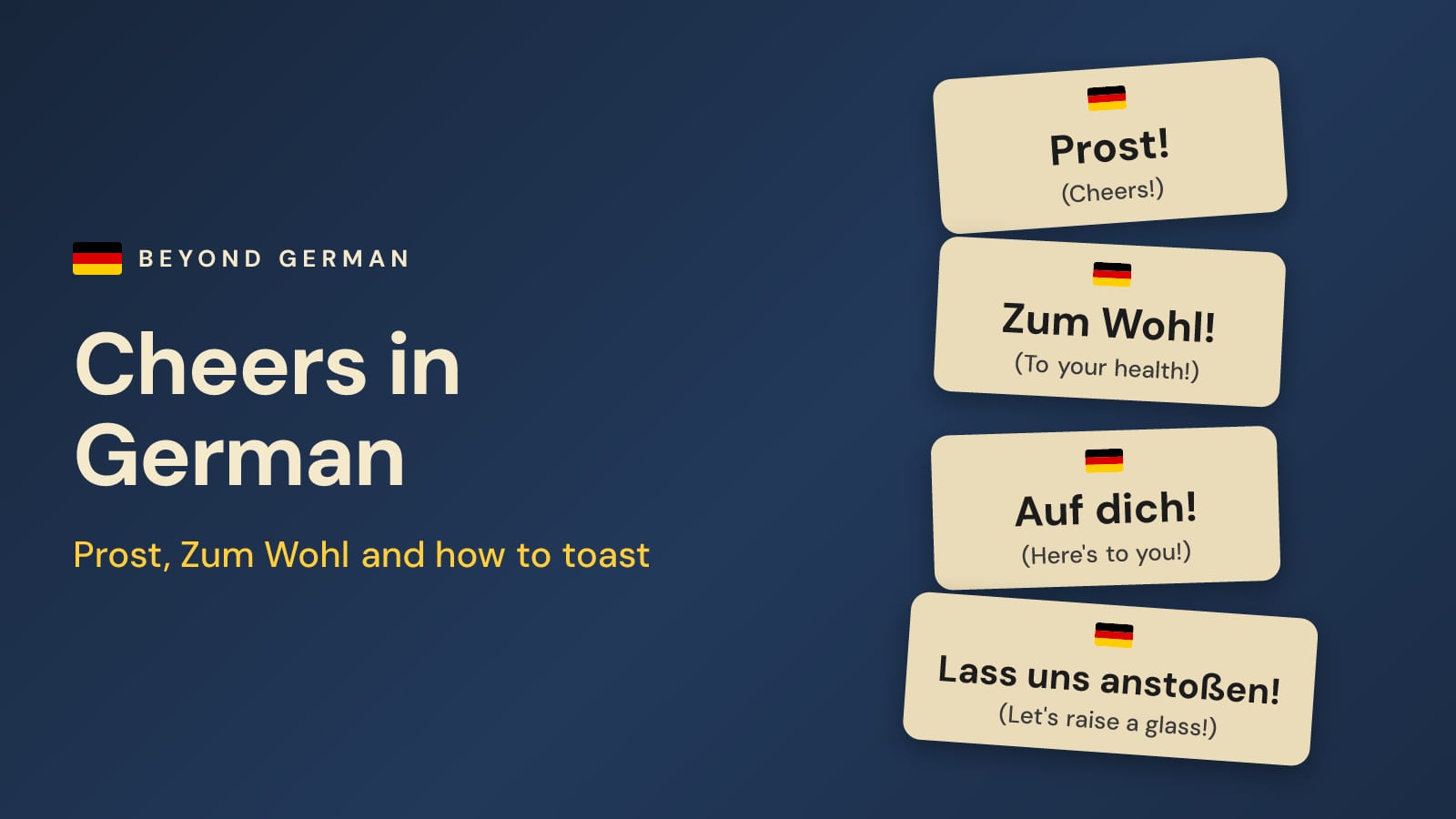
Cheers in German is Prost (PROHST). It's the everyday toast for raising a glass with friends, family or colleagues, whatever is in the glass. Over wine, at a dinner or in a more formal setting, many people say Zum Wohl! (tsum VOHL) instead.
The words are easy; the small customs around them make you sound at home. Below: a quick table, what Prost really means, how to toast a person, the etiquette, the famous Oktoberfest song, the British "cheers" that means thanks or bye, and why Gesundheit is not a toast. Then mistakes, practice and quick answers.
Cheers in German: The Quick Answer
All of these work when glasses go up:
| German | English | When to say it |
|---|---|---|
| Prost! | Cheers! | Everyday, with anyone |
| Prosit! | Cheers! | Older and more festive; New Year, the Oktoberfest song |
| Zum Wohl! | To your health! Cheers! | Wine, dinners, formal occasions |
| Auf dich! / Auf Sie! | Here's to you! | Toasting one person |
| Auf uns! | Here's to us! | Friends, couples, teams |
| Lass uns anstoßen! | Let's raise a glass! | Suggesting a toast |
| Hoch die Tassen! | Glasses up! | Casual and playful |
| Prost Neujahr! | Cheers to the New Year! | At midnight on New Year's Eve |
If you only learn one, learn Prost. It works almost everywhere.
Prost: Pronunciation and Meaning
How to Pronounce Prost
Say PROHST: it rhymes with "ghost". The o is long and pure, the r is the soft German r from the back of the throat, and the final st is a plain "st", not "sht". Our guide to the German alphabet and pronunciation covers the r in detail.
What Does Prost Mean?
Prost is short for prosit, a Latin word meaning "may it be good for you" or, more literally, "may it benefit". Dictionaries say it probably started out as university students' slang. So every time you say Prost, you're wishing the people around you well.
It also works as a noun, das Prost (a toast):
- Ein Prost auf die Köchin! (A toast to the cook!)
- Ein Prost auf uns alle! (Here's to all of us!)
Prost or Prosit?
They mean the same thing. Prosit (PROH-zit) is the older, fuller form and sounds a little more festive or old-fashioned. Today you mostly hear it in two places: the New Year wish and the song Ein Prosit der Gemütlichkeit (more on that below). For everything else, Prost is the natural choice, and it's used in Austria and Switzerland too.
Prost Neujahr: The New Year Toast
At midnight on New Year's Eve, people raise a glass and say Prost Neujahr! or Prosit Neujahr! (Cheers to the New Year!) The timing matters: before midnight, the wish is Guten Rutsch!, and after midnight it's Frohes neues Jahr! Our guide to Christmas and New Year in German has every wish for the season.
Zum Wohl: The Polished Way to Say Cheers
Zum Wohl (tsum VOHL) means "to your well-being". Das Wohl is well-being, from the adverb wohl (well), and zum is short for zu dem. The z sounds like "ts", the w like an English "v", and the h is silent.
It sounds a touch more refined than Prost, so you'll hear it:
- over a glass of wine or sparkling wine
- at dinner parties, weddings and business dinners
- with people you call Sie
- from servers as they bring your drinks
To toast a specific person, make it personal with auf:
- Auf Ihr Wohl, Herr Becker! (To your health, Mr. Becker!) Formal.
- Auf dein Wohl! (To your health!) For one person you call du.
- Auf euer Wohl! (To your health, everyone!) For a group.
In real life, the two overlap a lot. Many people lean toward Prost with beer and Zum Wohl with wine, but that's a tendency, not a rule.
How to Toast Someone in German
Auf: Here's to You, Here's to Us
English says "here's to…" or "to…". German says auf plus the accusative case:
| German | English |
|---|---|
| Auf dich! | Here's to you! (one friend) |
| Auf Sie! | Here's to you! (formal) |
| Auf euch! | Here's to you all! |
| Auf uns! | Here's to us! |
| Auf das Geburtstagskind! | To the birthday girl or boy! |
| Auf die Gastgeber! | To the hosts! |
| Auf das Brautpaar! | To the happy couple! |
| Auf die Freundschaft! | To friendship! |
| Auf ein gutes neues Jahr! | To a good New Year! |
| Auf gute Zusammenarbeit! | To working together! |
Two short reactions are worth knowing too: Darauf trinken wir! (Let's drink to that!) and Ein Hoch auf die Gastgeber! (Three cheers for the hosts!)
Anstoßen and Zuprosten: The Verbs
Anstoßen (AN-shtoh-sen) means to clink glasses or to drink a toast. It's a separable verb, so in a normal statement an jumps to the end:
- Lass uns anstoßen! (Let's raise a glass!) To one person. To a group: Lasst uns anstoßen!
- Wir stoßen auf dich an. (We're drinking a toast to you.)
- Darauf müssen wir anstoßen! (We have to toast to that!)
- Wir haben auf das Brautpaar angestoßen. (We drank a toast to the couple.)
Use mit for the people you clink with and auf for what you're celebrating: Ich stoße mit dir auf deinen neuen Job an. (I'm toasting your new job with you.)
Zuprosten means to raise your glass toward someone, often across a table or room, without clinking: Er prostet ihr über den Tisch zu. (He raises his glass to her across the table.) Sie prosten sich zu. (They raise their glasses to each other.)
Giving a Short Toast
A toast speech is ein Toast or ein Trinkspruch, and you "bring it out": Ich möchte einen Toast auf die Gastgeber ausbringen. (I'd like to propose a toast to the hosts.) Fun fact: der Toast is also toasted bread. A short toast at a friend's birthday could sound like this:
You: Ich möchte kurz etwas sagen. (I'd like to say a few words.)
You: Danke, dass ihr alle gekommen seid. (Thanks for coming, everyone.)
You: Lasst uns die Gläser erheben: auf Anna! (Let's raise our glasses: to Anna!)
Everyone: Auf Anna! Prost! (To Anna! Cheers!)
At birthdays, guests may also sing Hoch soll sie leben, the German "three cheers". Our happy birthday in German guide has the words and the midnight toast tradition.
Playful and Casual Toasts
- Prösterchen! A cute, affectionate little "cheers" for friends and family. Say it with a smile.
- Stößchen! A playful "little clink", from anstoßen. It's less common than Prost, and you'll hear it more in some regions than others.
- Hoch die Tassen! Literally "up with the cups": a casual "come on, glasses up!"
These are fun among friends but sound jokey at a formal dinner. When in doubt, Prost or Zum Wohl.
How to Clink Glasses in Germany: Toasting Etiquette
A few customs come with clinking glasses, and they're widely followed even at relaxed get-togethers:
- Look each person in the eye as your glasses touch. Looking at the glass instead is the classic beginner's slip.
- At a small table, clink with everyone, one person at a time.
- At a long table or in a big group, don't reach across. Raise your glass, catch people's eyes and nod. Many people also avoid crossing arms over another pair who are clinking, which some consider bad luck.
- Wait until everyone has toasted before your first sip. At a dinner, the host often opens with the first toast.
- At formal events, people often just raise their glasses without clinking.
Toasting Without Alcohol
Toasting is about the people, not the drink. Raising a glass of alkoholfreies Bier (alcohol-free beer), Apfelschorle (apple juice with sparkling water) or juice is completely normal. Some people say it's bad luck to toast with water; many simply don't care. Useful phrases:
- Ich trinke keinen Alkohol. (I don't drink alcohol.)
- Nein danke, ich muss noch fahren. (No thanks, I'm driving.)
- Für mich eine Apfelschorle, bitte. (An Apfelschorle for me, please.)
- Ich stoße mit Saft an. (I'll toast with juice.)
Ein Prosit der Gemütlichkeit: The Oktoberfest Toast Song
If you've searched for "ein prosit", this is probably the song you heard. Ein Prosit der Gemütlichkeit is a short traditional toast song that bands play again and again at Oktoberfest, other folk festivals and many parties. When it starts, everyone raises a glass and sings along:
Ein Prosit, ein Prosit der Gemütlichkeit! (A toast, a toast to good cheer!)
Ein Prosit, ein Prosit der Gemütlichkeit!
It's often followed by the shout Oans, zwoa, drei, g'suffa! That's Bavarian dialect for roughly "one, two, three, drink up!" Then the glasses clink.
Gemütlichkeit (guh-MEWT-likh-kite) has no single English match. It's the warm, relaxed, cozy feeling of being in good company, from gemütlich (cozy, comfortable). Der Gemütlichkeit is dative, an old-fashioned way to name what the toast is for. In everyday German today, you'd say Ein Prost auf die Gemütlichkeit!
When "Cheers" Doesn't Mean Prost
Cheers as Thanks
In British English, "cheers" often means "thanks". Prost doesn't work that way. Say:
- Danke! (Thanks!) Fine with anyone, or Danke dir! with friends.
- Danke schön! (Thank you!) Friendly and polite.
And if you sign off emails with "Cheers, Sam", use Viele Grüße (best wishes) for most people or Liebe Grüße (love, warm wishes) for friends. More in our guide to thank you in German.
Cheers as Goodbye
When "cheers" means "bye", German says Tschüss!, Ciao! or Mach's gut! (Take care!) See how to say goodbye in German for the full range.
Prost vs Gesundheit: Bless You in German
Gesundheit! (guh-ZOONT-hite) is what you say when someone sneezes: "bless you", literally "health". The answer is simply Danke! In very formal settings, some etiquette guides suggest saying nothing and letting the person who sneezed say Entschuldigung, but in everyday life Gesundheit is normal and friendly.
Because Gesundheit means health, learners sometimes use it as a toast. On its own, it only means "bless you". The full phrase Auf Ihre Gesundheit! or Auf deine Gesundheit! (To your health!) does work as a toast, though it sounds a little old-fashioned.
What Gesundheit means, how to reply and when Germans skip it: it is all in our guide to bless you in German.
Prost Mahlzeit! The Ironic One
Despite the words, Prost Mahlzeit! is not a mealtime wish. It's a colloquial, ironic "well, that's just great" when something goes wrong:
- Der Zug fällt aus? Na dann, prost Mahlzeit! (The train's cancelled? Well, that's just great!)
To wish someone a nice meal, say Guten Appetit!
Cheers at a Restaurant or Bar
When servers bring drinks, they often say Zum Wohl!, just as they say Guten Appetit! with the food. A simple Danke! is the answer. A typical evening out:
Server: Zwei Apfelschorlen und ein Rotwein. Zum Wohl! (Two Apfelschorles and a red wine. Enjoy!)
You: Danke! (Thanks!)
Friend: Prost! Auf einen schönen Abend! (Cheers! To a lovely evening!)
You, later: Noch eine Runde, bitte! (Another round, please!)
Just one more drink? Noch eins, bitte. (One more, please.) For ordering, see our German food and drink vocabulary, and for the bill, paying and tipping in Germany.
Common Mistakes
Saying Gesundheit as a Toast
Wrong: Gesundheit! (as you raise your glass) Right: Prost! or Auf deine Gesundheit!
On its own, Gesundheit answers a sneeze.
Using Prost for Thanks
Wrong: Prost! (when someone holds the door) Right: Danke!
British "cheers" for thanks is Danke in German.
Using the Wrong Case After Auf
Wrong: Auf dir! Right: Auf dich!
Wrong: Auf dem Gastgeber! Right: Auf den Gastgeber!
In a toast, auf takes the accusative.
Wishing Prost Mahlzeit Before a Meal
Wrong: Prost Mahlzeit! (as the food arrives) Right: Guten Appetit!
Prost Mahlzeit is ironic. In many workplaces, colleagues greet each other around lunchtime with plain Mahlzeit!
Watching Your Glass Instead of the Person
Wrong: eyes on the glasses as they clink. Right: eye contact with each person.
Practice
Try these, then check the answers below:
- You're having dinner with your partner's parents, whom you call Sie. Glasses go up. What do you say?
- Fill the gap to toast a friend: Auf ___!
- Put the words in order: an / wir / dich / stoßen / auf
- A British colleague writes "Cheers!" after you send a file. How do you say that in German?
- Someone sneezes. What do you say, and what do they answer?
- Your friend says Na dann, prost Mahlzeit! after the train is cancelled. Is she wishing you a nice meal?
Answers: 1. Zum Wohl! or Auf Ihr Wohl! (Prost! works too.) 2. Auf dich! 3. Wir stoßen auf dich an. 4. Danke! (or Danke dir!) 5. Gesundheit! The answer: Danke! 6. No, she means "Well, that's just great."
Keep going: see more examples on the Prost phrase page, learn the verb trinken (to drink), then test yourself with the A1 German quiz.
FAQ
How do you say cheers in German?
Say Prost! (PROHST). It works with anyone and any drink. In more formal settings or over wine, Zum Wohl! (tsum VOHL) is common too.
What does Prost mean?
It means "cheers". It comes from the Latin prosit, "may it be good for you", so it's a wish for everyone's well-being.
What is the difference between Prost and Zum Wohl?
Both mean "cheers". Prost is the everyday, all-purpose word. Zum Wohl ("to your well-being") sounds more refined, so it's popular with wine, at dinners and in formal company.
What does "Ein Prosit" mean?
Ein Prosit means "a toast". You'll hear it in the song Ein Prosit der Gemütlichkeit ("a toast to good cheer"), a favorite at Oktoberfest and other festivals.
What do Germans say when toasting?
Usually Prost! or Zum Wohl!, while looking each person in the eye. To toast someone, they add auf: Auf dich!, Auf die Gastgeber!, or Lass uns anstoßen! (Let's raise a glass!)
How do you say bless you in German?
Say Gesundheit! (guh-ZOONT-hite) when someone sneezes; the reply is Danke! It's not a toast, even though it literally means "health".
New from Beyond German
Learn every A1 word, with audio
The A1 Word Kit: 787 words sorted by real life in Germany, two example sentences each, and flashcards that remember for you.
See the kit · launch price €29Level Up Your German
Join 1,000+ learners getting weekly tips, grammar shortcuts, and cultural insights.
Share this article
Continue Reading
Goethe B1 Word List (Wortliste): What's on It and How to Learn It
The official Goethe B1 Wortliste explained in English: what's on it, how to read the entries, how big it really is, and a free extract of 39 B1 words by situation.
German for Nurses: Which Level You Need and How to Get There
Which German level nurses need for Germany: A2 for a recognition visa, B1 for Triple Win, B2 for the licence. Plus a study plan and 35 hospital words and phrases.
Cat in German: Katze, Kater, Kätzchen and Cat Idioms
Cat in German is die Katze. Learn Kater and Kätzchen, pronunciation, cat sounds, cat-owner words, why Kater also means hangover, and the best idioms.