
Merry Christmas in German: Frohe Weihnachten & Traditions
 Beyond German Team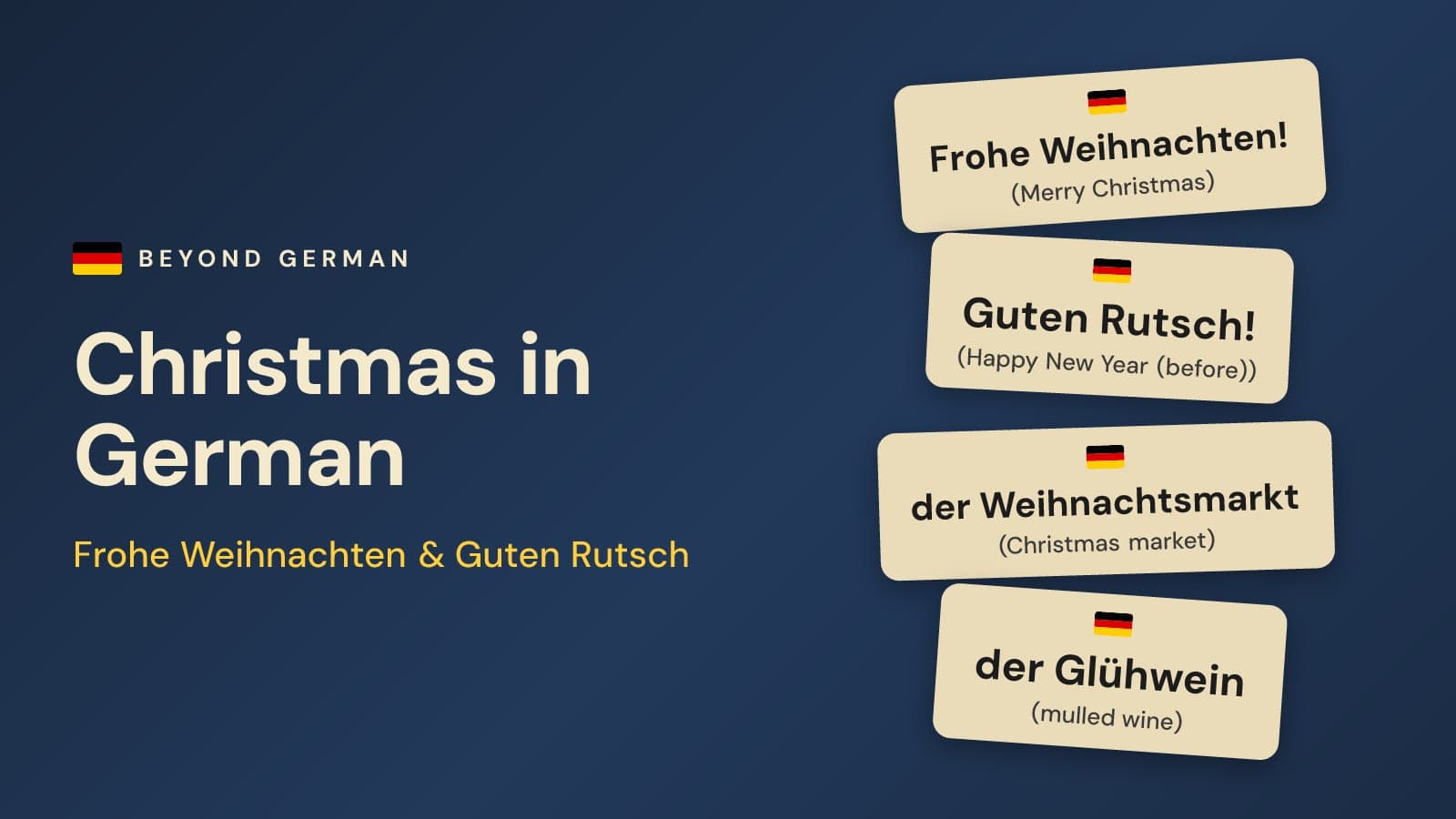
To say Merry Christmas in German, say Frohe Weihnachten! (FROH-uh VYE-nakh-ten). Before New Year, wish people Guten Rutsch! (literally "Good slide!"), and once the new year has begun, switch to Frohes neues Jahr! (Happy New Year!).
Below you'll find greetings for cards and conversations, then the German Christmas season date by date, from Advent to Silvester, plus the food, the Christmas market and the vocabulary you'll need.
How to Say Merry Christmas in German
| German | English | When to use |
|---|---|---|
| Frohe Weihnachten! | Merry Christmas! | The standard greeting; always right |
| Fröhliche Weihnachten! | Merry Christmas! | Same meaning; also very common |
| Frohes Fest! | Happy holidays! (literally "Happy celebration!") | Short and friendly |
| Schöne Feiertage! | Happy holidays! | Neutral; great at work and for non-Christians |
| Besinnliche Weihnachten! | Have a peaceful Christmas! | Cards; besinnlich means calm and reflective |
You can use them in the days before Christmas too, when you see someone for the last time before the holidays. Unlike an early happy birthday in German, which many people consider bad luck, an early Frohe Weihnachten is perfectly normal.
Why Frohe Weihnachten but Frohes Fest?
Weihnachten literally means "holy nights", and in greetings it's treated as a plural, so the adjective ends in -e: frohe, schöne, besinnliche Weihnachten. Das Fest and das Jahr are neuter, so they take -es: Frohes Fest!, Frohes neues Jahr! Our guide to German adjective endings explains the system.
In normal sentences, Weihnachten usually has no article: Weihnachten steht vor der Tür. — Christmas is just around the corner.
Christmas and New Year Wishes for Cards
German cards usually cover Christmas and New Year in one go:
- Frohe Weihnachten und einen guten Rutsch! — Merry Christmas and a happy New Year!
- Frohe Weihnachten und ein gutes neues Jahr! — Merry Christmas and a happy New Year!
- Wir wünschen euch frohe Weihnachten und ein gesundes neues Jahr! — We wish you all a merry Christmas and a healthy new year!
- Wir wünschen Ihnen besinnliche Feiertage und einen guten Start ins neue Jahr. — We wish you a peaceful holiday season and a good start to the new year. (formal; classic for business Christmas cards)
Happy New Year in German: Guten Rutsch vs. Frohes neues Jahr
German has two New Year wishes, and timing is everything:
- Before New Year: Guten Rutsch! or Einen guten Rutsch ins neue Jahr! It wishes you a good "slide" into the new year. Use it any time before midnight on 31 December, often together with Frohe Weihnachten.
- At midnight: Prost Neujahr! or Prosit Neujahr!, the New Year toast. Prost is the German "cheers".
- After midnight: Frohes neues Jahr! or Gesundes neues Jahr! (Happy / Healthy New Year!). Germans keep saying it for the first week or two of January.
To answer any of these, wish it right back: Danke, gleichfalls! or Danke, dir auch! (Thanks, you too!). More replies are in our guide to saying you're welcome, likewise and you too in German.
German Christmas Traditions, Date by Date
The German Christmas season starts in late November and runs into January. Dates are written day first (24.12. is Christmas Eve), as our guide to days, months and dates in German explains.
Advent: Adventskranz and Adventskalender
Advent covers the four Sundays before Christmas. The first, der erste Advent, falls between 27 November and 3 December. Two traditions mark it in almost every home:
- der Adventskranz (Advent wreath): a wreath of fir branches with four candles. You light one on the first Sunday, two on the second, and so on.
- der Adventskalender (Advent calendar): 24 little doors (Türchen), one for each day from 1 to 24 December, usually with chocolate behind them.
Children count the candles with a rhyme: Advent, Advent, ein Lichtlein brennt. Erst eins, dann zwei, dann drei, dann vier, dann steht das Christkind vor der Tür. (Advent, Advent, a little light is burning. First one, then two, then three, then four, then the Christ Child is at the door.) Advent is also the season for baking Plätzchen (Christmas cookies) and meeting friends at the Christmas market.
Nikolaustag on 6 December
On the evening of 5 December, children clean their boots (die Stiefel) and put them outside the door. By morning, der Nikolaus (Saint Nicholas) has filled them with chocolate, nuts and tangerines. He's traditionally a bishop with a long white beard, not Santa, and when he visits in person, he asks: Warst du auch brav? — Have you been good?
He often brings a scary sidekick. In many parts of Germany, it's Knecht Ruprecht, a dark-robed helper with a switch (die Rute) for naughty children. In Bavaria and Austria, it's the Krampus, a horned, furry devil figure who stars in noisy street parades.
Heiligabend on 24 December
For Germans, the big day is not the 25th but Heiligabend (Christmas Eve, literally "holy evening"). It isn't an official public holiday, but shops close by 2 p.m., and many families go to church in the afternoon. In the evening comes the highlight: the giving of presents, die Bescherung.
Who brings the presents depends on the region:
- das Christkind (the Christ Child, pictured as a golden-haired, angel-like figure) in southern and western Germany, Austria and Switzerland
- der Weihnachtsmann (Father Christmas, Santa) in northern and eastern Germany
Nobody ever sees the Christkind: a little bell rings, and the children may finally go into the room with the tree. The Weihnachtsmann sometimes knocks on the door in person, and children recite a poem before they get their presents.
Dinner is surprisingly simple. Germany's most popular Christmas Eve meal is Kartoffelsalat mit Würstchen (potato salad with sausages): it's quick, so nobody spends the evening in the kitchen. Many families also sing carols such as Stille Nacht, heilige Nacht (Silent Night) and O Tannenbaum.
1. und 2. Weihnachtsfeiertag: 25 and 26 December
Both days are public holidays: der erste Weihnachtsfeiertag (25 December) and der zweite Weihnachtsfeiertag (26 December). They're quiet family days with big meals, classically roast goose (die Weihnachtsgans) with red cabbage and dumplings. Shops stay closed, just like on Sundays, one of the cultural habits in Germany that newcomers have to plan around. The days until New Year have a lovely name: zwischen den Jahren ("between the years").
Silvester on 31 December
New Year's Eve is Silvester, named after Pope Silvester I, whose feast day is 31 December. It isn't a public holiday, but it's a huge party night:
- Raclette or fondue: a long, sociable dinner that keeps everyone at the table until midnight.
- Dinner for One: a black-and-white British comedy sketch, recorded in English by German TV in 1963 and a New Year's Eve fixture since 1972. Germans can quote "Same procedure as every year, James!", yet it's barely known in Britain.
- Wachsgießen (wax pouring): you melt a little wax, drop it into cold water and read your future in the shape. It replaced Bleigießen, which used lead; lead sets have been banned in the EU since 2018.
- Fireworks: rockets (die Raketen) and bangers (die Böller) go on sale only in the last few days of the year, and at midnight whole cities light up.
Just before midnight, everyone counts down (zehn, neun, acht…; need a refresher? See German numbers), then clinks glasses of Sekt and hugs.
Neujahr on 1 January
Neujahr (New Year's Day) is a public holiday for sleeping in, a winter walk and lots of Frohes neues Jahr! It's also time for gute Vorsätze (New Year's resolutions): Hast du gute Vorsätze fürs neue Jahr? — Have you made any New Year's resolutions? In Austria, Bavaria, Baden-Württemberg and Saxony-Anhalt, 6 January (Heilige Drei Könige, Epiphany) is one more public holiday.
German Christmas Food and Drinks
| German | English | When |
|---|---|---|
| der Glühwein | mulled wine | At the Christmas market |
| der Kinderpunsch | hot fruit punch without alcohol | At the Christmas market |
| die Plätzchen (singular: das Plätzchen) | Christmas cookies | Baked at home during Advent |
| der Lebkuchen | soft spiced gingerbread | All season; famous from Nuremberg |
| der Stollen | fruit bread dusted with powdered sugar | All season; famous from Dresden |
| die gebrannten Mandeln | sugar-roasted almonds | At the Christmas market |
| der Kartoffelsalat mit Würstchen | potato salad with sausages | Heiligabend |
| die Weihnachtsgans | Christmas goose | 25 or 26 December |
| das Raclette / das Fondue | raclette / fondue | Silvester |
| der Sekt | sparkling wine | Midnight on Silvester |
Two classic Plätzchen are Zimtsterne (cinnamon stars) and Vanillekipferl (vanilla crescents). For everyday food words and how to order, see our German food and drink vocabulary.
At the Weihnachtsmarkt: Christmas Market Vocabulary
From late November until just before Christmas, almost every German town has a Weihnachtsmarkt, called Christkindlmarkt in parts of the south (Nuremberg's famous one is the Christkindlesmarkt).
| German | Plural | English |
|---|---|---|
| der Weihnachtsmarkt | die Weihnachtsmärkte | Christmas market |
| die Bude | die Buden | wooden stall |
| die Tasse | die Tassen | mug |
| das Pfand | — | deposit |
| die Krippe | die Krippen | nativity scene |
| das Karussell | die Karussells | merry-go-round |
Glühwein comes in a mug with a deposit (Pfand) of a few euros: return the mug to get your money back, or keep it as a souvenir. Many stalls prefer cash, so read up on paying and tipping in Germany before you go. At the stall:
- Einen Glühwein, bitte! — A mulled wine, please!
- Mit Schuss? — With a shot? (of rum or amaretto)
- Zwei Glühwein und einen Kinderpunsch, bitte. — Two mulled wines and a children's punch, please.
- Was kostet das? — How much is that?
- Ich möchte die Tasse zurückgeben. — I'd like to return the mug.
German Christmas Vocabulary With Articles
The key words of the season. A dash (—) means the word normally has no plural.
| German | Plural | English |
|---|---|---|
| der Advent | — | Advent |
| der Adventskranz | die Adventskränze | Advent wreath |
| der Adventskalender | die Adventskalender | Advent calendar |
| die Kerze | die Kerzen | candle |
| der Weihnachtsbaum | die Weihnachtsbäume | Christmas tree |
| die Christbaumkugel | die Christbaumkugeln | Christmas bauble |
| der Stern | die Sterne | star |
| das Geschenk | die Geschenke | present |
| die Bescherung | — | the giving of presents |
| der Weihnachtsmann | die Weihnachtsmänner | Father Christmas, Santa |
| der Feiertag | die Feiertage | public holiday |
| das Feuerwerk | die Feuerwerke | fireworks |
| der Vorsatz | die Vorsätze | resolution |
Compound nouns take their article from their last part: der Weihnachtsbaum (der Baum), die Weihnachtsgans (die Gans), das Weihnachtsgeschenk (das Geschenk). It's one of the most reliable der, die, das rules.
Common Mistakes
Saying "Frohes neues Jahr" Too Early
Wrong: Frohes neues Jahr! (on 30 December) Right: Guten Rutsch!
Guten Rutsch is for before the new year, Frohes neues Jahr for after it.
Saying "Frohes Weihnachten"
Wrong: Frohes Weihnachten! Right: Frohe Weihnachten!
In greetings, Weihnachten is plural, so the adjective ends in -e. Frohes belongs with neuter nouns: Frohes Fest!, Frohes neues Jahr!
Saying "Gute Rutsch"
Wrong: Gute Rutsch! Right: Guten Rutsch! (or Einen guten Rutsch!)
The phrase is short for Ich wünsche dir einen guten Rutsch. Der Rutsch is a masculine object in the accusative case, so it takes -en, just like Guten Tag.
Using "in" With Weihnachten
Wrong: in Weihnachten. Right: an Weihnachten (common in the south) or zu Weihnachten (common in the north).
The same goes for Silvester: Was machst du an Silvester? — What are you doing on New Year's Eve?
Writing "Sylvester"
Wrong: Sylvester. Right: Silvester.
The holiday is spelled with an i. Sylvester with a y is a first name, as in Sylvester Stallone, and even native speakers mix them up.
Practice
Try these, then check the answers below:
- Wish a colleague a merry Christmas and a happy New Year in one sentence.
- It's 29 December, and you won't see your neighbor again this year. What do you say?
- It's 2 January, and you meet a friend for the first time this year. What do you say?
- Fill the gaps: Wir wünschen Ihnen frohe Weihnachten und ein___ gut___ Rutsch!
- Order two mulled wines at the Christmas market.
Answers: 1. Frohe Weihnachten und einen guten Rutsch! 2. Guten Rutsch! 3. Frohes neues Jahr! 4. einen guten Rutsch 5. Zwei Glühwein, bitte!
Keep going: learn Weihnachten and Plätzchen on their word pages, and take an A1 German quiz.
FAQ
How do you say Merry Christmas in German?
Frohe Weihnachten! is the standard greeting. Fröhliche Weihnachten! means the same, and Frohes Fest! or Schöne Feiertage! work like "Happy holidays!"
What does "Guten Rutsch" mean?
Literally "good slide": it wishes you a smooth start to the new year. Use it only before New Year. After midnight, switch to Frohes neues Jahr!
When do Germans open their Christmas presents?
On the evening of 24 December, Heiligabend. The gift-giving is called die Bescherung.
Is Christmas Eve a holiday in Germany?
Not officially. Shops close by 2 p.m. on 24 December and many people have the afternoon off, but the public holidays are 25 and 26 December.
How do you say Happy New Year in German?
Frohes neues Jahr! or Gesundes neues Jahr! Before midnight, say Guten Rutsch!, and at midnight, toast with Prost Neujahr!
Level Up Your German
Join 1,000+ learners getting weekly tips, grammar shortcuts, and cultural insights.
Share this article
Continue Reading
Colors in German: Rot, Blau, Grün and How to Use Them
All the colors in German with pronunciation, light and dark shades, when colors take endings, how to ask Welche Farbe hat…?, and the color idioms Germans really use.
Happy Birthday in German: Alles Gute zum Geburtstag & Wishes
Learn how to say happy birthday in German, from Alles Gute zum Geburtstag to formal card wishes, plus belated wishes, the birthday song and why Germans never congratulate early.
I Love You in German: Ich liebe dich vs. Ich hab dich lieb
Learn when to say Ich liebe dich and when to say Ich hab dich lieb, plus German pet names, romantic phrases, texting codes like HDL and Valentine's Day customs.