
Happy Birthday in German: Alles Gute zum Geburtstag & Wishes
 Beyond German Team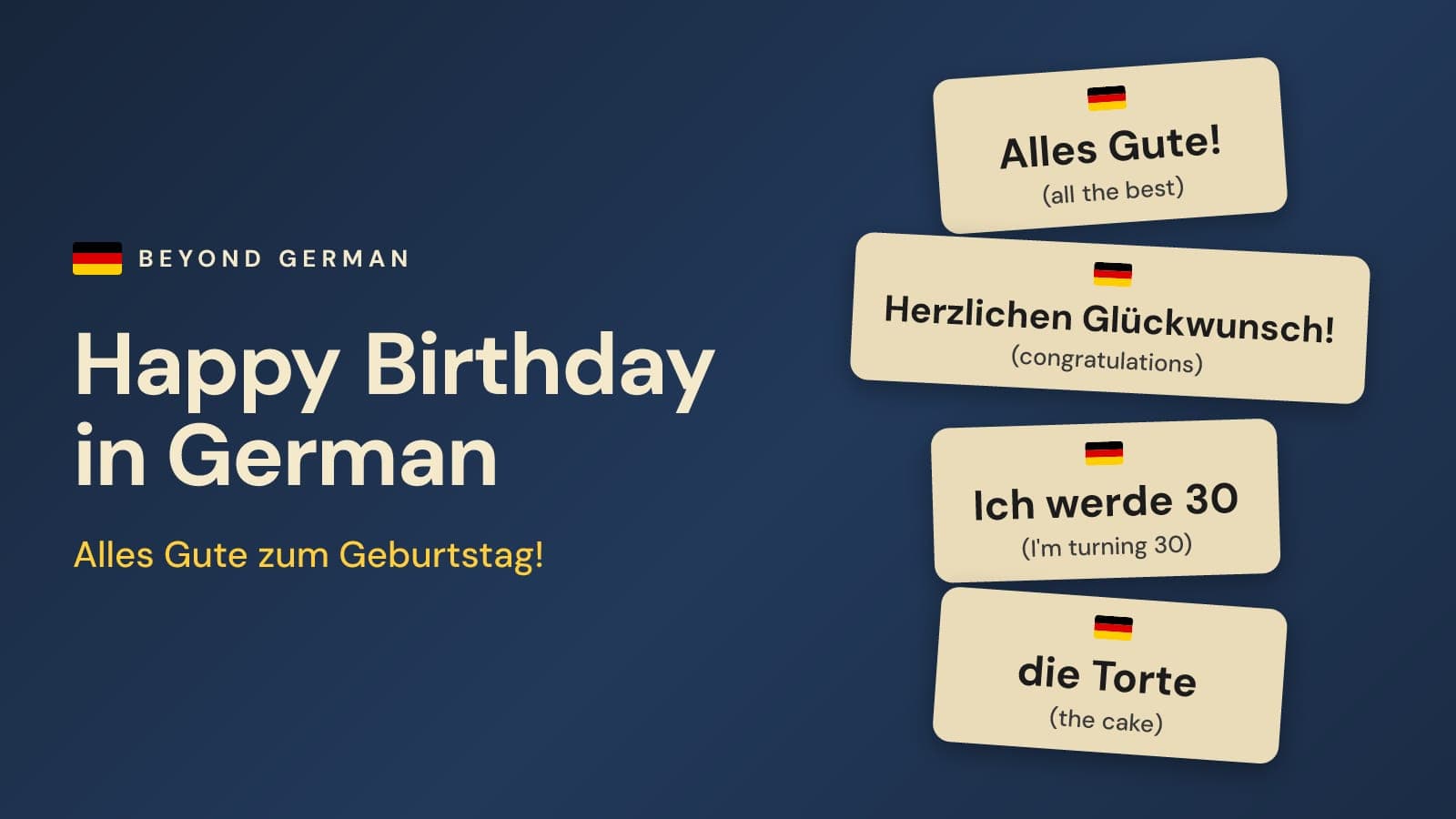
The most common way to say happy birthday in German is Alles Gute zum Geburtstag! (literally "All the best for your birthday!"). Just as popular is Herzlichen Glückwunsch zum Geburtstag!, and plenty of Germans simply say Happy Birthday! in English. One golden rule before you start: never wish a German happy birthday before the day. Many people believe it brings bad luck.
Below you'll find greetings, wishes for cards (formal and informal), belated wishes, the birthday songs, how to say your age, and the customs that surprise newcomers.
How to Say Happy Birthday in German
| German | English | When to use |
|---|---|---|
| Alles Gute zum Geburtstag! | Happy birthday! (literally "All the best for your birthday!") | Anyone; the safe default |
| Herzlichen Glückwunsch zum Geburtstag! | Happy birthday! (literally "Heartfelt congratulations on your birthday!") | A little more formal; classic in cards |
| Alles Liebe zum Geburtstag! | Lots of love on your birthday! | Family, close friends, your partner |
| Happy Birthday! | Happy birthday! | Casual: texts, social media, younger people |
| Ich wünsche dir / Ihnen alles Gute! | I wish you all the best! | dir is informal, Ihnen formal |
Germans often shorten these to Alles Gute! or Herzlichen Glückwunsch! On its own, Herzlichen Glückwunsch works for any congratulations, from a new job to a passed exam. Happy Birthday is pronounced the English way.
Alles Liebe is the warmest option, perfect for people you'd hug. For your partner, see our guide to saying "I love you" in German.
Why "Alles Gute" and Why "zum"?
Gute and Liebe are capitalized because after alles the adjective works as a noun: alles Gute means "everything good". Zum is short for zu dem: zu takes the dative, and der Geburtstag (literally "birth day") is masculine, so der becomes dem. In Ich wünsche dir alles Gute, the person who gets the wish is in the dative case too: dir (informal) or Ihnen (formal).
How to Pronounce Alles Gute zum Geburtstag
Alles Gute zum Geburtstag sounds like "AH-less GOO-tuh tsoom guh-BOORTS-tahk", with the z in zum as a "ts" sound. Herzlichen Glückwunsch sounds roughly like "HAIRTS-likh-en GLÜK-voonsh". For the ü, say "ee" with rounded lips.
Birthday Wishes for Cards and Messages
German birthday messages follow a simple formula: a greeting, a wish and a warm sign-off.
Short Wishes for Texts and Social Media
- Alles Gute zum Dreißigsten! — Happy 30th!
- Lass dich feiern! — Enjoy your special day! (literally "Let yourself be celebrated!")
- Feier schön! — Have a great party!
- Bleib, wie du bist! — Stay just the way you are!
Longer Wishes for Friends and Family
- Für dein neues Lebensjahr wünsche ich dir Gesundheit, Glück und viel Erfolg. — For the year ahead, I wish you health, happiness and lots of success.
- Ich wünsche dir, dass all deine Wünsche in Erfüllung gehen. — I hope all your wishes come true.
- Schade, dass ich nicht dabei sein kann. Feier schön! — Shame I can't be there. Have a great party!
- Alles Gute zum Geburtstag, Oma! Danke, dass es dich gibt. — Happy birthday, Grandma! Thank you for being you.
Das Lebensjahr literally means "year of life". Writing to Mama or Papa? Our list of family members in German has every name you need.
Formal Birthday Wishes (Sie)
For your boss, a client or anyone else you call Sie, use Ihnen and Ihr:
- Herzlichen Glückwunsch zum Geburtstag und alles Gute für das neue Lebensjahr! — Happy birthday and all the best for the year ahead!
- Zu Ihrem Geburtstag gratuliere ich Ihnen herzlich. — Warmest congratulations on your birthday.
- Ich wünsche Ihnen alles Gute, vor allem Gesundheit und Zufriedenheit. — I wish you all the best, above all health and contentment.
- Das ganze Team gratuliert Ihnen herzlich zum Geburtstag! — The whole team wishes you a happy birthday!
How to Start and Sign a Birthday Card
Start with Liebe for a woman and Lieber for a man: Liebe Sarah, Lieber Jonas, or in a formal card, Liebe Frau Weber. After the comma, the next line starts with a small letter unless it's a noun or Sie:
Liebe Sarah,
alles Gute zum Geburtstag! Ich wünsche dir ein neues Lebensjahr voller Glück, Gesundheit und schöner Momente. Lass dich heute richtig feiern!
Alles Liebe
deine Anna
(Dear Sarah, happy birthday! I wish you a year full of happiness, health and wonderful moments. Enjoy your special day! Love, Anna)
Sign off with Alles Liebe (love), Liebe Grüße (best wishes) or, formally, Herzliche Grüße (warm regards). Informally, write dein (if you're a man) or deine (if you're a woman) before your name.
Belated Birthday Wishes: Nachträglich alles Gute!
Missed someone's birthday? The magic word is nachträglich (belated, after the fact):
- Nachträglich alles Gute zum Geburtstag! — Happy belated birthday!
- Alles Gute nachträglich! — Belated best wishes!
- Herzlichen Glückwunsch nachträglich! — Belated congratulations!
- Tut mir leid, dass ich deinen Geburtstag vergessen habe! — Sorry I forgot your birthday!
In Germany, late wishes are far better than early ones. Here's why.
Never Say Happy Birthday Early in Germany
In the US or the UK, an early happy birthday is thoughtful. In Germany, many people believe that congratulating, celebrating or giving presents before the day brings bad luck, because it tempts fate.
Not everyone takes it seriously, but it isn't worth the risk. If a colleague's birthday is on Sunday and you see them on Friday, say nothing, or joke about the rule:
- Ich darf dir ja noch nicht gratulieren! — I'm not allowed to congratulate you yet!
- Ich gratuliere dir dann am Montag. — I'll congratulate you on Monday, then.
Parties happen on the day itself or afterward. Celebrating later has its own verb, nachfeiern: Wir feiern am Samstag nach. — We're having a belated party on Saturday.
Reinfeiern: Celebrating Into Your Birthday
The popular loophole is reinfeiern, colloquial for "celebrating into" your birthday. The party starts the evening before, and at midnight (um Mitternacht) everyone congratulates the birthday person and raises a glass, often of Sekt (German sparkling wine).
- Feierst du rein? — Are you celebrating into your birthday?
- Um Mitternacht stoßen alle auf das Geburtstagskind an. — At midnight, everyone drinks a toast to the birthday girl or boy.
Reinfeiern, nachfeiern and anstoßen (to clink glasses) are all separable verbs: the prefix jumps to the end of the sentence. When the glasses meet, say Prost! And yes, das Geburtstagskind (literally "birthday child") is used for people of any age.
Birthdays at Work: Bring Your Own Cake
Here's what surprises newcomers most: in Germany, the birthday person treats everyone else. Don't expect a cake from your colleagues. You bring one (or pastries, pretzels or snacks) for them:
- Ich habe heute Geburtstag und habe Kuchen mitgebracht. Bedient euch! — It's my birthday today, and I've brought cake. Help yourselves!
Invite friends out for your birthday, and they'll often expect you to pay, or at least to buy the first round:
- Ich gebe einen aus! — Drinks are on me!
- Die erste Runde geht auf mich! — The first round is on me!
In return, colleagues often chip in for a present and a card that everyone signs: Wir legen für ein Geschenk zusammen. — We're chipping in for a present. It's one of those cultural habits in Germany worth knowing before your first German birthday.
The German Birthday Songs
Zum Geburtstag viel Glück
Germans sing Zum Geburtstag viel Glück ("lots of luck on your birthday") to the tune of Happy Birthday to You:
Zum Geburtstag viel Glück,
zum Geburtstag viel Glück,
zum Geburtstag, liebe Anna,
zum Geburtstag viel Glück!
For a man, sing lieber: zum Geburtstag, lieber Tom. Just as often, though, Germans sing Happy Birthday to You in English. At children's parties, you'll also hear Rolf Zuckowski's Wie schön, dass du geboren bist ("How lovely that you were born").
Hoch soll er leben
At adult parties, guests raise their glasses and sing this traditional toast, the German version of "three cheers for…":
Hoch soll er leben, hoch soll er leben, dreimal hoch!
For a woman, sing Hoch soll sie leben.
Saying When Your Birthday Is and How Old You Are
The most common way to talk about your birthday is literally "I have birthday": Ich habe Geburtstag, with no article. (Mein Geburtstag ist am 3. Oktober works too.)
| German | English |
|---|---|
| Wann hast du Geburtstag? | When is your birthday? |
| Ich habe am 3. Oktober Geburtstag. | My birthday is on October 3rd. |
| Heute habe ich Geburtstag! | It's my birthday today! |
| Wie alt wirst du? | How old are you turning? |
| Ich werde 30. | I'm turning 30. |
| Ich bin 29 (Jahre alt). | I'm 29 (years old). |
| Ich bin gestern 30 geworden. | I turned 30 yesterday. |
| Ich bin 1996 geboren. | I was born in 1996. |
Say the date with an ordinal number: am 3. Oktober is spoken am dritten Oktober. Our guide to days, months and dates in German shows how it works, and German numbers 1–100 covers every age you'll need.
Turning a year older uses werden (to become). In the perfect tense, werden takes sein: Ich bin 30 geworden. Round birthdays (30, 40, 50…) are runde Geburtstage, and Germans celebrate them in style: Sie feiert ihren Fünfzigsten. — She's celebrating her 50th.
Birthday Gifts and Party Vocabulary
| German | Plural | English |
|---|---|---|
| das Geschenk | die Geschenke | present, gift |
| die Geburtstagskarte | die Geburtstagskarten | birthday card |
| der Geburtstagskuchen | die Geburtstagskuchen | birthday cake |
| die Torte | die Torten | layered cream cake, gateau |
| die Kerze | die Kerzen | candle |
| der Gutschein | die Gutscheine | voucher, gift card |
| der Blumenstrauß | die Blumensträuße | bouquet of flowers |
| die Einladung | die Einladungen | invitation |
| die Party | die Partys | party |
| die Überraschung | die Überraschungen | surprise |
Note the plural Partys: German spells it with a y, not "Parties". The key verbs:
- schenken (to give as a present): Ich schenke dir ein Buch. — I'm giving you a book.
- auspacken (to unwrap): Pack es aus! — Open it!
- sich etwas wünschen (to wish for something): Was wünschst du dir zum Geburtstag? — What would you like for your birthday?
Giving and getting presents:
- Ich habe eine Kleinigkeit für dich. — I've got a little something for you.
- Ich hoffe, es gefällt dir. — I hope you like it.
- Das wäre doch nicht nötig gewesen! — Oh, you shouldn't have!
- Wünsch dir was! — Make a wish! (before blowing out the candles)
Common Mistakes
Wishing Happy Birthday Early
Friendly in English, unlucky in German. Wait for the day, or send your wishes nachträglich.
Saying "Herzliche Glückwunsch"
Wrong: Herzliche Glückwunsch! Right: Herzlichen Glückwunsch! (or the plural, Herzliche Glückwünsche!)
Der Glückwunsch is masculine, and the phrase needs the masculine accusative ending -en, the same one you hear in Guten Tag and Vielen Dank.
Writing "Alles gute"
Wrong: Alles gute! Right: Alles Gute!
After alles, the adjective works as a noun, so it gets a capital letter: alles Gute, alles Liebe.
Using "dich" With wünschen
Wrong: Ich wünsche dich alles Gute. Right: Ich wünsche dir alles Gute.
The person who gets the wish is in the dative: dir or Ihnen. The same goes for gratulieren: Ich gratuliere dir!
Translating "I'm Turning 30" Word for Word
Wrong: Ich drehe 30. Right: Ich werde 30.
Drehen means turning something physically, like a key. For ages, German uses werden (to become). Likewise, skip Glücklichen Geburtstag!, a word-for-word "happy birthday" that Germans don't say.
Practice
Try these, then check the answers below:
- Wish your friend Lena a happy birthday, the most common way.
- Write a formal birthday wish to your boss, Herr Braun, using Ihnen.
- You forgot Tom's birthday yesterday. What do you text him?
- Say that your birthday is on May 12th, with the date written out in words.
- Say that you're turning 25.
Answers: 1. Alles Gute zum Geburtstag, Lena! 2. Herzlichen Glückwunsch zum Geburtstag, Herr Braun! Ich wünsche Ihnen alles Gute. 3. Alles Gute nachträglich! 4. Ich habe am zwölften Mai Geburtstag. 5. Ich werde fünfundzwanzig.
Want more? Look up Geburtstag on its word page, test yourself with an A1 German quiz, and when December comes, read our guide to German Christmas phrases and traditions.
FAQ
How do you say happy birthday in German?
Alles Gute zum Geburtstag! or Herzlichen Glückwunsch zum Geburtstag! With family and close friends, Alles Liebe zum Geburtstag! sounds warmer, and Happy Birthday! works too.
How do you say happy belated birthday in German?
Nachträglich alles Gute zum Geburtstag! or, shorter, Alles Gute nachträglich!
Is it bad luck to say happy birthday early in Germany?
Many Germans think so. Wait for the birthday itself, or celebrate into it at midnight (reinfeiern).
How do you reply to "Alles Gute zum Geburtstag"?
Say Danke!, Vielen Dank! or Danke, das ist lieb von dir! (Thanks, that's sweet of you!). Avoid Danke, gleichfalls! (Thanks, you too!) unless it's their birthday too. For more ways to say thanks, see thank you in German.
What is the German birthday song?
Zum Geburtstag viel Glück, sung to the tune of Happy Birthday to You. Many Germans sing the English version too.
Level Up Your German
Join 1,000+ learners getting weekly tips, grammar shortcuts, and cultural insights.
Share this article
Continue Reading
Colors in German: Rot, Blau, Grün and How to Use Them
All the colors in German with pronunciation, light and dark shades, when colors take endings, how to ask Welche Farbe hat…?, and the color idioms Germans really use.
Merry Christmas in German: Frohe Weihnachten & Traditions
Learn how to say Merry Christmas and Happy New Year in German, plus the traditions from Advent and Nikolaus to Heiligabend and Silvester, with food and market words.
I Love You in German: Ich liebe dich vs. Ich hab dich lieb
Learn when to say Ich liebe dich and when to say Ich hab dich lieb, plus German pet names, romantic phrases, texting codes like HDL and Valentine's Day customs.