
Thank You in German: Danke schön, Vielen Dank & How to Reply
 Beyond German Team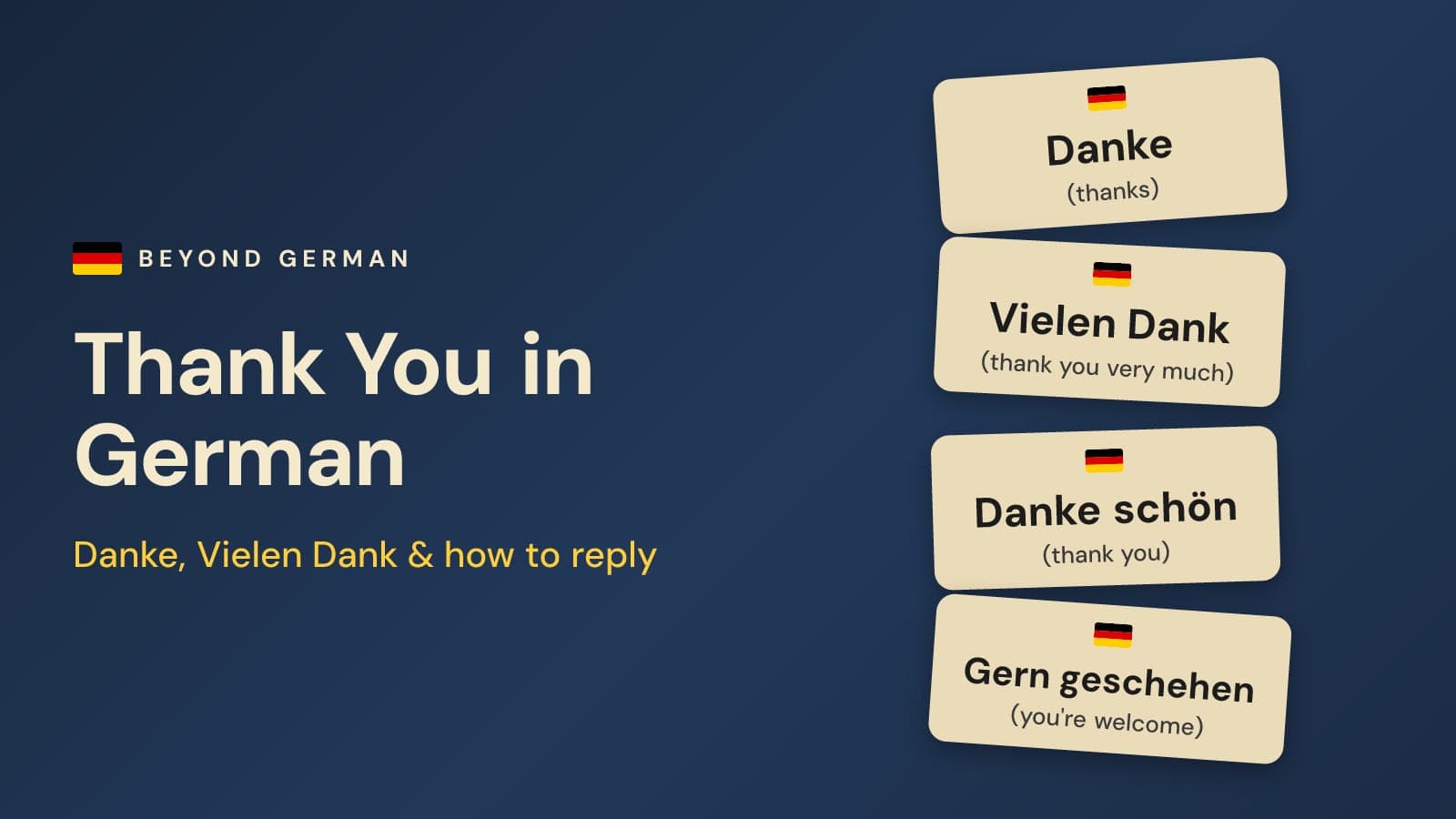
The most common way to say thank you in German is Danke (DAHN-kuh). To say "thank you very much", use Danke schön or Vielen Dank: both are polite enough for friends, strangers and your boss. When someone thanks you, the standard reply is Bitte (you're welcome), and our guide to saying "you're welcome" in German covers every other answer.
Below you'll find every common way to say thanks, from a quick Danke to a formal Ich bin Ihnen sehr dankbar, plus how to thank someone for something, email phrases, and how to reply.
Thank You in German: From Casual to Very Formal
All of these mean "thank you". What changes is how warm or formal they sound. The table runs roughly from casual to very formal:
| German | English | When to use |
|---|---|---|
| Tausend Dank! | A thousand thanks! | Casual and enthusiastic: friends, family, texts |
| Danke! | Thanks! / Thank you! | Everywhere; short, neutral and always correct |
| Danke schön! | Thank you very much! | Warm and polite; great for shops, cafés and small favors |
| Danke sehr! | Thank you very much! | Means the same as Danke schön |
| Danke vielmals! | Many thanks! / Thanks a lot! | Polite and friendly; especially popular in Austria |
| Vielen Dank! | Many thanks! / Thank you very much! | Polite and a little more formal; the standard in emails |
| Herzlichen Dank! | Many thanks! (literally "heartfelt thanks") | Warm and formal: emails, cards, speeches |
| Ich danke dir. / Ich danke Ihnen. | Thank you. (literally "I thank you.") | Personal and emphatic; dir is informal, Ihnen formal |
| Ich bin Ihnen sehr dankbar. | I'm very grateful to you. | Very formal; for a real favor |
When in doubt, say Danke or Vielen Dank. Neither will ever sound rude or strange. For extra warmth, Germans also combine the phrases:
- Vielen lieben Dank! — Thanks so much! (friendly; common in messages)
- Vielen herzlichen Dank! — Thank you so much! (warm; works anywhere)
- Danke, sehr nett von Ihnen. — Thank you, that's very kind of you.
How to Pronounce Danke, Danke schön and Vielen Dank
- Danke sounds like "DAHN-kuh". The final -e is a short, relaxed "uh", never "ee" or "ay", so it doesn't sound like "donkey".
- Danke schön: the sch is an English "sh". For the ö, say the "ay" in "say" and round your lips as if you were about to whistle.
- Vielen Dank sounds like "FEE-len dahnk". German v usually sounds like an English f.
- Bitte sounds like "BIT-uh".
To practice the sounds that trip up English speakers, try our German Pronunciation Lab.
Danke schön vs. Vielen Dank: What's the Difference?
In everyday life, Danke schön, Danke sehr and Vielen Dank all mean "thank you very much", and you can swap them freely. Vielen Dank ("many thanks") sounds a touch more polite, and it's the standard in writing, from text messages to business emails.
Why It's "Vielen Dank" (Not "Viele Danke")
Dank is a masculine noun, der Dank (thanks, gratitude), and it has no plural. Vielen Dank is a shortened sentence: (Ich sage Ihnen) vielen Dank. Dank is the object, so it's in the accusative, and viel takes the masculine accusative ending -en. The same pattern gives you Herzlichen Dank, Besten Dank and even Guten Tag (from Ich wünsche Ihnen einen guten Tag).
Danke schön or Dankeschön?
As a phrase, the standard spelling is two words: Danke schön! Written as one word, das Dankeschön is a noun meaning "a thank-you":
- Die Blumen sind ein kleines Dankeschön. — The flowers are a small thank-you.
How to Thank Someone for Something: Danke für + Accusative
To say what you're thankful for, add für (for). Für is always followed by the accusative case, but don't panic: only the word in front of a masculine noun changes. Der becomes den, dein becomes deinen and Ihr becomes Ihren. With feminine, neuter and plural nouns, nothing changes.
| Noun | German | English |
|---|---|---|
| der Tipp (masc.) | Danke für den Tipp! | Thanks for the tip! |
| der Anruf (masc.) | Vielen Dank für Ihren Anruf. | Thank you for your call. |
| die Hilfe (fem.) | Danke für deine Hilfe! | Thanks for your help! |
| die Einladung (fem.) | Vielen Dank für die Einladung! | Thank you for the invitation! |
| das Geschenk (neut.) | Danke für das Geschenk! | Thanks for the present! |
| die Blumen (plural) | Danke für die Blumen! | Thanks for the flowers! |
A fun extra: Germans also say Danke für die Blumen! ironically when someone criticizes them, like a sarcastic "Well, thanks a lot!"
Thanks for Coming, Thanks for Listening
English often puts an -ing verb after "thanks for". In German, you can turn the verb into a capitalized noun after fürs (short for für das), or use a dass clause, which sends the verb to the end:
- Danke fürs Kommen! — Thanks for coming!
- Danke fürs Zuhören! — Thanks for listening!
- Danke, dass du gekommen bist. — Thanks for coming.
- Vielen Dank, dass Sie mir geholfen haben. — Thank you for helping me.
Ich danke Ihnen: Saying Thank You With the Verb danken
Danke is short for ich danke, "I thank (you)". The full verb danken sounds more personal and deliberate. It takes the dative case, so the person you thank is dir or Ihnen, never dich or Sie. What you thank them for still goes after für:
- Ich danke dir für alles. — Thank you for everything.
- Ich danke Ihnen für Ihre Geduld. — Thank you for your patience.
In everyday speech, this often shrinks to Danke dir! or Danke Ihnen! — Thanks (to you)!
Ich bin Ihnen sehr dankbar
For a real favor, use the adjective dankbar (grateful). The person goes in the dative again:
- Ich bin Ihnen sehr dankbar. — I'm very grateful to you.
- Ich bin dir so dankbar für deine Hilfe. — I'm so grateful for your help.
In speeches and formal emails, you'll also meet sich bedanken bei (+ dative) für (+ accusative), one of the many German verbs with prepositions:
- Ich möchte mich bei Ihnen für die Einladung bedanken. — I'd like to thank you for the invitation.
Thank You in German Emails
Written German leans on Vielen Dank and Herzlichen Dank. These lines cover most emails:
| German | English | When to use |
|---|---|---|
| Vielen Dank für Ihre Nachricht. | Thank you for your message. | First line of a reply |
| Vielen Dank für Ihre schnelle Antwort. | Thank you for your quick reply. | When someone answered quickly |
| Vielen Dank im Voraus. | Thank you in advance. | Last line, after you've asked for something |
| Herzlichen Dank für Ihre Unterstützung. | Many thanks for your support. | After someone has helped you |
| Vielen Dank für Ihr Verständnis. | Thank you for your understanding. | After announcing a delay or a change |
In very formal letters, some people find Vielen Dank im Voraus a little pushy, because it assumes the reader will say yes. A softer close is Ich freue mich auf Ihre Antwort. — I look forward to your reply.
Start the Next Line With a Small Letter
In German emails, the greeting ends with a comma and the next line starts with a small letter, unless the first word is a noun or a formal Sie or Ihr. Dank keeps its capital D because it's a noun. And there's no comma after Mit freundlichen Grüßen:
Sehr geehrte Frau Schmidt,
vielen Dank für Ihre schnelle Antwort. Der Termin am Montag passt mir sehr gut.
Mit freundlichen Grüßen
Anna Becker
(Dear Ms. Schmidt, thank you for your quick reply. The appointment on Monday suits me very well. Kind regards, Anna Becker)
Nein, danke and Danke, gleichfalls
Nein, danke: Saying No Politely
Nein, danke means "no, thank you". You'll need it at the checkout and at the dinner table:
- Brauchen Sie eine Tüte? → Nein, danke. — Do you need a bag? → No, thanks.
- Noch ein Stück Kuchen? → Nein, danke, ich bin satt. — Another piece of cake? → No, thanks, I'm full.
To accept an offer instead, say Ja, bitte! or Ja, gerne! (Yes, please!)
Danke, gleichfalls: Thanks, You Too
When someone wishes you something, wish it right back with Danke, gleichfalls! or Danke, ebenfalls! Both mean "Thanks, you too!"
- Schönes Wochenende! → Danke, gleichfalls! — Have a nice weekend! → Thanks, you too!
- Guten Appetit! → Danke, gleichfalls! — Enjoy your meal! → Thanks, you too!
More personal versions are Danke, dir auch! (informal) and Danke, Ihnen auch! (formal).
Danke, gut: Answering "How Are You?"
When someone asks Wie geht's?, the classic short answer is Danke, gut! (Fine, thanks!). Add Und dir? or Und Ihnen? to ask back. For all the other answers, see how to say "How are you?" in German.
How to Respond to Danke
Full guide: for every reply, including regional ones like Dafür nicht, with example dialogues, read German Ways to Say You're Welcome, Likewise, and You Too.
| German | English | When to use |
|---|---|---|
| Bitte. | You're welcome. | The default reply; always correct |
| Bitte schön. / Bitte sehr. | You're very welcome. | A little warmer; the natural answer to Danke schön |
| Gern geschehen. | My pleasure. (literally "gladly done") | After you've done someone a favor |
| Gerne! / Gern! | My pleasure! / Sure! | Very common in shops, cafés and at work |
| Kein Problem. | No problem. | Casual; friends and colleagues |
| Nichts zu danken. | Don't mention it. (literally "nothing to thank for") | Modest; for small favors |
Bitte works hard in German: it means "please", "you're welcome" and "here you go", and Wie bitte? means "Sorry, what did you say?"
The Danke schön – Bitte schön Exchange in Shops
At a German checkout, thanks bounce back and forth, because Bitte schön does two jobs: "here you go" when you hand something over, and "you're welcome" when someone thanks you. A typical visit to the bakery:
| Who | German | English |
|---|---|---|
| Seller | Guten Morgen! Was darf's sein? | Good morning! What can I get you? |
| You | Zwei Brötchen, bitte. | Two bread rolls, please. |
| Seller | Bitte schön. Sonst noch etwas? | Here you go. Anything else? |
| You | Nein, danke. Das war's. | No, thanks. That's all. |
| Seller | Das macht 1,20 Euro. | That's 1.20 euros. |
| You | Bitte schön. | Here you go. |
| Seller | Danke schön. Und 80 Cent zurück. | Thank you. And 80 cents change. |
| You | Danke schön! | Thank you! |
| Seller | Bitte schön! Schönen Tag noch! | You're welcome! Have a nice day! |
| You | Danke, gleichfalls! Tschüss! | Thanks, you too! Bye! |
That's four danke and four bitte in under a minute, and nobody thinks it's too much. If you lose track, a friendly Danke! always works. To end the conversation smoothly, see how to say goodbye in German.
Common Mistakes
Saying "Viele Danke"
English says "many thanks", so learners often build Viele Danke. But Dank has no plural, and the phrase needs the accusative ending: Vielen Dank!
Saying "Ich danke dich"
Danken takes the dative, so it's Ich danke dir. (informal) or Ich danke Ihnen. (formal). The same goes for dankbar: Ich bin dir dankbar. — I'm grateful to you.
Using the Dative After für
If you've just learned mit dem, it's easy to say Danke für dem Tipp. But für always takes the accusative: Danke für den Tipp! — Thanks for the tip!
Answering an Offer With Just "Danke"
If your host asks Möchtest du noch Tee? and you only say Danke, they may well take it as "No, thanks", and you won't get your tea. To accept, say Ja, bitte! or Ja, gerne!
Saying "Gleichfalls" to Birthday Wishes
Gleichfalls wishes the same thing back. That's perfect for Schönes Wochenende!, but odd after Alles Gute zum Geburtstag! (Happy birthday!) or Gute Besserung! (Get well soon!). Unless it's their birthday too, or they're ill as well, just say Danke!
Practice
Try these, then check the answers below:
- Thank a friend for the tip. (der Tipp)
- Thank your boss for the invitation, using Ihnen. (die Einladung)
- Fill the gap: Ich danke ___ für alles. (to a friend)
- A colleague says Schönes Wochenende! What do you answer?
- Your host offers more cake, and you'd love some. What do you say?
Answers: 1. Danke für den Tipp! 2. Ich danke Ihnen für die Einladung. 3. dir 4. Danke, gleichfalls! (or Danke, dir auch!) 5. Ja, gerne! or Ja, bitte!
Want more? Take an A1 German quiz, and learn the phrases that go with Danke in our list of essential German phrases for beginners.
Keep learning:
FAQ
How do you say "thank you very much" in German?
Say Danke schön, Danke sehr or Vielen Dank. All three are polite and common. For extra warmth, try Vielen herzlichen Dank!
What does "Danke schön" mean literally?
Roughly "thanks nicely". Schön usually means "beautiful" or "nice", but in Danke schön it just makes the thanks warmer, so the phrase means "thank you very much".
How do you say "thanks for everything" in German?
Danke für alles! or, a little warmer, Vielen Dank für alles!
How do you reply to "Danke schön"?
The classic answer is Bitte schön! You can also say Gern geschehen! or simply Gerne!
Level Up Your German
Join 1,000+ learners getting weekly tips, grammar shortcuts, and cultural insights.
Share this article
Continue Reading
Colors in German: Rot, Blau, Grün and How to Use Them
All the colors in German with pronunciation, light and dark shades, when colors take endings, how to ask Welche Farbe hat…?, and the color idioms Germans really use.
Merry Christmas in German: Frohe Weihnachten & Traditions
Learn how to say Merry Christmas and Happy New Year in German, plus the traditions from Advent and Nikolaus to Heiligabend and Silvester, with food and market words.
Happy Birthday in German: Alles Gute zum Geburtstag & Wishes
Learn how to say happy birthday in German, from Alles Gute zum Geburtstag to formal card wishes, plus belated wishes, the birthday song and why Germans never congratulate early.